- Category
- Latest news
Europe Overtakes US as Ukraine’s Biggest Weapons Buyer Since 2022
 Prefer U24 Media on Google
- Authors


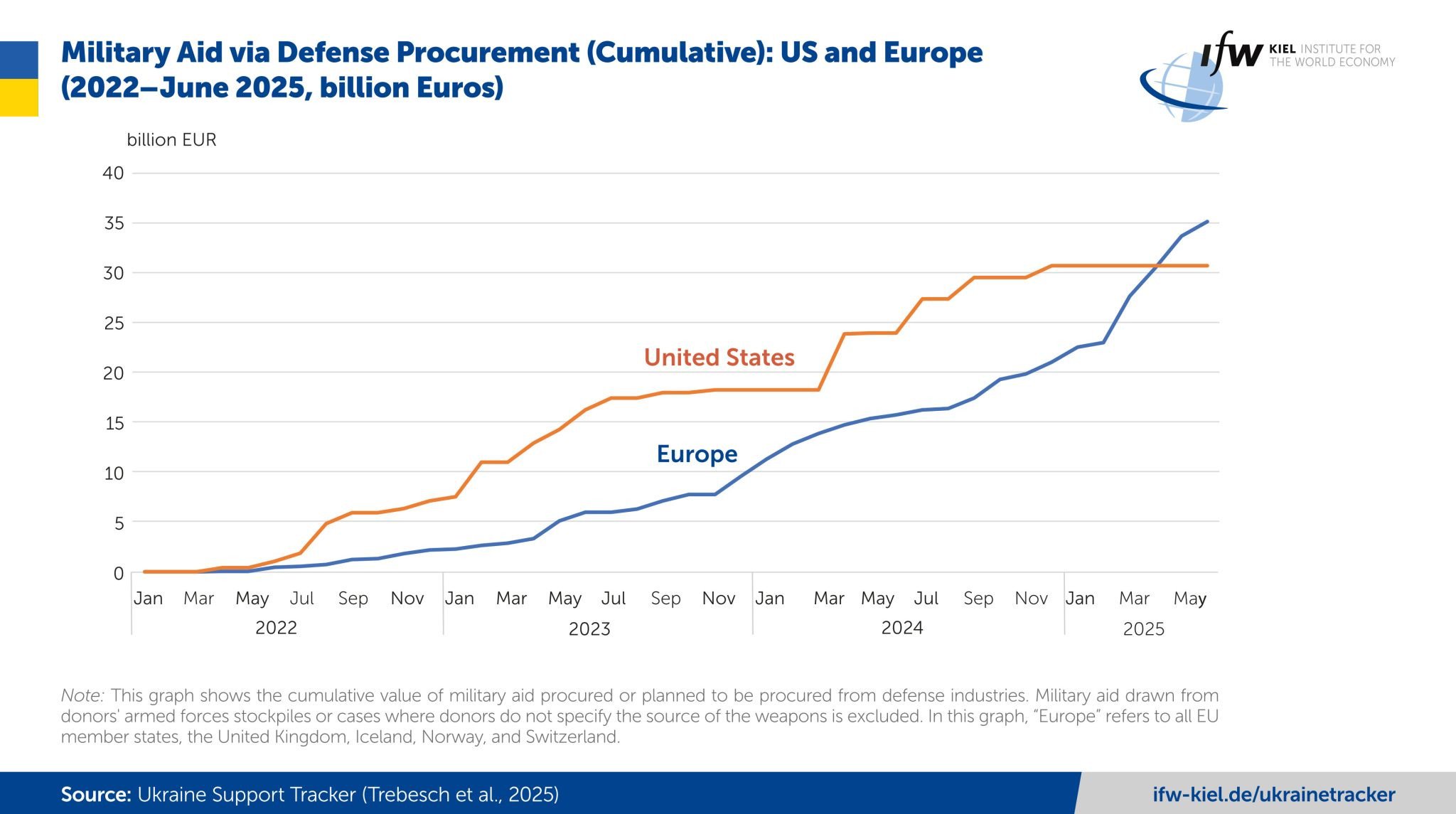
For the first time since Russia’s full-scale invasion in 2022, European countries have contracted more weapons for Ukraine than the United States, according to research by the Kiel Institute for the World Economy.
Between February 2022 and the end of June 2025, European states allocated at least €35.1 billion ($41.1 billion) for weapons production for Ukraine—€4.4 billion more than the US contribution during the same period.
According to EU data, member states collectively have provided over $65 billion in military support for Ukraine, with additional contributions from non-EU countries such as Norway.
In May and June 2025 alone, European governments allocated an extra €10.5 billion ($12.3 billion) in new aid, including at least €4.6 billion ($5.4 billion) through contracts with defense manufacturers rather than supplies from existing stockpiles.
Germany is the largest European donor, committing €5 billion in the past two months. Norway contributed €1.5 billion, Belgium €1.2 billion, and the Netherlands, United Kingdom, and Denmark each provided between €500–600 million.
In relative terms, Baltic states and Denmark remain among the largest contributors when measured against their GDP, with Denmark’s support reaching 2.9 percent of GDP plus an additional 0.4 percent via EU mechanisms.
Researchers note that an increasing share of Ukraine’s military aid now comes from new production lines rather than depleting old arsenals, which were largely exhausted in the early stages of the war.
“The provision of military assistance is increasingly determined by industrial capacity. Europe has now contracted more weapons through defense companies than the United States, indicating a clear transition from relying on stockpiles to new production,” said Taro Nishikawa, head of the Ukraine Support Tracker project.
Ukraine’s financial support is also tied to the Extraordinary Revenue Acceleration mechanism, backed by the G7 and the European Commission.
The program channels €45 billion in loans to Ukraine, financed by profits from frozen Russian assets. In May and June 2025, the EU allocated €2 billion through ERA, Canada provided €1.5 billion, and Japan contributed €2.8 billion.
While European military commitments are rising, experts caution that previously pledged funds are being gradually disbursed. Whether donors can maintain the current level of support over the long term remains uncertain.
Earlier this year, The Wall Street Journal reported that the Pentagon turned to Ukraine’s battle-tested drone technology after US startups failed to meet battlefield demands. Ukrainian manufacturers, producing millions of affordable and combat-proven drones, have become key partners for American defense companies, with firms like Skyfall now cleared as suppliers for the US military.
Discuss this article:

-c439b7bd9030ecf9d5a4287dc361ba31.jpg "Photo of Katherina Popilnichenko")