- Category
- War in Ukraine
Russia Claims to Defend Christian Values. Here's What Its Army Is Doing to Christians in Ukraine
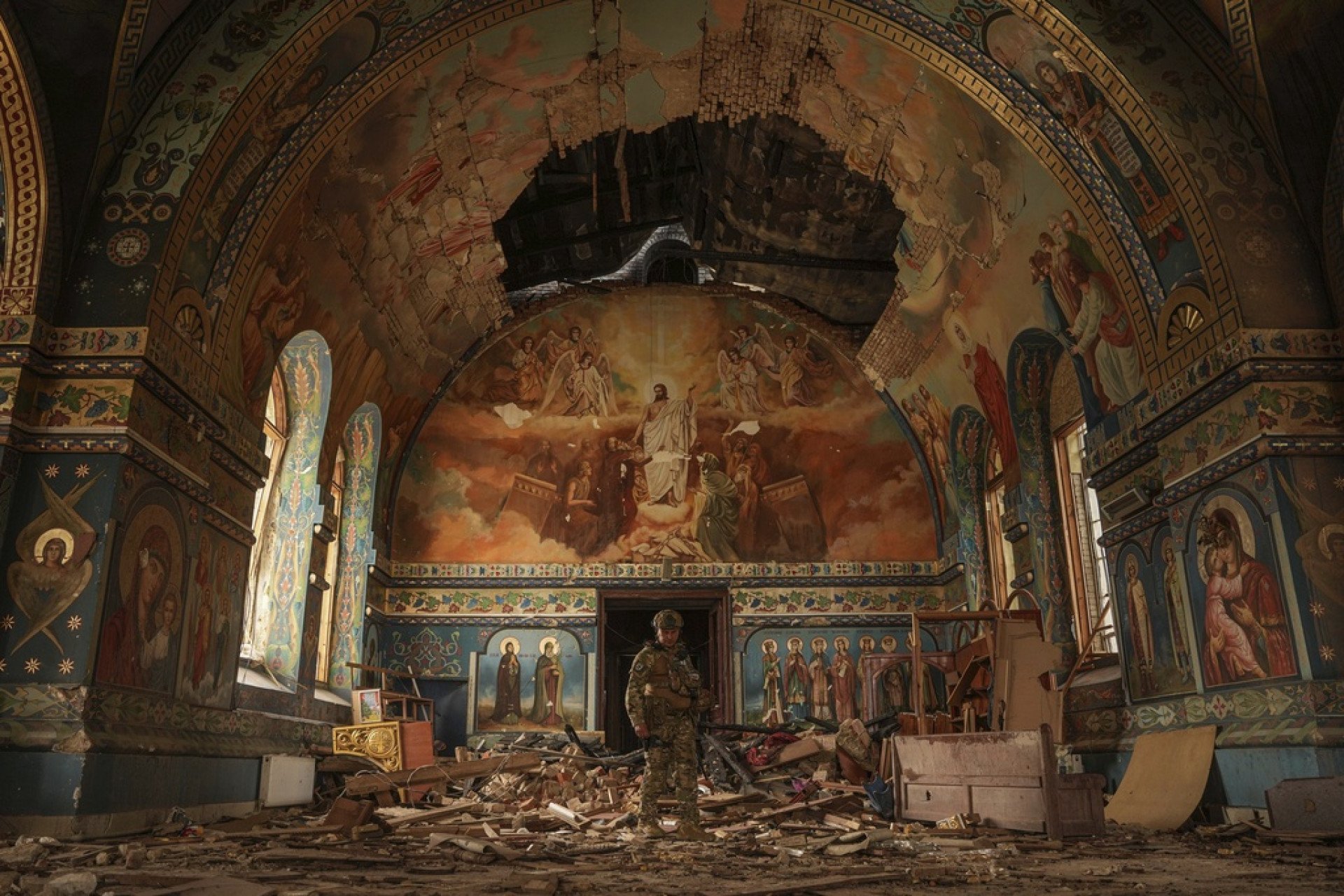
“You believe in your Jesus, but did he save you? [You’ve been] declared dead, so nothing’s holding us back. Now we'll tear you apart piece by piece.”
 Prefer U24 Media on Google
- Authors

These were the chilling words hissed at Father Serhii Chudinovych of Kherson by a Russian soldier nicknamed Voron on March 30, 2022, near the beginning of Russia’s occupation of the city. Shoved into a car and blindfolded, the clergyman was taken to a basement, where more soldiers first processed and booked him, then locked him in a cell. Shortly after, they returned, beat and strangled him for hours, undressed him forcefully, and—as a final insult—attempted to sodomize him with a rubber baton.
Accounts like Father Chudinovych’s have become increasingly common in the temporarily occupied regions of Ukraine since the start of Russia’s full-scale invasion. In fact, with the support of various rights groups, including the International Religious Freedom and Belief Alliance, Ukraine’s Foreign Ministry has ascertained that since February 2022, Russian troops have killed 67 clergy members of various denominations in Ukraine.
Additionally, within the occupied territories, the Foreign Ministry notes that Russia has forcibly annexed eight dioceses of the Ukrainian Orthodox Church to the Russian Orthodox Church—which includes more than 1,600 parishes and 23 monasteries—and has eliminated all communities of the Orthodox Church of Ukraine on the temporarily occupied Crimean Peninsula. The United Nations Human Rights Monitoring Mission has also documented cases of torture and ill treatment of Greek Catholic priests who have been imprisoned by Russian occupation authorities within the Donetsk region since 2022.
These flagrant and numerous examples of a disregard for the sacred lie in stark contrast to the Russian government’s insistence that Russia is one of the last bastions of “traditional Christian values.” It’s not a stretch to claim that torturing and killing religious leaders, indiscriminately attacking Christian religious sites, and wantonly using sexual violence as a tool of coercion are not aligned with Christ’s guidance for how to treat one’s fellow man.
With each new detail that comes to light from Ukraine’s Russian-occupied territories about the abuse and torture faced by the millions of civilians still living there, the complex web that the Kremlin has spun regarding Russia’s claim to moral authority further unravels. More than anything, this claim is a political tool: a facade to frame the Kremlin’s imperial aims and cruelty in Ukraine as part of a holy war. It’s exactly this mythology that Steven E. Moore—founder of the Ukraine Freedom Project and former congressional Republican Chief of Staff—has set out to dismantle since he started his work in Ukraine, on Day 5 of Russia’s full-scale invasion.
In the US, as of 2025, between 62% and 65% of the population identified as Christian, according to the Pew Research Center Religious Landscape Study; in Ukraine, that figure stands at nearly 85%, according to the Kyiv International Institute of Sociology.
While some may take these figures and bring up the fact that between 65% and 70% of the Russian public also identify as Christian, nearly 67% of Russia’s Christians belong to the Russian Orthodox Church. It’s worth noting that the Russian Orthodox Church, however, has long operated as a state-run ideological and political instrument for the Kremlin rather than a traditional, independent religious body. In fact, Patriarch Kirill—the head of the Russian Orthodox Church—is a strong supporter of Russia’s invasion of Ukraine, characterizing it as a “holy war,” praising Russian troops’ military campaigns—including those that include violence against civilians and destruction of holy sites—and claiming that the war is “necessary to fight against Western moral corruption and values.”
Below is our full conversation with Steven E. Moore regarding the reality of religious persecution in occupied Ukraine. In it, he also outlines a mission to bridge the gap between American believers and Ukrainian Christians on the frontlines of faith, and his quest to dismantle the mythology wrapped in the legitimacy of religion peddled by Russia and the Kremlin.
Q&A: Inside the Struggle for Ukraine’s Religious Freedom
Q: You’ve been on the ground in Ukraine since the first week of the full-scale invasion. When we talk about Russia’s persecution of Ukrainian Christians in the occupied territories, what does that look like on a human, day-to-day level compared to what people read in reports?
A: In the US, anyone can go to the church of their choice on Sunday. But if you are in occupied Donetsk, Melitopol, or Mariupol, and you want to attend a service, there will be a Russian soldier standing at the door who will not let you in. Vladimir Putin has shut down every single church in occupied Ukraine that he does not directly control.
Across Ukraine, Russian forces have killed as many as 80 pastors and priests, and damaged or destroyed more than 800 churches. What we are seeing is that as Russia continues to lose tens of thousands of soldiers a month and Ukrainian strikes target Russian energy and refinery capacity, Putin has actually stepped up his destruction of places of worship. In recent months, the rate of church destruction by Russian forces has nearly tripled.
There is a grim historical parallel here: much like when it became clear the Nazis were losing World War II and they accelerated their extermination efforts, the Kremlin—using the Russian Orthodox Church as an arm of state control—is doubling down on destroying true, independent faith. In occupied Ukraine today, you can be sentenced to 20 years in prison simply for holding a Bible study in your own home.
Most Americans simply do not realize the extent to which Putin is killing pastors, destroying churches, and torturing Christians for their faith.
Steven E. Moore
Founder, Ukraine Freedom Project
Q: How do the Kremlin and the Russian Orthodox Church use religious narratives as an ideological weapon to systematically erase non-Russian Orthodox Christian communities?
A: The Russian Orthodox Church is not a traditional church as Westerners understand it; it is an official instrument of Kremlin power. Vladimir Putin was a KGB officer. Patriarch Kirill was a KGB officer. Their alliance is an open secret.
When a Russian soldier enters a village in [the] Donetsk, Luhansk, Zaporizhzhia, or Kherson [regions] and meets a Baptist pastor, he looks at him and says, "You’re a Baptist? That’s an American religion. You must be working with the CIA, just like our priests work with the Kremlin." They arrest the pastor, interrogate him, torture him, and in many cases, murder him.
The data confirms this systematic targeting. Protestants make up roughly 4% of Ukraine’s population, yet Protestant pastors account for nearly 45% of all clergy killed by Russian forces. They are being killed at 11 times their demographic rate.
Look at the Catholic Church: there is not a single Catholic priest left in occupied Ukraine—every single one has been killed or expelled.
Steven E. Moore
Founder, Ukraine Freedom Project
Putin openly claims that Russian Orthodoxy has more in common with Islam than Catholicism. Russia recognizes four "official" religions: Russian Orthodoxy, Judaism, Islam, and Buddhism. Everything else—including Protestantism and Catholicism—is treated as a dangerous heresy. While Putin puts on a public show pretending to be a great defender of Christian civilization, it is complete fiction designed to manipulate Western audiences. In reality, under Russia's "Yarovaya laws," you cannot even spread the Gospel or talk about Jesus outside a church building without risking imprisonment.
Documenting Persecution: From Tortured Clergy to Systemic Cleansing
Q: Non-Russian Orthodox believers face targeted property seizures, arrests, and torture in occupied areas. Is this the work of rogue commanders on the ground, or are we looking at a deliberate, centralized policy of religious cleansing?
A: This is a deliberate, organized policy crafted by Putin and executed by the Russian military to purge occupied Ukraine of independent Christianity, with a specific focus on eradicating Protestants and Catholics.
Consider Pastor Mykhailo Britsyn from Melitopol. Before the occupation, his church looked like any modern church you would find in Dallas, St. Louis, or suburban Tulsa, Oklahoma. During a live-streamed service, a Russian soldier in full battle gear walked up onto the stage, took the microphone from the worship team, shut down the service, and announced that everyone present was being documented. The officiating pastor was arrested and taken to prison.
After the occupation of Melitopol, all the city's churches were closed except the Russian Orthodox Church.
— Olga Stefanishyna (@StefanishynaO) February 5, 2026
On September 11, 2022, armed men forcibly stopped the Sunday service. Pastor Mykhaylo Brytsyn, who had led Grace Church since 1991, was detained and threatened. The… pic.twitter.com/RimiJTMnNp
This was not an isolated incident; it was methodical. The goal is to eliminate every church that Putin cannot control. Christians recognize Jesus Christ as their ultimate authority, which makes them inherently difficult for an authoritarian regime to manipulate. Putin does not want the competition, so he uses state terror to purge them.
Q: There is a persistent narrative among certain political circles in the US—including parts of the Republican base—that Ukraine is the actor restricting religious freedom, while Russia is viewed as a protector of traditional values. How do you address that misconception?
A: Figures like Tucker Carlson claim that Ukraine is persecuting Christians by arresting priests and nuns. Like all effective propaganda, it takes a kernel of truth and twists it.
Yes, Ukrainian authorities have arrested and prosecuted certain clergy members from the Ukrainian Orthodox Church (UOC)—the branch historically affiliated with the Moscow Patriarchate. But none of those individuals are on trial for believing in Jesus Christ; they are on trial for aiding the Russian military.
We are talking about clergy who helped direct Russian artillery fire onto Ukrainian positions, reported on Ukrainian troop movements, or collaborated with invaders. In Bucha, a UOC priest reportedly guided Russian soldiers directly to the homes of local citizens most likely to resist. There are now 500 people in a mass grave in Bucha, some placed there because of that collaboration.
Even clergy within that tradition recognize the reality. Bishop Nicodemus in Kherson, who originally belonged to the UOC before switching to the independent Orthodox Church of Ukraine, told me directly that the UOC had been turned into an instrument of criminal politics. As he put it, those priests are not on trial for believing in Christ; they are on trial for collaborating with a terrorist state.
Ukraine is far from alone in taking these steps. At least seven other European nations—including Estonia, Finland, Sweden, and Bulgaria—have taken legal or security actions against the Russian Orthodox Church’s state-aligned apparatus within their borders. Today, 85% of Ukrainians view the Moscow-aligned church as a direct national security threat.
Connecting Kyiv to Capitol Hill: Reaching the American Faithful
Q: Through your work with the Ukraine Freedom Project, you have documented countless personal testimonies. Is there a specific story that best illustrates the reality Ukrainian believers face?
A: The reason I became so deeply committed to this cause goes back to November 2022. I was doing humanitarian work in Kyiv when a man named Viktor walked up to me and said, "Hi, I'm Viktor, I'm an evangelical Christian."
Viktor was a junior pastor in Luhansk in 2014 when Russian forces first invaded. While helping evacuate civilians—including a pregnant woman and a newborn baby—Russian troops pulled him out of his vehicle and threw him into a basement. In Ukraine, "the basement" is a universal euphemism for torture.
Viktor was held for 25 days and subjected to repeated torture. On one occasion, while praying in his cell with a Baptist cellmate, a Russian Orthodox priest walked past and asked, "You’re not Orthodox, are you?"
When Viktor confirmed he was an evangelical Christian, the priest summoned the guards. They dragged Viktor to a torture room, strapped him to a chair, and shocked him with electricity while the Russian Orthodox priest attempted to perform an "exorcism" on him for his evangelical faith.
Steven E. Moore
Founder, Ukraine Freedom Project
When I later heard commentators in the US claiming that Ukraine was the one persecuting Christians, it lit a fire under me. They were employing classic Soviet propaganda tactics: accusing your opponent of what you yourself are doing.
I realized that if conservative Christians in America knew Viktor’s story, they would immediately understand why supporting Ukraine is a moral imperative. Many Americans are busy with their daily lives and view Ukraine as a distant place they have no connection to. But when you explain that fellow believers are being tortured and facing 20 years in Russian prison simply for worshipping God, it creates a powerful spiritual and emotional bridge.
Q: As a former congressional chief of staff, how do you frame this issue when speaking with US lawmakers and policy leaders?
A: During his first term, President Trump elevated religious freedom into a key pillar of the National Security Council. American Christians and policymakers across the political spectrum care deeply about international religious liberty.
Right now, there are more than 3 million Christians living under Russian occupation who cannot worship freely without risking imprisonment, torture, or death. Russian propaganda works by introducing just enough doubt to stall action. Sharing these firsthand accounts removes that ambiguity and puts the [war] into stark black-and-white relief: Ukraine is fighting for its existence against an aggressive authoritarian regime.
Some political figures ask why Ukraine and Russia cannot simply reach a settlement and resume normal relations. The reality is that Ukrainians have seen what occupation looks like across 20% of their territory. If Russia stops fighting, the war ends. If Ukraine stops fighting, Ukraine ceases to exist—and millions of people are left exposed to a regime where faith is crushed, sexual violence is weaponized, and children are stolen. Ukrainians will continue to fight because they have no other choice.
Q: If Ukrainian forces are unable to liberate these occupied areas, what does the future of religious freedom look like in eastern Ukraine over the next decade?
A: It will look like a return to the Soviet era. Russia has changed its name, but its methods remain identical. For 70 years, faith was suppressed under the Soviet Union. When it collapsed, religious life exploded in Ukraine, turning the country into a spiritual breadbasket for Eastern Europe.
Now, Putin is attempting to reimpose that Soviet-style total suppression. But the tragedy extends even beyond religious persecution—it is a demographic catastrophe. Russia is facing a severe birth-rate crisis, and one of the primary resources it is seeking to extract from Ukraine is its people.
Kremlin officials have openly boasted about transferring more than 700,000 Ukrainian children to Russia. They are attempting to forcibly erase their identity and integrate them into Russian society to offset their own demographic decline.
Every liberated city I have worked in—like Kherson—bears the deep scars of Russian rule. Even today, Russian forces on the occupied bank of the Dnipro River use small [suicide] drones to target civilians in what locals call a "human safari."
🔴 Chilling video of Russia's "human safari" in Kherson.
— UNITED24 Media (@United24media) August 7, 2026
A Russian FPV drone operator deliberately targeted a civilian bus as fleeing passengers desperately tried to run for safety. pic.twitter.com/ycH8odpgzd
That is the reality of occupation. If these territories remain under Russian control, independent religious life will be completely eradicated, replaced by total state surveillance and systematic terror.
Discuss this article:


-c439b7bd9030ecf9d5a4287dc361ba31.jpg "Photo of Katherina Popilnichenko")
-72b63a4e0c8c475ad81fe3eed3f63729.jpeg "Photo of Cyril Barabaltchouk")