- Category
- War in Ukraine
What 12 Years of Russian Population Engineering Did to Crimea
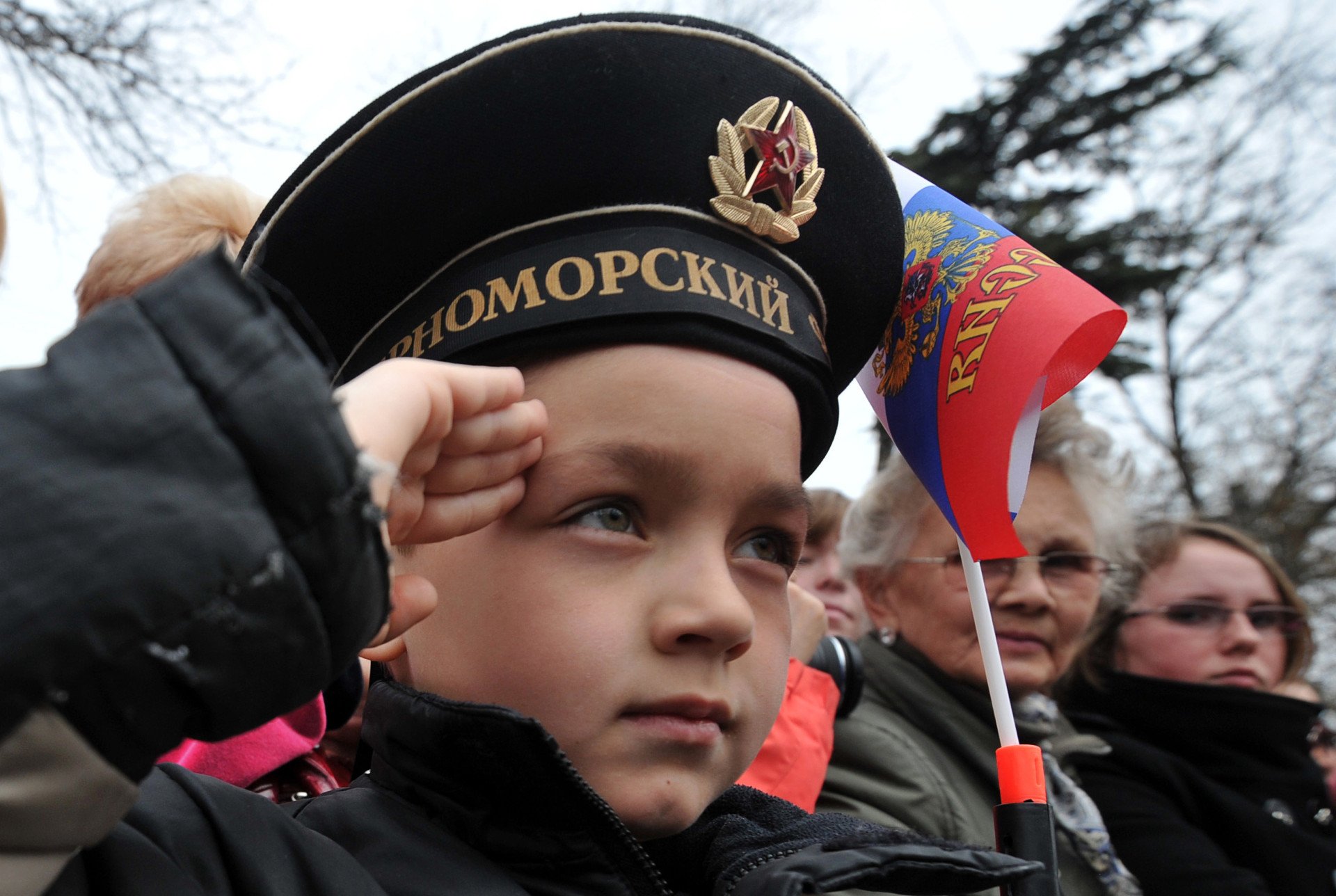
A million Russian settlers, an FSB-dominated state, and schools that drill children for war. Over twelve years of occupation, Russia has been changing who lives in Crimea, bringing in soldiers, security officials, and their families, building a society designed to hold the peninsula.
 Prefer U24 Media on Google
- Authors


By late 2025, residents of Yalta, Yevpatoria, and Sevastopol who applied for housing or land plots were hearing the same answer at government offices:
“For the participants of the 'SVO .' Come back later.”
In the same period, Sevastopol’s occupation administration set aside 40 hectares of land near the village of Poliushko specifically for Russian servicemen who fought against Ukraine, and their families.
In the spring of 2026, residents of the city’s Kozacha Bay district learned what the flip side of that priority looks like: occupation courts ruled that the land under their legally purchased homes belonged to the Russian Defense Ministry and ordered the houses demolished at the owners' own expense.
Twelve years into Russian occupation, this is Crimea’s new social contract in miniature. While Russia has covered the peninsula with bases, airfields, and air defense batteries, it has also been building a society organized around the military, settled by it, run by it, and raising its children for it.
Changing who lives in Crimea
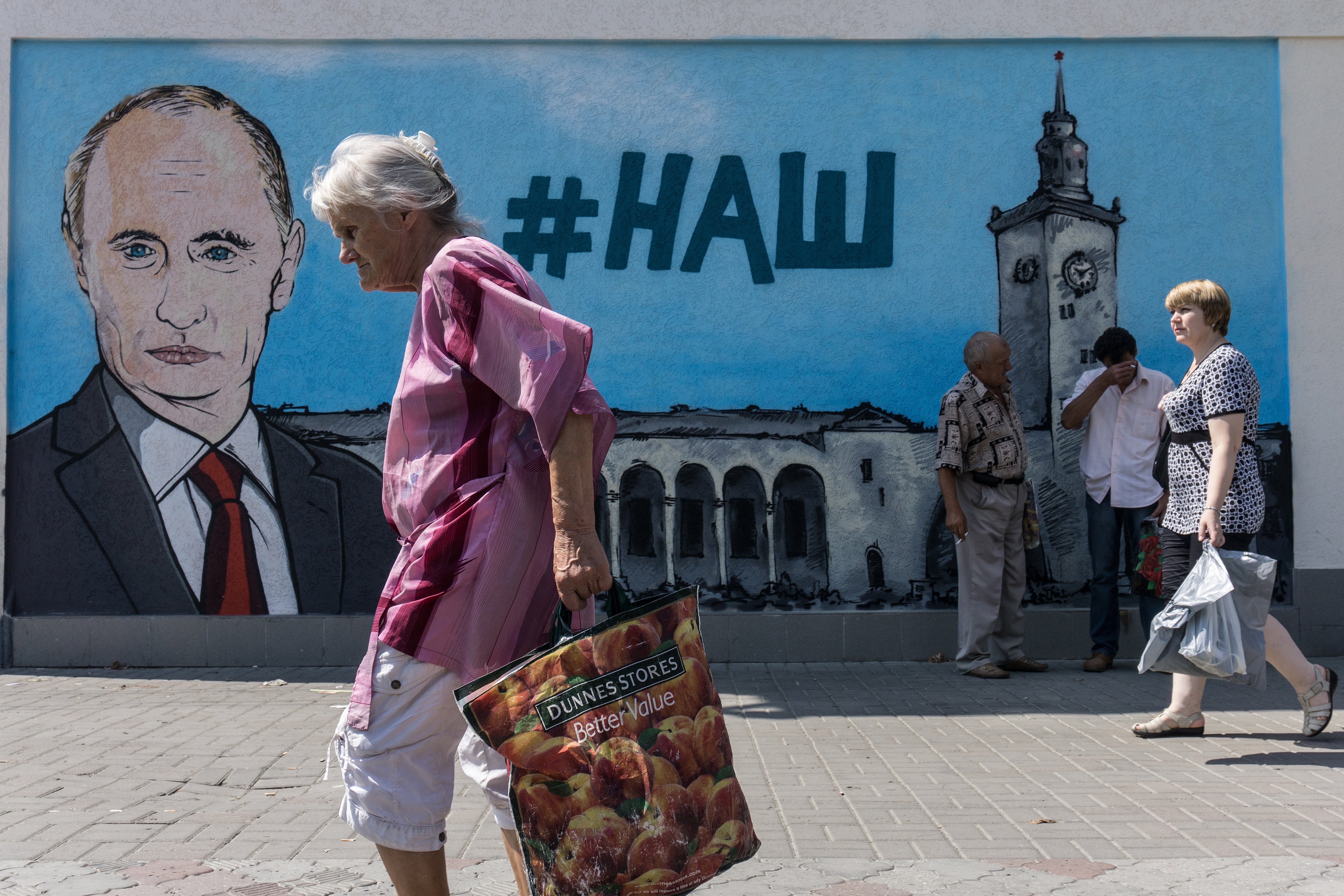
The most consequential change in occupied Crimea is not visible on satellite images. It is the people.
Olha Kuryshko, the Permanent Representative of the President of Ukraine in the Autonomous Republic of Crimea, explains how her office arrives at a figure: Crimea’s pre-occupation population was about 2.5 million; Russian occupation statistics now claim roughly 3.5 million. The gap—around a million people—is the measure of who has been moved in. She is careful to call it an estimate.
“A million is a very, very approximate figure,” she says, because no side operating from Ukrainian-controlled territory can independently verify it.
That estimate isn’t hers alone. It originates with the Mejlis of the Crimean Tatar People, whose head, Refat Chubarov, said in July 2026 that about a million illegally transferred Russians still live on the peninsula.
Moving the other way, around 57,000 Crimeans have registered as displaced persons on mainland Ukraine, by Kuryshko’s count—and the true outflow is higher, since many who left never registered.
Separately, the Mejlis estimates that some 50,000 Crimean Tatars have left the peninsula and settled abroad. Crimea’s deaths now outnumber its births, so without the influx the population would be shrinking.
The real number is unknowable by design. Forced passportization means anyone issued a Russian passport in Crimea is counted by Moscow as a Russian citizen, Kuryshko says, so settlers and locals blur into a single statistic. Servicemen and security officers add another layer: many are formally posted to bases on the peninsula while registered elsewhere in Russia, so they live in Crimea without appearing in its population at all. Between passportization and a security presence that keeps its records closed, no one—not Kyiv, not human rights monitors, and arguably not Moscow—can state the real figure.
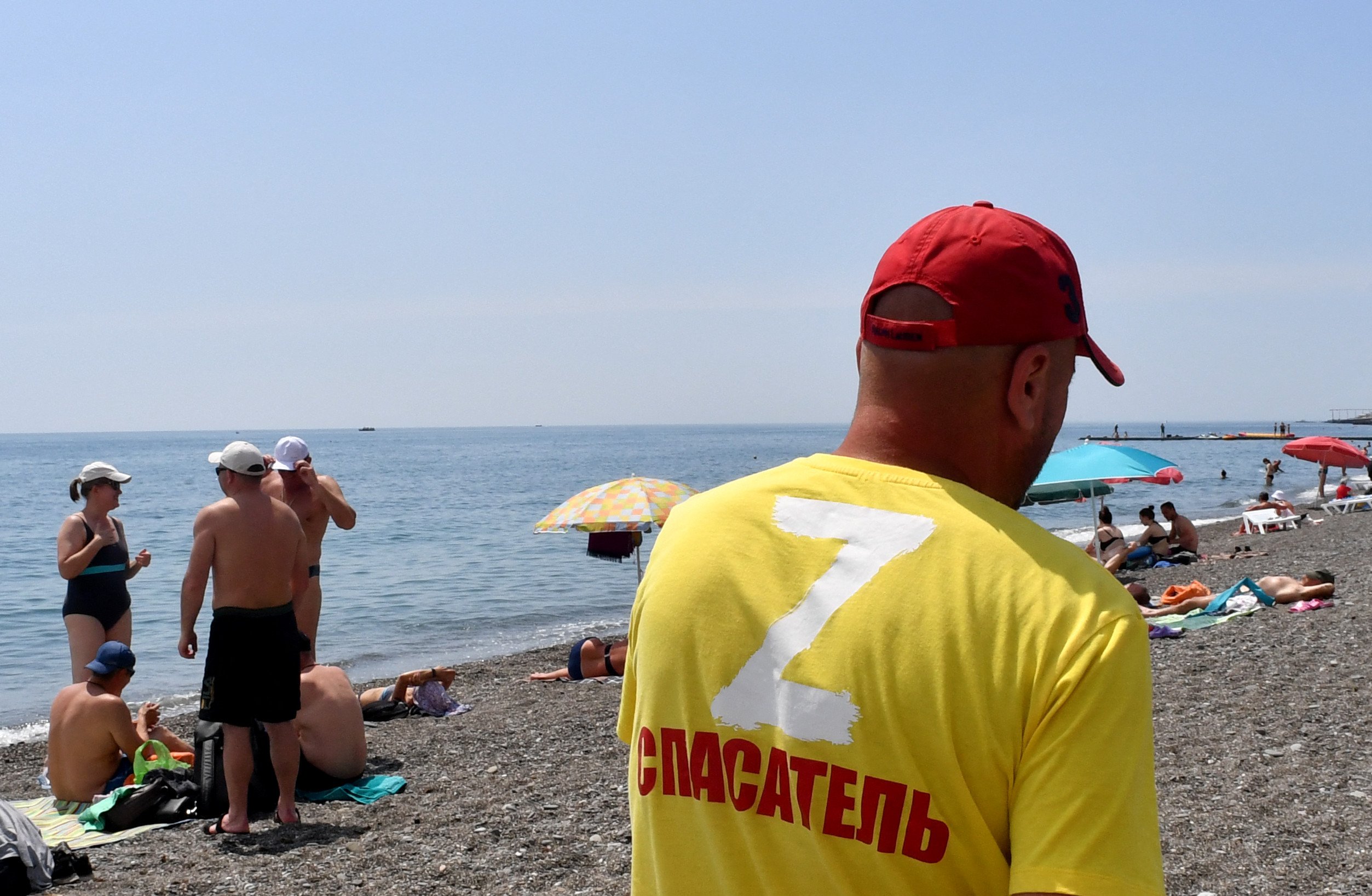
This did not happen by itself. Moscow built an entire machinery to move loyal people in, and it has been widened repeatedly. In December 2022 the occupation authorities began granting plots of land to “SVO participants” registered in Crimea, mostly in the coastal Saky, Chornomorske, Lenine, and Simferopol districts.
In September 2024 the right was extended to any Russian who signed a contract with the defense ministry in occupied Crimea, and a month later to people with “legal relations with an organization defending the interests of veterans of local wars and military conflicts,” meaning Wagner personnel. By the end of 2024, more than 10,000 applications had been filed. The plots permit housing construction, which means the recipients will in time become residents with a say in how their new communities are run.
The land has to come from somewhere. A Putin decree that came into force in 2021 barred foreigners from owning land across almost all of Crimea, catching more than 11,000 plots belonging to people without Russian passports, most of them Ukrainians. Russian occupation courts have since begun confiscating those plots.
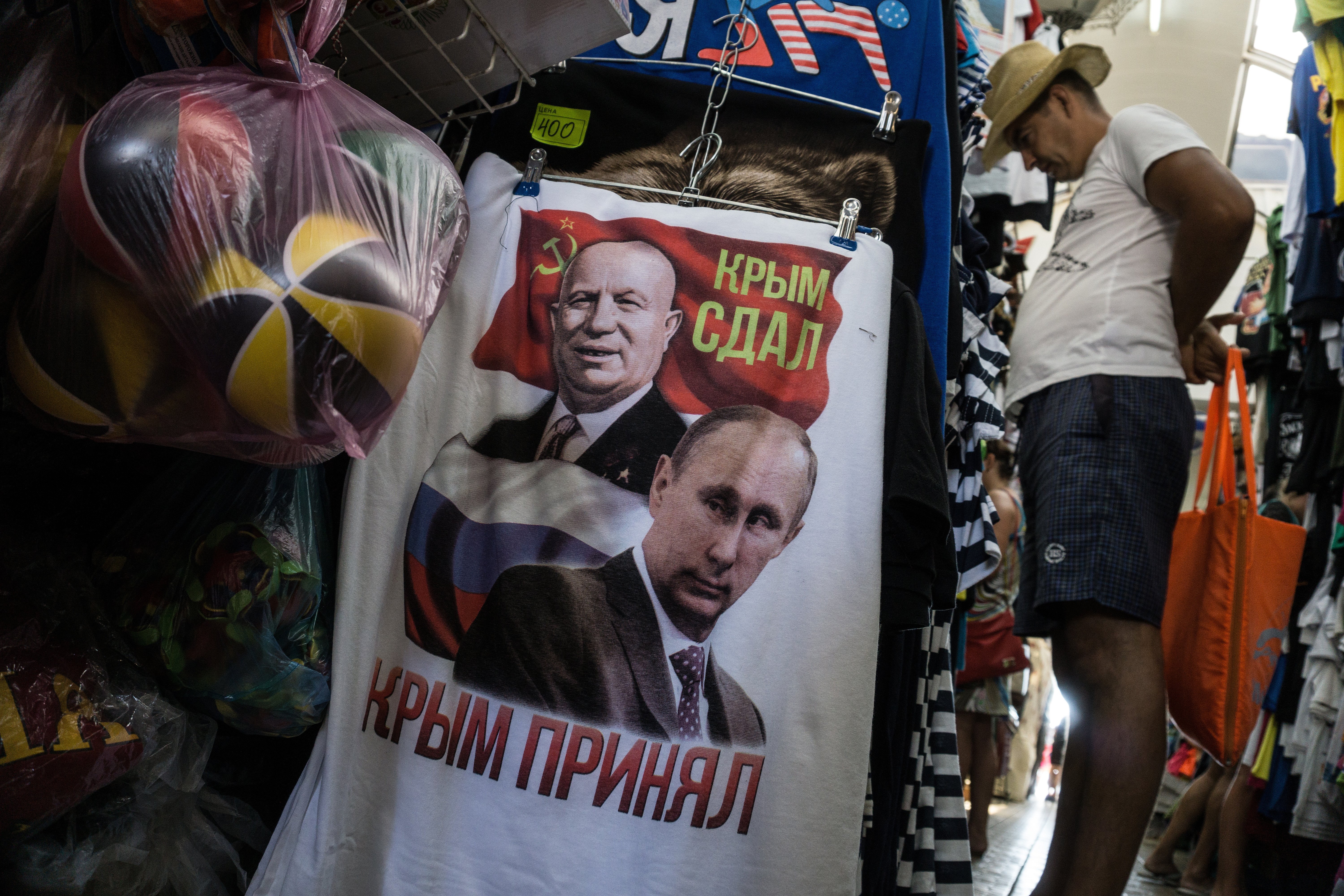
Kuryshko’s office has documented 128 published rulings in which occupation prosecutors went to court to seize the land outright or force its sale; most were granted. The victims are not only Ukrainians—the confiscations have also swept up citizens of Germany, Kazakhstan, Armenia, Estonia, the Netherlands, Israel, Moldova, and the UK. And the land, she says, is being redirected to meet Russia’s obligations to the soldiers of its war: those registered as “SVO participants,” or their families if the serviceman was killed, qualify for a plot.
Alongside the military, Russia has drawn in civilians from poorer regions with subsidized mortgages and salary premiums. And the drive is still scaling up. In May 2026, the occupation head of Crimea met with the leadership of DOM.RF, Russia’s state housing-development institution, a meeting Chubarov sees as an effort to accelerate and institutionalize the resettlement drive.
The law is clear on this. Article 49 of the Fourth Geneva Convention prohibits an occupying power from transferring its own civilian population into occupied territory, and the UN human rights monitoring mission has described the resettlement as an apparent attempt to change Crimea’s demographic structure.
It follows an older pattern of demographic engineering in Crimea. The peninsula was colonized after the annexation of 1783, then repopulated with Soviet settlers after the deportation of the entire Crimean Tatar nation in 1944. The post-2014 wave follows the same logic: change the people, and the territory follows.

Who the Russian settlers are
The new arrivals are not a random cross-section of Russians looking for sea views. Disproportionately, they are the state itself: military officers, FSB personnel, judges, prosecutors, police, and their families.
That composition shapes how the peninsula is governed. From the first months of the occupation, key positions in Crimea’s courts, law enforcement, and administration were filled with personnel imported from Russia. The result, twelve years on, is a society where the security services are not one branch of power but its core. Per capita, political prosecutions in occupied Crimea run more than three and a half times higher than in Russia itself, according to the human rights group Memorial.
In March 2026, a Simferopol pre-trial detention center was among seven facilities across Russia transferred to direct FSB control, and, unlike the other six, its registry records were quietly sealed. Mykola Polozov, a lawyer who represents political prisoners in occupied Crimea, said the change turns such facilities into a closed-cycle system for extracting confessions, with FSB investigators and operatives running everything and no outside check on abuses.
Underneath the repression sits a two-tier society. Belonging to the military-security class is the ticket to housing, land, and status; everyone else lives under its supervision, and some, as in Kozacha Bay, are stripped of homes they bought legally.
The settlers arrive as families, and the families are organized. Kuryshko points to the Union of Women of Russia, which has a Crimean branch made up of servicemen’s wives; since 2025 it has spun up “women’s councils” on the peninsula, part of an all-Russian model exported to occupied territory. Their remit is soft but pointed—family, health, “spiritual upbringing,” entrepreneurship—and it is often servicemen’s wives and relatives who initiate the school renamings honoring the war dead.
Raising Crimea’s children for war
The most systematic part of the project targets those who cannot remember Ukrainian Crimea at all: children.
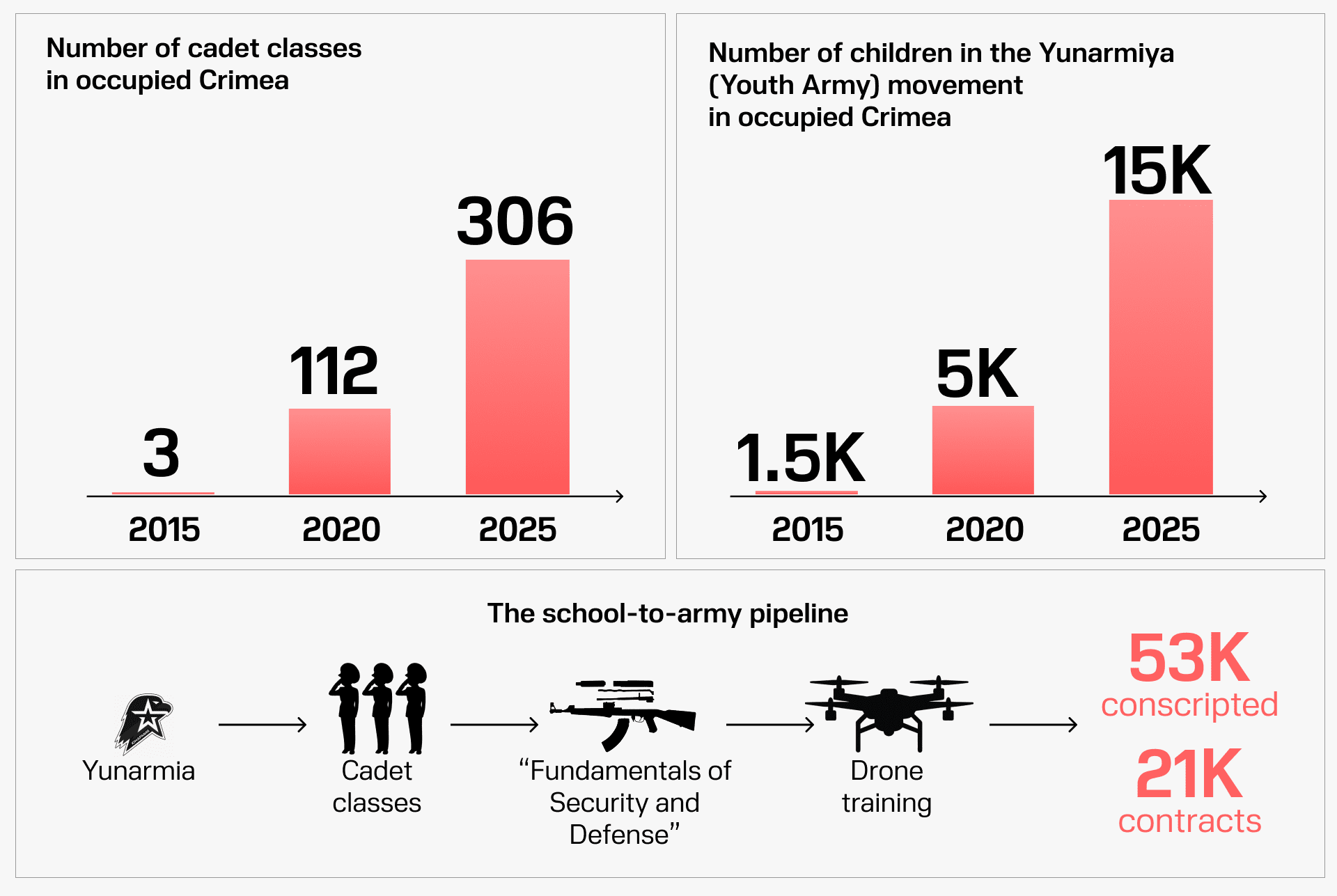
In 2015, there were three cadet classes in Crimean schools. By 2025, there were 306, a hundredfold increase documented by the Ukrainian educational rights group Almenda. The Kremlin’s youth army, Yunarmia, grew from 1,500 members on the peninsula in 2017 to more than 15,000 by late 2024.
As of December 2025, the Ukrainian language has been completely removed from school curricula. In its place, students take “Fundamentals of Security and Defense of the Motherland”: schools have been supplied with mock Kalashnikovs and FPV drones for the practical classes, and veterans of the war against Ukraine are brought into classrooms as “mentors.” Schools across occupied Crimea have installed 421 “hero desks” honoring Russians killed in the invasion.
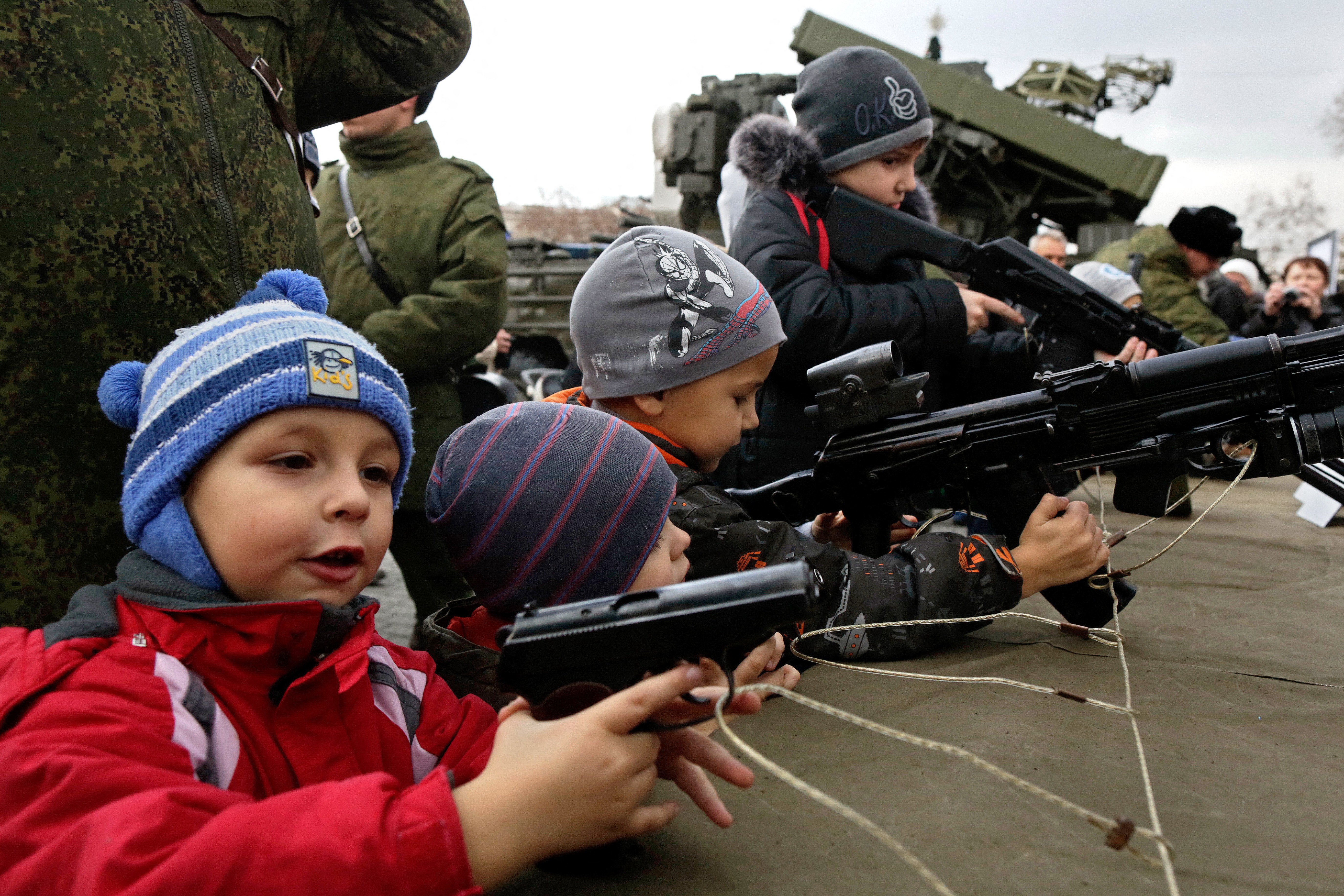
The vertical does not end at graduation. Crimea’s occupation head claims that the peninsula is the only region under Kremlin control with a full training cycle for drone-warfare personnel, starting with the selection of promising schoolchildren and students.
Training centers for FPV drone pilots operate on training ranges, and experts say that producing drone crews has effectively become Crimea’s assigned military specialization. A region Ukraine knew for children’s summer camps now trains drone operators for the Russian army.
The pipeline already has casualties. Ukrainian Dmytro Kotov graduated from a school in Dzhankoi, northern Crimea, in 2015, was enrolled in Yunarmia, and after university signed a contract with the Russian military. He died aboard the landing ship Novocherkassk in March 2022, fighting against Ukraine. His is one of several such cases documented by UNITED24 Media.
Kuryshko’s office puts the toll in figures. As of December 2025, at least 53,000 residents of the peninsula had been conscripted into the Russian army, and about 21,000 Crimeans had signed military contracts since 2022.
The share of Crimeans among all Russian conscripts tells its own story: under half a percent in 2015, it had risen to around 2% — evidence, she says, that Russia is deliberately drawing on the population of occupied territory, which the Geneva Conventions forbid. From 2026, Russia is moving from twice-yearly call-ups to year-round conscription.
Refusal is prosecuted. Her office has tracked 625 criminal cases for evading service; half were opened after February 2022, and 570 people have been convicted, most punished with fines, suspended sentences, or forced labor. Crimean Tatars make up about 30% of those convicted while forming roughly 15% of the population, Kuryshko says.
Taken together, the schooling and the conscription that follows it have drawn international scrutiny. In July 2026, an OSCE Moscow Mechanism expert mission concluded that Russia’s militarization and indoctrination of Ukrainian children is a systematic state policy that may amount to a crime against humanity.
The society Russia built
Put the pieces together and occupied Crimea looks less like a fortified region than a purpose-built garrison society. Around 200 schools have been renamed under a project honoring Russian and Soviet military figures. Private business has largely given way to federal subsidies, and the resort economy that once defined the peninsula now serves military payrolls.
The physical transformation—hospitals on a war footing, fortified beaches, nature reserves handed to the military—is a story UNITED24 Media has told through the eyes of Ukraine’s Permanent Representative in Crimea. What that transformation rests on is the subject of this one: the people brought in to man it.
This is what makes Crimea different from a base. Bases can be dismantled. Russia has spent twelve years building something slower to undo: a population whose homes, salaries, and status all flow from the occupation, and a generation of children raised inside it.
Yet what Moscow bought may be exactly as durable as the payments that secured it. The Atesh partisan movement reported in June 2026 that, under pressure from Ukrainian strikes, Black Sea Fleet officers were quietly moving their families from Crimea to Novorossiysk, a Russian port city across the Black Sea, and selling property without waiting for orders. Chubarov is more cautious: no mass exodus yet, he says, only an anxiety the settlers now discuss openly. Twelve years on, the population Russia brought in to make Crimea permanently its own is watching the exits.
Discuss this article: