- Category
- Business
How Ukrainian Businesses Are Creating Jobs and Generating Billions in the US Economy
Ukrainian entrepreneurs are behind as much as $60 billion in US economic activity and roughly 300,000 jobs, new research reveals. We spoke with founders and experts to understand how that impact is being built.
 Prefer U24 Media on Google
- Authors

-e704648019363ef9514cdd89b9bacc91.jpg "David Kirichenko")
Since Russia’s full-scale invasion in 2022, hundreds of thousands of Ukrainians have entered the United States through multiple pathways, including more than 240,000 via the Uniting for Ukraine humanitarian parole program. Many more had already built lives in the US over decades as entrepreneurs, engineers, and tradespeople, yet their collective economic footprint had never been systematically measured.
The Ukrainian presence in the United States is not new. It stretches back more than a century, encompassing churches, credit unions, cultural institutions, and generations of small businesses.
“The Ukrainian community in the United States has existed for more than a hundred years,” Vitaliy Goncharuk, chief executive of A19Lab and former chairman of Ukraine’s Artificial Intelligence Committee, told us. “It has contributed to the American economy for generations.”
In Ukraine, survival has depended in part on a culture of improvisation and technological adaptation.
Civilian engineers helped transform commercial drone technology into battlefield systems that forced a much larger military power into a grinding war of attrition. Abroad, that same problem-solving instinct has quietly reshaped local economies across the United States.
Ukraine’s now-famous interceptor drones, explained ⬇️
— UNITED24 Media (@United24media) March 20, 2026
🔗 https://t.co/v004pEhtHX pic.twitter.com/AIOCAQkO53
“Ukrainians are inherently innovative. This started long before the collapse of the Soviet Union,” said Vitalii Bandura, a Ukrainian tech founder based in the United States. “The mindset we commonly share is quite different from what I see in the US. We are used to living in scarcity, which fosters a survival mentality that makes us highly flexible and resourceful.”
Some Ukrainian tech entrepreneurs who had established careers in the United States returned home when the invasion began. Lyuba Shipovich was among them.
“Before the war, I ran a successful fintech company and was planning a European expansion. Russia destroyed all that,” Shipovich said. When war broke out, she shut down the company, paid her employees three months of salary, and went back to Ukraine. She co-founded Dignitas, an organization focused on introducing new technologies to the Ukrainian military. While some entrepreneurs redirected their skills toward wartime innovation, others continued building companies in the United States.
From anecdotes to evidence
A new report by ISE Group, a Washington-based think tank and startup accelerator, estimates that Ukrainian-American businesses generate between $55 billion and $60 billion in annual revenue and support roughly 300,000 American jobs.
Researchers verified 2,270 Ukrainian-founded firms across all 50 states and modeled a broader network of about 45,000 enterprises nationwide. The findings represent the first systematic attempt to quantify the economic footprint of Ukrainian-American entrepreneurship in the United States.
“We knew our people were contributing so much, but how do we prove it beyond stories?” said Oleksandr Romanishyn, a former Ukrainian Deputy Minister of Economy and a lead author of the study. “At some point, someone challenged me to show the numbers. That was the turning point.”
Romanishyn traces the study’s origin to two conversations. The first took place during Ukrainian Week at a prayer gathering, where he and Dmytro Galan, a Chicago-based radio host, discussed the diaspora’s visible but unmeasured economic role. “We felt this intense pride,” Romanishyn said, “but also frustration that it was all anecdotes.”
The second occurred in a meeting with a US State Department official. “I was making the case that our diaspora isn’t just about cultural festivals or charity, but an economic force,” he said. “And he listened and said, ‘This sounds great, but show me the numbers.’”
Between community pride and policy skepticism, the idea took shape. On a flight home, Romanishyn began sketching a framework. What began as a modest effort to gather statistics became a national mapping project.
Mapping 2,270 firms and counting
The research team launched an online survey for Ukrainian-founded businesses, but self-identification was only the starting point. “We wanted a verified registry, not just a list of whoever raised their hand,” Romanishyn said.

The team cross-checked business registrations, LinkedIn profiles, media reports, and community references. Diaspora institutions—including Selfreliance Federal Credit Union, Allrise Capital, and the Ukrainian American Chamber of Commerce & Industry—helped identify founders. SelectUSA and the Ukrainian Embassy in Washington validated companies that had participated in investment programs.
In the end, the team verified 2,270 firms spanning industries from aerospace components in California to family-run bakeries in Illinois. Each entry, Romanishyn said, was confirmed through at least two independent sources. Beyond that core dataset, the researchers estimate roughly 45,000 Ukrainian-origin businesses operate in the United States, including sole proprietors and micro-enterprises.
“We deliberately took a conservative approach,” Romanishyn said. “These numbers are a floor, not a ceiling.”
A tech-heavy but broad-based footprint
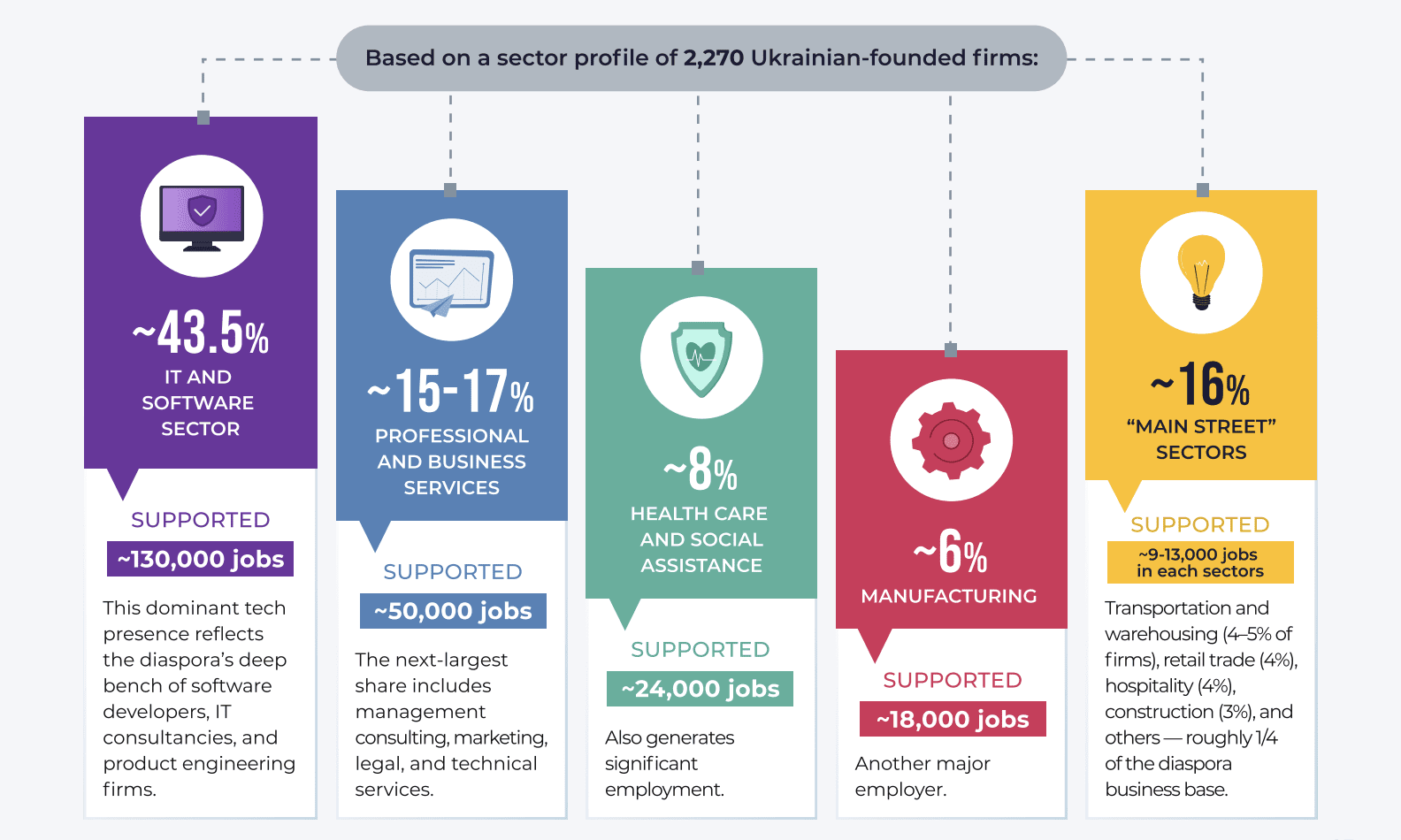
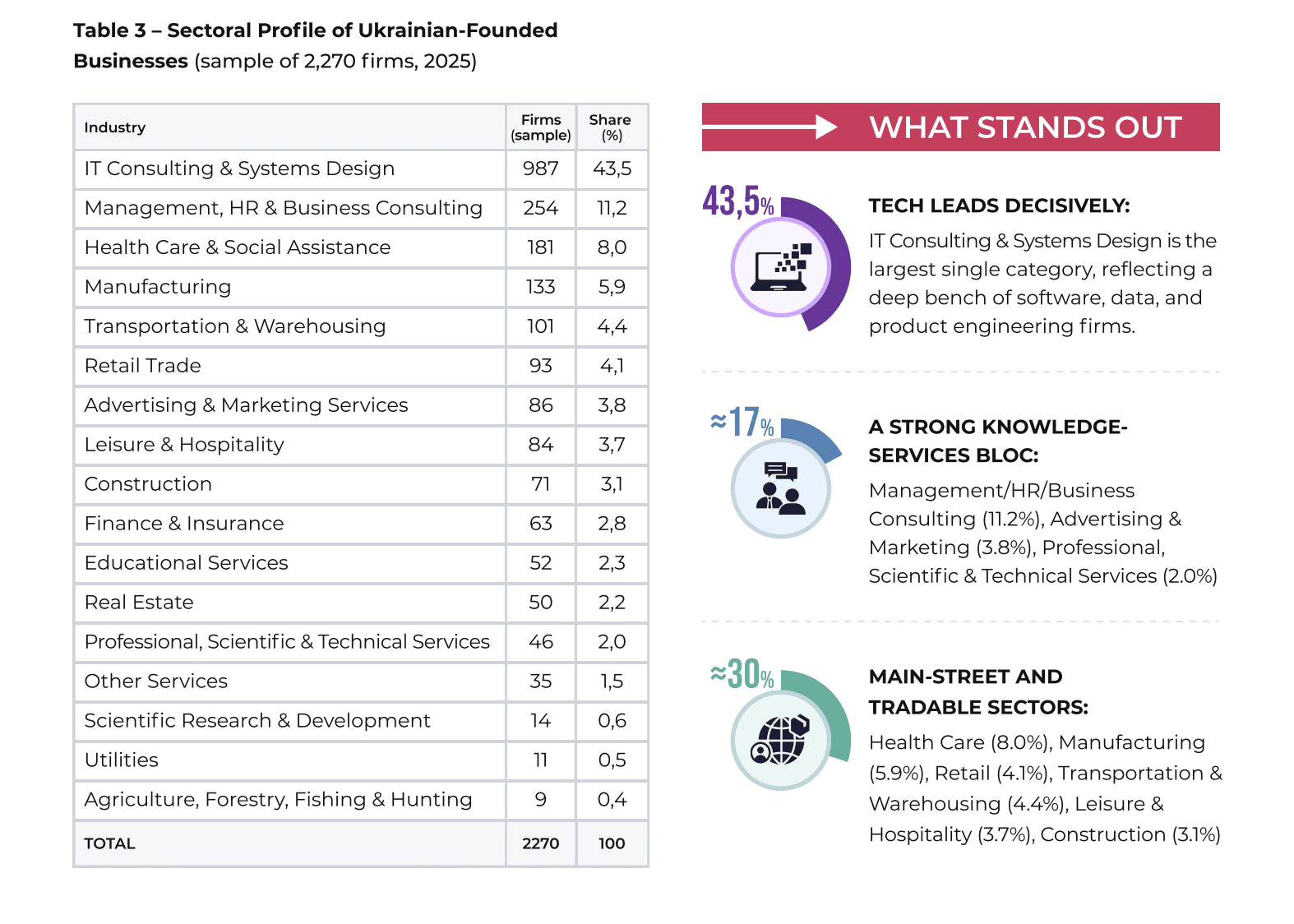
Technology firms account for roughly 43% of the verified sample, reflecting Ukraine’s strong engineering culture and its global reputation in software development and artificial intelligence.
One example is Valerii Iakovenko, who relocated to Pennsylvania in 2022 and expanded his agricultural drone company rather than winding it down. After pioneering agro-scouting and aerial fertilization in Ukraine, his firm now supplies farmers from North Carolina to Ohio and Maine, using drones to detect soil stress and improve yields.
It’s not just about drones. It’s about building a culture of innovation.
Valerii Iakovenko
Chair of the Agricultural Committee of the Pennsylvania Drone Association
The report estimates that around 130,000 jobs—nearly half the total employment impact—are concentrated in tech and knowledge-intensive services.
Clusters stretch from Silicon Valley and Boston to Austin, Dallas, and Seattle. Many firms maintain transatlantic models, with US client teams and engineering centers in Kyiv or Lviv.
But the economic footprint is not confined to tech. Ukrainian entrepreneurs run health care practices in New Jersey and Florida, trucking fleets in Washington State and California, construction firms in Chicago and Philadelphia, and manufacturing businesses in the industrial Midwest.
“Economic contributions of Ukrainian-Americans in Washington State depend a lot on the wave of immigration that brought them here,” said Katerina Sedova, a nonresident senior fellow at the Atlantic Council’s Eurasia Center. “We know of at least five major waves, from the turn of the twentieth century to the most recent arrivals after Russia’s aggression.”
The post-Soviet wave from 1991 to 2014 brought roughly 300,000 Ukrainians to the United States, many of whom launched businesses or were recruited by technology companies on the West Coast. The Seattle area, she noted, now has a substantial Ukrainian presence within major firms, including Microsoft, Amazon, Google, and a growing network of startups.
California and New York together account for nearly half of all Ukrainian-owned firms, but the presence extends nationwide, with notable concentrations in Illinois, Florida, Texas, and New Jersey.
In many cases, especially among recent arrivals, businesses began as acts of necessity: home bakeries, cleaning services, freelance IT work. “Ukrainians who arrived after 2022 did not sit on the sidelines,” said Dmytro Kavun, co-founder and president of Dignitas. “They moved into sectors where the United States needed workers—medical aides, skilled trades, warehouse staff, IT professionals. Many have strong technical education, particularly in STEM.”
The study projects that these newcomers could create between 18,000 and 27,000 additional enterprises in the coming years.
There’s something about arriving in a new country and having to rebuild your life that breeds entrepreneurial energy. Most of the economic impact we measured comes from first-generation immigrants.
Oleksandr Romanishyn
Former Ukrainian Deputy Minister of Economy
Builders in a political moment
The report arrives at a delicate moment in American politics, as lawmakers debate immigration policy and the administration’s approach to Ukraine—and the possibility of a future peace deal.
At the Ukraine Action Summit in Washington last fall, organizers handed out copies to more than 700 Ukrainian American advocates before meetings on Capitol Hill. What began as a two-page briefing meant to open doors has since taken on a broader role.
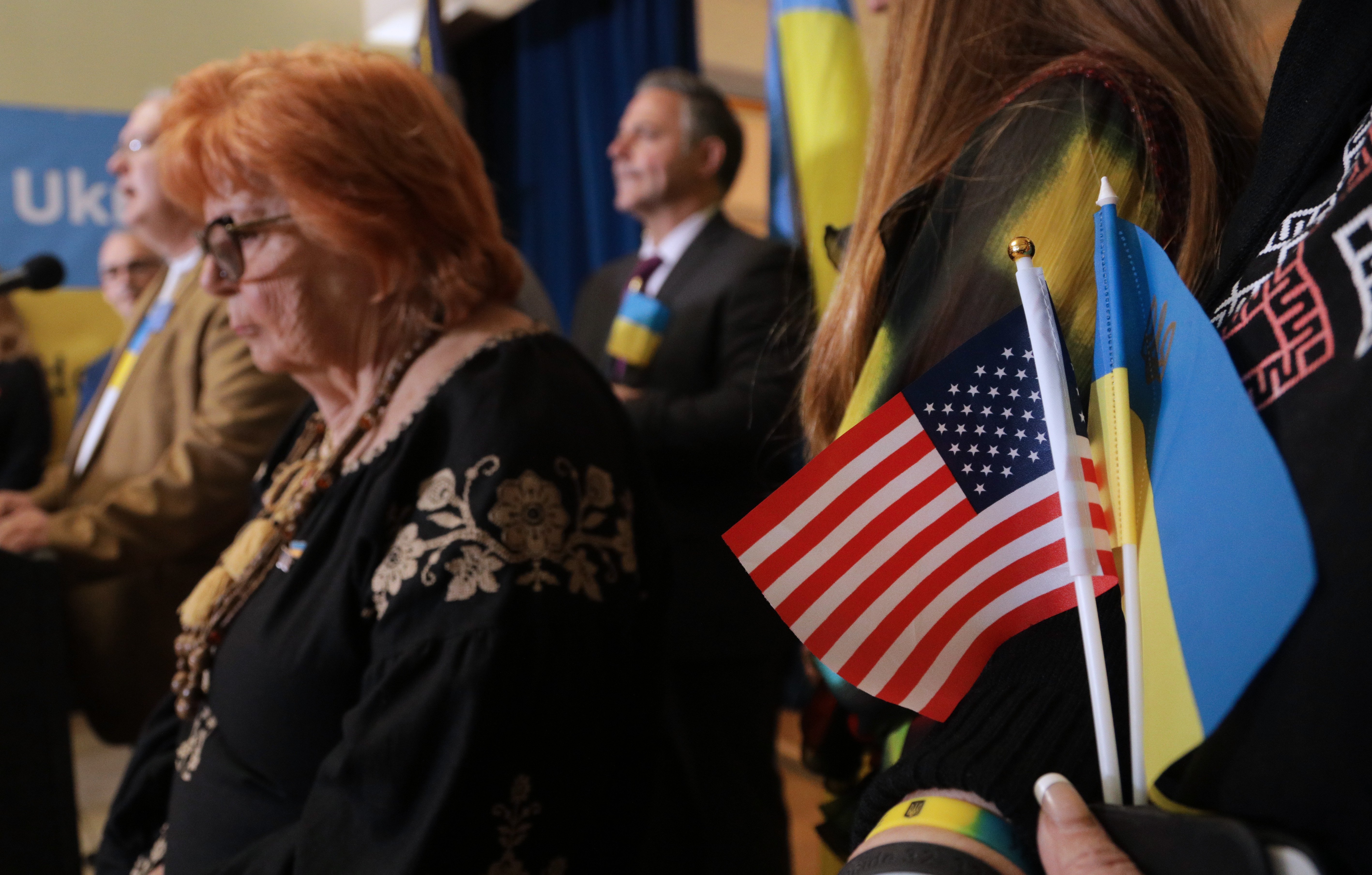
During Ukrainian Week in Washington in February, the study moved from handouts to something more consequential. After a meeting with Representative Mike Quigley, his office encouraged the group to widen its outreach to other lawmakers, framing support for Ukraine not as foreign aid but as an economic issue tied to local jobs, wages, and tax revenue.
“Ukraine isn’t just a recipient of aid,” Romanishyn said. “Ukrainians here are contributors to the US economy.”
The effort is now expanding beyond advocacy days and photo opportunities. Organizers are scheduling follow-up meetings with congressional offices and state officials, hoping to translate the data into policies that would improve access to capital and government contracts for immigrant-founded businesses.
In April, the group plans to host a private business roundtable on Capitol Hill timed to coincide with the International Monetary Fund and World Bank spring meetings. In May, during the SelectUSA Investment Summit, the focus will shift toward connecting Ukrainian American entrepreneurs with state officials and corporate partners.
Longer term, Romanishyn mentioned they are pushing for what they call a Ukrainian Adjustment Act–legislation that would provide a pathway to permanent residency for Ukrainians currently on temporary humanitarian status.
“Many of them are building businesses and creating jobs while living in legal uncertainty,” Romanishyn said. “If we want them to keep contributing, stability matters.”
The research effort is continuing to expand. Organizers say a second edition of the study is being launched, alongside a new initiative inviting Ukrainian-American entrepreneurs to submit their stories and businesses for inclusion in a growing national registry. With support from Nova Ukraine, which has networks in all 50 states, the next phase aims to map the diaspora’s economic footprint at the state level and strengthen connections between Ukrainian-founded companies across the country.
The iceberg beneath the surface
At a Ukrainian-American Business Forum in Chicago, where the findings were presented to bankers and investors, a phrase kept resurfacing.
“This is the visible tip of the iceberg,” Romanishyn recalled. Community leaders suggested the real number of diaspora-owned enterprises could be far higher once every sole proprietor and small family shop is counted. The study’s authors acknowledge methodological constraints and stress that their employment and revenue figures are conservative. But even under cautious assumptions, the numbers are striking.
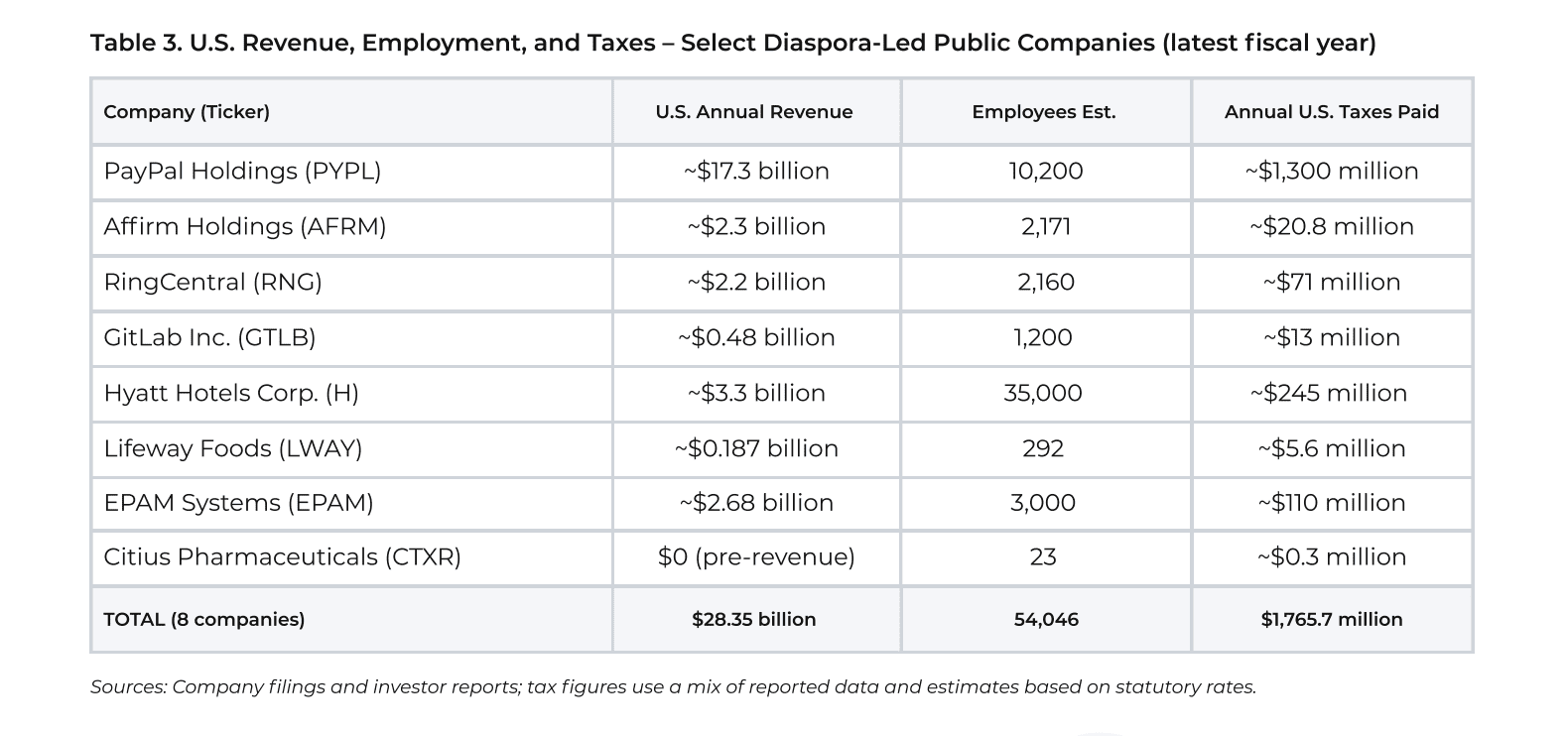
Across industries and states, thousands of Ukrainian entrepreneurs are doing exactly that—building businesses and creating jobs—not as beneficiaries of the American system, but as participants in it.
“We wanted to tell our community’s story in a language policymakers understand,” Romanishyn said. “Numbers.”
Discuss this article:

-5f84711170d2769c4cda67ca2bebf5d2.jpg "Carpathian 8 Summit: Ukraine Leads Push for Security & Regional Growth")

-111f0e5095e02c02446ffed57bfb0ab1.jpeg "Photo of Roman Kohanets")
-4258f90da45ed571f27851d158610665.jpeg "Photo of Valeriya Ionan")
-92cc3cc3704a042ef4f32eb51a51081d.png "Activitis Builds Fintech Infrastructure for Ukrainian Business During Wartime")
-29a1a43aba23f9bb779a1ac8b98d2121.jpeg "Photo of Illia Kabachynskyi")