- Category
- Latest news
Humanoid Robot Soldiers Have Arrived in Ukraine—And the Battlefield May Never Be the Same
Ukraine has received two Phantom MK-1 humanoid robots designed for military use, marking one of the first real-world battlefield evaluations of humanoid soldier technology.
 Prefer U24 Media on Google
- Authors


According to the US robotics company Foundation, the robots were delivered to Ukraine in February to assess their potential effectiveness in combat environments, the company told Time magazine on March 10.
We bring you stories from the ground. Your support keeps our team in the field.
Ukraine has increasingly become a global testing ground for emerging military technologies, with defense startups from around the world using the war to evaluate new systems under real combat conditions.
Among those companies is Foundation, which hopes to eventually deploy its Phantom humanoid robots closer to the frontlines as part of ongoing development.
🇺🇦🤖 Phantom MK-1 humanoid robot soldiers have been delivered to Ukraine to evaluate their effectiveness, - TIME
— MAKS 25 🇺🇦👀 (@Maks_NAFO_FELLA) March 13, 2026
Two robots were delivered to Ukraine in February.
Ukraine has become the world's main testing ground for weapons manufacturers, including Western startups. pic.twitter.com/rIoUcgz0QN
Designed to operate like a human soldier
In a commentary for Time magazine, Foundation co-founder Mike LeBlanc said the experience of bringing the Phantom system to Ukraine reinforced his belief that humanoid robots could play a major role in future warfare.
“Humanoid soldiers can be invaluable for resupply and reconnaissance work, especially in places drones can’t access, like bunkers,” LeBlanc explained.
gm, here’s a video of @foundation_robo’s Phantom MK1 being built. pic.twitter.com/56Lh3zmGkb
— XMAQUINA (@xmaquina) February 9, 2026
Because the robot produces a heat signature similar to that of a human, it could also confuse enemy surveillance systems.
LeBlanc added that the long-term goal is for the robot to operate any weapon system designed for human soldiers.
“How many .50-caliber guns do we have? How many grenade launchers? How many Humvees? We need something that can interact with all of these,” he said.
Foundation has delivered two Phantom MK-1 humanoid robots to Ukraine for testing, the company told Time. Co-founder Mike LeBlanc called what he witnessed in Ukraine "truly shocking," describing it as "a full-scale robot war where the robot is the primary fighter." #Ukraine pic.twitter.com/qZ654bAUAM
— NOELREPORTS 🇪🇺 🇺🇦 (@NOELreports) March 13, 2026
Ukraine becomes the world’s weapons laboratory
The war in Ukraine has rapidly accelerated military innovation.
The country now launches thousands of drones per day, and increasingly autonomous systems are transforming the battlefield.
According to LeBlanc, the environment has already become what he describes as “a complete robot war.”
“It’s a complete robot war, where the robot is the primary fighter and the humans are in support,” he said.
“It is the exact opposite of when I was in Afghanistan: the humans were everything, and we had supplementary tools.”
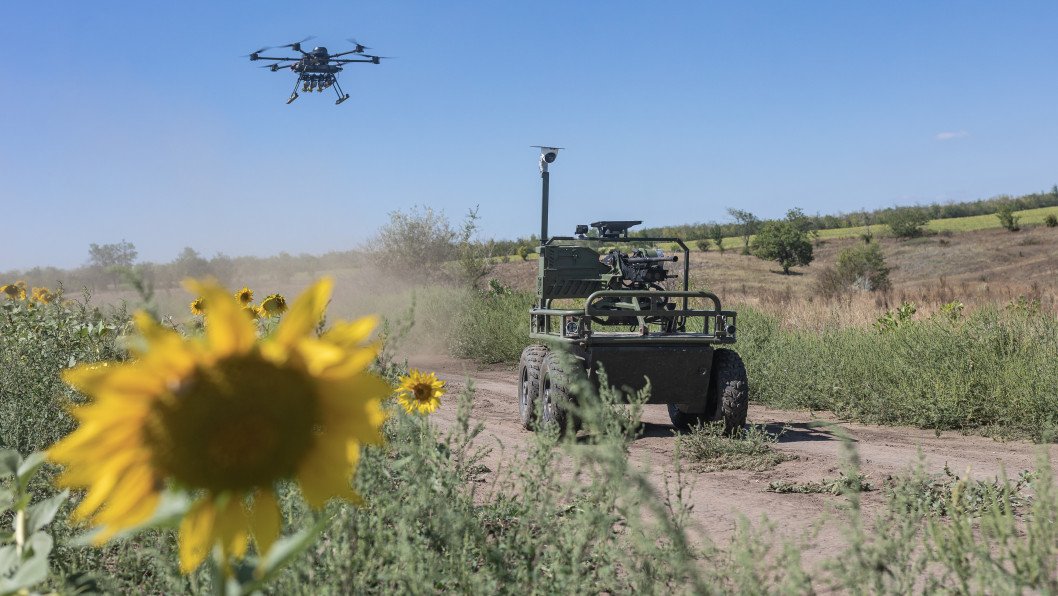
For companies like Foundation, Ukraine provides a unique opportunity to improve technology through real battlefield feedback.
“Just like drones, machine guns, or any technology, you first have to get them into the hands of customers,” said Foundation executive Pathak.
US military already investing in the technology
The Foundation has already secured $24 million in research contracts with the US Army, Navy, and Air Force, making it an approved military vendor.
The Phantom platform is also scheduled to participate in testing with the US Marine Corps, where engineers will train the robot to place explosives on doors to help troops safely breach buildings.
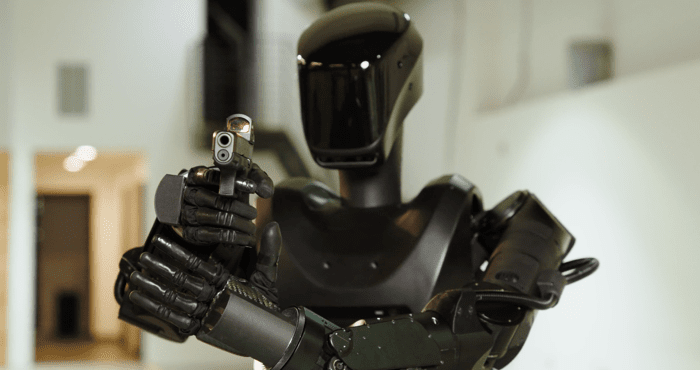
The company says it is also in “very close contact” with the US Department of Homeland Security regarding the potential use of Phantom robots for patrol missions along the southern US border.
For now, Phantom systems are still undergoing testing in controlled environments ranging from factories in Atlanta to shipyards in Singapore.
A more advanced version, Phantom MK-2, is expected to debut in April with improved electronics, waterproofing, larger battery capacity, and the ability to carry loads of up to 80 kilograms.
We are moving from model controller to RL for locomotion. The policy is starting to look quite robust. Even more convinced now that legs are easier than wheels, given the software complexity has shrunk tremendously with RL. pic.twitter.com/3NMEPY25uX
— Sankaet (@sankaet) September 18, 2025
Risks remain
Despite rapid technological progress, humanoid combat robots still face significant limitations.
The machines are heavy, expensive, require regular recharging, and can be prone to mechanical failure. Each Phantom unit relies on roughly 20 motors to control its movement, and even a small malfunction can disable the system.
There are also concerns about the risks of deploying autonomous machines in combat.
“If you fall over next to a baby, you know how to land without hurting the baby,” said Prahlad Vadakkepat, a robotics researcher at the National University of Singapore. “Will a humanoid be able to do that?”
Phantom does not like being made fun of pic.twitter.com/vm1cJVnhE6
— Sankaet (@sankaet) December 18, 2025
Captured drones have already proven to be valuable sources of intelligence, as they often function like flying smartphones that store operational data.
Experts warn that a compromised humanoid combat robot could create new risks if enemies manage to hack or seize control of the system.
Artificial intelligence itself also remains imperfect.
Experts note that AI systems can produce errors known as “hallucinations,” generating incorrect information or flawed decisions despite appearing confident.
“With these large language models, we cannot fully explain how they make decisions,” researchers say. “You cannot allow lethal autonomous systems that occasionally decide to hallucinate.”
The future battlefield: robots versus robots
LeBlanc believes the increasing use of autonomous systems could fundamentally change the nature of warfare.
Eventually, he suggests, conflicts could become largely technological contests between machines rather than battles between human soldiers.
“Droid battles, with drones overhead and humanoids walking toward each other, become an economic conflict,” he said. “I think that’s all for the better.”
Earlier, Britain’s Minister for the armed forces, Al Carns, said the war in Ukraine is forcing the UK and its allies to rethink how wars will be fought, with AI-enabled software and robotic systems increasingly shaping outcomes on the battlefield.
Carns told reporters the war has produced “huge lessons for us within the UK,” describing “this revolution in military affairs” in which uncrewed systems are beginning to dominate at the tactical level.
Discuss this article:
-9a7b3a98ed5c506e0b77a6663f5727c5.png)