- Category
- War in Ukraine
Russia’s Msta-S Had a Forest to Hide In—Ukraine Had Six Drones to Find It
 Prefer U24 Media on Google
- Authors


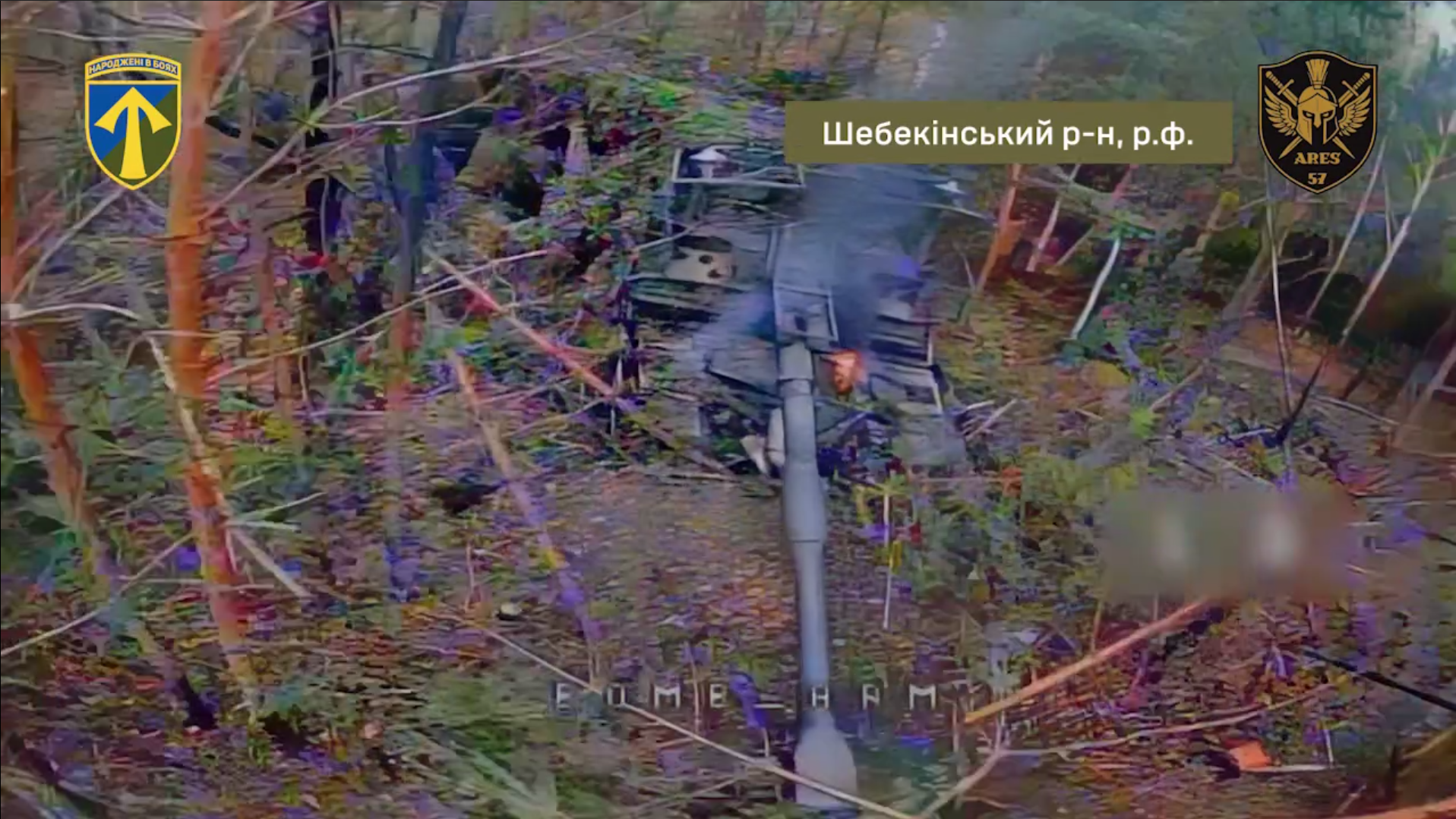
Ukrainian drone operators tracked down a Russian 2S19 Msta-S self-propelled howitzer concealed in a forest in Russia’s Belgorod region, striking the artillery system with six drones despite Russian attempts to keep it hidden from aerial reconnaissance.
Ukraine’s 16th Army Corps reported the operation on November 11, releasing footage of the strike carried out in the Vovchansk sector near the Ukrainian-Russian border.
We bring you stories from the ground. Your support keeps our team in the field.
The footage shows the Russian artillery piece positioned among trees, apparently relying on dense conifer branches and the remaining autumn foliage to avoid detection. However, the natural camouflage proved insufficient to conceal the howitzer from Ukrainian reconnaissance drones.
Operators from the Ares Artillery Reconnaissance Battery of Ukraine’s 57th Separate Motorized Infantry Brigade located the weapon and launched a series of strikes against the concealed position, reportedly hitting it with all six drones.
Good day!☕️🔥
— Challenger Tank In Ukraine🇬🇧🇺🇦 (@ChallengerInUA) November 10, 2026
A Russian 2S19 Msta-S self-propelled gun is hit multiple times before it burnt like a Russian refinery!☄️💥🔥
Artillery Reconnaissance Battery “ARES” of the 57th Separate Motorised Infantry Brigade in Belgorod region. pic.twitter.com/nyqV6RZga1
“The Ares Artillery Reconnaissance Battery of the 57th Brigade knows the forests in the Vovchansk sector better than the Russian troops know their own positions. This time—six attack runs on a single artillery piece. Six drones, all hitting the target,” Ukrainian troops said, commenting on the released footage.
The 2S19 Msta-S is a Soviet-designed, 152mm tracked self-propelled howitzer that entered service in 1989 and remains a major component of Russia’s artillery forces.
It can engage targets at distances of roughly 25 kilometers (15.5 miles) using conventional shells, with extended-range ammunition allowing strikes at greater distances.
The system can also fire Krasnopol laser-guided artillery rounds, enabling precision strikes against designated targets.
Earlier, reports emerged that Russia has lost nearly 140 heavy thermobaric rocket launcher systems during its full-scale invasion of Ukraine, exceeding estimates of its entire prewar fleet.
Despite the losses and their vulnerability to Ukrainian drones, Moscow continues to manufacture the weapons and introduce new variants.
Discuss this article: