- Category
- War in Ukraine
Ukraine Reveals Russia’s “Klin” Drone Built With Western and Chinese Technology
 Prefer U24 Media on Google
- Authors


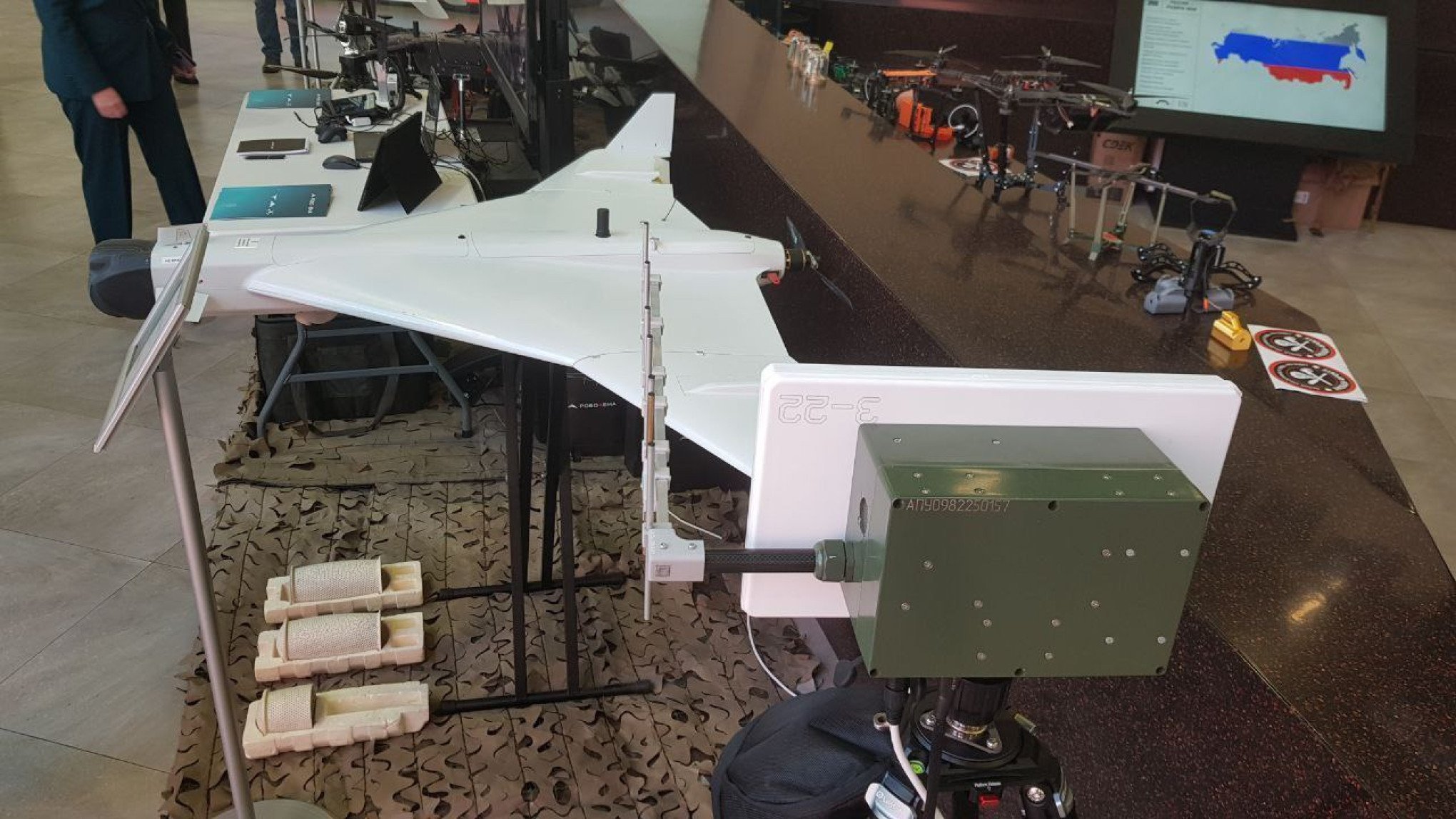
Ukraine’s military intelligence has identified a wide range of foreign-made components in Russia’s new “Klin” unmanned aerial vehicle, underscoring Moscow’s continued reliance on international technology in its weapons production.
The findings were reported by the Main Intelligence Directorate of Ukraine’s Defense Ministry (HUR) on May 4.
We bring you stories from the ground. Your support keeps our team in the field.
According to the agency, the “Klin” drone is developed and manufactured by the Russian company Roboavia. The UAV features a delta-wing fuselage design, measuring approximately 1.6 meters in length with a wingspan of 1.9 meters.
Investigators found that the drone is powered by a Chinese-made Scorpion F-4225-500KV V2 brushless electric motor and uses two lightweight Li-AFB batteries. A key distinguishing feature of the “Klin” is its use of machine vision technology, enabling the drone to autonomously detect and lock onto targets without direct operator control.
This capability is based on the Nvidia Jetson TX2, a US-manufactured computing module. Similar systems have previously been identified in other Russian UAVs, including Lancet, Zala, and Geran-2 models.
The flight control system relies on the commercially available Cube Orange controller developed in Australia, while navigation is handled by the Chinese-made Holybro F9P module, which supports Real-Time Kinematic positioning for enhanced accuracy. Communications are maintained via a LoRa radio modem, built around the Ra-01H module produced by China’s Ai-Thinker.
In addition to Chinese and American components, the drone also incorporates electronics manufactured in Switzerland, Taiwan, and South Korea, according to Ukrainian intelligence.
The “Klin” is capable of carrying either a shaped-charge or high-explosive warhead weighing up to 5 kilograms. It also features advanced forward control surfaces, allowing it to adjust its trajectory during the attack phase across varying speeds and angles of approach. Russian sources claim the drone can reach speeds of up to 300 kilometers per hour during its terminal phase.
HUR reports that multiple variants of the “Klin” system are currently under development for both land and maritime use. In the naval version, target detonation is triggered by radar, while the ground-based variant employs lidar technology.
What is “Klin”
“Klin” is a Shahed-style strike drone was presented at a recent exhibition where its creators highlighted two primary operational roles: conducting long-duration patrols—acting as a persistent “aerial minefield”—and performing autonomous search-and-strike missions over long distances.
The platform is reportedly equipped with an air-burst fuze and can be armed with either high-explosive or shaped-charge (cumulative) warheads.
According to Soniashnyk, the “Klin” has a total takeoff weight of 13.5 kilograms, which includes a 5-kilogram payload. While its standard range is 120 kilometers, this can be increased through the use of signal relays.
The drone can maintain flight for about 80 minutes and operates at speeds between 108 and 300 kilometers per hour. Physically, the airframe is 1.6 meters long with a wingspan of 1.92 meters, and it is capable of flying at altitudes of up to 2,000 meters. Its design allows it to utilize an air-burst detonation system to trigger its chosen warhead.
At the same time, Russian engineers are reportedly testing a specialized shotgun round designed to disable the optics of FPV drones during close-range encounters.
The footage reveals that the ammunition releases a highly adhesive red substance when discharged. This payload generates a dense cloud of fine particles that stick to the drone's camera lens and rapidly solidify. Once hardened, the material becomes entirely opaque, effectively blinding the operator and neutralizing the drone.
Discuss this article:


-c439b7bd9030ecf9d5a4287dc361ba31.jpg "Photo of Katherina Popilnichenko")

-111f0e5095e02c02446ffed57bfb0ab1.jpeg "Photo of Roman Kohanets")