- Category
- World
AI Is Now Watching NATO’s Border With Belarus—And Poland Is Adding Robots Too
 Prefer U24 Media on Google
- Authors


Poland has begun using artificial intelligence to monitor its border with Belarus, combining feeds from cameras, drones, and other sensors into a single system that automatically flags suspicious activity for soldiers and Border Guard officers.
The platform, known as Inteligentna Granica, or Intelligent Border, is already operating as part of Poland’s Operation Safe Podlasie, according to Defence Blog on October 2.
We bring you stories from the ground. Your support keeps our team in the field.
The military operation supports Poland’s Border Guard along one of NATO’s most closely watched eastern frontiers.
Instead of requiring personnel to continuously monitor dozens of individual camera feeds, Intelligent Border analyzes incoming data, recognizes objects, assesses their behavior and directs operators toward incidents that may require intervention.
According to Defence Blog, Poland is currently testing the system across a section of the Belarusian border several dozen kilometers long.
Today's feel good video. On the Polish-Belarus border illegal migrants breach the fence using an angle grinder. They are quickly intercepted by armed, Polish forces.
— David Atherton (@daveatherton) January 6, 2026
They are searched and immediately sent back over the border. pic.twitter.com/GRjNu2Cl7O
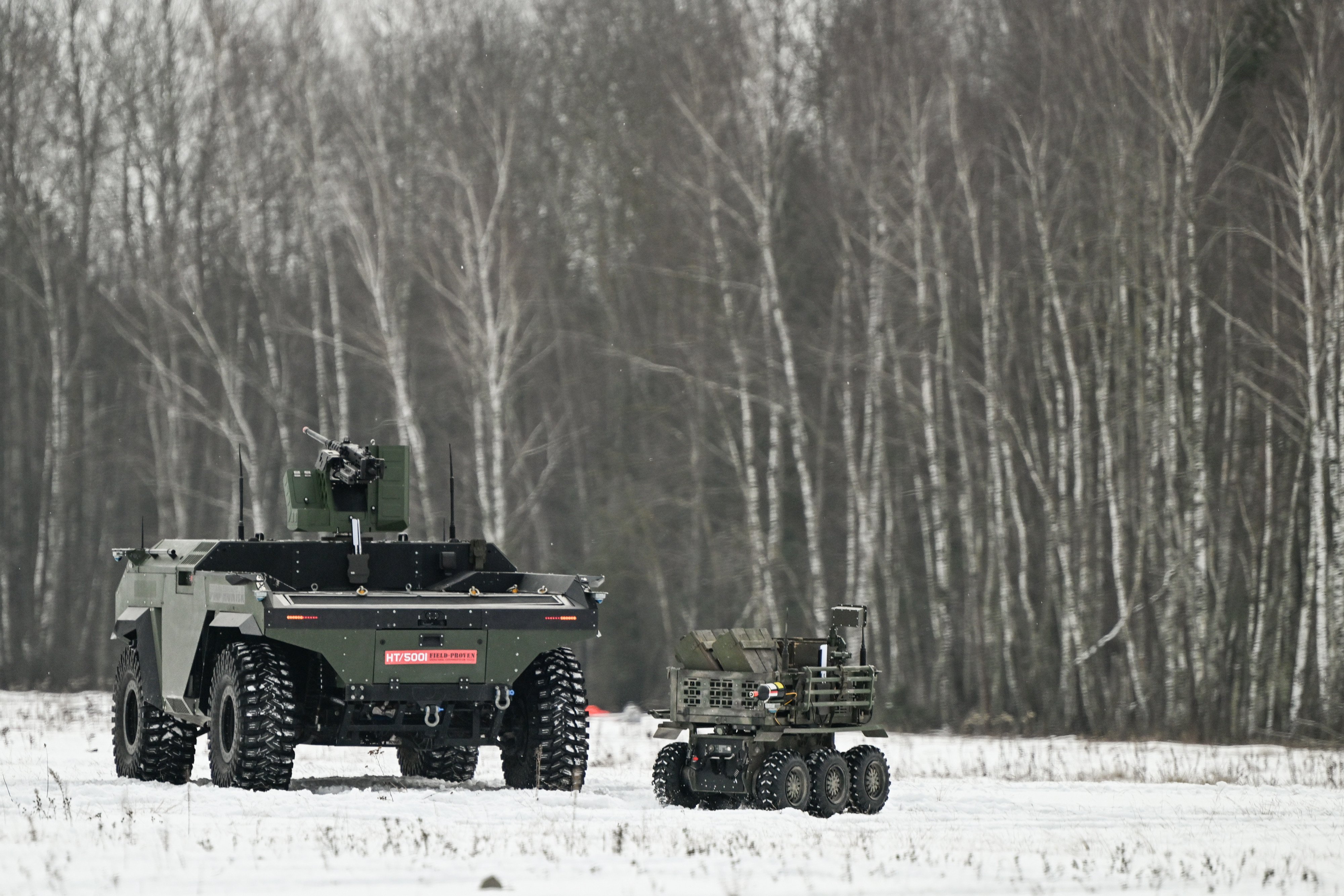
The trials extend beyond artificial intelligence. Poland’s Operational Command said robotics and autonomous systems are also being tested, though officials have not disclosed which platforms are involved, how many are deployed or the precise location of the test zone.
The system was developed jointly by Poland’s Artificial Intelligence Implementation Center—part of the country’s Cyberspace Defense Forces—and the Border Guard.
Its purpose is not to remove humans from border security decisions, but to dramatically reduce the amount of time personnel spend manually staring at surveillance footage.
🇱🇹🇵🇱 Poland and Lithuania have installed a river barrier at the tri-border with Belarus
— Visegrád 24 (@visegrad24) September 30, 2026
A special structure was put up to stop illegal crossings along the Marycha River.
Lithuanian border guards say non-European migrant groups arriving from Belarus regularly try to cross or… pic.twitter.com/DXo5wvNoQ9
The AI instead acts as a filter, identifying potentially significant movement and giving human operators a much narrower set of events to examine.
Defence Blog noted that data from cameras, observation equipment and other sensors can be fused into the same operational picture.
The Border Guard is responsible for installing and maintaining the surveillance infrastructure and providing its data, while the military handles much of the analysis.
At the center of that military component is AIRON TACTIC, an artificial intelligence platform developed by Poland’s cyber forces.
Information generated by the system can then be fed into TAK and JAŚMIN tactical command systems already used by Polish troops and Border Guard personnel.
-b84bae12b935531911624e1ead564a99.jpg)
That means a suspicious movement detected by a camera or drone can potentially move rapidly from automated recognition to the tactical networks used by forces operating on the ground.
Polish officials have described the project as part of a wider effort to automate surveillance along the country’s eastern frontier.
Defense Minister Władysław Kosiniak-Kamysz said earlier this year that Intelligent Border was expected to move into operational use in August.
Defence Blog reported that Brig. Gen. Jarosław Chojnacki, chief of staff of Poland’s Operational Command, recently reviewed the system’s progress during a visit to Task Group Podlasie, receiving a briefing on both its deployment and day-to-day performance.
The technology is arriving on a border already guarded by a substantial military presence.
🚨🇵🇱🇧🇾 At least 17,000 troops from Poland’s 18th Mechanized Division kicked off a large-scale operation on the border with Belarus (near the Polish borderlands occupied by Belarus) on August 1, to secure the frontier against a migrant-fueled hybrid war by Belarus against Poland.… pic.twitter.com/aYhlpsSS7U
— C14 News | EN (@c14english) August 3, 2024
Operation Safe Podlasie began on August 1, 2024, replacing two previous Polish military missions along the eastern frontier.
More than 10,000 troops participated in one recent rotation, with around 5,000 soldiers supporting the Border Guard along the Belarusian border each day.
Polish forces have supported border officers there since 2021, when Warsaw accused the government in Minsk of deliberately channeling migrants toward the Polish frontier as part of a hybrid pressure campaign.
Since then, Poland has steadily hardened the border with physical barriers, observation towers, thermal cameras, drone-detection equipment and additional military infrastructure.
Earlier, Belarus moved troops and military equipment to its borders with Poland and Lithuania for four-day command-staff exercises, with part of the maneuvers occurring right near the Suwałki Gap—a strategically vital section of the Polish-Lithuanian border for NATO.
Discuss this article:


-c439b7bd9030ecf9d5a4287dc361ba31.jpg "Photo of Katherina Popilnichenko")

-111f0e5095e02c02446ffed57bfb0ab1.jpeg "Photo of Roman Kohanets")

-a1738cb523135070a26ed61c09a8eb5e.jpg "Police stand in front of the Russisches Haus in Berlin, Germany. (Source: Getty Images)")
-72b63a4e0c8c475ad81fe3eed3f63729.jpeg "Photo of Cyril Barabaltchouk")