- Category
- World
Putin Says Russia Outgrew World—But IMF Data Shows it Is Growing Few Times Slower
 Prefer U24 Media on Google
- Authors

-111f0e5095e02c02446ffed57bfb0ab1.jpeg "Photo of Roman Kohanets")

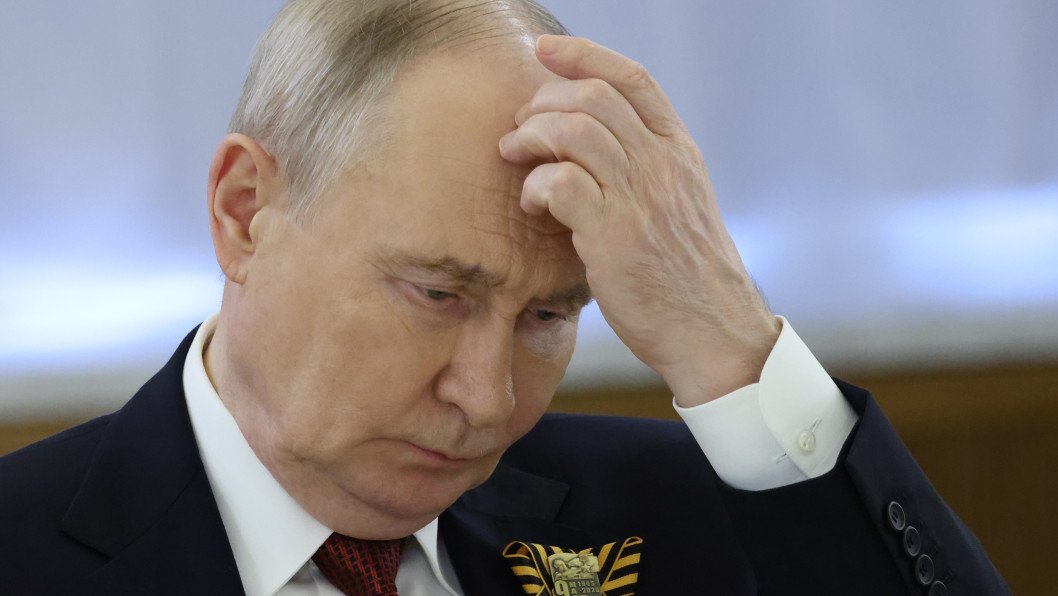
Russian leader, Vladimir Putin, claimed on September 11 that Russia's economy had outpaced global growth over the past three years, despite International Monetary Fund data indicating otherwise.
The remarks, delivered at the BRICS summit in New Delhi, were reported by The Moscow Times on September 11. Putin addressed a gathering that included China's Xi Jinping, Iran's Masoud Pezeshkian, and India's Narendra Modi.
We bring you stories from the ground. Your support keeps our team in the field.
"Over the previous three years, economic growth rates in Russia exceeded the global average; from 2023 to 2025, GDP added 10.3%," Putin stated. He credited structural changes that, he claimed, had left the economy stronger and more resilient despite more than 30,000 sanctions.
Putin further asserted that Western states imposing those measures had faced severe consequences, including budget deficits, rising public debt, and industrial decline. He put the drop in EU industrial output at 8%.
That figure is not supported by official statistics. According to Eurostat data cited by The Moscow Times, EU industrial production fell in 2023 and 2024 but rebounded sharply in 2025, leaving a three-year decline of roughly 0.6%—far short of the 8% Putin described.
The central claim also diverges from IMF figures. The fund's data show the world economy grew 10.7% across 2023 to 2025, marginally ahead of Russia's 10.3%. Russia expanded faster than the global average in 2023 and 2024, but its growth slowed to 1% in 2025, while the world grew by 3.5%.
Russia's own projections point to a widening gap. The Ministry of Economic Development expects growth of just 0.4% in 2026, against an IMF world forecast of 3%. That would leave Russia trailing the US, China, and India, which the IMF projects to grow 2.3%, 5%, and 6.4%, respectively.
Moscow foresees only gradual acceleration thereafter, with GDP rising 1.4% in 2027, 1.9% in 2028, and 2.4% in 2029. Cumulatively across those three years, the government forecasts growth of 5.8%.
The upbeat framing sits awkwardly against recent official data: Russia's economy grew just 1.3% in the second quarter of 2026, its strongest showing in six quarters.
Cumulative first-half growth reached only 0.6%, roughly half the previous year's pace and nearly seven times slower than the 2023–2024 wartime boom. On September 3, Putin acknowledged that the federal budget deficit was widening, though he insisted it remained manageable, with the shortfall reaching 2.8% of GDP in January through July against a full-year target of 1.6%.
Discuss this article:

-c439b7bd9030ecf9d5a4287dc361ba31.jpg "Photo of Katherina Popilnichenko")