- Category
- World
Russia's Dirty Business of Death is Booming
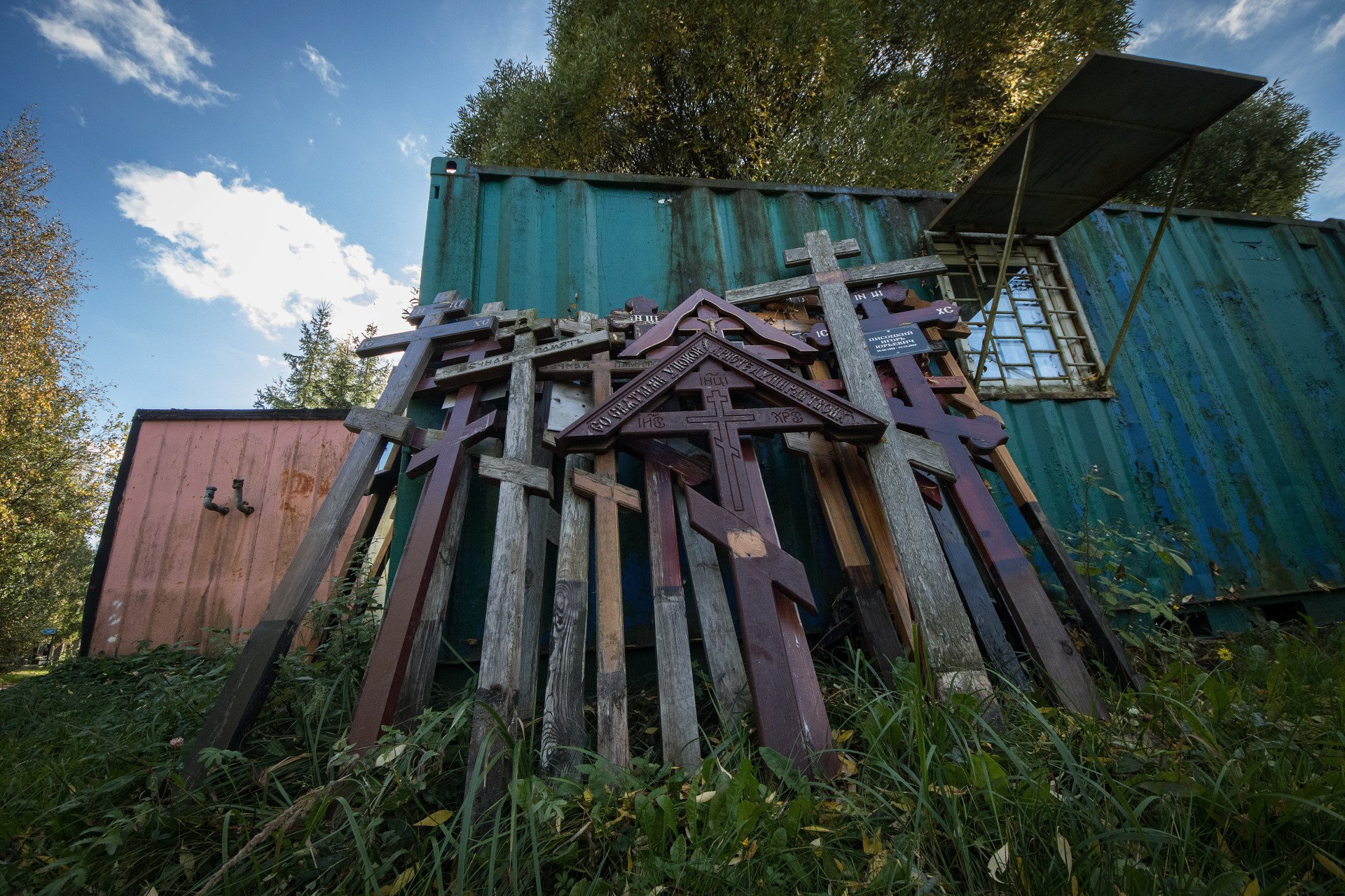
In Russia, death is big business. Funerals are surging, and the dead end up worth more than the living. Behind the coffins lies a criminal empire of morgue gangs, crooked officials, and security-service insiders—a shadow network growing darker amid Russia’s war in Ukraine.
 Prefer U24 Media on Google
- Authors

-46f6afa2f66d31ff3df8ea1a8f5524ec.jpg "Photo of Jess Daly")
Sergey Rakityansky, who once fought for Russia’s Wagner private military company (PMC) in Moscow’s invasion of Ukraine, left the city of Bakhmut without his legs. He returned to Russia with $4,500 “compensation” from the state, which he used to start a business—making funeral wreaths.
“Someone often died,” Rakityansky told reporters. “I wanted to make something beautiful.”
Beauty, in today’s Russia, comes wrapped in black ribbon.
DEATH CULT: Coffin Expo in Moscow, #Russia. Competitions held on who can dress & paint the deceased (mannequins) the fastest, "Best Funeral Director" based on their speeches, and other abominations. pic.twitter.com/5B4nyz9Nb6
— Igor Sushko (@igorsushko) November 5, 2022
The booming funeral industry
A Russian funeral magnate bribed the police for access to confidential lists of the recently deceased, state media Izvestia reported in April 2025.
A search of his home reportedly turned up more than $250,000 in cash, two cars, and six luxury watches worth nearly $600,000.
It was just another headline in a blood-stained industry.
In the first four months of 2025, Russia’s funeral services market surged by 12.7% compared to the same period in 2024. More than 200 new funeral-related businesses opened, coffin prices jumped 9%, and grave-digging fees soared 15%, RFE/FL reported.
Revenue in the sector also surged, with funeral service providers earning nearly $500 million during this period. St Petersburg earned the most, at $46.5 million. The number of funeral services in Russia increased by 16%, compared to the same period last year, Ukraine’s Centre for Countering Disinformation (CCD) reported.
While the costs of funeral services are up, state reimbursement for soldiers’ burials remains tightly capped.
Many families of killed Russian soldiers complain that the state hasn’t compensated them at all, and others have been compensated with “grotesque” gifts, ranging from meat grinders, kitchen appliances, to bags of onions.
-330e3fd8eafbf22f3e9a15884c23eaa2.png)
Over 121,500 Russian soldiers have been confirmed killed in Ukraine, according to counts by the BBC Russian Service and Mediazona. They estimate the real figure—including the unnamed soldiers—at more than 165,000. Total Russian losses on the Ukrainian front have now exceeded one million.
While Russia’s economy is plummeting, its criminal funeral business is surging, with the trade in the dead at its most profitable since the 1990s. In wartime, burials inevitably rise, but in Russia, those bodies have become currency in an industry deeply entwined with corruption, organized crime, and state collusion.
Mortuary mafia state
Over the last 40 years, the funeral business in Russia has been divided between organized criminals, siloviki , and the state. During the Soviet era, the state was responsible for all funerals.
In 1996, Russia passed a law retaining control of cemeteries and crematoriums in state hands, while delegating the management of funeral services to local municipalities, which issued mortuary licenses to private entrepreneurs.
By the early 2000s, “the mortuary business was one of Russia’s most criminal industries,” Meduza in 2019 reported. Now, the war turns body bags into cash bags.
From the mid-1990s, criminal gangs ruled the funeral business. Even Russian state media Tass reported in 2013 that the shadow funeral market in Russia had “grown to 60%.” In Moscow alone, illegal revenues were estimated at $1.1 to $2.5 billion.
The funeral trade reportedly offers many profit streams—from harvesting body parts like eyeballs and gold teeth to gravestone carving, cemetery land deals, and pricey legal services.
"The crematorium works around the clock. The stench of burning bodies hangs over the district. Who is being burned at night at such a terrible speed that the pipes are red-hot?"
— Anton Gerashchenko (@Gerashchenko_en) May 28, 2025
Residents of the Russian Rostov region complain that the crematorium near the village of Bolshiye… pic.twitter.com/hQuC1w1eZs
Corruption
Russian gangs bribe or intimidate officials to secure access to death notifications before families are informed, allowing them to “sell” funeral services on the spot, before their rivals. Doctors, district police officers, ambulance, and firefighting services are just some of the officials who could be bribed at around $250 per death, Russian news agency Interfax reported in 2016.
As reports from the aforementioned April 2025 bribery case show, that fruitful aspect of the business continues to this day.
Gangs, often with ties to police, security services, or local officials, offer—or force—protection services, known in Russia as “Krysha” (literally “roof”) for funeral homes, morgues, and cemeteries. Businesses would pay for safety, market access, or to avoid harassment.
“Krysha” payoffs let criminals shape state policy by buying officials or by attaining public office themselves, the US Department of Justice reported.
Over time, many gangs embedded themselves in local governments, effectively merging criminal enterprise with state authority, Meduza reported.
Murder
In the 1990s, Saint Petersburg saw a bloody wave of murders of funeral industry employees.
A senior orderly in the pathology department, Vladimir Pivovarov, was shot in the back of the head in 1995. Still, prosecutors reportedly claimed his death was by suicide.
Two morgue orderlies, Valery Savintsev and Dmitry Sitner, were strangled. Their colleague, Mikhail Verstukov, was stabbed. Another orderly, Alexander Khitrov, was beaten to death.
Murders continued into the mid-2000s. Funeral home owners, cemetery directors, priests, lawyers, and morgue employees were gunned down and stabbed in the streets, and some simply disappeared for resisting criminal takeovers.
This became a common theme; funeral business disputes across Russia were often settled with gunfire and violence.
Tight-knit networks linked to military academies, the FSB, and Kremlin insiders controlled a $412.5 million funeral monopoly known as “Ritual ”, Russian journalist Ivan Golunov revealed in 2019.
Golunov's investigation into the funeral trade reads like the script of a mafia thriller.
BBC World Service
A brutal turf war exploded in 2016 at a Moscow cemetery, sparking a mass brawl involving 400 people, including FSB officials, BBC reported. Three were killed, and over 30 were injured, including bystanders, as rival gangs fought for control.
Golunov was later arrested—he says in retaliation for exposing the deeply entrenched corruption and violence of the funeral business within the state.
Hospitals are a graveyard goldmine
In July 2024, “Rucriminal ” exposed a darker kind of murder, where a hospital has become a graveyard goldmine. At the heart of the scandal is Toksovskaya Interdistrict Hospital in Russia’s Leningrad region, described as “the epicenter of corruption and crime, where human lives are bargaining chips.”
Patients are left in appalling conditions—no water for days, no urgent care, and filthy wards. The head doctor, Madina Zagorodnikova, is tied to Roman Ikizli, a violent funeral business kingpin. Ikizli took over the hospital for funerals but has turned it into a “death factory”.
Mildly ill patients are extorted for bribes, while seriously ill patients are more profitable in the form of dead bodies. For every corpse, Ikizli’s undertakers pay Zagorodnikova in cash.
Ikizli’s gang has a record of frequent violence, from burning a woman alive inside a locked funeral home, to a gunfight between business rivals and funeral workers during a ceremony, and using a coffin as a battering ram, to the savage beating of a cemetery worker.
Here, death isn’t an accident. It’s a business model.
7/ In the Vsevolozhsk region, a gun battle broke out between rival funeral companies during a funeral. As well as opening fire, they used a coffin with a deceased woman inside as a battering ram. A badly beaten cemetery worker told the media: pic.twitter.com/Yl7wRtMUhS
— ChrisO_wiki (@ChrisO_wiki) September 19, 2024
Who are the St. Petersburg funeral gang leaders?
The St. Petersburg murders were attributed by investigators to a gang headed by Valery Burykin, who was formally employed as the executive examiner at the city’s Pathoanatomical Bureau. His gang was initially based in one morgue, but expanded its control over several others, according to Meduza.
Burykin and his group's key leaders were arrested for the murders. That’s when Igor Minakov, a former Soviet soldier, police officer, and criminal investigator in Sestroretsk, St. Petersburg, stepped up.
Russia: A morgue near Saint Petersburg in Leningrad region stashed 68 corpses in a container on the street. The unclaimed bodies were supposed to be buried. pic.twitter.com/rOD57MIamq
— Igor Sushko (@igorsushko) August 21, 2024
Minakov founded a private security company called “Zashchita” meaning “protection.” This group guarded cemeteries since 1998, and by 2014, his empire was worth more than $16 million, according to Russian media.
Minakov’s main business partner was Valery Larkin, the former head of “Ritual”. Together, Minakov and Larkin controlled 90% of the St. Petersburg multi-billion-dollar funeral market, according to Russian media.
The pair manufactured caskets and tombstones, rented morgues and medical examiners’ offices, and owned businesses that collected bodies.
Ikizli is, according to Russian media, also working under Larkin. In September 2024, Toksovskaya hospital was raided by a group of armed men who stormed the hospital to take control of the facility.
In December 2023, Larkin pledged to invest in a “one-stop shop” funeral business, funding nearly $19 million for the new company in St. Petersburg. Larkin reportedly said that the centre would serve 600-700 funerals a month.
I have long wanted to create a funeral complex that, in my opinion, would be full-fledged and modern. Exemplary, if you like.
Valery Larkin
Today, some of the most profitable funeral firms in Moscow—like Ritual—are registered as legitimate companies, yet remain intertwined in criminal networks, corrupt officials, and ex-law enforcement.
Larkin continues to invest in the funeral business, generating billions of dollars while working as President of the St. Petersburg Hockey Federation.
Hiding the dead
In 2024, Russia nearly tripled spending on cemetery expansion compared to the first two years of its full-scale invasion—almost six times more than in 2020, Moscow Times reported.
I can’t talk about the countless successful strikes on military targets in Russia without mentioning the “honors” with which Russian authorities bury their cannon fodder.
— Victoria (@victoriaslog) September 18, 2024
They’ve even stockpiled coffins near Moscow. Things are even worse in other parts of Russia. pic.twitter.com/afjNeP6mM1
By May 2025, Rosstat had gradually stopped publishing key demographic data and refused, for the first time, to release mortality figures for 2024. Meduza says the blackout is government-ordered, burying the truth about Russia’s dead.
“Rosstat is concealing population data in an attempt to obfuscate Russia’s ongoing demographic problems, and the omission of demographic data..likely also aims to obscure the Russian military's high personnel loss rates,” US-based think-tank Institute for the Study of War (ISW) stated.
From morgue gangs to monopolies like Ritual run by FSB-linked insiders, Russia’s funeral trade has long thrived on corruption and coercion. Now, with the Kremlin hiding battlefield losses in Ukraine, this machinery grinds on in the shadows—profiting from war deaths while concealing their scale.
Discuss this article:

-c439b7bd9030ecf9d5a4287dc361ba31.jpg "Photo of Katherina Popilnichenko")

-72b63a4e0c8c475ad81fe3eed3f63729.jpeg "Photo of Cyril Barabaltchouk")