- Category
- Defense Tech
You’ll Never Guess What Ukraine Uses to Keep Drones Flying at −20°C
 Prefer U24 Media on Google
- Authors



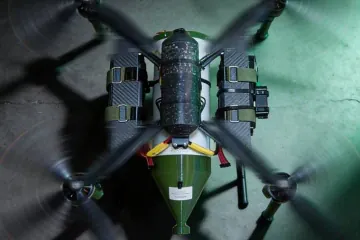
Ukraine’s defense industry builds drones capable of reaching deep inside Russia and cruise missiles carrying massive warheads—but when temperatures plunge to −20°C (−4°F), one surprisingly effective engineering solution is considerably less sophisticated: salo .
Ukrainian defense manufacturer Fire Point on October 26 revealed that extreme cold can cause frost to form on drone cameras and cables while batteries discharge significantly faster, threatening the reliability of unmanned systems operating through the winter.
We bring you stories from the ground. Your support keeps our team in the field.
One workaround is a simple layer of salo used to help shield vulnerable components from freezing conditions.
It is an unusually low-tech solution from a company responsible for some of Ukraine’s most advanced long-range weapons.
The sneaky thing about rocket science? The best solution isn’t always the most sophisticated one. Sometimes it’s salo.
— Fire Point (@FirePointUA) October 26, 2026
At around −20°C, frost can freeze drone cameras and cables and drain batteries faster. The workaround: a simple layer of salo to protect sensitive components… pic.twitter.com/ZoW4QRJw76
Fire Point manufactures the FP-1 deep-strike UAV and FP-2 strike drone, as well as the FP-5 Flamingo ground-launched cruise missile. The company is also developing the FP-7 and FP-9 ballistic missiles, with the latter designed for strikes at ranges of up to 850 kilometers.
Its FP-1 and FP-2 drones are already used extensively for strikes deep inside Russia, while the Flamingo has become another component of Ukraine’s expanding domestic long-range arsenal.
Yet battlefield engineering is not always about finding the most technologically sophisticated answer.
Choose your fighter 🔥 pic.twitter.com/b9OdK9tarS
— Fire Point (@FirePointUA) October 13, 2026
At around −20°C, preventing a camera, cable, or other exposed component from freezing can matter just as much as advanced guidance software or propulsion.
Earlier, reports emerged that Ukraine and Norway were accelerating development of the Fire Point FP-5.x FREYJA anti-ballistic missile defense program, with initial components already showing progress and the first tests targeted for the end of 2026.
Discuss this article: