- Category
- Latest news
As Orban Blames Ukraine, Russian Meddling in Hungary’s Election Happens in Plain Sight
 Prefer U24 Media on Google
- Authors

-72b63a4e0c8c475ad81fe3eed3f63729.jpeg "Photo of Cyril Barabaltchouk")
As Hungary faces a high-stakes general election on April 12, 2026, Prime Minister Viktor Orbán is relying on overt Russian support and anti-Ukrainian disinformation to maintain his grip on power, The New York Times reported on April 6.
Unlike the clandestine meddling seen in other Western elections, Moscow’s collaboration with Budapest is entirely in the open. Last month, Russian leader Vladimir Putin hosted Hungarian Foreign Minister Péter Szijjártó at the Kremlin, assuring him of continued cheap Russian energy supplies—even as the rest of the European Union sanctions Moscow over its invasion of Ukraine.
We bring you stories from the ground. Your support keeps our team in the field.
The depth of this alliance was laid bare last week when a consortium of European media released leaked audio from a 2024 phone call between Szijjártó and Russian Foreign Minister Sergey Lavrov. In the recording, Szijjártó can be heard actively working at Moscow’s request to lift EU sanctions against Gulbahor Ismailova, the sister of Kremlin-linked billionaire Alisher Usmanov. Before hanging up, the Hungarian official told Lavrov, “I am always at your disposal.”
The leak sparked outrage across Europe, with Irish Prime Minister Micheál Martin stating it confirms the Hungarian government has been “doing the bidding for Russia within the European Union for quite some time,” The New York Times wrote.
To rally his base against a surging opposition, Orbán’s ruling Fidesz party has made hostility toward Ukraine the centerpiece of its campaign. The government has plastered the country with billboards featuring sinister images of Ukrainian President Volodymyr Zelenskyy alongside opposition leader Péter Magyar. The campaign has also utilized AI-generated fake news, recently spreading fabricated photos of Ukrainian bank vehicles supposedly carrying illicit funds for Magyar’s Tisza party.
The claim was quickly debunked after the “Hungarian” police officers in the AI images were spotted wearing badges written in Cyrillic, according to The New York Times.
-1a5fcbcc996c3558ed26e0f3739360a9.jpg)
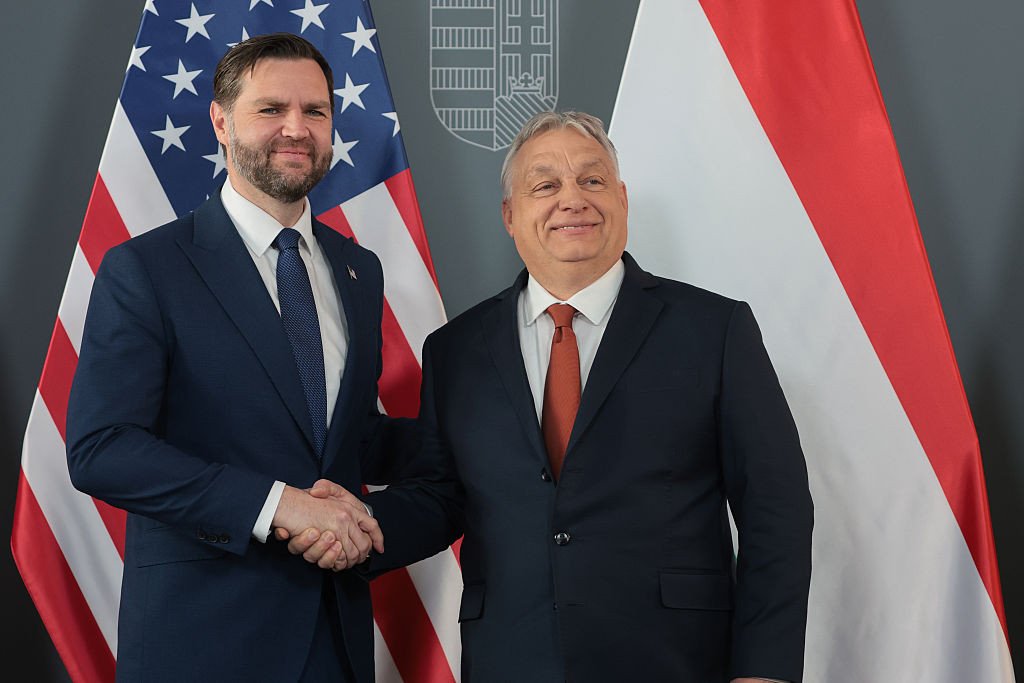
The race has drawn heavy international involvement, with US President Donald Trump offering his “complete and total endorsement” to Orbán, and Vice President JD Vance traveling to Budapest to bolster the embattled Prime Minister.
During his highly unusual visit to Budapest just days before the vote, Vance amplified the Fidesz party’s anti-Kyiv narrative by publicly accusing Ukrainian intelligence services of international election interference. Speaking alongside Orbán, Vance alleged that Ukrainian officials “conducted a campaign” with Democrats to sway the 2024 US presidential election and are now using similar tactics—including shutting down oil flows through the Druzhba pipeline—to actively interfere in Hungary’s current elections.
These explosive claims of Ukrainian meddling stand in stark contrast to the overwhelming, documented evidence of overt Russian collusion and state-sponsored disinformation specifically designed to keep Orbán in power, The Guardian wrote.
In contrast, Magyar is urging voters to remember Hungary’s long, painful history of Soviet oppression. Pointing to the 70th anniversary of the 1956 uprising, Magyar framed Sunday’s vote as a fight to keep the nation a “truly sovereign, truly free, truly independent and European country.”
Further underscoring the deep ties between Budapest and Moscow ahead of the elections, it was reported earlier that Hungary and Russia have signed a previously undisclosed 12-point plan to deepen their cooperation. Endorsed following a December 2025 meeting, the agreement lays out an extensive agenda to reverse the decline in bilateral trade caused by EU sanctions.
The sweeping plan calls for expanding Russian oil, gas, and nuclear fuel projects, and even includes proposals to import Russian teachers and cultural programs into Hungary. For the Hungarian opposition, this newly revealed pact serves as further evidence of what they call an “outright betrayal,” emphasizing the massive geopolitical liability of Viktor Orbán’s relationship with the Kremlin.
Discuss this article: