- Category
- Latest news
Berlin Confirms Sea Lynx Helicopters Will Fly On—Likely, in Ukraine
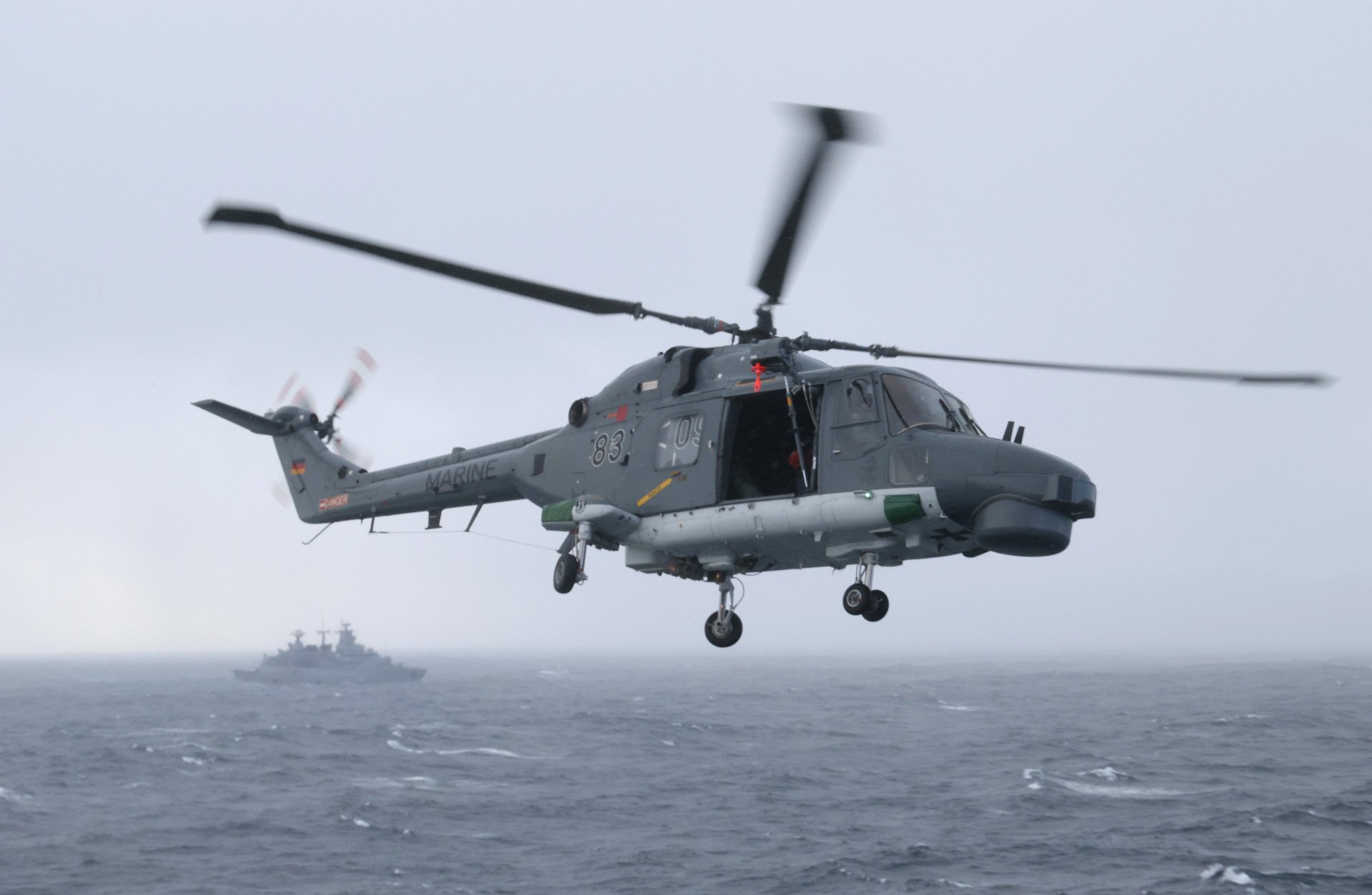
Germany may soon pass on part or all of its Sea Lynx naval helicopter fleet to Ukraine, as Berlin prepares to retire the aircraft from frontline service, according to comments by Germany’s naval aviation commander ahead of the introduction of the new NH90 Sea Tiger.
 Prefer U24 Media on Google
- Authors


Germany may transfer part or all of its remaining Sea Lynx shipborne helicopters to Ukraine as the Bundeswehr begins phasing the type out of naval service, according to Germany’s naval aviation commander, Captain Broder Nielsen, according to defense outlet Janes on December 16.
Nielsen made the remarks ahead of the handover of the first new NH90 Sea Tiger helicopter.
We bring you stories from the ground. Your support keeps our team in the field.
According to Nielsen, the 21 Sea Lynx helicopters scheduled for retirement will not be scrapped or sent to museums but will instead continue operating “elsewhere.”
When asked directly whether Ukraine could be the destination—mirroring Germany’s earlier transfer of Sea King helicopters to the Ukrainian Armed Forces—Nielsen confirmed that this was the case.
He noted that the Sea Kings have remained operational after their transfer and said the Sea Lynx could follow the same path.
Germany’s naval aviation operates a specialized maritime variant of the helicopter, the Sea Lynx Mk 88A.
First #NH90 Sea Tiger officially delivered to the German Navy. 🪖⚓️🚁. A total of 31 Sea Tigers are set to be delivered by 2030. Specifically designed for anti-surface and anti-submarine warfare missions, they will replace the Mk88A Sea Lynx fleet which entered service in 1981. https://t.co/K8qrvvXhjb pic.twitter.com/lmdmGS49ob
— Airbus Helicopters (@AirbusHeli) December 16, 2025
Service history in the German Navy
According to Ukrainian defense outlet Militarnyi, within the German Navy, Sea Lynx helicopters were primarily assigned to shipborne aviation units. They were operated by naval air squadrons later designated Marinefliegergeschwader 5 (MFG 5) and Marinefliegergeschwader 3 (MFG 3), which were responsible for crew training and operational deployment.
The helicopters were routinely embarked aboard Bremen-class (F122), Brandenburg-class (F123), and later Sachsen-class (F124) frigates, forming a core element of German naval aviation for decades.
Lynx helicopter landing on ship in rough 🌊 sea and windy day!!!#Rotary_wing #Helicopter_daily pic.twitter.com/wWLak7prhE
— Rotarywing (@Rotarywings1) October 17, 2017
Sea Lynx operations in the German Navy continued into the mid-2020s. The formal decision to retire the type was linked to the introduction of the NH90 Sea Tiger, which is replacing the Sea Lynx in the maritime role.
On December 17, 2025, Airbus Helicopters delivered the first NH90 Sea Tiger multirole maritime helicopter to the German Navy.
Capabilities of the Sea Lynx Mk 88A
The Sea Lynx Mk 88 is powered by two Rolls-Royce Gem 42-1 turboshaft engines, each producing approximately 900 to 1,000 horsepower, Militarnyi noted. The twin-engine configuration provides high reliability for over-water operations and allows continued flight in the event of a single-engine failure, meeting NATO standards for shipborne aviation.
The helicopter has a maximum takeoff weight of about 5.3 metric tons and an empty weight of roughly 3.3 to 3.5 tons, depending on configuration.
Its compact dimensions—around 15.2 meters in fuselage length with a 12.8-meter main rotor diameter—allow it to operate from standard naval frigate hangars. Both the rotor blades and tail boom can be folded for shipboard storage.
Indian Navy's frontline frigate INS Tabar conducted a Maritime Partnership Exercise (MPX) with German Navy's Sea Lynx helicopter off the Kiel Canal in North Sea. pic.twitter.com/IUWE6GWkyN
— Dillip Mahapatra🇮🇳 (@dillipmahapatra) August 7, 2024
One of the Sea Lynx’s standout features is its speed. With a maximum speed exceeding 320 km/h (about 200 mph), it ranks among the fastest production helicopters of its era. Cruising speed ranges from roughly 250 to 270 km/h, while the operational range is approximately 500 to 550 km.
Combat radius typically falls between 200 and 250 km, depending on mission profile and payload. Service ceiling is estimated at 3,000 to 3,500 meters.
The Mk 88A variant is equipped with a suite of maritime sensors enabling autonomous operations. These include a Seaspray surface-search radar for detecting ships and navigating in poor conditions, as well as antisubmarine warfare systems such as a dipping sonar and the ability to deploy sonobuoys.
The upgraded Mk 88A also integrates a thermal imaging system, significantly enhancing night-time and low-visibility operations.
Weapons and mission flexibility
Militarnyi added that Sea Lynx armament is modular and tailored to mission requirements. In an antisubmarine configuration, the helicopter can carry up to two NATO-standard lightweight torpedoes, such as the Mk 46 or MU90.
For surface warfare, the platform can be equipped with Sea Skua light anti-ship missiles, enabling engagements against small and medium-displacement vessels beyond the range of shipboard guns. For self-defense or support of boarding operations, door-mounted or forward-firing heavy machine guns can also be installed.
Naval Jack of German Navy and Westland Sea Lynx Mk.88A anti-submarine helicopter. pic.twitter.com/xZi8qzgfqJ
— Kanaan Ahmed (@KanaanAhmed5) January 5, 2025
If transferred, the Sea Lynx would represent a capable and well-proven maritime aviation asset for Ukraine, particularly given Germany’s precedent with Sea King helicopters and the continued operational life of the type despite its retirement from German service.
Earlier, reports emerged that Australia was evaluating a Ukrainian request for the transfer of its retiring fleet of Tiger Armed Reconnaissance Helicopters as it prepares a new package of military aid for Kyiv.
Discuss this article:


-c439b7bd9030ecf9d5a4287dc361ba31.jpg "Photo of Katherina Popilnichenko")