- Category
- Latest news
Russia Deploys the Knyaz Pozharsky, a New Nuclear Submarine Built to Slip Past NATO Defenses
 Prefer U24 Media on Google
- Authors


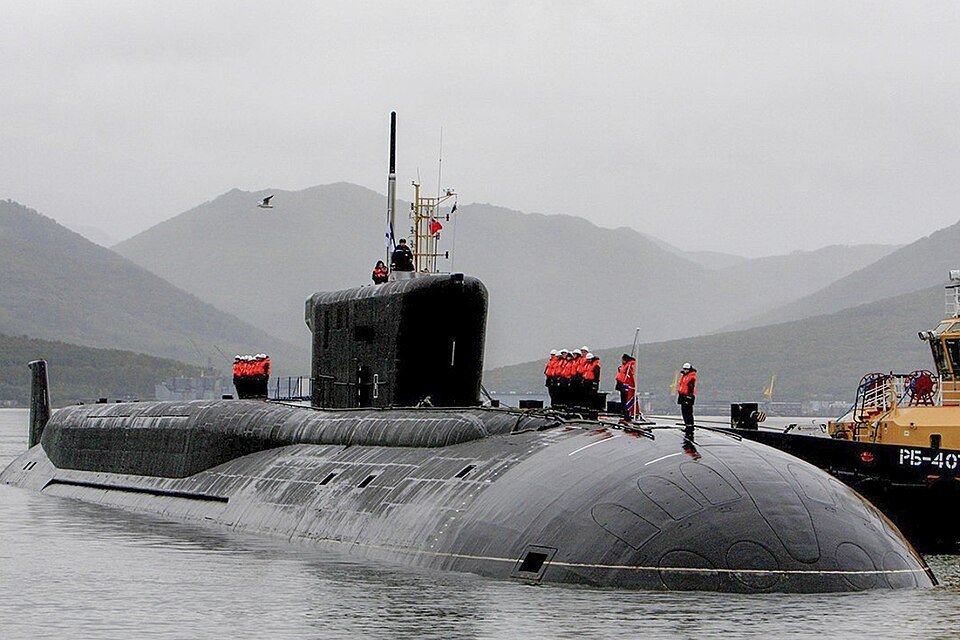
On July 24, 2025, the Russian Navy officially commissioned the Knyaz Pozharsky, a Project 955A Borei-A class nuclear-powered ballistic missile submarine.
The flag-raising ceremony, attended by Vladimir Putin, marked the vessel’s entry into operational service and highlighted Moscow’s continued investment in strategic naval assets.
According to Army Recognition on July 25, Knyaz Pozharsky is the seventh submarine in the Borei series and part of the improved Borei-A class. It features upgraded stealth, enhanced survivability, and increased missile capacity, forming a core component of Russia’s sea-based nuclear deterrent.
The Borei-A class represents a modernized evolution of the original Borei design, incorporating advanced sonar, quieter propulsion, and improved hull hydrodynamics. Each submarine carries 16 RSM-56 Bulava submarine-launched ballistic missiles, each capable of delivering multiple independently targetable nuclear warheads.

In addition to strategic payloads, the submarine is armed with 533-mm torpedo tubes, RPK-2 Viyuga anti-submarine missiles, and the REPS-324 Shlagbaum system for launching anti-torpedo countermeasures.
Knyaz Pozharsky will reportedly serve under Russia’s Northern Fleet, operating primarily in the Arctic and Atlantic regions in accordance with Russia’s maritime strategy.
During the commissioning event, Putin announced plans to deploy six additional nuclear submarines by 2030. These submarines will be equipped with Poseidon, an unmanned nuclear-powered underwater vehicle.
First revealed in 2015 and designated Status-6 by NATO, Poseidon is designed for strategic deterrence with a reported range of 10,000 kilometers and a top speed of up to 100 knots. The system operates at depths of up to 1,000 meters and is powered by a miniature nuclear reactor.
Its payload is estimated to be several megatons, with some reports suggesting up to 100 megatons.
-9e8153966a6e91f02831add015d29413.png)
Presidential aide and chairman of the Russian Maritime Board, Nikolai Patrushev, confirmed that a long-term naval development plan covering 2025–2050 is in progress and will be submitted to Putin for approval in September. The strategy will prioritize second-strike survivability, strategic deterrence, and advanced underwater capabilities.
As of mid-2025, the Russian Navy operates 79 submarines, including 54 nuclear-powered vessels. These include 14 nuclear-powered ballistic missile submarines—8 Borei-class and 6 Delta-class units—alongside 13 nuclear-powered guided missile submarines and 16 nuclear attack submarines.
The fleet also includes 10 special mission submarines and one dedicated special-purpose submarine. The conventional force consists of 25 diesel-electric submarines, comprising Kilo, Improved Kilo, and Lada classes.

By comparison, the United States Navy operates 71 nuclear-powered submarines, including 14 Ohio-class ballistic missile submarines and approximately 53 fast-attack submarines.
US strategic submarines carry Trident II D5 missiles and maintain a larger deployed warhead stockpile than Russia, with an estimated 4,032 submarine-launched warheads compared to Russia’s 1,648.
Earlier, on July 2, the Royal Navy tracked the surfaced Russian Kilo-class submarine Novorossiysk as it transited the North Sea and English Channel, escorted by the tug Yakov Grebelski.
The move, monitored by HMS Mersey and Royal Navy helicopters, was seen as a deliberate show of force near NATO maritime infrastructure.
Discuss this article:


-c439b7bd9030ecf9d5a4287dc361ba31.jpg "Photo of Katherina Popilnichenko")