- Category
- Latest news
Too Little, Too Late? Russia Launches 16 Satellites to Rival Starlink’s Thousands-Strong Constellation
 Prefer U24 Media on Google
- Authors


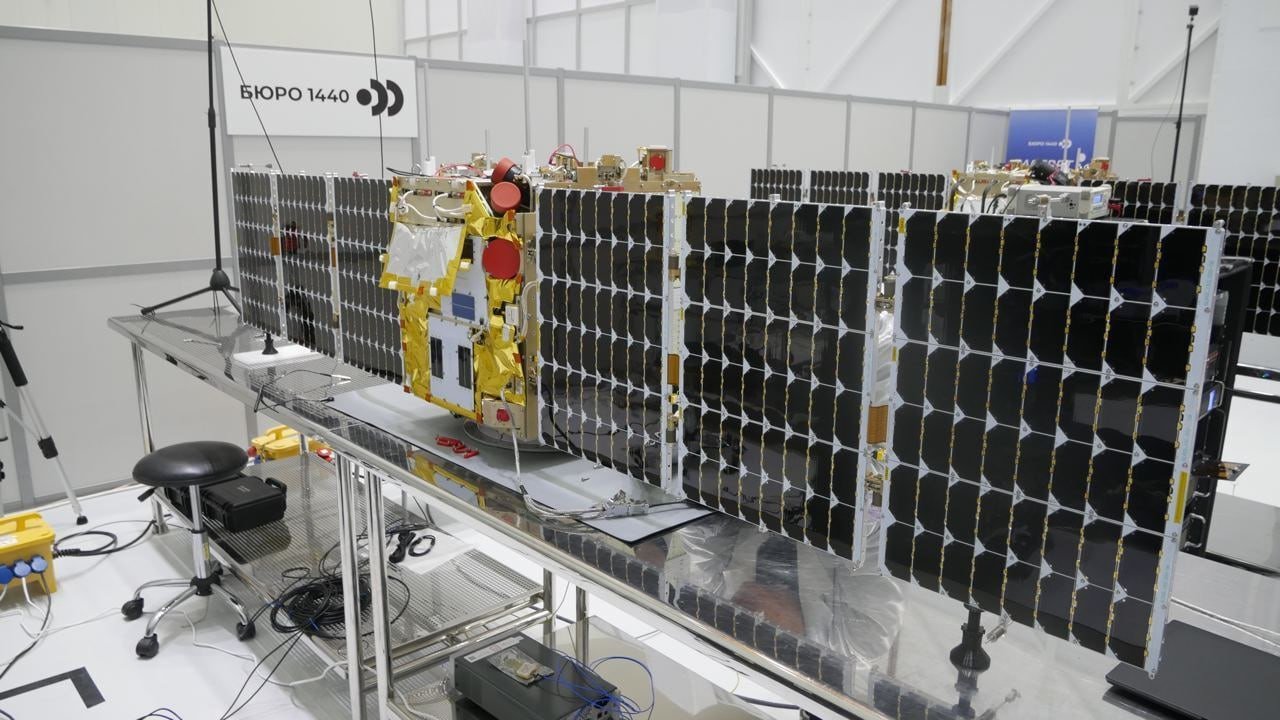
Russia has launched the first batch of satellites for its “Rassvet” broadband internet system, a project widely described as a domestic alternative to Elon Musk’s Starlink—with growing indications it may serve military needs, according to Russian aerospace company Bureau 1440 on March 24.
The launch took place late on March 23, when 16 company-developed satellites were sent into orbit.
We bring you stories from the ground. Your support keeps our team in the field.
According to the company, all spacecraft successfully separated from the launch vehicle and were taken under control by mission operators.
The deployment marks the first time serial production satellites—rather than experimental units—have been placed into orbit as part of the program.
“Launch of the first spacecraft of the target constellation marks the transition from experiments to building a communications service,” the company said in a statement. It added that dozens more launches and hundreds of satellites will be required to achieve global coverage.
Orbital launch no. 65 of 2026 🇷🇺🚀16🛰️
— Space Intelligence (@SpaceIntel101) March 24, 2026
Rassvet | Roscosmos | March 23 | 2024 UTC@Roscosmos successfully launched the first 16 Rassvet comm🛰️ on its Soyuz 2.1b from Plesetsk Cosmodrome Site 43 for Bureau 1440's Starlink-like comm constellation.
The footage shows the payload… pic.twitter.com/wMTSSKpFvF
Despite the milestone, experts say the current deployment is far from sufficient to compete with Starlink, which operates thousands of satellites.
Space analyst Vitaly Egorov noted that while the project was initially intended for civilian use—such as providing connectivity for airlines and rail networks—its strategic value has shifted.
Following restrictions on Russian military access to Starlink, the need for a domestic satellite communications network has become more urgent, he said. However, Egorov added that replacing Starlink would require significantly more launches, as well as the development and mass production of affordable ground terminals.
The actual Soyuz launch placed 16 new Rassvet 3s into orbit after the previous test satellites, Rassvet 1 and 2, in 2021.
— Space Intelligence (@SpaceIntel101) March 24, 2026
Like the US Starlink or Chinese Guowang constellation, it will provide internet connection from Low Earth Orbit. pic.twitter.com/ObZ2HYqrZT
The Rassvet program has been in development since at least 2023, with earlier launches conducted from Russia’s Vostochny Cosmodrome. Authorities previously stated the system could begin providing nationwide broadband coverage by 2027, though timelines have already slipped due to production delays.
Pro-government commentators have increasingly emphasized the project’s military importance, particularly after Russian forces lost access to Starlink services earlier this year.
At the time, some noted that even a limited satellite constellation could allow initial testing of a domestic system, though it would not yet meet operational demands.
The ruSSian analogue of “Starlink,” the “Rassvet” project by Bureau 1440.
— 𝔗𝔥𝔢 𝕯𝔢𝔞𝔡 𝕯𝔦𝔰𝔱𝔯𝔦𝔠𝔱△ 🇬🇪🇺🇦🇺🇲🇬🇷 (@TheDeadDistrict) February 1, 2026
According to the stated plans, the launch of the 1st 16 low-Earth-orbit broadband internet satellites was supposed to take place back in 2025, but this did not happen. The launch has been postponed to
1/ pic.twitter.com/pSU4bOSH2T
Starlink-style internet connection proved to be essential for multiple Russian units. Previously, following a Russian account deactivation, reports emerged that Russian artillery operations in Ukraine have been hindered by a loss of reliable communications.
Earlier, Ukraine’s Minister of Defense, Mykhailo Fedorov, revealed that the deactivation of Russian Starlink terminals has significantly reduced Russia’s military activities, with the number of Russian military streaming operations decreasing by 11 times.
Fedorov emphasized that Ukraine had effectively “cut off Russia’s communication” by disabling the Starlink terminals, leading to increased interception of radio transmissions.
This move was a response to the Russian army’s use of Starlink terminals for drone control and general communications, which had become a critical tool for their military operations.
Discuss this article:
-9a7b3a98ed5c506e0b77a6663f5727c5.png)