- Category
- Latest news
Ukraine Blows Apart Key Russian Tunguska Short-Range Air Defence, Video
 Prefer U24 Media on Google
- Authors



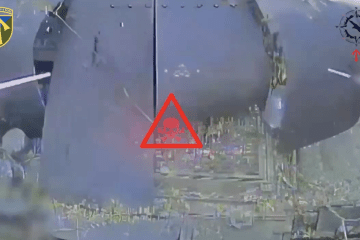
A Ukrainian drone bomber operated by Marine Corps units has destroyed a Russian 2S6 Tunguska self-propelled anti-aircraft gun-missile system, according to combat footage published by the military-affiliated Telegram channel “Nikolaevskiy Vanyok” on December 14.
The strike was carried out by fighters from Lasar’s Group, a unit of Ukraine’s National Guard, with support from the Venom 34th Unmanned Systems Center of the 39th Separate Coastal Defense Brigade under the 30th Marine Corps.
We bring you stories from the ground. Your support keeps our team in the field.
Video footage shows a Ukrainian drone dropping a powerful munition directly onto the front section of the Tunguska combat vehicle, triggering a large explosion. A second munition then struck the turret area, with visible secondary detonations—likely involving the air defense missiles mounted on the launcher.
As a result of the attack, the Russian air defense system was destroyed. The estimated cost per unit is believed to be $15 million.
🔥🇷🇺Russian 2S6 «Tunguska» anti-aircraft missile and gun complex gets destroyed by the 🇺🇦Lasar’s Group with bomber drone on the left bank of the Kherson region pic.twitter.com/UczLo7an82
— Cloooud |🇺🇦 (@GloOouD) December 14, 2025
Ukrainian defense outlet Militarnyi notes that the 2S6 Tunguska is considered a relatively rare target in the Russia–Ukraine war. According to the open-source tracking project Oryx, at least 11 Tunguska systems have been destroyed, three damaged, and one captured since the start of the full-scale invasion.
By comparison, Russia has lost at least 29 Pantsir-S1 air defense systems destroyed, with several more damaged and two captured.
Ukrainian 2S6 Tunguska, December 2022 pic.twitter.com/AkbLZSzM7M
— War Diary (@WarDiaryOffi) March 9, 2025
The 2S6 Tunguska was designed to protect mechanized and armored units on the move and during combat, combining surface-to-air missiles and rapid-fire cannons into a single platform. Unlike many missile-only systems, Tunguska was built to eliminate “dead zones” by engaging targets first with missiles and then with guns.
The system is armed with two twin-barreled 2A38 30mm automatic cannons, capable of firing 4,000–5,000 rounds per minute, and 9M311 surface-to-air missiles with an engagement range of up to 8 kilometers and altitudes of up to 3.5 kilometers. Cannon fire can engage targets at distances of up to 4 kilometers and altitudes of 3 kilometers, even while the vehicle is moving.
2S6 Tunguska Operator Panel pic.twitter.com/aX1CABFQNl
— SAБOT (@sabotpetal) January 13, 2023
Tunguska is equipped with a computerized fire-control system, laser rangefinder, “friend-or-foe” identification, onboard navigation, and both search and tracking radars, detecting aerial targets at distances of up to 18 kilometers. Its overall reaction time—from detection to engagement—is estimated at 6–8 seconds.
In layout and concept, the system closely resembles Germany’s Gepard self-propelled anti-aircraft gun, with a radar mounted at the rear of the turret and missile launchers and cannons arranged on either side.
Anti-Aircraft Defense Battalion of Ukrainian 72nd Mechanized Infantry Brigade in 2020 - 2S6 "Tunguska" and Strela-10 short-range SPAAG/SAM systems can be seen in service. pic.twitter.com/QONNDCohEP
— B-AREV (@trip_to_valkiri) July 16, 2024
Earlier, Ukraine’s Security Service released footage showing the destruction of a Russian Mi-26 heavy transport helicopter—a loss made more significant by the fact that Moscow is no longer able to manufacture new models of the aircraft due to engine supply shortages.
It is the first verified destruction of a Mi-26 during the war.
Discuss this article:


-111f0e5095e02c02446ffed57bfb0ab1.jpeg "Photo of Roman Kohanets")

-7647a088f8ed2b81f52ab779f3a93cd0.png "Equipment and personal gear belonging to Ukrainian troops from the 425th Separate Assault Regiment “Skelya” are transported on a small wagon through an underground gas pipeline near Kupiansk. (Source: 425th Separate Assault Regiment “Skelya”)")
-72b63a4e0c8c475ad81fe3eed3f63729.jpeg "Photo of Cyril Barabaltchouk")