- Category
- Latest news
Ukraine’s Drones Prove America’s $175B Golden Dome Isn’t Enough. Here’s Why
 Prefer U24 Media on Google
- Authors



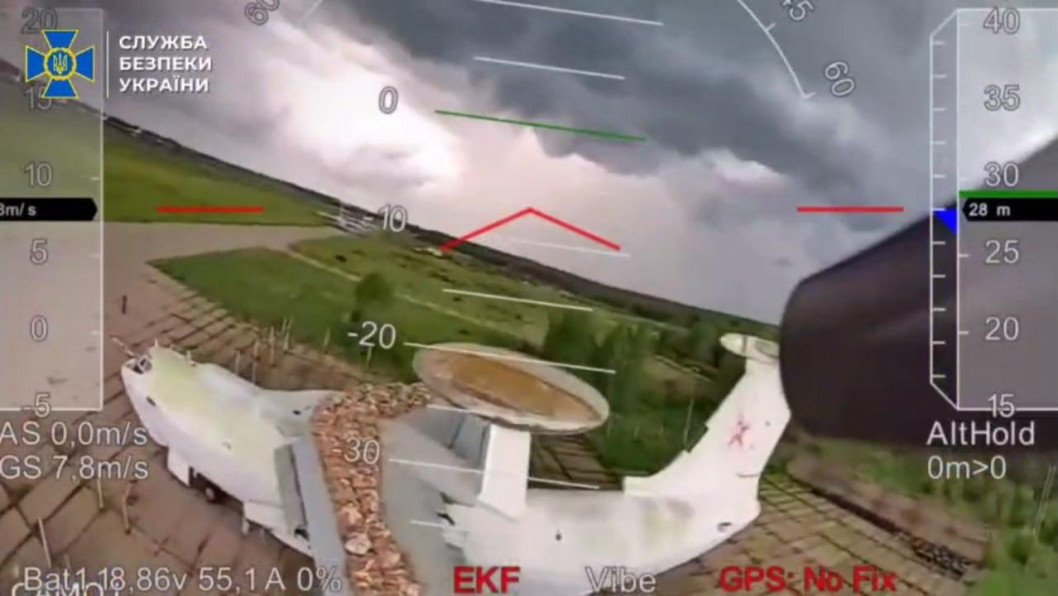
Ukraine’s June drone attack on Russian air bases, known as Operation Spiderweb, is prompting the United States to reassess how it protects its own military assets and territory.
The operation used small explosive-laden drones launched from inside Russia to disable and destroy unprotected Tu-160, Tu-95MS, and Tu-22M3 strategic bombers parked on airfields.
According to Air and Space Forces Magazine on August 7, the attack has influenced discussions on the design of the US “Golden Dome” missile defense project, valued at $175 billion, as well as broader homeland defense strategies.
-04df4aadbcb4826e9e7fd30da33613f4.jpg)
Analysts note that while previous US planning focused on threats from cruise and hypersonic missiles, the operation underscored the need to also address low-cost unmanned aerial systems (UAS) and other short-range attacks that can bypass traditional defenses.
Doug Jones, chief technology officer for Leidos’ Defense Sector, said the strike demonstrated how small UAS, moved covertly near a target, can compensate for their limited range and evade early detection.
He added that future systems must protect not only against long-range missile threats but also safeguard the radars, missile batteries, and other assets critical for intercepting such threats.
Leidos, which may receive between $4 billion and $5 billion in Golden Dome-related contracts, is exploring automated decision-making tools to optimize the use of defensive systems.
Under this approach, high-value interceptors such as Patriot and THAAD would be reserved for hypersonic and ballistic missiles, while other systems would counter cruise missiles, and short-range air defenses would engage drones and low-cost weapons.
The company is also working on both lower-cost offensive systems—such as cruise missiles priced around $300,000 and tactical hypersonic missiles under $10 million—and affordable defensive solutions to address the growing challenge of “mass” low-end threats.
Jones noted that conflicts in regions such as the Red Sea have shown the high cost of using expensive interceptors against inexpensive weapons, highlighting the need for layered and cost-effective defense strategies.
Earlier, The Wall Street Journal reported that with US drone startups struggling to meet battlefield needs, the Pentagon is partnering with Ukrainian manufacturers whose low-cost, battle-tested drones have proven effective against Russian forces, marking the first time a Ukrainian drone maker has been approved to supply technology for the US military.
Discuss this article:


-c439b7bd9030ecf9d5a4287dc361ba31.jpg "Photo of Katherina Popilnichenko")