- Category
- War in Ukraine
Unidentified Explosive Drone Detonates Near Key Gas Route Supplying Ukraine in Bulgaria
 Prefer U24 Media on Google
- Authors



An unidentified drone carrying explosives entered Bulgarian airspace from Romania and detonated near the Trans-Balkan gas pipeline, a route used to transport natural gas north toward Ukraine.
We bring you stories from the ground. Your support keeps our team in the field.
According to the Associated Press on August 8, citing Bulgarian Prime Minister Rumen Radev, the drone exploded shortly after 5 a.m. about 100 meters inside Bulgarian territory after crossing the border from Romania. No casualties or damage to buildings were reported.
The explosion occurred approximately 1 kilometer—about 0.6 miles—from a Bulgarian compressor station on the Trans-Balkan pipeline and roughly 200 meters from a Romanian compressor facility, Prime Minister Rumen Radev said. The area was cordoned off while military specialists examined the wreckage to determine the drone’s type and origin.
“There are no casualties or damage to buildings. The area has been cordoned off. We continue to monitor the situation,” Radev said following an emergency government meeting, according to the Associated Press.
Bulgarian National Radio reported that Romanian border officers first heard the drone’s engine before Bulgarian personnel near the border heard a powerful explosion. The aircraft crashed in a sunflower field and produced black smoke. Radev said the drone was larger than a recreational model and appeared to have carried a substantial explosive payload.
Neither Romanian nor Bulgarian monitoring systems detected the drone while it was airborne. Radev said Bulgaria had also received no warning from NATO's Combined Air Operations Centre responsible for monitoring airspace over southern Europe. He attributed the detection difficulty to the aircraft’s small dimensions and low-altitude flight profile.
Bulgarian authorities said surveillance around strategic infrastructure and along the Romanian border would be reinforced following the incident. Radev also announced that Border Police counter-drone detection and response capabilities would be redeployed toward the border with Romania. Bulgaria’s Defense Minister Dimitar Stoyanov said the incident would be raised at a meeting of NATO's North Atlantic Council early next week, according to AP.
The origin of the drone remains unknown, and Bulgarian authorities have not established whether it was connected to Russia or Ukraine. Specialists from the Defense Ministry are continuing to examine the wreckage.
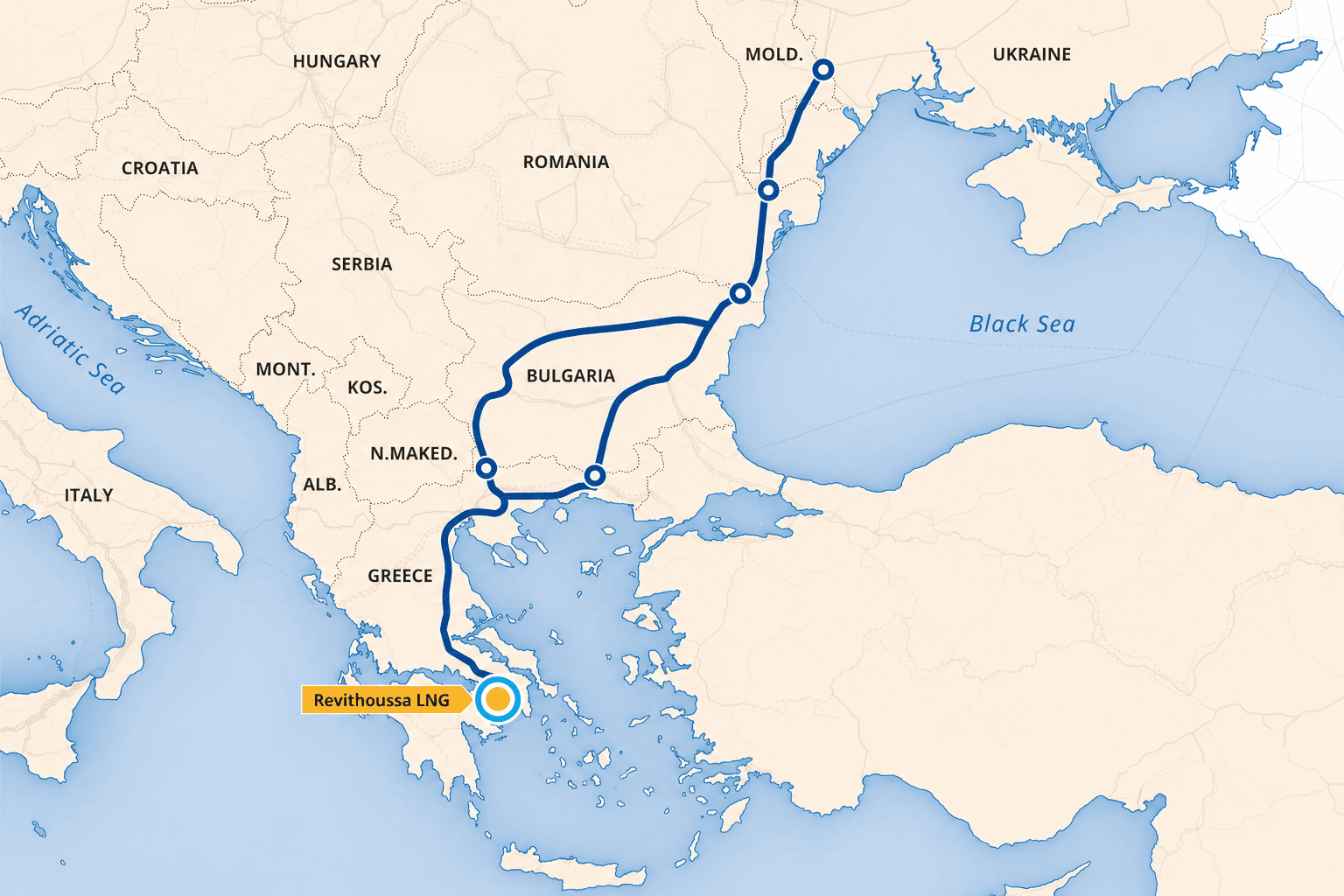
The Trans-Balkan pipeline was originally designed to carry Russian gas southward through Ukraine, Moldova, Romania, and Bulgaria toward Turkey. The infrastructure is now increasingly being used in reverse as part of efforts to bring alternative gas supplies from southeastern Europe toward Moldova and Ukraine.

In July 2025, Ukraine’s state energy company Naftogaz signed its first agreement to purchase Azerbaijani gas from SOCAR Energy Ukraine, with the first test shipment delivered through the Trans-Balkan corridor along the Bulgaria–Romania–Ukraine route.
The route has since become part of broader efforts by gas transmission operators in Greece, Bulgaria, Romania, Moldova, and Ukraine to expand south-to-north supplies. In March 2026, the operators reached an agreement with the European Commission on measures aimed at improving commercial use of the Trans-Balkan Pipeline and Vertical Corridor.
The Bulgarian incident also comes less than two weeks after Romanian fighter jets shot down three drones during a series of airspace violations. Romanian authorities identified the first of those aircraft as a Shahed-type drone used by Russia in its war against Ukraine, while investigations into the others continued.
Discuss this article:
-9a7b3a98ed5c506e0b77a6663f5727c5.png)

-c439b7bd9030ecf9d5a4287dc361ba31.jpg "Photo of Katherina Popilnichenko")



-72b63a4e0c8c475ad81fe3eed3f63729.jpeg "Photo of Cyril Barabaltchouk")