- Category
- World
China Counters US-Philippine Drills With Bomber Flights and Naval Deployment
 Prefer U24 Media on Google
- Authors


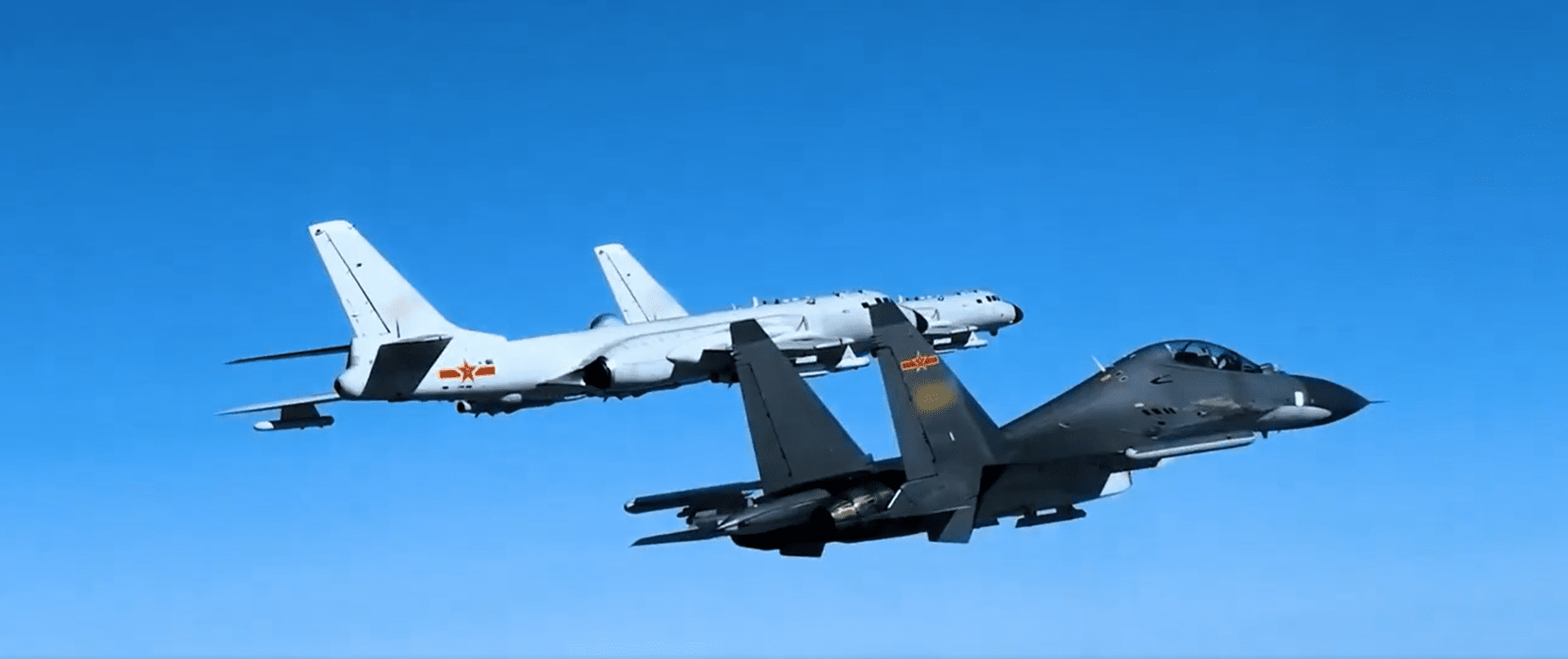
China deployed heavily armed bombers, fighter jets, and naval vessels over and around a disputed South China Sea shoal, signaling a show of force as the United States and the Philippines conducted their largest joint military exercises to date, according to Naval News on May 5.
Two H-6 anti-ship bombers, escorted by J-16 fighter jets, flew over the Scarborough Shoal during a combat readiness drill carried out by the People’s Liberation Army’s Southern Theater Command.
We bring you stories from the ground. Your support keeps our team in the field.
Chinese military officials described the patrol as a response to what they called “provocative acts” in the region.
“These patrols serve as an effective countermeasure to cope with all sorts of rights-violation and provocative acts,” the command said in a statement.
On April 30, 2026, the navy and air force troops assigned to the Chinese PLA Southern Theater Command (#STC) conducted combat readiness patrols in the territorial sea and airspace of China’s Huangyan Dao and its surrounding areas.
— China Military Bugle (@ChinaMilBugle) April 30, 2026
Huangyan Dao is an inherent part of China’s… pic.twitter.com/vjM9AGxiMc
The exercise also included multiple surface vessels, among them two Type 054A frigates, a Type 056A corvette, and additional air assets. One of the J-16 fighters was observed carrying a YJ-91 missile, a Chinese-developed derivative of the Russian Kh-31 capable of striking ships or radar systems.
While such bomber patrols are not unusual over the disputed waters, the scale and firepower of the deployment drew attention, particularly as it coincided with the ongoing Balikatan exercises.
This year’s drills involve around 17,000 personnel from the United States, the Philippines, and several partner nations, including Japan, Australia, and Canada.
U.S. Soldiers assigned to 25th Infantry Division Artillery, fire a High Mobility Artillery Rocket System during a counter-landing live-fire exercise as part of Exercise Balikatan 2026 at La Paz Sand Dunes, Laoag City, Philippines.
— U.S. Indo-Pacific Command (@INDOPACOM) May 5, 2026
Balikatan is a longstanding annual exercise… pic.twitter.com/EKdTO7pYsQ
The exercises focus heavily on maritime strike operations and coordinated defense scenarios, with Japan participating at a higher level than in previous years.
A multinational naval formation operating off northern Luzon—comprising 11 ships from allied nations—was closely monitored by Chinese warships, including a Type 815 reconnaissance vessel, according to Naval News.
Beijing has increasingly expanded its presence during these drills. The Chinese aircraft carrier Liaoning has been operating in the South China Sea since the exercises began, while additional surface groups have conducted live-fire drills east of Luzon.
JUST IN; CHINA Deploys World’s First Drone Carrier Warship on Maiden South China Sea Mission.
— Global Surveillance (@Globalsurv) April 25, 2026
The Chinese People’s Liberation Army (PLA) Navy has deployed its first warship built primarily to deploy unmanned aircraft, the Type 076 class aircraft carrier Sichuan, for its first… pic.twitter.com/mt1e514HfG
One such formation, led by a Type 055 guided-missile destroyer, carried out exercises in an area that could threaten reinforcement routes used by US and Philippine forces in the event of a conflict, Naval News added.
The drills reflect a broader shift in regional military planning, with increasing emphasis on defending northern Philippine territories near Taiwan.
Chinese officials have criticized these developments, accusing Manila of allowing foreign powers to establish positions close to sensitive areas.
Earlier, a sharp escalation unfolded in the South China Sea near the disputed Scarborough Shoal, where Chinese vessels confronted Filipino fishing boats, prompting a rapid response from Philippine authorities.
Discuss this article:



-c439b7bd9030ecf9d5a4287dc361ba31.jpg "Photo of Katherina Popilnichenko")