- Category
- World
NATO Just Showed Russia Its F-35s Don’t Need a Proper Runway
 Prefer U24 Media on Google
- Authors


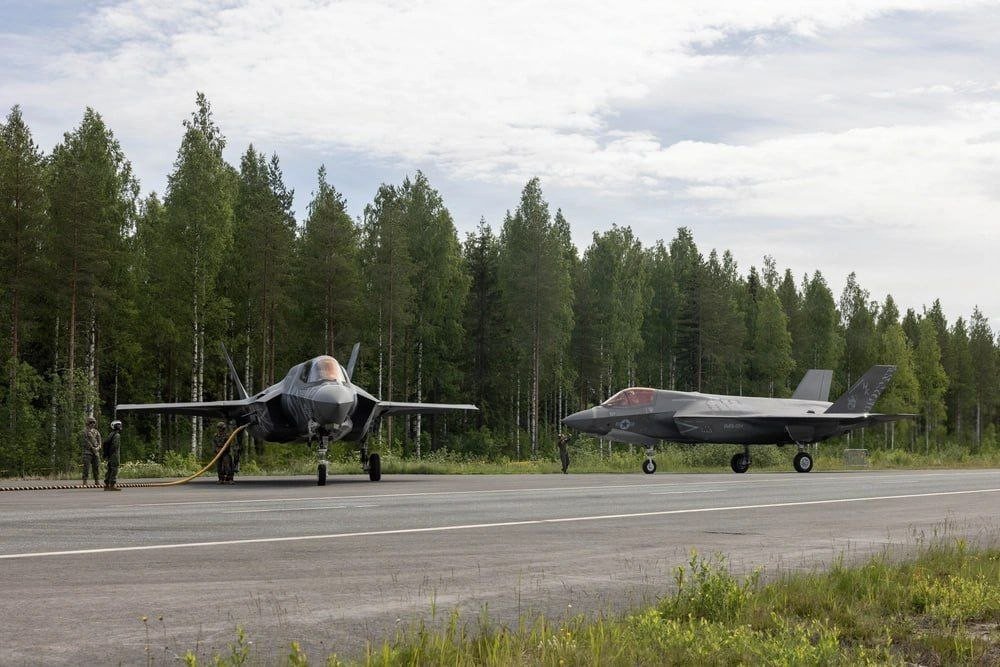
US Marine Corps F-35B stealth fighters operated from a Finnish highway for the first time during NATO’s Ramstein Flag 2026 exercise, according to Army Recognition on June 22.
Two F-35B Lightning II jets from Marine Fighter Attack Squadron 224, Marine Aircraft Group 31, 2nd Marine Aircraft Wing, conducted landing and takeoff operations from a highway strip in Tervo, Finland.
We bring you stories from the ground. Your support keeps our team in the field.
The operation took place during the June 8–12 exercise, which involved 19 nations and more than 15 operating locations.
According to Army Recognition, the highway landing was not just a dramatic visual of fifth-generation jets using a road as a runway. It was a test of how NATO aircraft could keep flying in a high-intensity war if large air bases came under attack.
History made on the highway
— U.S. Marine Corps Forces Europe & Africa (@USMCFEA) June 19, 2026
For the first time, U.S. Marine Corps F-35Bs have transformed a public highway in Finland into a fully operational airstrip. This is Agile Combat Employment—a critical capability that proves our Alliance can project lethal combat power from anywhere. pic.twitter.com/shTiP5kcsd
That matters because fixed air bases would be obvious targets in any major confrontation with Russia. Runways, fuel depots, shelters, command posts, and air defense nodes could all be hit early by missiles, drones, electronic warfare, cyberattacks, or sabotage.
The answer NATO is practicing is dispersed air warfare. Instead of keeping aircraft at a few predictable bases, the alliance is training to spread jets, crews, fuel, maintenance teams, weapons, and command links across temporary operating sites.
Ramstein Flag 26 ‒ Tervo highway strip 🛬
— Ilmavoimat (@FinnishAirForce) June 15, 2026
During the first week of Ramstein Flag 26, the U.S. Marine Corps & the Polish and Spanish air forces operated fighter jets from a Finnish highway strip for the first time. 🇫🇮🇺🇸🇵🇱🇪🇸#ilmavoimat #RamsteinFlag pic.twitter.com/Fe0lmWWUr4
Army Recognition noted that this approach forces an adversary to solve a much harder targeting problem. If aircraft can move between highways, smaller airfields, and temporary forward sites, Russia would need to find and strike a larger, more fluid network rather than a handful of known bases.
The F-35B is especially suited for this kind of operation because of its short takeoff and vertical landing capability. Unlike the F-35A, which Finland selected for its future fighter fleet, the F-35B was built to operate from amphibious assault ships, expeditionary bases, and shorter surfaces where full runways may not be available.
But the operation was not only about the jet. Army Recognition emphasized that highway-based airpower depends on the full support chain around it. Marine Wing Support Squadron 272 provided forward arming and refueling support, showing that fuel, maintenance, ground handling, communications, security, and rapid relocation are what turn a road into a temporary combat airfield.
Ramstein Flag 26 provides Allies with an opportunity to learn about the Finnish Air Force's dispersed operations.
— Ilmavoimat (@FinnishAirForce) June 9, 2026
The U.S. Marine Corps as well as the Polish and Spanish air forces are operating from a Finnish highway strip for the first time. 🇫🇮🇺🇸🇵🇱🇪🇸#ilmavoimat #RamsteinFlag pic.twitter.com/ngeYKgwgCS
Finland was a natural place to test the concept. Because of its geography and proximity to Russia, Finland has long trained to disperse aircraft across road strips and alternate bases. After joining NATO, that experience became part of the alliance’s northern defense posture.
The exercise also showed that the idea is broader than one aircraft or one country. Spanish F-18s and Polish F-16s also took part in similar Finnish roadway operations, pointing to a wider NATO push to make allied airpower harder to suppress.
Command and control remained central to the drill. During Ramstein Flag 2026, the Combined Air Operations Center in Bodø, Norway, helped coordinate air activity, highway operations, and deep-strike scenarios. Dispersed aircraft may be physically separated, but they still need to receive tasking, share data, avoid friendly-fire risks, and operate inside NATO’s wider air campaign.
For the first time ever, @ItalianAirForce F-35B fighters landed on a Finnish road base! 🇫🇮🤝🇮🇹
— NATO (@NATO) June 7, 2026
During an exercise in Jokioinen, the @FinnishAirForce teamed up with the Italian jets to conduct short and touch-and-go landings and takeoffs pic.twitter.com/H79jY22eK4
The maneuver also exposed the limits of the concept. A fifth-generation fighter cannot simply land on any road. Surface quality, road width, debris, fuel access, communications, local security, weather, and emergency recovery options all matter. F-35B vertical or short-takeoff profiles can also affect fuel, payload, and sortie generation.
Earlier, Finland’s parliament voted to lift the country’s ban on nuclear weapons on its territory. a shift toward firmer deterrence against Russia as it deepens its integration with NATO.
Discuss this article:
-9a7b3a98ed5c506e0b77a6663f5727c5.png)


-c439b7bd9030ecf9d5a4287dc361ba31.jpg "Photo of Katherina Popilnichenko")