- Category
- World
Russia Is Repeatedly Striking Ukraine’s Borders With Moldova and NATO Countries. Here’s What’s Happening

Russia’s attacks on Ukraine’s borders are expanding. On September 13, a Russian drone struck a Kyiv-Warsaw passenger train just two kilometers from Poland, days after deadly strikes near the border with Moldova. What began as isolated attacks on border infrastructure is becoming a recurring threat along Ukraine’s borders with Europe.
 Prefer U24 Media on Google
- Authors

-29a1a43aba23f9bb779a1ac8b98d2121.jpeg "Photo of Illia Kabachynskyi")
Editor’s note: This article was updated to include a Russian drone strike on a Kyiv-Warsaw passenger train and infrastructure near the Ukraine-Poland border.
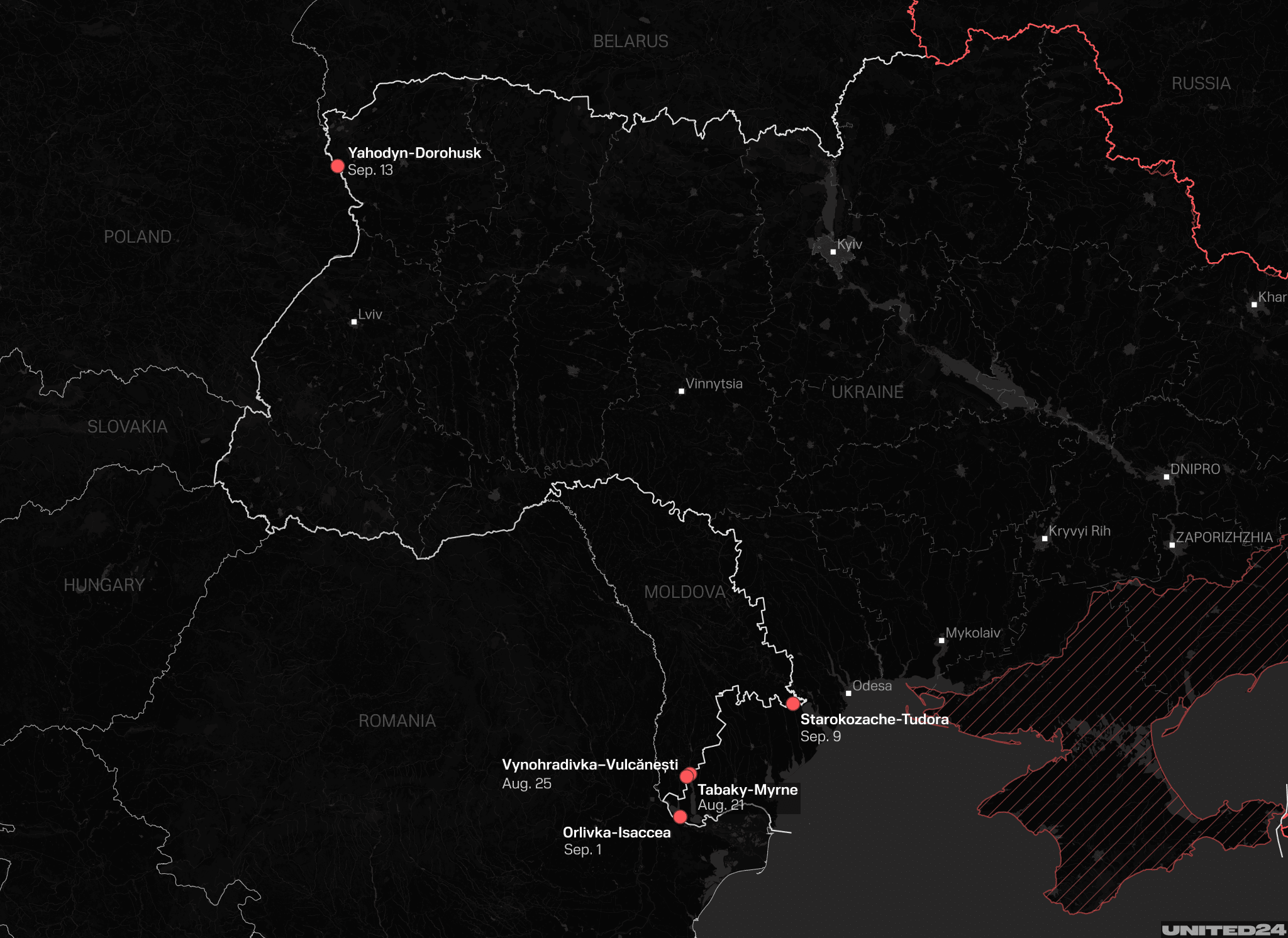
On September 9, Russian drones struck the Starokozache road border crossing on the Ukraine-Moldova border in the Odesa region, hitting the checkpoint infrastructure and surrounding area. The attack sparked a fire and left people dead and injured: Russia killed two civilians and wounded three. They were near the checkpoint when the strike occurred.


“This is a deliberate attack on border areas, an attempt to intimidate civilians, reduce the flow of passengers and goods across the border, and inflict economic losses,” told us Heorhii Tykhyi, spokesperson for Ukraine’s Ministry of Foreign Affairs. “Overall, Russians would not mind striking other borders as well. They have attacked the border with Romania, for example, but there, unlike Moldova, they are dealing with the borders of the EU and NATO.”
More Russian drone strikes near NATO
This was already the third such strike on the border with Moldova alone. The previous two occurred three weeks earlier:
August 21 — A strike on the Tabaky-Myrne border checkpoint. Buildings and structures were damaged, and fires broke out, forcing authorities to suspend the movement of people and vehicles through the crossing. Some of the Russian drones also flew through Moldovan territory.
August 25 — An attack by strike drones on the Vynohradivka-Vulcănești border checkpoint, after which it suspended operations.
Russia is expanding the geography of its strikes not only toward Moldova, but also toward another Ukrainian neighbor and NATO member—Romania.
Night of September 1 — A Shahed drone attack on the Orlivka-Isaccea border checkpoint. The building and surrounding grounds were hit, sparking a fire.
Night of September 6 — Another drone strike on border infrastructure in the Izmail district, which again affected Orlivka. It was the second attack in a week and the third since the start of the war.
Romania is under constant pressure from Russian provocations and is suffering the consequences of Russian drone attacks. One example was the incident on May 29, 2026, when a drone involved in an attack on the Izmail area crossed the border and struck an apartment building in the Romanian city of Galați, prompting Romania to scramble F-16 fighter jets.

Russia’s strikes have now reached Ukraine’s border with Poland. On September 13, a Russian drone struck the locomotive of a Kyiv-Warsaw passenger train in the Volyn region, approximately two kilometers from the Polish border. No injuries were reported.
The same Russian attack also hit infrastructure near the Yahodyn-Dorohusk international border crossing, one of the main road links between Ukraine and Poland. Falling drone debris caused a fire at a nearby gas station and damaged several trucks, while operations at the checkpoint were temporarily suspended during the air raid alert.
🚨 BREAKING: Russian drone targeted a passenger train on the border with Poland.
— UNITED24 Media (@United24media) September 13, 2026
"Russian barbarians are at your gate, dear partners. Act now: throw the full weight of your sanctions at Putin’s aggressive regime," Ukrainian Foreign Minister Sybiha wrote in response. pic.twitter.com/VsgQ2UGtPb
Ukrainian Foreign Minister Andrii Sybiha said the strike showed Putin’s terror was “knocking” directly on the doors of the EU and NATO and called on Ukraine’s partners to impose stronger sanctions on Russia.
Stronger European defenses
Today, Ukrainian border areas adjacent to European NATO member states are no longer a red line for Russia. The Kremlin is ordering strikes on these areas even though it understands that civilians are present there—potentially including people who are not Ukrainian citizens.
Moscow is sending a clear message: its hybrid war against Europe continues, and Russian leader Vladimir Putin has no intention of ending it. Maritime and aerial drones have become a constant danger to Romania, while Shahed drones and missiles threaten Moldovan airspace. More provocations should be expected, and their intensity appears likely to increase: attacks on border areas are shifting from isolated incidents to an almost weekly occurrence.
This is a direct signal from the Kremlin to European countries: there are no boundaries capable of restraining Russian aggression.
-5cb7e9e1318be990d6b922ede67c233b.png)
That is precisely why Ukraine is promoting initiatives such as the creation of an anti-ballistic coalition and the FREYJA project, which would allow European capitals to develop their own defenses against Russian ballistic missiles. Ukraine is also prepared to help partner countries build comprehensive defenses against Russian drones through the Drone Deal framework, developing shared infrastructure for the defense of the European continent.
Putin is also demonstrating something else directly: he is not prepared to de-escalate, even as Ukraine and its partners insist that it is time to sit down at the negotiating table. In that case, the only course of action is to strengthen support for Ukraine and provide even more capabilities that can destroy Russia’s economic and offensive potential, while also building up Europe’s own defenses. Such support is critically important at this moment.
Discuss this article:


-111f0e5095e02c02446ffed57bfb0ab1.jpeg "Photo of Roman Kohanets")

-c439b7bd9030ecf9d5a4287dc361ba31.jpg "Photo of Katherina Popilnichenko")
-a1738cb523135070a26ed61c09a8eb5e.jpg "Police stand in front of the Russisches Haus in Berlin, Germany. (Source: Getty Images)")
-72b63a4e0c8c475ad81fe3eed3f63729.jpeg "Photo of Cyril Barabaltchouk")