- Category
- War in Ukraine
Project FREYJA: Europe Is Building Its Own Missile Shield Against Russia’s Ballistic Threat

Russia’s ballistic missiles—and the parallel threat from Iran—pose one of Europe’s most pressing security challenges. Ukraine has already shown it can contain Russian forces on land and at sea while intercepting more than 90% of cruise missiles and drones. Ballistic missiles, however, remain a critical vulnerability. Both Ukraine and Europe still rely on external partners for protection. FREYJA is designed to change that.
 Prefer U24 Media on Google
- Authors

-29a1a43aba23f9bb779a1ac8b98d2121.jpeg "Photo of Illia Kabachynskyi")
The ballistic missile threat has become the greatest challenge facing Ukraine’s air defense. During the first two weeks of July 2026, Ukraine failed to intercept a single Russian ballistic missile. The reason: the country had no Western-supplied interceptors capable of engaging those targets. It was not a matter of failing to shoot them down—there was simply nothing available to do so.

Several months ago, Ukrainian President Volodymyr Zelenskyy proposed establishing a European anti-ballistic coalition capable of developing its own interceptor missile to counter ballistic threats. The goal is not for Ukraine to build the system on its own. Rather, it is to unite Europe’s powerful defense industrial base and decades of technological expertise with Ukraine’s innovation and rapid development cycle.
In other words, the project seeks to combine the strengths of each participating country to create a defensive shield capable of protecting Europe from Russian ballistic missiles. This is especially important because Europe’s current missile defense architecture remains heavily dependent on external partners for ballistic threats.
Today, Europe largely purchases its missile defense capabilities rather than producing them independently. It does not possess a fully sovereign missile defense shield, and nearly every layer of its ballistic missile defense architecture depends on non-European interceptors and non-European decision-making processes. As a result, Europe lacks a missile defense architecture with a controlled supply chain and the ability to evolve independently.
What is project FREYJA?
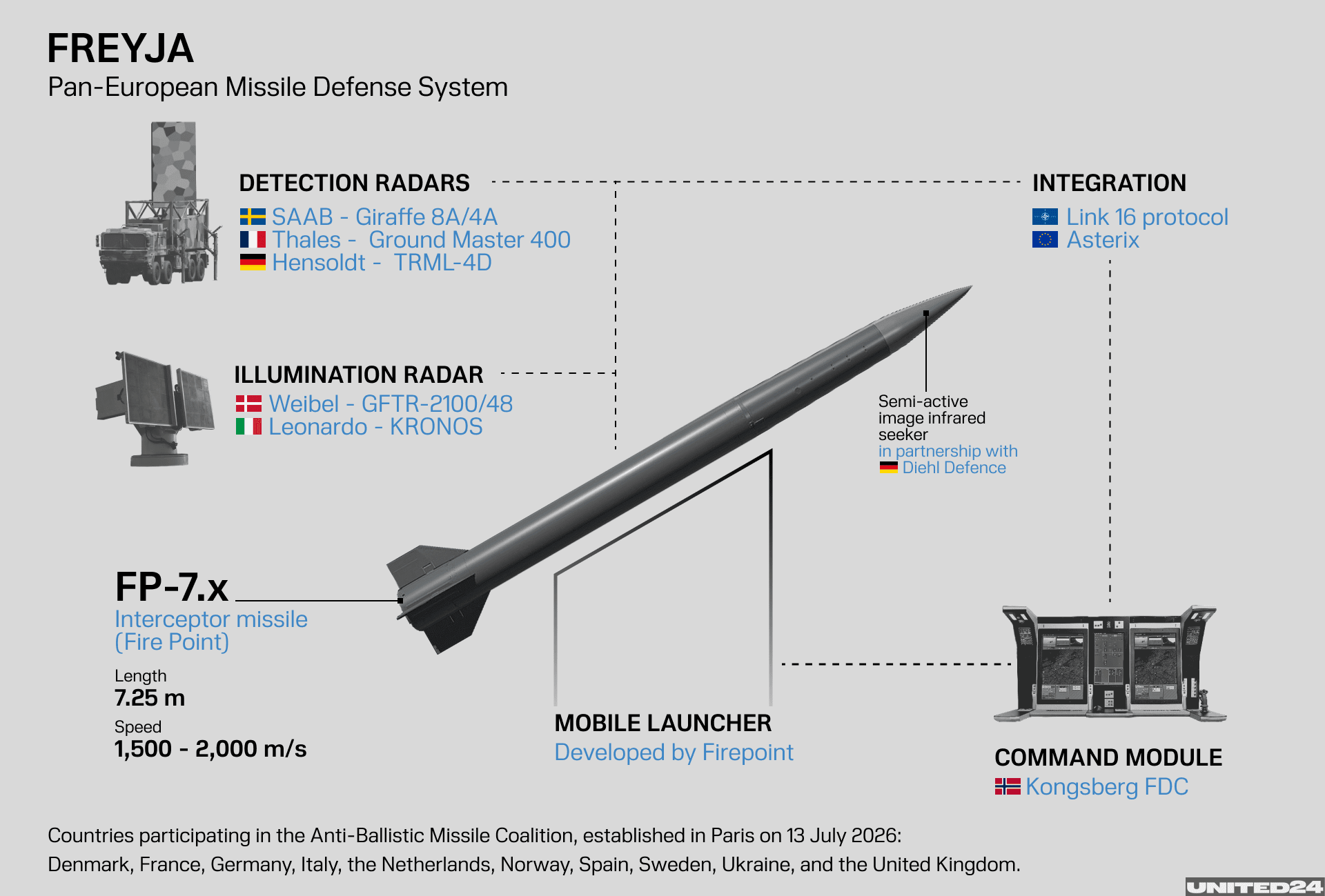
Announced in Paris on July 13 and backed by ten participating nations, the FREYJA project is a pan-European, multilayered missile defense architecture designed to detect, track, discriminate, and intercept ballistic threats throughout every phase of flight.
The project’s scope makes clear that this is a large and technically complex undertaking requiring integration across numerous systems. For that reason, FREYJA brings together a broad coalition of countries from its very first phase.
The founding participants are Sweden, Germany, Denmark, France, Italy, the Netherlands, Norway, Spain, the United Kingdom, and Ukraine. Together, these countries form the founding members of the Anti-Ballistic Coalition.
Given the project’s scale, Europe’s leading defense companies have also joined the initiative:
Ukraine—Fire Point (FP): FP-7.X interceptor missile and launcher; project initiator, technical integrator, and developer of the missile and launch solution.
Denmark—Weibel Scientific: GFTR-2100/48 target detection and tracking radar.
France—Thales: GM400 long-range surveillance and tracking radar.
Germany—Hensoldt: TRL-4D / TRML-4D early warning and tracking radar.
Germany—Diehl: Infrared seeker technology and related guidance systems.
Italy—Leonardo: Kronos Land radar and potential manufacturing capacity.
Norway—Kongsberg: C2 command center, command-and-control systems, and integration working group.
Spain—Sener Tactica: Data Link, tactical data link terminals.
Sweden—Saab: Giraffe 4A early warning and tracking radar.
United Kingdom: Partner responsible for selected interceptor components, currently being finalized.
The coalition remains open to additional European countries willing to share technology, adopt an open architecture, comply with common security standards, and participate in resilient supply chains.
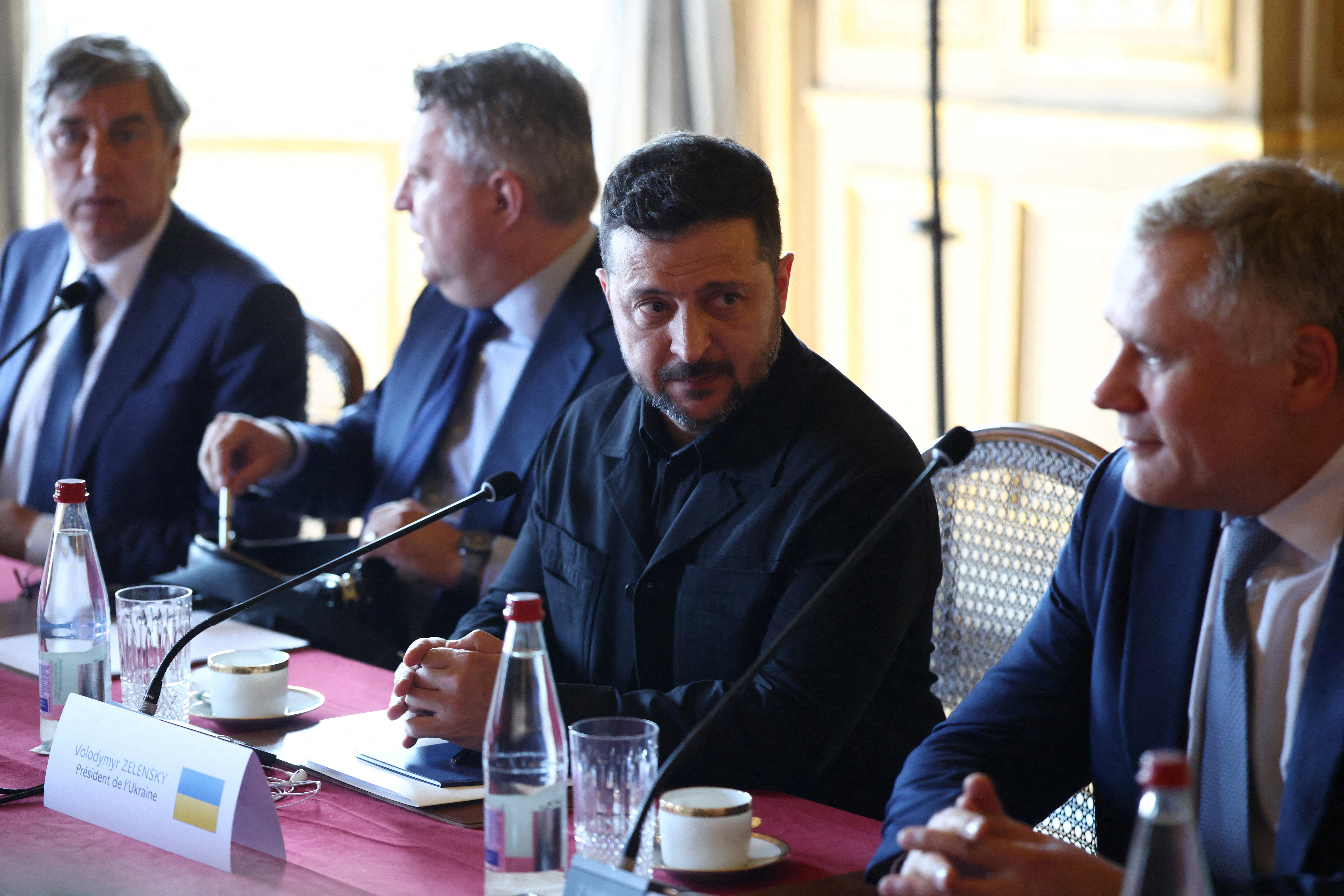
The concept is driven by pragmatism. Its objective is to reduce the cost of intercepting ballistic missiles by a factor of four to ten compared with current systems while creating an architecture that can outlast any individual technology within it. The system is designed to be open, modular, and distributed among participating nations so that the loss of a single node would never blind the entire continent. Rather than creating dependencies, every participant contributes capabilities that strengthen the system as a whole.
Ukraine plays a central role in FREYJA for several reasons. Above all, Ukrainian territory is currently absorbing the largest missile campaign on the European continent since World War II, providing a real-world demonstration of the threats every European capital must be prepared to face. At the same time, Ukraine has become the world’s primary testing ground for ballistic missile defense and other air defense technologies at an unprecedented scale. Before Russia’s full-scale invasion, few imagined just how effectively Western weapons could perform in capable hands under real combat conditions.
As a result, Ukraine has been designated the coalition’s System Integrator Nation, giving it responsibility for integrating the overall architecture.
How project FREYJA’s missile defense system will work
The system is built around a multilayered missile defense architecture capable of detecting, tracking, discriminating, and intercepting ballistic threats throughout every stage of flight. To function effectively, the architecture must remain open, free from dependence on any single supplier or nation, and continuously expandable through modular upgrades.
Each new participating country expands the defensive shield by adding new detection, tracking, and interception capabilities. The coalition refers to this concept as distributed resilience—there is no single point of failure whose loss would blind the entire continent. Command structures, sensor networks, and manufacturing are intentionally distributed across participating countries. Meanwhile, operational feedback from the battlefield can be translated into system improvements within months rather than decades—a discipline Ukraine brings from its wartime experience.
In its fully realized form, the system would operate as follows:
Early warning: Space-based and long-range sensors detect the launch of an enemy ballistic missile.
Coalition alert: Participating nations receive immediate warning.
First interception layer: Initial attempts are made to destroy the missile during its flight toward the target. In the case of mass attacks, this first layer reduces the size of the incoming salvo.
Midcourse engagement: The system continues tracking the target, discriminates between genuine warheads and decoys, and conducts additional interception attempts.
Terminal defense: The final defensive layer protects cities, civilian infrastructure, and critical facilities through point defense during the missile’s terminal phase.
The architecture follows four sequential functions:
Detection → Tracking → Discrimination → Interception
Europe possesses the financial resources, industrial capacity, and scientific expertise required to build such a complex architecture. Ukraine contributes real-world combat experience and the ability to adapt military technologies at exceptional speed.
How project FREYJA will be implemented
Ukraine serves as the project’s initiator and operational leader because it has spent five years defending its skies against ballistic missile attacks during the full-scale war. Kyiv defines operational requirements based on real threats, develops test scenarios, coordinates government agencies, the system integrator, and international partners, and provides combat-tested operational experience through ongoing battlefield use.
A dedicated Steering Committee serves as the coalition’s highest decision-making body. It establishes priorities, approves project phases, manages risks, authorizes expansion, and resolves disputes among participating partners.
The partner governments—currently nine in number—provide political support and resources. Their responsibilities include issuing national authorizations and export licenses, mobilizing the domestic industry, and securing financing for the development of Europe’s future missile defense shield.
Fire Point serves as the project’s technical integrator. The company develops the implementation roadmap, defines the technical architecture, oversees missile and launcher integration, and coordinates the work of all participating organizations.
Europe’s major defense companies supply technologies, manufacturing capabilities, engineering expertise, and research support throughout the program.
The coalition expects the first phase of FREYJA to produce a pilot configuration that demonstrates interoperability among national components and lays the foundation for scaling the system across the European continent.
The ultimate objective is to intercept the first Russian ballistic missile using an entirely European-developed and European-operated system by 2027. Ukraine’s experience across multiple areas of wartime technological development suggests that this goal is achievable.
Discuss this article:
-4a56a6b482ec132402c16ef6fcabf9a2.png)





-efa69d4733b5af9f7cd0a642f85424a6.jpeg "Thick black smoke rises from the heavily damaged Proton-Electrotex plant in Orel, Russia, following a reported strike. (Source: Exilenova+)")