- Category
- Culture
Russian Flag Over Venice Festival—The Tip of the Iceberg?
 Prefer U24 Media on Google
- Authors

-24deccd511006ba79cfc4d798c6c2ef5.jpeg "Photo of Louis Beaudemont")
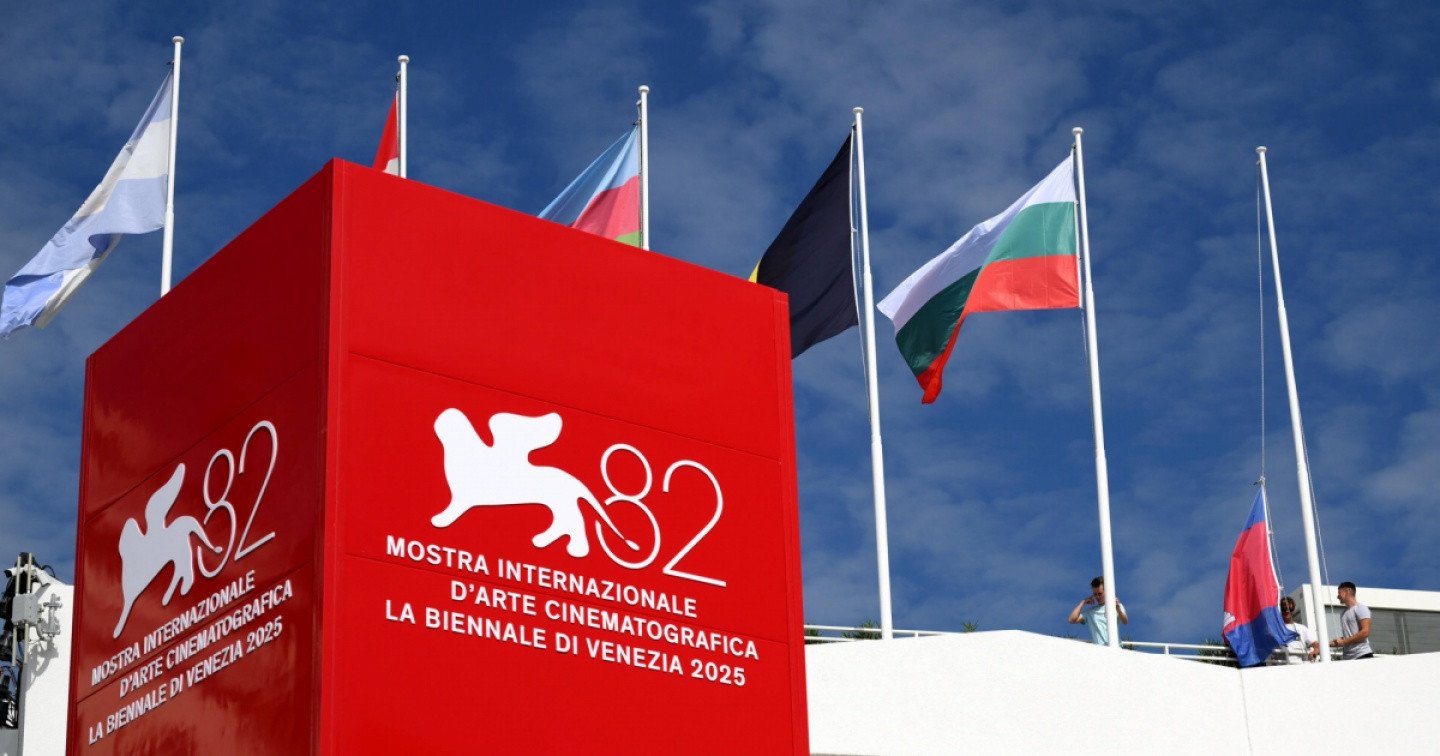
Despite Russia being excluded from most international festivals since its full-scale invasion of Ukraine, the Russian flag reappeared on the roof of the Palazzo del Cinema on the Venice Film Festival’s opening day—reviving questions about Moscow’s political, economic, and cultural influence at major international events.
Ukrainian filmmaker Oleh Sentsov—globally known for receiving the support of the international artistic community during his captivity in Russia—presented his latest film, Rhino, at a premiere at the Venice Film Festival in 2021, two years after being freed. He stopped his cinema career in 2022 to join the army after Russia launched its full-scale war in Ukraine.
Four years later, as Ukraine fights off the invading Russian army—its cities devastated, thousands of civilians and soldiers losing their lives every day, and Ukrainian cinema severely affected by funding shortages and mobilization—the Venice Festival once again raises the Russian flag.
On opening day, in front of the Palazzo del Cinema in Venice, the Russian tricolor seems conspicuously out of place on the roof of the building that is set to welcome stars from around the world for the 82nd Venice Film Festival's 10 days.
If the flags are meant to indicate the nationality of the films being presented, how is it that Russia—banned as a country from most film festivals worldwide—makes here such a deliberately spectacular return? George Clooney, Julia Roberts, Cate Blanchett, Emma Stone, Tilda Swinton, Werner Herzog, Francis Ford Coppola, Adam Sandler, or Laura Dern will pose on the red carpet, framed by the Russian flag flying above.
“Under this flag, Russian soldiers are committing war crimes right now,” the Ukrainian Ministries of Foreign Affairs and of Culture said on 29. “Even today, Russia carried out a brutal attack on Kyiv and several other Ukrainian cities, killing at least 21 people, including four children. At the same time, the organizers prefer to turn a blind eye, further damaging the reputation of the festival.”
The Ministry of Foreign Affairs of Ukraine and the Ministry of Culture and Strategic Communications of Ukraine strongly condemn the presence of the Russian flag at the Venice Film Festival.
— MFA of Ukraine 🇺🇦 (@MFA_Ukraine) August 28, 2025
The festival has just started, and the first tragicomedy has been screened, featuring… pic.twitter.com/1sJkJZT19h
The festival’s management has not yet explained the reasons for this flag's presence.
Ukrainian film critic Sonya Vseliubska told UNITED24 Media that “The Russian presence has always been there, is there, and will be. Their industry is doing fine. Some flags won’t solve this in any way. To think that taking it down will change something is very delusional.”
That flag, in fact, has always been there—just not physically
Sonya Vseliubska
Ukrainian film critic
According to Vseliubska Russia had a massive presence at the last Cannes Film Festival, with 43 accredited Russian journalists—some representing openly pro-war outlets. She also said that Russian distributors bought half of the films in the main competition.
The out-of-competition premiere of Russians at War already sparked controversy at the 81st Venice Film Festival in 2024. Directed by Anastasia Trofimova, the film follows a Russian battalion in occupied Ukrainian territories—doing so without authorization and in violation of Ukrainian law—and pointedly claims no war crimes were observed, contradicting extensive reports from international investigators documenting atrocities committed by Russian forces.
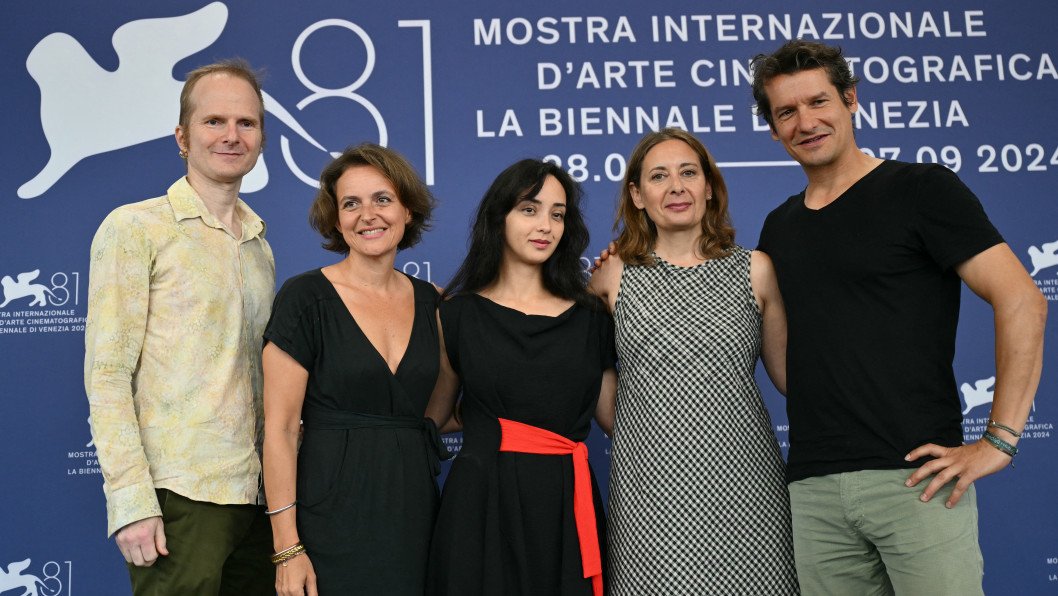
The decision to display—or not—flags other than the Italian and European ones remains at the festival’s discretion. Perhaps it is useful to pause on the Russians, whose films are being shown this year.
Russian presence at the festival
There are indeed two “Russian” films at the festival.
The first is by Russian filmmaker Alexander Sokurov, presenting his film out of competition. Alexander Sokurov has remained close to power throughout the Putin years. Since 2018, he has been a member of the Presidential Council for the Development of Civil Society and Human Rights. In 2015, he publicly asked Russian leader Vladimir Putin to release Ukrainian filmmaker Oleh Sentsov, but his stance on broader political issues has been less clear. In an interview with Russian journalist Kseniya Sobchak on December 6, 2023, Sokurov described Russia’s war in Ukraine as “a chain of mistakes on all sides, including the West and Ukraine.” He also called Joseph Stalin “the most important political figure of the 20th century” and said many underestimate “the magnitude of Putin’s personality.” After his last film was not selected at the Cannes Film Festival, he denounced what he called “criminal discrimination against Russian culture.”
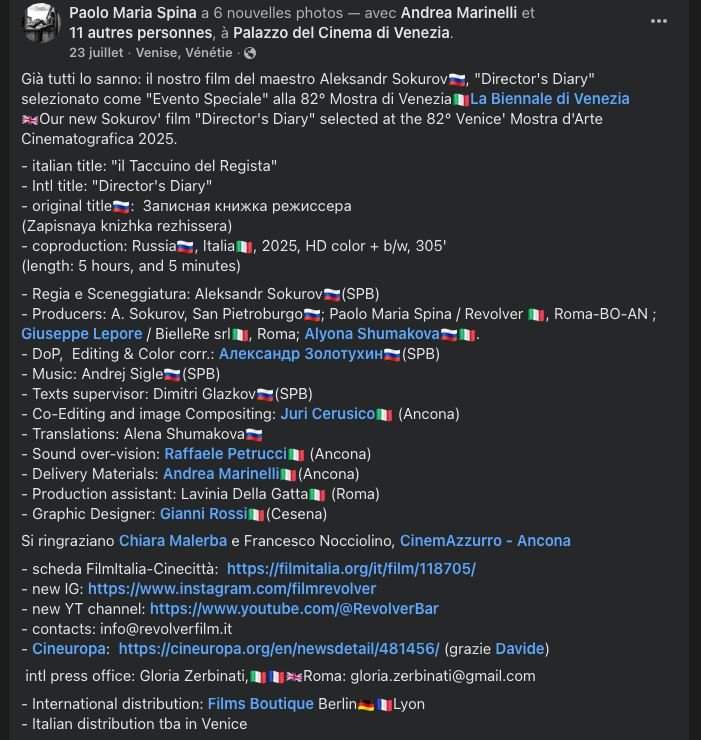
Sokurov’s film is produced in Italy by Paolo Maria Spina of Revolver Film. Spina has already produced Russian films and is—according to the website of the Moscow Film School—listed as a jury member of Russia’s next VGIK International Student Festival, supported by the country’s Ministry of Culture. The festival will be held in October-November 2025, alongside Serbian director Emir Kusturica, one of the loudest defenders of Putin in the film world.
“I want to thank you for your just, personal, and historic stance,” Kusturica told Putin during a meeting in 2024, while seeking funding for his upcoming films regarding Russia’s war on Ukraine.
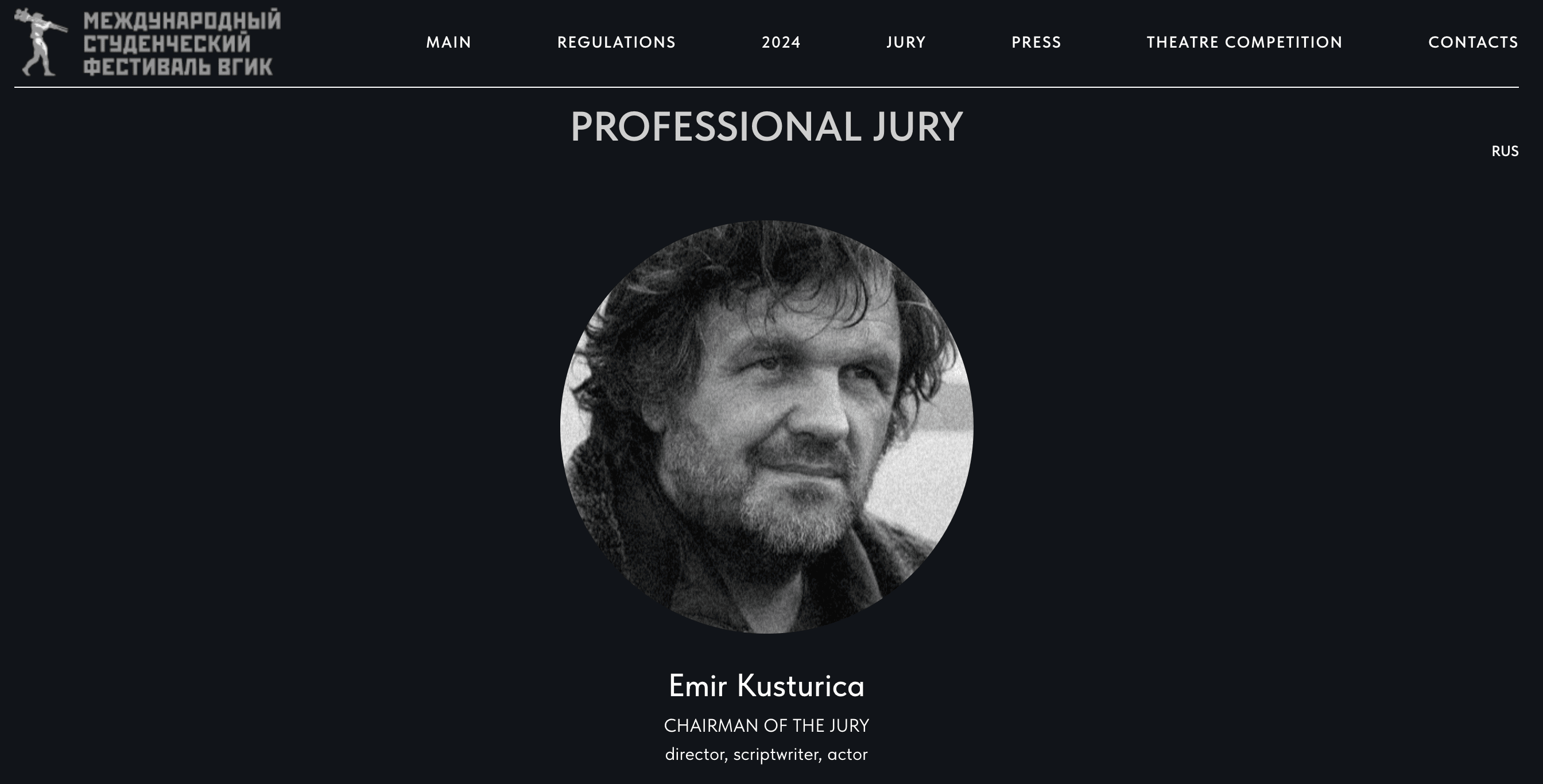
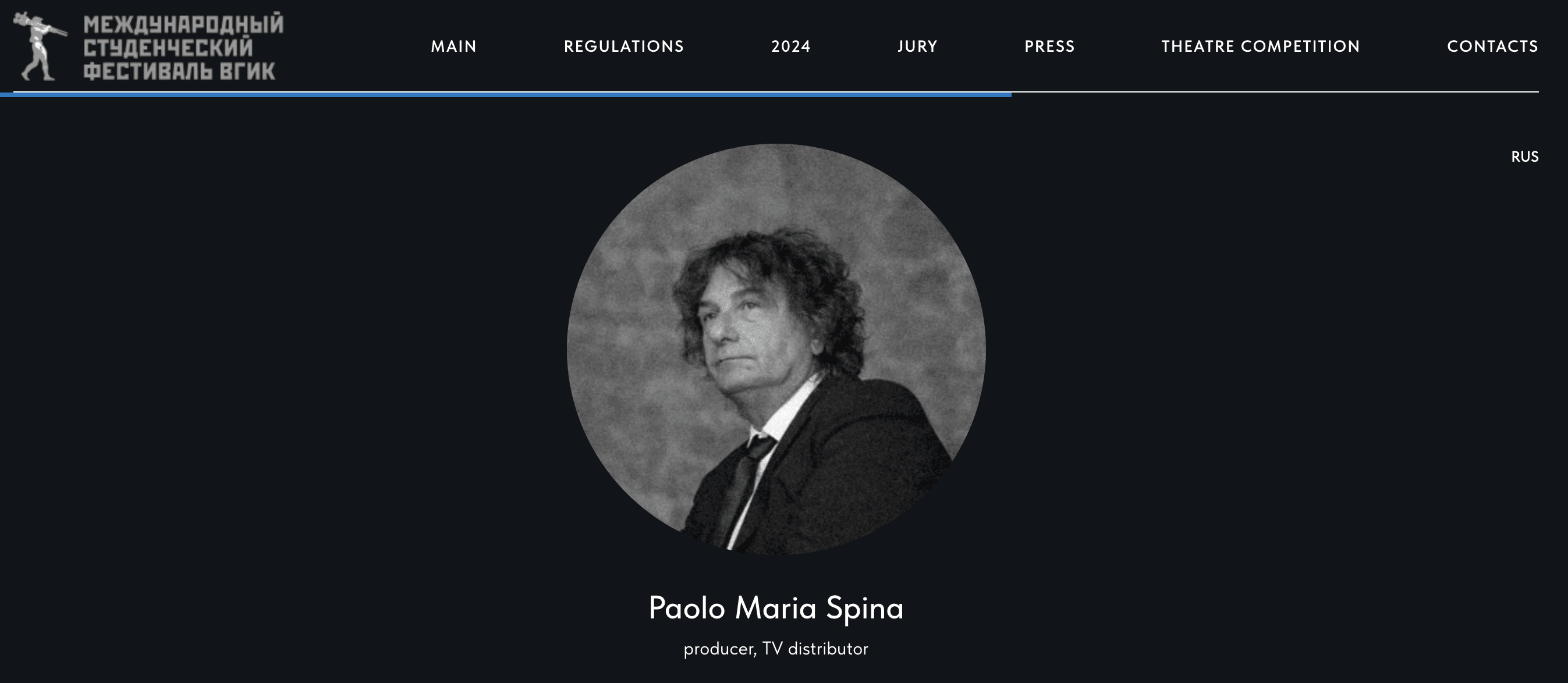
Paolo Maria Spina also posted the film’s crew, carefully noting each person’s nationality in order to justify the project’s co-national status.
Another film featured is by Russian filmmaker Vladlena Sandu, who is presented as “Crimea-born,” showing her debut feature as the opening film of the Giornate degli Autori, a sidebar program to the Venice Festival. The film is produced by the Russian producer Yana Buriak. In February and March 2022, at the very start of Russia’s full-scale invasion of Ukraine, Sandu’s series Identifikatsia, produced by Gazprom-Media—the production and broadcasting arm of the Russian state hydrocarbon giant—was aired on its VOD platform “Premier.” She has since been living in Europe, making films about her family's past in Crimea and in Grozny, the capital city of Chechnya. Her new film is distributed by the French company Loco Film.
Normalisation of the criminals
Russian artist and activist Katia Margolis, who lives in Venice and was contacted for this article, says that this event could be a cultural-diplomatic operation aimed at reasserting Russia’s political and cultural presence on the European stage, following the failed attempt to organize a concert by Valery Gergiev, the conductor close to Putin. While she can only assume Russian influence behind the decision to raise the flag, she views it as part of a slow resurgence of Russian “soft power ” in Italy, after it was abruptly halted in 2022.
It’s another use of art to normalize crimes, genocide
Katia Margolis
Artist, activist
Another scandal of Russian presence has shaken Venice in recent months: the opening of an institution promoting contemporary art in a Venetian palace, the Scuola Piccola Zattere, co-financed by Viktoria Mikhelson, daughter of oligarch Leonid Mikhelson, who is under international sanctions because of his company Novatek’s role in Russia’s war effort.
One Ukrainian work has made it into this year’s Venice Film festival official selection. In the Orizzonti short film competition, Kyrylo Zemlyanyi’s Unavailable will make its international premiere, an intimate portrait that speaks to the silences, absences, and dislocations shaping Ukrainian life today.
Discuss this article:
-6c7b568bf1f65853b7afd9dc1c3ca1fe.jpeg)



-e00d178a31a987cd514e15ad3a8c2131.jpeg "Max Klymenko wearing the Etnodim, featuring embroidery inspired by traditional Ukrainian crafts. (Source: Ian Treherne)")
-e88c01988249cd60b6f04f79d29156b7.jpeg "Damage to “Cosmogony,” the largest painting in Ukraine, following a Russian drone attack on Lutsk on October 13, 2026. (Source: @sashyyna/Instagram)")
-480d70a36b9b34492b0b32ca04af4489.jpg "People attend the funeral ceremony of the famous Ukrainian writer Victoria Amelina at the Garrison Church, in Lviv, Ukraine, on July 5, 2023. (Source: Getty Images)")