- Category
- Defense Tech
Ukraine’s R-2200 Keeps Battlefield Networks Running When LTE and Starlink Fail
 Prefer U24 Media on Google
- Authors

-111f0e5095e02c02446ffed57bfb0ab1.jpeg "Photo of Roman Kohanets")
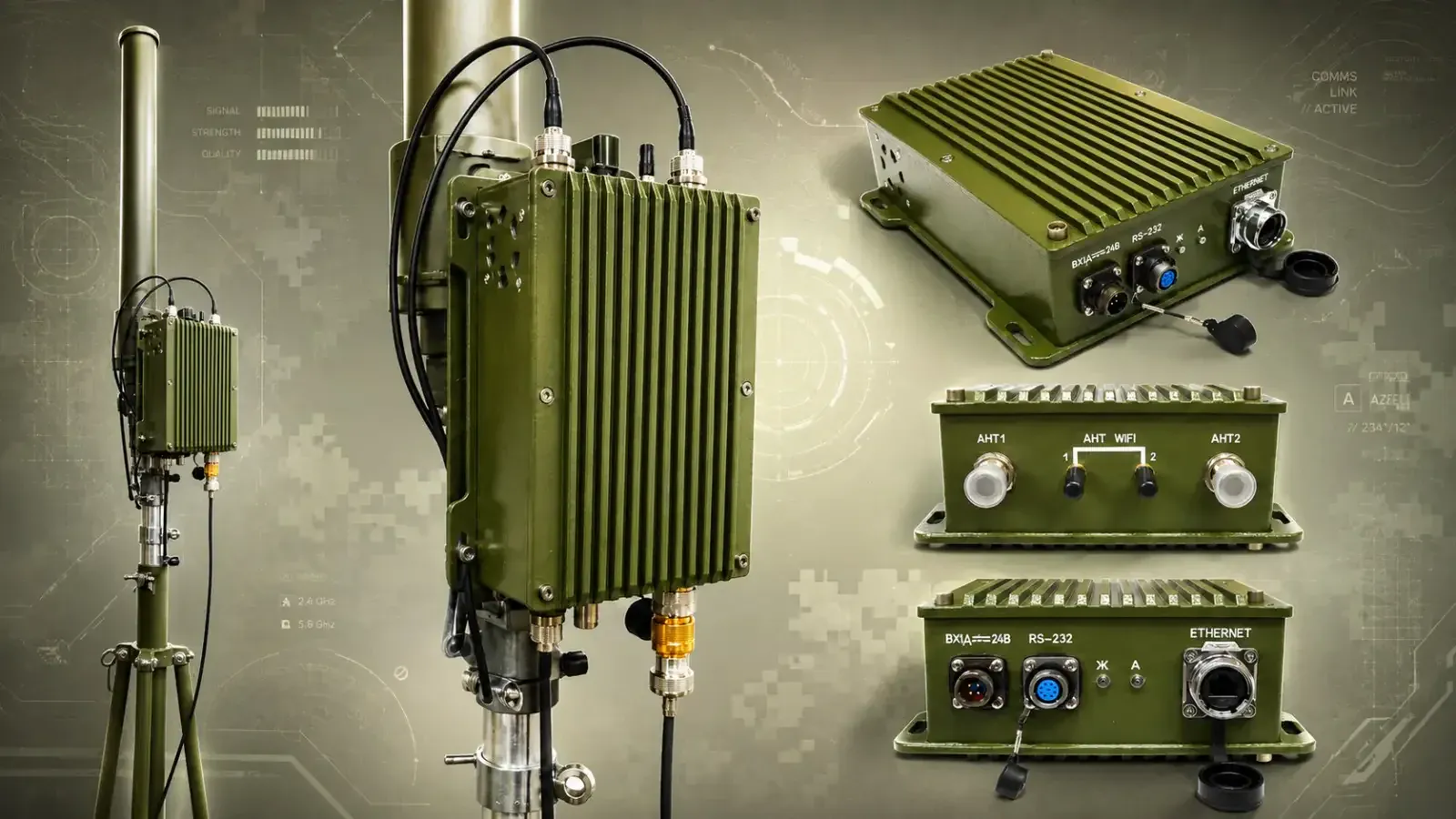
An unnamed Ukrainian military technology company has developed a broadband radio station designed to keep battlefield communications running where satellite and cellular networks fail, Oboronka reported on September 4.
The system, designated the R-2200, has passed experimental operation with units of Ukraine's Armed Forces in both its stationary and mobile configurations, according to the outlet. Both variants have been codified and assigned NATO Stock Numbers.
We bring you stories from the ground. Your support keeps our team in the field.
Oboronka informed that the R-2200 works across the 2202–2602 MHz band and delivers several core functions:
reliable links over at least 10 kilometers, or about six miles, in line-of-sight conditions;
integration into a subscriber's local network through Ethernet and 802.11 Wi-Fi interfaces;
relay and Wi-Fi mesh operation at up to 54 Mbit/s, and up to 100 Mbit/s in point-to-point mode;
output power reaching 43 dBm, or up to 20 watts, per antenna connector.
The R-2200 is a digital broadband station built for both fixed and field networks serving military and civilian users. Its defining feature is the ability to hold a connection when LTE and satellite systems are jammed or unavailable, according to the source.
The station supports BPSK, QPSK, 16QAM, and 64QAM modulation and runs in point-to-point, point-to-multipoint, and decentralized relay modes. It carries frequency retuning to counter interference and pairs with omnidirectional antennas rated at 10 or 13 dBi.

Oboronka noted that the network self-organizes and self-heals, extending coverage for mobile command posts and for reconnaissance and fire-control systems operating at range. That design targets mobility on a front where Russian electronic warfare routinely severs conventional links.
Two versions are on offer. The stationary R-2200 runs as a network node on 220-volt alternating current, while the mobile R-2200-01 draws 12 or 24 volts from a vehicle's onboard supply.
The R-2200 fits a wider shift in Ukraine's defense industry, where the assumption of dependable satellite and cellular links has quietly collapsed.
As Russian jamming has spread across the front, developers have moved to build redundancy into everything from ground robots to tactical radios, layering MESH links, Wi-Fi fallbacks, and self-healing networks that keep operating when a single channel goes dark.
Systems are increasingly judged less by peak performance than by whether they can maintain a connection under sustained electronic attack. The station's emphasis on functioning without LTE or satellite reflects that reordering of priorities.
Discuss this article: