- Category
- Latest news
As US Sanctions Roll Out, Two Russian Tankers Are Now Stranded on Their Way to India
 Prefer U24 Media on Google
- Authors




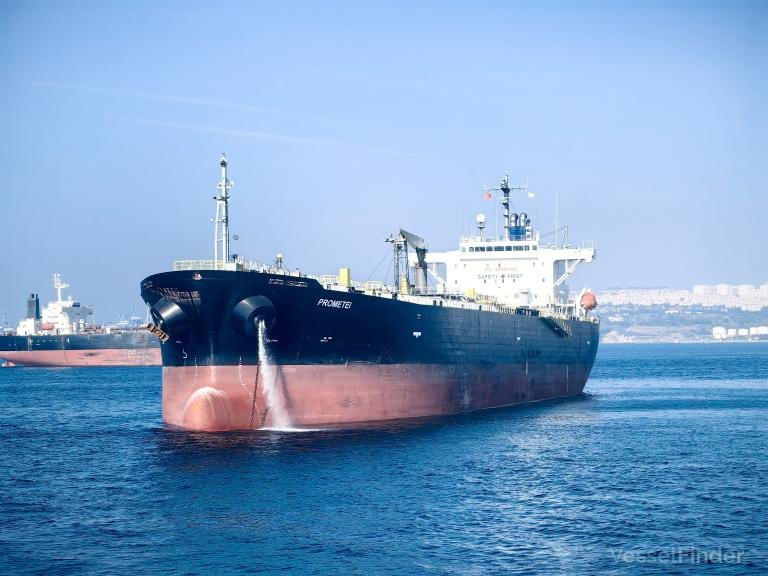
A Russian tanker carrying around 40,000 tons of crude oil has been drifting off India’s western coast since October 26, unable to dock at its destination port of Mundra, after Indian refiners began turning away cargoes linked to newly sanctioned Russian energy firms, Reuters reported, citing traders and LSEG shipping data on October 30.
The vessel, Prometei, loaded its cargo at Ust-Luga, a Russian port on the Baltic Sea, before setting sail for India earlier this month.
The Russian oil tanker Furia, en route to India with a cargo of Urals crude, reversed course and stopped in the Baltic Sea, Bloomberg reported.
— Anton Gerashchenko (@Gerashchenko_en) October 30, 2025
The vessel was moving west through the strait between Denmark and Germany but turned around on Oct. 28.
The Furia lifted nearly… pic.twitter.com/1dPurrW7eI
According to traders quoted by Reuters, the ship’s buyer remains unclear—but the cargo appears to be part of the usual supply chain serving HPCL-Mittal Energy, which operates a refinery in the northern Indian state of Punjab and receives its crude and feedstock shipments through Mundra.
An HPCL-Mittal source told Reuters the company had stopped buying from any sanctioned entities, confirming a broader industry trend among Indian refiners since Washington imposed blocking sanctions on major Russian oil exporters Rosneft and Lukoil last week.
“We will not buy from any sanctioned entity,” the source said, adding that HPCL-Mittal has enough naphtha reserves and plans a scheduled refinery maintenance in November.
The report follows a similar case involving another Russian vessel, Furia, which loaded 730,000 barrels of crude oil from Rosneft in Primorsk and then reversed course, entering a holding pattern off Germany’s coast instead of continuing toward Sikka, a port in India’s Gujarat state that hosts refineries operated by Reliance Industries and Bharat Petroleum.
Both Reliance and Bharat Petroleum have recently scaled back Russian crude purchases in response to the latest US sanctions, which effectively block transactions with entities tied to Rosneft and Lukoil.
Despite the disruptions, overall exports of Russian oil and oil products via western ports—Primorsk, Ust-Luga, and Novorossiysk—have not yet declined, traders told Reuters.
Flows in October remained steady at roughly 2.33 million barrels per day, in line with Russia’s export program.
However, payment processing is expected to become a growing challenge. “Banks will find it hard to prove that payments aren’t going to sanctioned companies. Payments in rupees are not attractive,” one trader told Reuters.
Industry analysts cited by the agency said Rosneft and Lukoil may be forced to add extra layers of intermediaries to keep shipments flowing — a workaround that could inflate transaction costs for sellers but reduce sanctions exposure for buyers.
Since Moscow launched its full-scale war against Ukraine, India has become the largest buyer of seaborne Russian oil, importing between 1.6 million and 2 million barrels a day. It is also the world’s second-largest importer of Russian naphtha, trailing only Taiwan.
In September, India imported about 170,000 tons of naphtha, while October loadings reached 185,000 tons, most of which are still en route, according to LSEG data cited by Reuters.
Earlier, a Russian-flagged oil tanker under international sanctions briefly blocked the Suez Canal on October 28 after running aground due to engine failure.
Discuss this article:
-9bd5e1532102621f8fb1c4ba871a3171.png)



-111f0e5095e02c02446ffed57bfb0ab1.jpeg "Photo of Roman Kohanets")
-72b63a4e0c8c475ad81fe3eed3f63729.jpeg "Photo of Cyril Barabaltchouk")