- Category
- Business
How Ukraine's "Kinetic Sanctions" Cripple Russia's War Economy
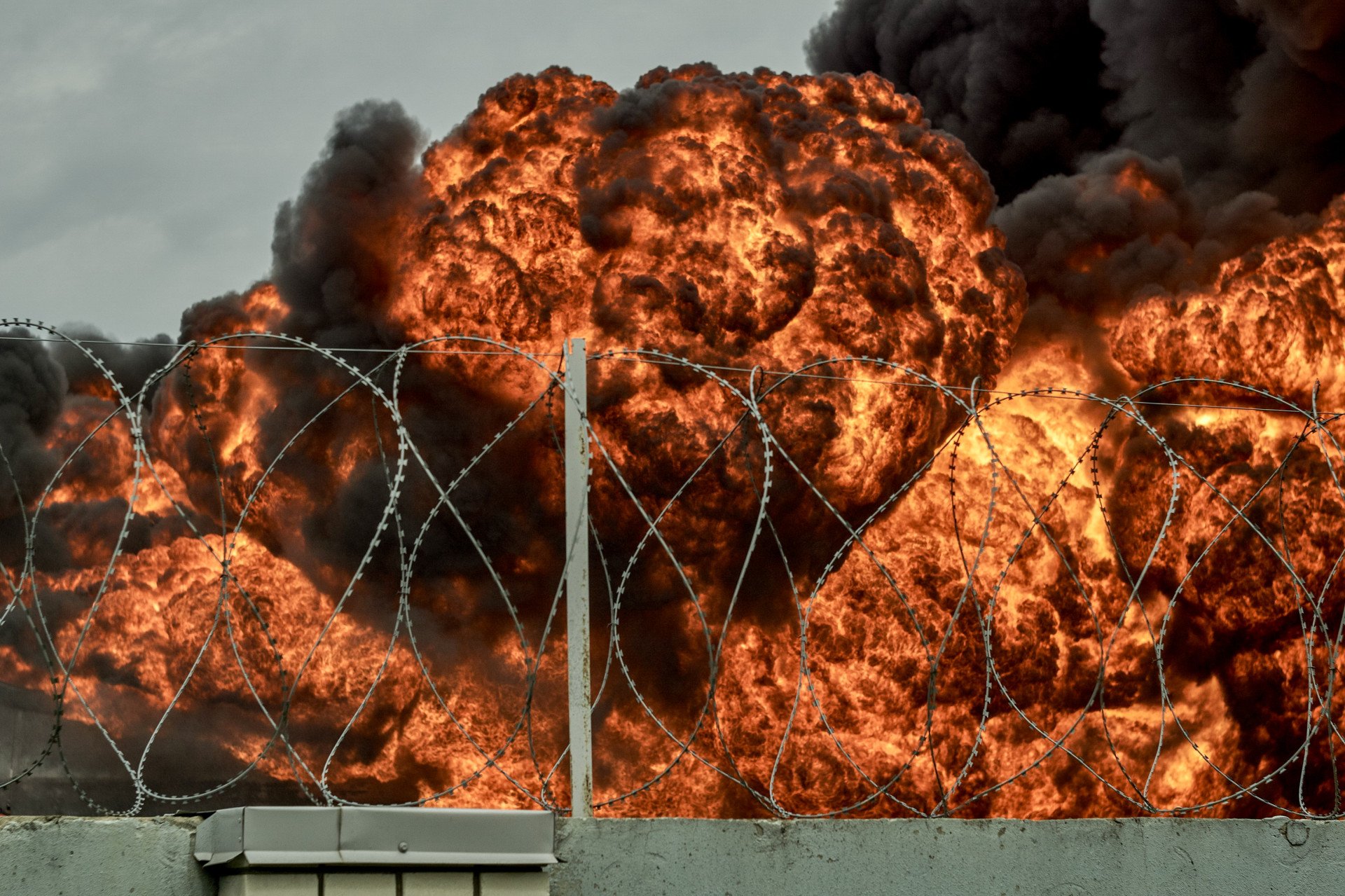
Ukraine’s latest drone strike targeted the Rosneft refinery in Ryazan, one of Russia’s five largest. The strike halted half of its refining capacity and ignited fires that lit the night sky. The strikes mark a continuation of Kyiv’s intensified campaign against Russian oil infrastructure, which is now deepening fuel shortages across the country and expanding the number of regions facing queues at the pump.
 Prefer U24 Media on Google
- Authors


In August, fuel shortages appeared across several Russian regions. Long lines formed at stations in Primorye, Crimea, and parts of the Volga, with some outlets forced to suspend sales altogether. Local authorities in certain areas introduced rationing measures. Moscow and St. Petersburg were less affected, but reports of queues in the capital underscored that the disruption was no longer confined to peripheral regions.
Wholesale fuel prices broke records. AI-95 (unleaded gas) reached ₽82,380 ($1,000) per ton on August 28, a historic high. The figure represents a 50% or more increase since January 2025, according to the St. Petersburg International Mercantile Exchange. Though prices dipped slightly the next day (about 2%), they remained at the ceiling.
Experts traced the surge to one factor: Ukrainian drone strikes on Russia’s refineries—particularly those of Rosneft, the Kremlin-controlled oil behemoth—during the peak summer driving and harvest season:
“There is a driving season, vacation, and now there are some queues, even in Moscow… everybody is unhappy with a higher price for [petrol], especially if you used to buy it at a low subsidized price,” explained Borys Dodonov, head of the Center for Energy and Climate Studies at the Kyiv School of Economics (KSE).
Insane gasoline lines all over Russia.
— Jay in Kyiv (@JayinKyiv) September 13, 2025
pic.twitter.com/8IztXiA5BA
The Kremlin scrambled to respond. Export bans for gasoline were imposed in August and September, with an extension into October now under discussion. Oil majors adjusted refinery repair and maintenance schedules to avoid downtime during demand spikes. Officials floated tweaks to the “fuel damper” subsidy mechanism, which compensates companies for keeping domestic fuel cheap. If firms had previously feared losing payouts for allowing prices to rise, new rules could widen the permitted gap between domestic and export prices, allowing them to pocket subsidies despite record wholesale levels.
These measures buy time, but they don’t refill tanks. As Dodonov put it bluntly: “Everybody is unhappy… first, they cannot buy it, there is a shortage. And second, the prices go up.”
The refinery chokehold
The queues aren’t random. They’re the most observable consequence of Ukraine’s systematic bombing campaign. Drone attacks in August alone knocked out about 17% of Russia’s refining capacity—1.1 million barrels per day—driving total offline primary refining to 6.4 million tonnes, a record.
“It’s around 70% of Russian refining capacity [that] is currently in the range of Ukrainian drones,” Dodonov said. The Ukrainian’s reach into Russian territory has grown by 400 kilometers to at least 1,700, bringing most major plants—Ryazan, Volgograd, Syzran, and even the Ust-Luga terminal—into reach.
Map of Ukrainian drone strikes on russian oil refineries starting from August 2, 2025.
— Angelica Shalagina🇺🇦 (@angelshalagina) September 14, 2025
A total of 13 oil refineries were attacked, some of them multiple times, with a total processing capacity of the targeted russian oil refineries being 114.5 million tons per year pic.twitter.com/PajPhdvarG
The impact isn’t just physical damage. Russia’s refining sector is being squeezed into a corner. “It’s very difficult to replace these damaged capacities,” Dodonov explained. “Refinery equipment is very technological… produced only in coalition countries. They cannot import it from China. If there is damage to the Crude Distillation Unit (CDU), then they have to repair it through a third country. It takes time, additional money.”
In practice, every destroyed distillation unit means months of reduced throughput. Sanctions on spares stretch repair cycles further. Even those in the Russian energy sector have admitted they’re reworking maintenance calendars simply to avoid overlapping with the next wave of strikes.
That vulnerability has turned drones into the sharpest sanction yet. “For Ukraine, it makes sense to continue these attacks,” Dodonov said.
Moscow’s balancing act
The Kremlin is stuck between inflation and subsidies. If fuel prices rise, they risk fueling inflation, which is already running above target. If they cap prices, the “fuel damper” system bleeds money from the budget into the pockets of oil majors. Kommersant reported that companies let prices rise last month on the assumption that subsidies would be retroactively adjusted to cover the gap.
The EU’s oil price cap is now dynamic — set at $47.6/bbl, reviewed every 3 months. The idea is to cap 🇷🇺 Russia’s export revenue without cutting supply. Oil & gas still make up ~25% of Russia’s federal budget, yet revenues fell 35% YoY in Aug 2025. With Urals prices sliding from… pic.twitter.com/hMFmotXv1n
— Kyrylo Shevchenko (@KShevchenkoReal) September 8, 2025
Russia’s export revenue is also squeezed. Brent crude has slid to around $66 per barrel, down from the $80s a year earlier. Urals crude trades at a discount—$2–$4 below Dubai M1 in India, while freight costs to China are higher because the main export grade Urals have to travel farther from Baltic and Black Sea ports.
That means subsidies come directly at the expense of war spending. Initial estimates suggested Moscow would have to curtail military expenditures, but the data show the opposite: 2025’s defense budget has ballooned to 15.5 trillion rubles, about 7–8% of GDP—a post-Soviet record.
The Kremlin is spending heavily to keep queues tolerable, but every option carries a price. Export bans hold fuel at home, but at the expense of foreign sales. Subsidies preserve calm at the pump, but drain the treasury.
“Russia has a dilemma… either increase expenditures or inflation will go up,” Dodonov said.
Kinetic sanctions in practice
Ukraine calls its campaign of refinery attacks kinetic sanctions. The idea is straightforward: in the absence of stronger coalition measures to curb Russia’s oil revenues or answer its daily missile strikes on Ukrainian cities, Kyiv has turned to drones as sanctions delivered directly against the backbone of Russia’s economy.
“Many of these refineries that were hit supply the Russian army,” said Dodonov. “Now logistics will become more difficult.” Diesel and gasoil exports—the fuel that powers Russia’s trains, trucks, and armor—fell 9.1 percent month-over-month in August to about 0.80 mb/d, according to the International Energy Agency estimate.
💥 Overnight, drones struck the Kirishi oil refinery in Russia’s Leningrad region.
— UNITED24 Media (@United24media) September 14, 2025
The attack was carried out by fighters of the 14th UAV Regiment and Special Operations Forces. The refinery is one of Russia’s largest. pic.twitter.com/yo2YvF1X87
Every strike that disables a distillation unit reduces refining output for months, forcing Russia to export more crude at a widening discount and leaving drivers at home in queues. Russian television has been left explaining away footage of ration coupons and cars idling at gas stations in Crimea and Vladivostok. Western refiners, by contrast, have quietly welcomed higher margins as Russian products thin from competition.
For Ukraine, the cumulative effect is what matters: disrupted logistics, swelling subsidies, and mounting frustration inside Russia. But as Dodonov stressed, the global picture remains stable. “There is no impact on world oil prices, as global oil supply remains intact,” he says. “They are affected much more by OPEC decisions and uncertainty over US policy. Despite continuing Ukrainian attacks on energy infrastructure, Brent prices have actually decreased and are projected to go further down in 4Q2025-1H2026 on widening oil surplus at the world market.”
Discuss this article:
-5f84711170d2769c4cda67ca2bebf5d2.jpg "Carpathian 8 Summit: Ukraine Leads Push for Security & Regional Growth")


-111f0e5095e02c02446ffed57bfb0ab1.jpeg "Photo of Roman Kohanets")
-4258f90da45ed571f27851d158610665.jpeg "Photo of Valeriya Ionan")
-92cc3cc3704a042ef4f32eb51a51081d.png "Activitis Builds Fintech Infrastructure for Ukrainian Business During Wartime")
-29a1a43aba23f9bb779a1ac8b98d2121.jpeg "Photo of Illia Kabachynskyi")