- Category
- Latest news
Moscow’s Electronics Exhibition Exposed as Global Hub for Illegal Microchip Pipeline
 Prefer U24 Media on Google
- Authors


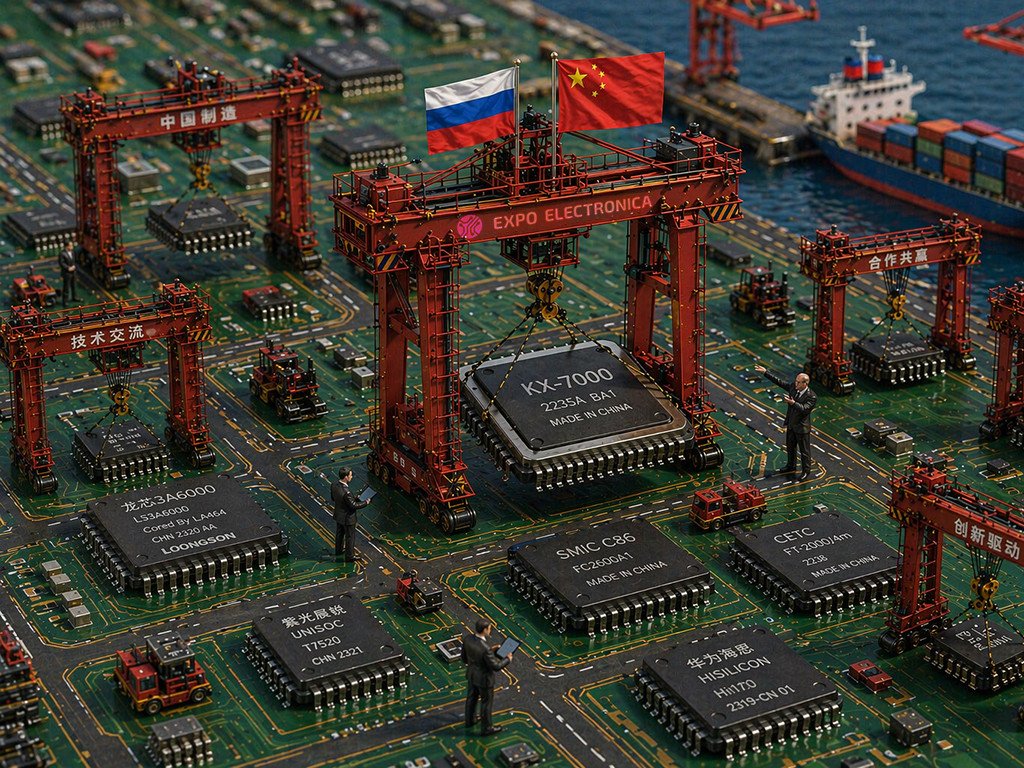
The annual ExpoElectronica electronics exhibition, held in Moscow from April 14 to 16, has emerged as a primary hub for coordinating international sanction-evasion schemes.
According to an investigation by the Dallas analytical group, the event gathered hundreds of firms dedicated to supplying the Russian military-industrial complex and energy sector with restricted Western-made components.
We bring you stories from the ground. Your support keeps our team in the field.
Experts identified 376 Chinese and 337 Russian enterprises among the 719 participants. The exhibition effectively functioned as a database for entities facilitating the parallel import of microchips from the US, Europe, and Taiwan to meet the needs of the Russian military.
A central figure in the report is the Russian company Lifelectronics, which openly offers its services to sanctioned defense giants such as Almaz-Antey and Tactical Missiles Corporation. Despite supplying electronics for naval, aviation, and air defense systems—and its direct involvement in producing Universal Joint Glide Munitions—the firm has so far avoided international restrictions.
The investigation also highlighted several specific logistical chains. The Pskov Long-Distance Communications Equipment Plant, which has been under US, EU, Swiss, Canadian, and Japanese sanctions since 2022, procured Altera microchips manufactured by Intel through a middleman called Radiotekhkomplekt for state defense orders.
Meanwhile, Chinese intermediaries like HK JDW Electronic Co. Limited openly advertised their ability to deliver global brands to the Russian market. Analysts obtained price lists from this firm for Siemens and Honeywell products, ordered by Russian intermediaries to service Lukoil, Rosneft, and Gazprom facilities.

Internal documents further reveal a systemic network of Chinese hubs, including Hong Kong Hongchang Technology and Faraday Technology, which accumulate electronics from across the globe for Russian buyers.
Furthermore, sanctioned entities like the Oktava plant, which produces military communication equipment, continue to secure foreign components through a sprawling network of local distributors such as GetChips.
Meanwhile, Ukraine’s Main Directorate of Intelligence (HUR) has exposed a network of over 100 companies critical to the production of Russia’s Su-57 fifth-generation fighter jets.
The intelligence report highlights several key industrial players, including the St. Petersburg-based “Krasny Oktyabr,” which supplies auxiliary gas turbine engines, and the National Institute of Aviation Technologies, responsible for the aircraft's advanced cockpit glazing.
The manufacturing chain also relies on the Institute of Theoretical and Applied Electrodynamics of the Russian Academy of Sciences for specialized radar-absorbent coatings, while YASHV Avia LLC provides the necessary aviation tires.
Despite their role in sustaining Russia’s aerial combat capabilities, HUR noted that roughly one-third of these firms have yet to be targeted by international sanctions.
Additionally, according to a Reuters, efforts by Russian firms to secure low-cost capital within China's extensive bond market are failing. Chinese financial institutions and investors are increasingly retreating from these deals, driven by the threat of secondary Western sanctions.
Discuss this article:
-9bd5e1532102621f8fb1c4ba871a3171.png)


-80134f2dc17b4a887d01513a1c7bc929.png "Illustration of Russian military infrastructure targeted by Ukrainian strikes in temporarily occupied eastern Ukraine. (Source: General Staff of the Armed Forces of Ukraine)")