- Category
- Latest news
Royal Navy Unveils “Atlantic Net” Drone Network to Hunt Russian Submarines
 Prefer U24 Media on Google
- Authors



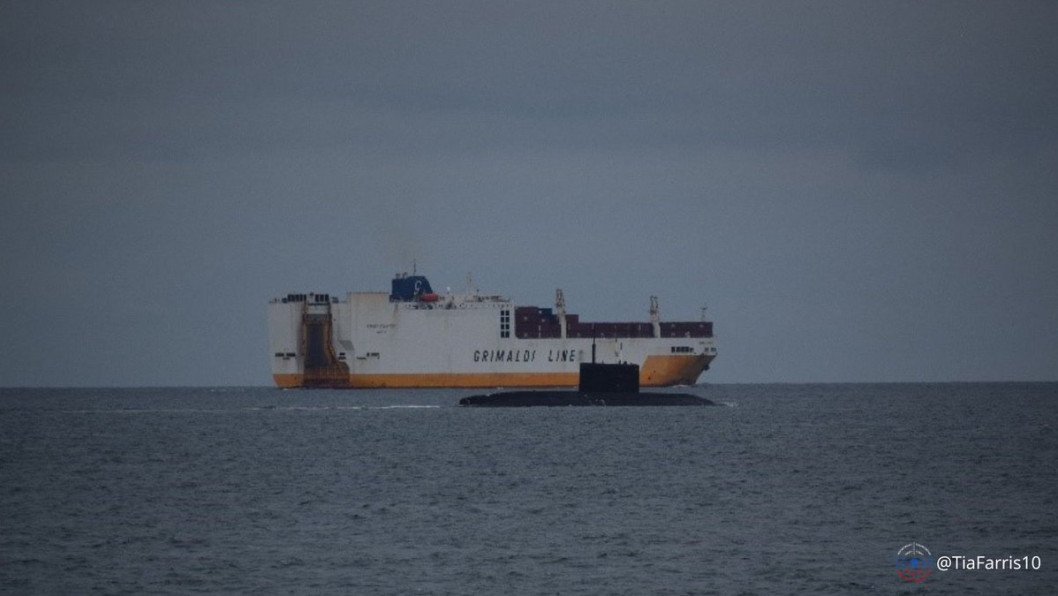
Britain has begun developing a new Atlantic surveillance drone network designed to detect submarines and strengthen maritime intelligence operations amid rising concerns over Russian espionage and undersea activity, according to the UK Defence Journal on October 15.
The move comes just weeks after a Russian submarine reportedly suffered a breakdown near Gibraltar during a covert mission near NATO waters.
Very interested by Project: CABOT.
— UK Forces Tracker (@UKForcesTracker) February 21, 2025
Appears to suggest procurement of Type 92 Sloop ASW USVs (similar in size to XV Patrick Blackett) and Type 93 Chariot XLUUVs (Cetus/Herne?) to secure ‘Bastion Atlantic’ against submarines.
(Src/img: https://t.co/wOyZjlxE11) pic.twitter.com/Ak6L9QBAyV
The Ministry of Defence has launched a tender for Atlantic Net, the opening phase of Project CABOT, which will advance the Royal Navy’s use of autonomous and data-driven systems for anti-submarine warfare and long-range surveillance, UK Defence Journal wrote.
According to the notice, “the Ministry of Defence would like to announce the intention to publish an Invitation to Tender (ITT) to contract a Commercial Mission Partner (s) (CMP) as part of the Royal Navy’s Atlantic Net (AN) initiative in the near future.”
The system will provide “Underwater Intelligence, Surveillance and Reconnaissance (ISR) as a service” through a Contractor Owned, Contractor Operated, Naval Oversight (COCONO) model—a structure that enables private partners to operate surveillance assets under military supervision.
The network will be data-focused, feeding real-time intelligence directly to maritime commanders ashore. The framework, symbolically valued at £1 for each of its two lots, will run from December 17, 2025, to March 31, 2026, according to the MOD’s tender portal.
UK Defence Journal reported that the first lot will appoint Commercial Mission Partners under individual contracts specifying milestones and deliverables, while the second will create a “Potential Supplier Pool” for additional firms whose technologies may later be integrated into the system.

The MOD also clarified that the procurement is “exempt from the Procurement Act 2023 under Defence Intelligence and National Security Grounds,” but said it would “follow the spirit of the Act where possible, hence the open publication of this notice.”
According to the UK Defence Journal, Atlantic Net is the first stage of Project CABOT, described as an effort to “accelerate the Royal Navy’s pivot to autonomy with a specific focus on anti-submarine warfare.”
It is built on previous experimental programs such as Project CHARYBDIS and the ASW Spearhead Initiative, and aligns with NATO’s Smart Defence strategy to create an automated anti-submarine barrier across the North Atlantic.

Future phases, including Atlantic Bastion, will bring the system under direct Royal Navy control using Type 92 Sloop drone ships and Type 93 Chariot autonomous submarines.
Together, the projects aim to reduce dependence on crewed platforms and establish a persistent undersea surveillance grid capable of monitoring submarine movements across the Atlantic—a domain where Russian espionage and sabotage threats have sharply increased in recent years.

Earlier, a Royal Air Force RC-135W Rivet Joint electronic intelligence aircraft conducted a patrol circling the Russian exclave of Kaliningrad.
The flight is part of regular NATO intelligence-gathering operations along the Alliance’s eastern border. The United Kingdom has conducted similar surveillance missions for years, maintaining a steady presence in the region well before Russia’s full-scale invasion of Ukraine in 2022.
Discuss this article:
-331a1b401e9a9c0419b8a2db83317979.png)




-6b3c58bbcf8c8f2f38775f349181b1ab.jpg "Recruits, supervised by instructors, cover a distance on Day Zero of Basic Military Training at the 118th Separate Mechanised Brigade of the Ukrainian Armed Forces on April 5, 2026. (Source: Getty Images)")