- Category
- Latest news
Russia Turns Vienna Into Europe’s Spy Capital With Massive Signals Intelligence Network
 Prefer U24 Media on Google
- Authors


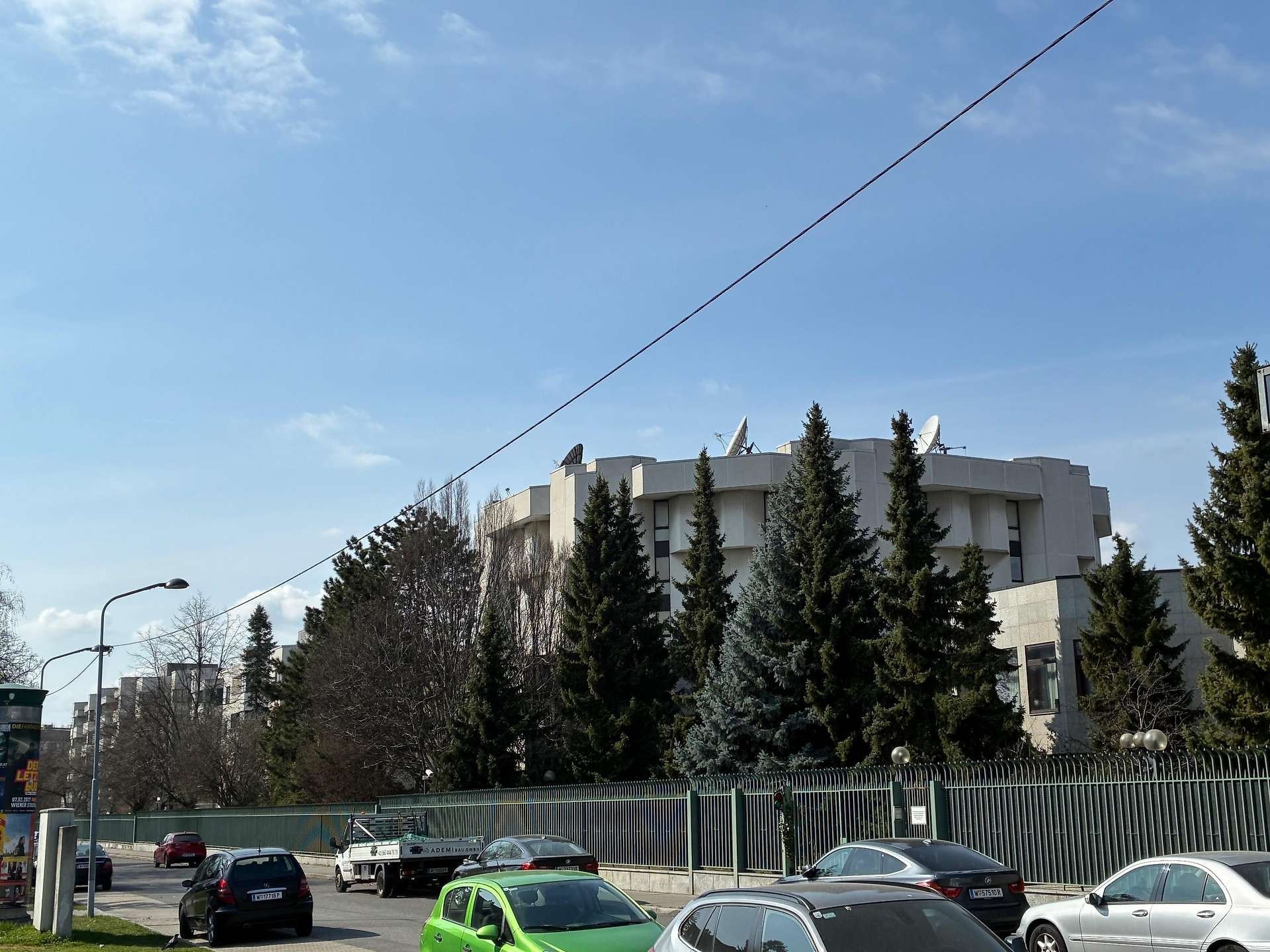
Russia has expanded its intelligence-gathering infrastructure in Vienna, turning the Austrian capital into a central platform for electronic surveillance across Europe, the Middle East, and Africa, according to Financial Times and Austrian broadcaster ORF.
We bring you stories from the ground. Your support keeps our team in the field.
Russia has significantly upgraded surveillance capabilities across its diplomatic properties in Vienna, using rooftop antennas and satellite equipment to intercept sensitive communications, Financial Times reported on March 17.
Western intelligence officials cited by the outlet describe the city as “their European center” for signals intelligence operations. Parallel reporting by ORF indicates that Russian installations in Vienna—particularly in the Donaustadt district and central areas—have seen continuous expansion since the start of Russia’s full-scale war against Ukraine.
A senior European diplomat based in Vienna said Russia is monitoring “governmental and military communications of NATO countries” from within Austria, adding: “This is their European hub.”
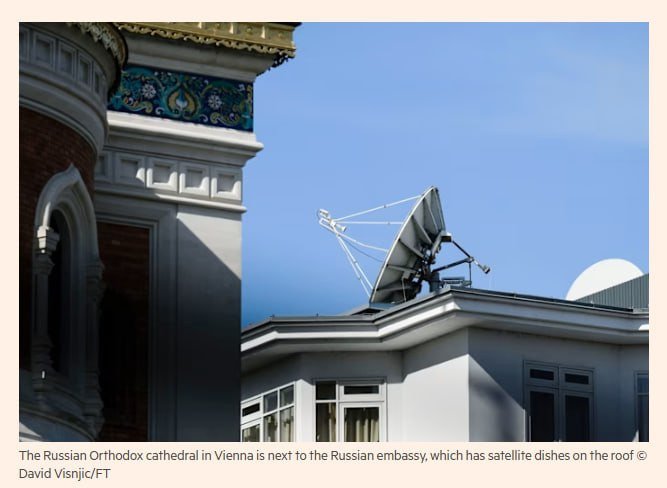
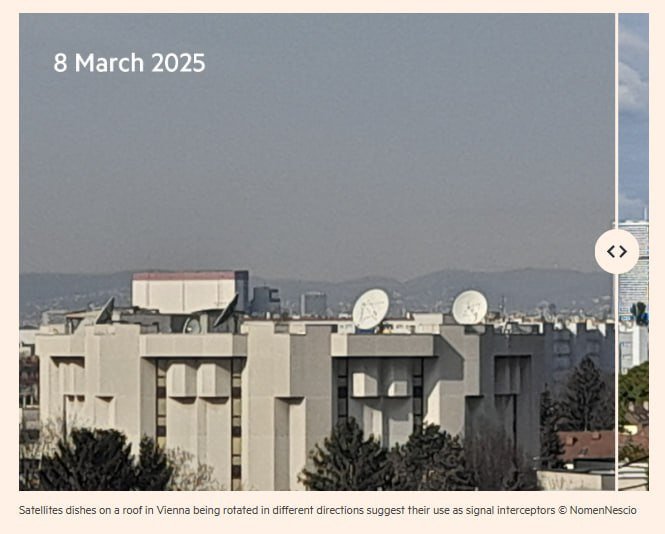
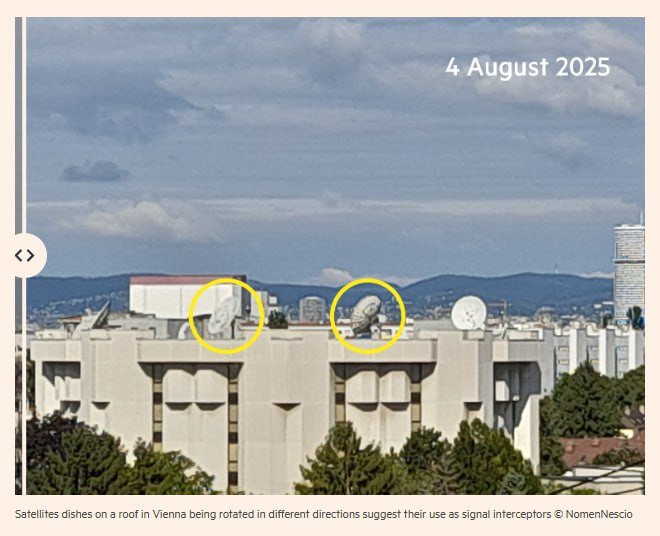
A representative of a Western intelligence service told Financial Times that new antennas and technical structures have appeared on Russian buildings over the past two years, with some systems regularly changing orientation.
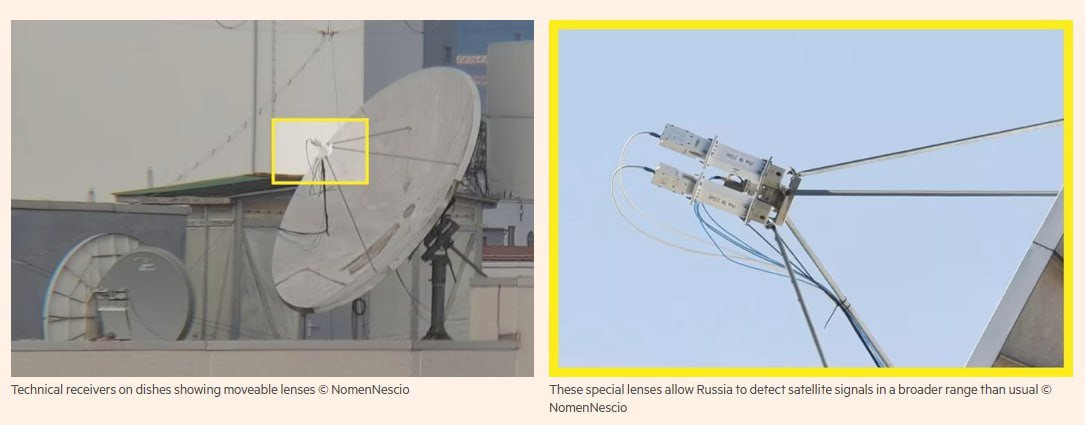
Researcher Erich Möchel from the investigative group NomenNescio, cited by both Financial Times and ORF, described the operational behavior of the equipment: “I would say that movement at least once a week is the minimum.”
According to Financial Times, hundreds of satellite images analyzed over a two-year period show extensive equipment installed on rooftops of Russian diplomatic buildings, including a large complex near the Danube informally known as “Russencity.”
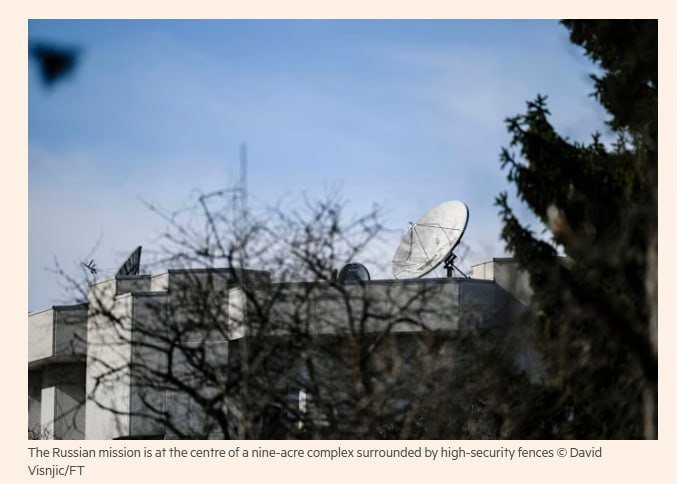
At the center of the site is a multi-story octagonal building belonging to Russia’s mission to the United Nations, equipped with numerous satellite dishes.
Most antennas are oriented westward, targeting geostationary satellites positioned between 0° and 15° east longitude. Möchel identified four satellites used in these operations—Eutelsat 3B, Eutelsat 10B, SES-5, and Rascom QAF1—adding: “We identified four satellites: Eutelsat 3B and 10B, as well as SES5 and Rascom QAF1. All of them are used to provide communications between Africa and Europe.”
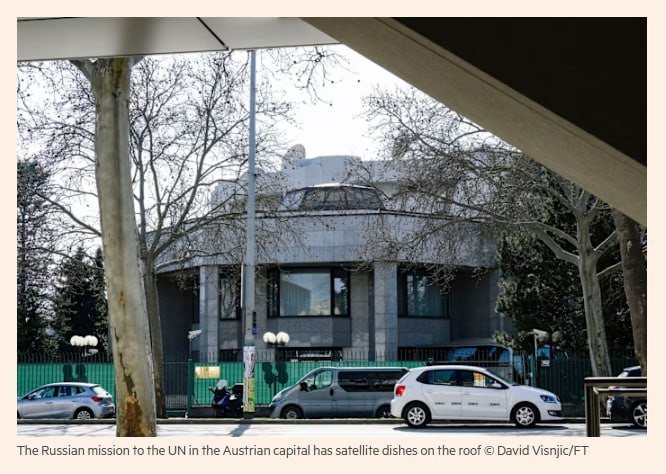
According to ORF, between six and eight antennas are installed on the roof of the Russian embassy alone, with at least one capable of intercepting signals not intended for Russian recipients.
Western intelligence services have also observed that antenna positioning changes frequently, including before and after major international events such as the Munich Security Conference. Additional installations have been identified on other Russian-owned properties in Vienna, including the cultural center at Brahmsplatz and a former sanatorium on Sternwartestrasse.
According to Financial Times, Vienna hosts numerous international organizations, including the United Nations, the Organization for Security and Co-operation in Europe, the International Atomic Energy Agency, and OPEC, all of which rely on satellite communications, making the city a strategically valuable location for interception activities.
Möchel noted that a major European satellite communications station is located approximately 100 kilometers southeast of Vienna, further increasing its intelligence value. Austrian historian Thomas Riegler told Financial Times that the Russencity complex, initiated under former Soviet leader Yuri Andropov in the 1980s, was likely designed with intelligence functions in mind.
Following Russia’s full-scale invasion of Ukraine, many European countries expelled Russian diplomats suspected of espionage, but Austria has taken a more limited approach. According to Financial Times, Austrian intelligence estimates that around 500 Russian diplomatic staff remain in Vienna, with up to one-third suspected of intelligence activity.
-972b40303f2e57597e22987d16a593dd.jpg)
Austria’s Directorate for State Protection and Intelligence warned that Russia’s systems in Vienna pose “a significant security risk” due to their “technical capabilities and flexible configuration,” while the Austrian foreign ministry stated it is “working intensively” with security agencies to address the issue, without providing operational details.
Earlier, according to Financial Times on February 4, European intelligence officials warned that Russian Luch-1 and Luch-2 satellites may have intercepted unencrypted communications by operating close to European satellites, potentially accessing sensitive data across Europe, Africa, and the Middle East.
Discuss this article:
-4a56a6b482ec132402c16ef6fcabf9a2.png)

-c439b7bd9030ecf9d5a4287dc361ba31.jpg "Photo of Katherina Popilnichenko")