- Category
- Latest news
Russia’s “Courier” UGV Pulls 3-Ton Howitzer, But Terrain and Power Issues Limit Battlefield Use
 Prefer U24 Media on Google
- Authors


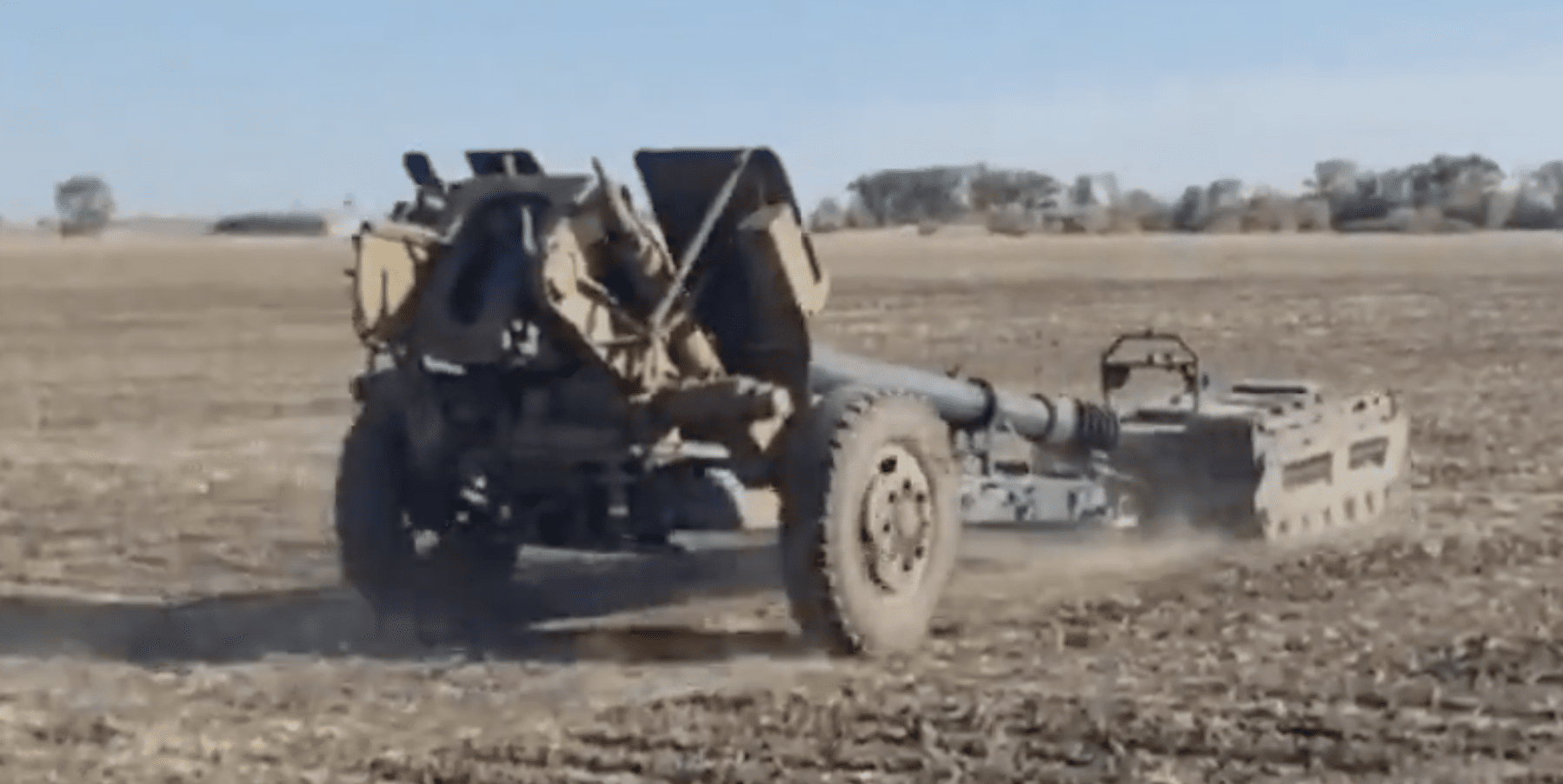
Russian forces have demonstrated a new application for the “Courier” ground-based robotic complex, showcasing the UGV’s ability to tow a full-sized 122mm D-30 howitzer, according to Defense Express on April 20.
In recently released footage, the tracked “Courier” robot is seen both pulling and pushing the artillery system across a relatively flat, open field. The D-30 howitzer has a transport weight of approximately 3,290 kg, indicating that the “Courier” possesses the torque necessary to move heavy payloads.
We bring you stories from the ground. Your support keeps our team in the field.
In an environment saturated with FPV drones, any manned vehicle acting as a tractor is a high-priority target. Utilizing a UGV to reposition artillery theoretically allows units to move their firing positions without risking a crew.
Despite the successful demonstration on flat terrain, the Courier’s small stature creates immediate practical issues for frontline use. As reported by Defense Express, the UGV is significantly smaller than the howitzer it tows, and in the current setup, the D-30’s trails are positioned extremely close to the ground.
On a real battlefield riddled with craters and debris, these trails would likely snag or dig into the earth, potentially immobilizing the entire system. Furthermore, the robot moves at a modest pace, raising questions regarding how long the UGV’s batteries can sustain a 3.2-ton load.
Increasing endurance would likely require additional battery packs, which could inadvertently reduce the robot's overall payload capacity and complicate its power management.
Video of a Russian Courier UGV pulling a D-30 howitzer. https://t.co/Qn6bZ2VYjy pic.twitter.com/FkPhAvOLfz
— Rob Lee (@RALee85) April 18, 2026
While the sight of a robot towing a howitzer is visually striking, analysts suggest that the "Courier's" dimensions make it better suited for a different high-risk task: ammunition resupply.
Delivering shells to frontline positions often involves traveling the same predictable routes repeatedly, making it one of the most dangerous jobs for human crews. Given the current constraints of the “Courier’s” frame and ground clearance, refining its role as a persistent ammunition carrier may offer more immediate tactical value than attempting to move heavy artillery across the difficult terrain of the contact line.
Days earlier, the Russian heavy unmanned ground vehicle “Chelnok” has made its battlefield debut in the Kharkiv sector.
“Chelnok” was marketed as a specialized engineering platform for mine-clearing operations. Early prototypes were specifically showcased with the UR-83P demining system, designed to create safe paths through hazardous terrain by detonating linear explosive charges.
Discuss this article:
-9bd5e1532102621f8fb1c4ba871a3171.png)

-9fc3cf73e00823179b7f7cb9b3c735e8.jpeg "Damage to a building in Kyiv following a Russian ballistic attack on the capital. (Source: State Emergency Service of Ukraine)")
-72b63a4e0c8c475ad81fe3eed3f63729.jpeg "Photo of Cyril Barabaltchouk")