- Category
- Latest news
Ukraine Patents Bohdana 6.0 Artillery System, Eyes Licensed Production Abroad
 Prefer U24 Media on Google
- Authors


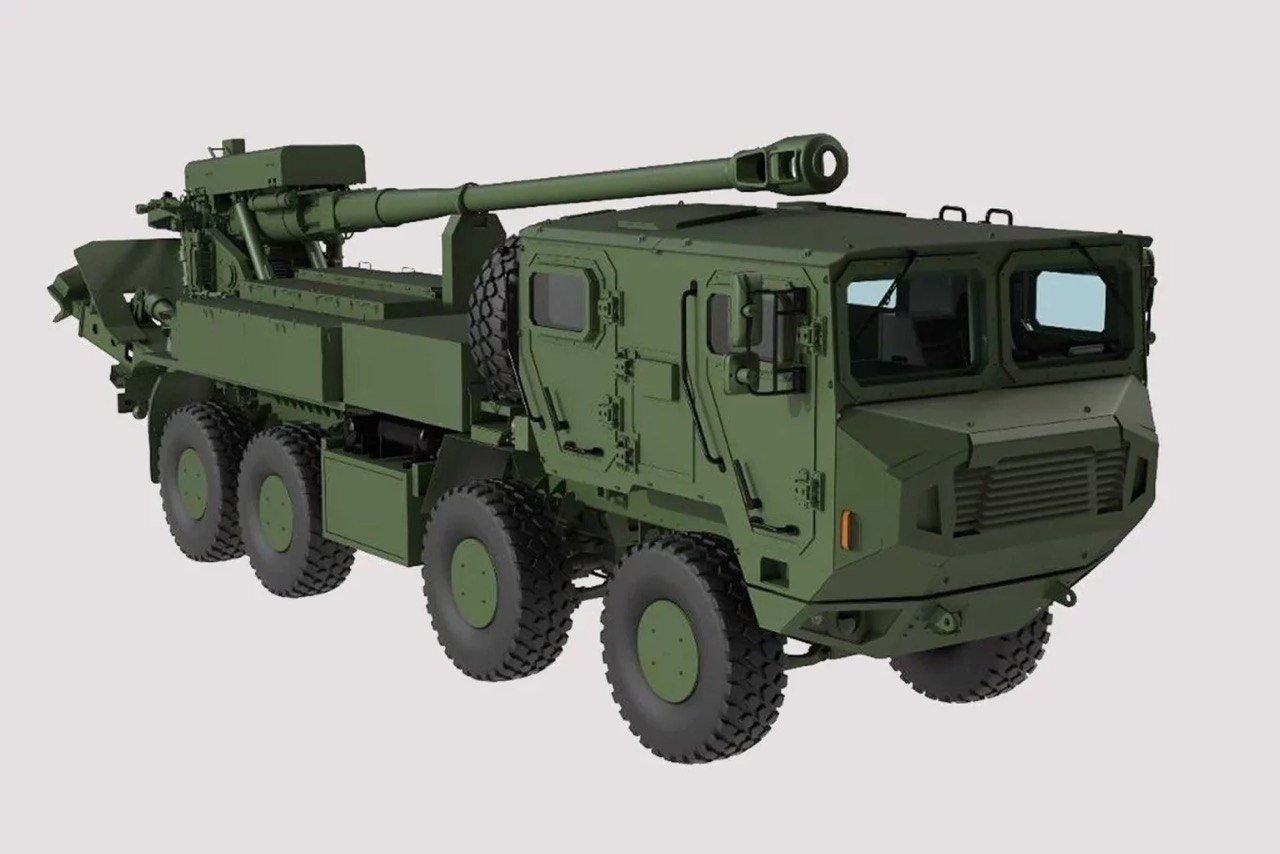
Ukraine advanced its domestic artillery capabilities with the development of a new variant of the 155mm self-propelled howitzer, designated Bohdana 6.0 on July 2.
The update follows the international registration of a patent by the Kramatorsk Heavy Machine Tool Building Plant (KZVV) under the Patent Cooperation Treaty (PCT), enabling legal protection of the design across multiple jurisdictions.
The documentation covers both a complete self-propelled configuration and a modular artillery system adaptable to different wheeled platforms.
According to Army Recognition on July 7, the new patent signals Ukraine’s intent to expand international co-production of the Bohdana system. The 6.0 variant becomes the sixth self-propelled model in the Bohdana family, joining a towed version known as the Bohdana-B or 2P22 Bohdana-BG.
The patented design features a new chassis integration and includes a semi-automatic rammer. Although not yet deployed operationally due to current limitations that prevent simultaneous loading and aiming, the inclusion of this system in the patent indicates ongoing efforts to enhance automation.
The patent’s release suggests preparations for licensed production abroad, aligning with recent defense cooperation initiatives, including Denmark’s $47 million investment in Ukrainian weapons manufacturing on Danish territory. Denmark previously supported the delivery of 18 Bohdana units to Ukraine in 2024.
The most recent deployed version, Bohdana 5.0, entered service with Ukraine’s 44th Separate Artillery Brigade in May 2025. It features a Tatra Force 8×8 chassis, a domestically produced armored cabin replacing the earlier Czech Puma L2 units, a mechanical loading arm, and an anti-drone net system. This variant supports reloading from the ground or supply vehicles and incorporates a reorganized rear section.
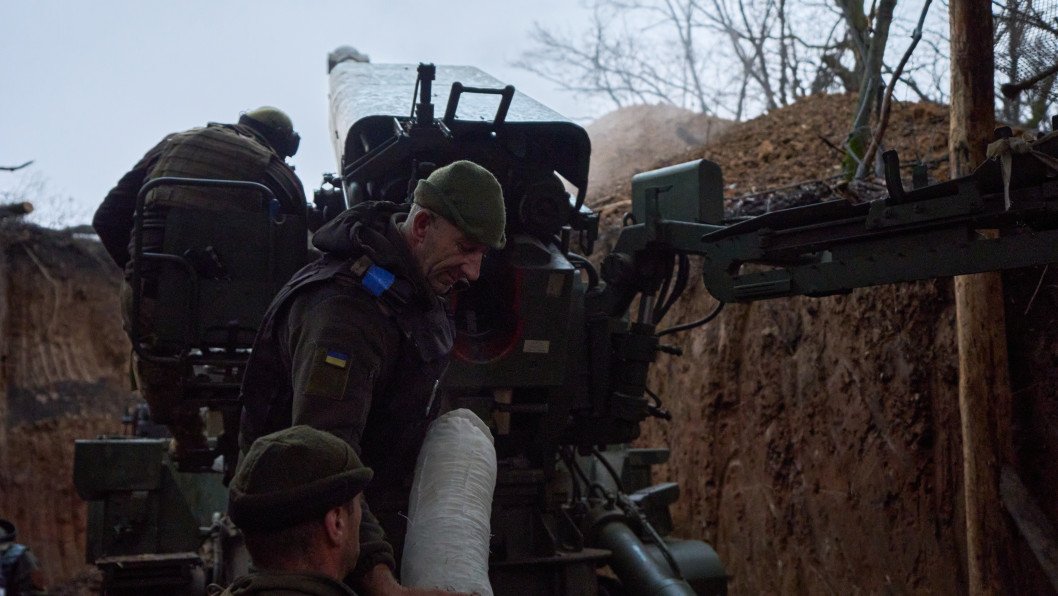
The development of the Bohdana series began in 2018 with a prototype mounted on a KrAZ-6322 chassis. Initial progress was delayed by legal disputes, technical challenges, and supply chain issues related to 155mm ammunition.
These obstacles were resolved by 2021, leading to operational deployment in 2022 following the platform’s involvement in the campaign to retake Snake Island. Ukraine transitioned to serial production in 2023.
Subsequent variants have included the 2.0 on a MAZ-6317 chassis, the 3.0 on a Tatra 815-7, and the 4.0 on a Tatra Phoenix with enhanced loading and protection systems. By late 2024, over 150 Bohdana units had been produced.
Ukrainian defense officials have stated that monthly output reached 20 units, with optimal conditions allowing for up to 36. By mid-2025, more than 85% of components were sourced domestically, with a target of reaching 95% by the end of the year. Manufacturing operations are distributed across facilities in Ukraine and EU member states to reduce exposure to missile attacks.
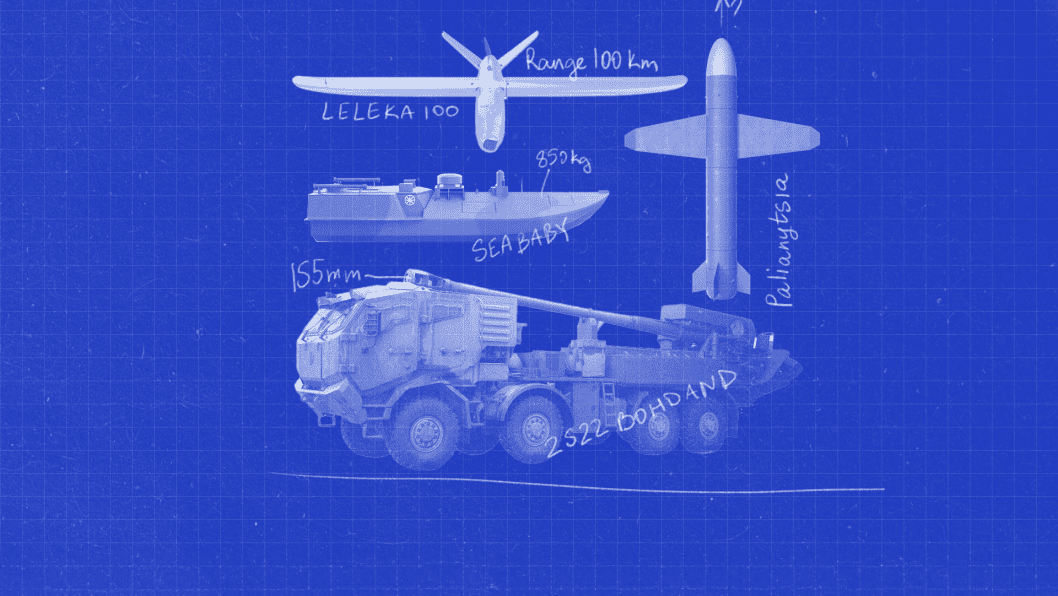
In response to vehicle chassis shortages, Ukraine developed the Bohdana-B, a towed version using the same 155mm L52 artillery module. Mounted on a modified Soviet 2A36 Giatsint-B carriage, it was first presented in October 2024 and entered service with the 47th Separate Artillery Brigade in March 2025.
The towed version is transported by Daewoo Novus trucks and incorporates upgrades to recoil and aiming systems. While it lacks an autoloader and offers lower mobility, it is more cost-effective, with an estimated price between $1.5 and $2 million—compared to $2.5 to $3 million for the self-propelled versions.
Barrel and artillery module production currently exceeds the availability of vehicle platforms, prompting consideration of additional adaptations, such as shortened 39-caliber barrels or retrofitting Soviet-era systems to NATO standards.
The Bohdana system uses a 155mm L52 barrel compatible with NATO-standard ammunition, including M107, M795, M549A1 RAP, BONUS submunitions, and M982 Excalibur precision-guided projectiles. Ukrainian forces have also employed German DM121, South African V-LAP, and Indian-manufactured rounds.
-4f4595657c2936cbd7988534635071d0.jpg)
Fire control is managed via an integrated Ukrainian system combining GPS, inertial navigation, UAV input, and counterbattery radar. More recent versions include ballistic velocity radar, likely the 112L4. The system is capable of firing 5 to 6 rounds per minute, with effective ranges between 42 and 60 kilometers depending on the munition type.
Operational use has been confirmed in multiple regions, including Bakhmut, Zaporizhzhia, and Kherson. Ukrainian forces have documented successful strikes at distances exceeding 48 kilometers. As of June 2025, open-source analysts confirmed the destruction or damage of at least 27 Bohdana units across all variants.
The platform’s vehicle weight is approximately 28 tonnes, with a top road speed of 80 km/h and an operational range of 800 kilometers. Off-road mobility allows for 30 km/h over a distance of 300 kilometers.
The armored cabin, developed by Ukrainian Armor, offers protection against 7.62mm armor-piercing rounds and mine resistance up to STANAG Level 2b. Vehicle systems feature built-in redundancy, with mechanical backups for hydraulic and electrical subsystems.
The onboard ammunition storage capacity is 20 rounds, and the platform allows for remote operation of targeting and fire control systems. The manufacturer reports that most repairs are completed within 48 hours, and spare parts are typically available within 24 hours.
Ukrainian crews have reported low barrel degradation, with some claiming over 8,000 rounds fired with sustained accuracy, supported by proprietary rifling and stabilizing mechanisms.
The 2S22 Bohdana is in service with multiple units of the Armed Forces of Ukraine, including the 44th, 45th, 55th, and 26th Artillery Brigades; the 57th Motorized Brigade; and the 406th and 32nd Naval Artillery Brigades. It is also used by the National Guard, the National Police’s “Liut” and “Khizhak” brigades, and elements of the Main Intelligence Directorate (HUR).
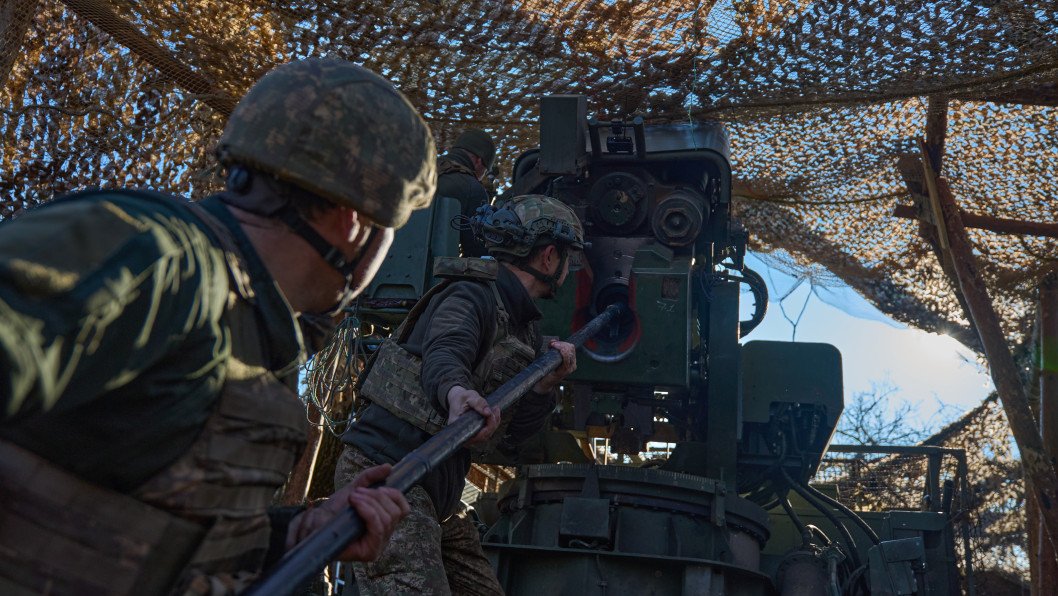
Training documents and combat imagery confirm its widespread operational use and survivability against drone attacks, including ZALA Lancet munitions.
In addition to being Ukraine’s first NATO-standard artillery platform, the Bohdana series serves as the foundation of a broader defense strategy aimed at increasing domestic weapons production and reducing reliance on foreign artillery systems.
Earlier, in April 2025, Ukraine nearly doubled the monthly production rate of its Bohdana self-propelled howitzers to as many as 36 units. The increase followed efforts to decentralize manufacturing across domestic and international facilities, with over 85% of components produced within Ukraine.
Discuss this article:

-3dc43d0d8b8ab0d7d00a1b4d64f1a3a5.jpg "The national flags of China and Russia flutter at Tian’anmen Square on May 19, 2026 in Beijing, China. (Source: Getty Images)")
-72b63a4e0c8c475ad81fe3eed3f63729.jpeg "Photo of Cyril Barabaltchouk")

-111f0e5095e02c02446ffed57bfb0ab1.jpeg "Photo of Roman Kohanets")