- Category
- Latest news
Zelenskyy at Munich Security Conference: “It Is Ukrainians Who Hold the European Front”
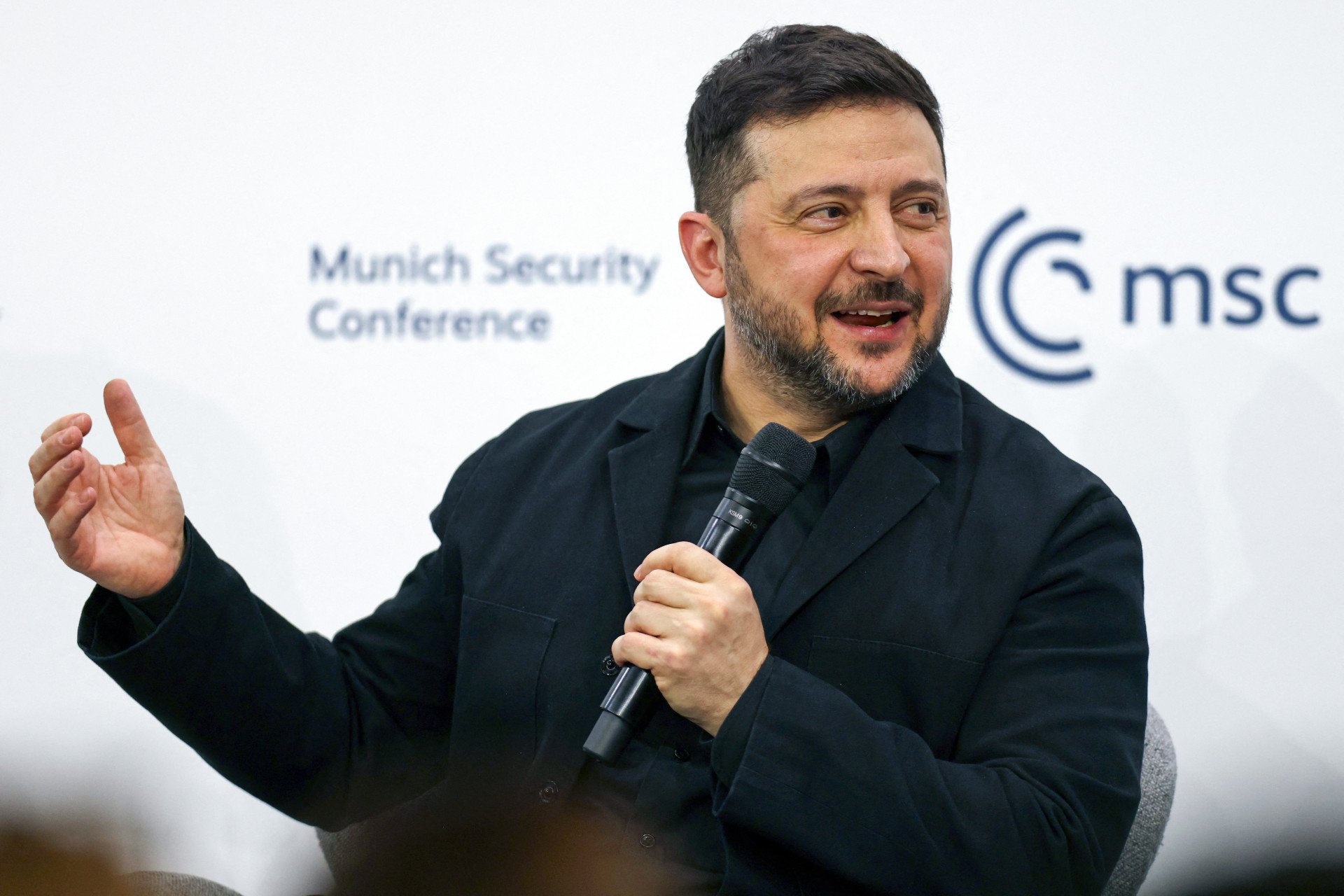
At the Munich Security Conference on February 14, President Volodymyr Zelenskyy delivered a wide-ranging speech focused on security guarantees, battlefield realities, Western responsibility, and what he described as the fundamental nature of Russia’s leadership.
 Prefer U24 Media on Google
- Authors


According to Zelenskyy’s address, any agreement to end the war without firm international guarantees would be fragile and could fail to prevent renewed aggression. His remarks combined historical warnings, operational data, and direct political messaging aimed at both European capitals and Washington.
We bring you stories from the ground. Your support keeps our team in the field.
“He may see himself as a Tsar, but he is a slave of war”
Zelenskyy argued that Vladimir Putin remains driven by imperial logic and is incapable of stepping away from war. He said the Russian leader “consults more with Tsar Peter and Empress Catherine about territorial gains than with any living person about real life,” suggesting Moscow’s decisions are shaped by historical expansionism rather than present-day realities.
⚡ Zelenskyy: "Putin consults more with Tsar Peter and Empress Catherine about territorial gains than with any living person about real life.
— UNITED24 Media (@United24media) February 14, 2026
Can you imagine Putin without war?" pic.twitter.com/jWXuLrG5TH
“He may see himself as a tsar, but in reality he is a slave of war,” Zelenskyy said, adding that Putin “cannot imagine life without power or after power.” According to him, the longer the war continues, the more dangerous its evolution becomes.
“War reveals forms of evil we did not expect,” he warned, stressing that the evolution of weapons, the war itself, and Putin’s own trajectory are becoming increasingly dangerous.
Security guarantees must come before any settlement
The central diplomatic message of the speech was clear: guarantees must precede peace.
Zelenskyy said Ukraine has “strong agreements ready to be signed with the United States and Europe” and insisted that “an agreement on security guarantees must come before any agreement on ending the war.”
⚡ Zelenskyy: "Ukraine is ready for a deal—one that brings real peace to Ukraine and to Europe.
— UNITED24 Media (@United24media) February 14, 2026
I am confident that this war can be ended, and ended with dignity." pic.twitter.com/4Cr91tkuSy
He framed this as the only reliable way to answer what he described as the key strategic question: “Guarantees will answer the main question: how long there will be no war?”
He expressed hope that US President Donald Trump “will hear us,” while emphasizing that elections in Ukraine could only take place after active hostilities cease and security guarantees are secured.
Trump’s “big packages”—but Kyiv wants sequencing
Commenting on Trump’s negotiating style, Zelenskyy said the US leader “wants to conclude a deal immediately because he likes big packages.”
While acknowledging this approach, he stressed that for Ukraine the order of decisions matters more than the scale of the package itself.
⚡ Zelenskyy: "We hope Trump hears us. We hope Congress hears us. We hope the American people hear us. And we are grateful for all the real help." pic.twitter.com/yDQ6OICm1e
— UNITED24 Media (@United24media) February 14, 2026
According to Zelenskyy, enforceable security mechanisms must be defined first, ensuring that any broader agreement does not become temporary or reversible.
“We shoot down 90% of Shaheds”
Expanding on the scale of nightly attacks, Zelenskyy addressed the effectiveness of Ukraine’s air defense against Iranian-made Shahed drones used by Russia, underscoring both the intensity of the assaults and the growing resilience of Ukraine’s defenses.
“Every night we face no fewer than a hundred Shaheds, sometimes 400–500. We shoot down 90% of them,” he said, describing the sustained pressure on Ukrainian cities and energy infrastructure.
⚡ Zelenskyy: "We will reach the point where we produce enough interceptors to make Shahed drones meaningless for Russia." pic.twitter.com/d93YeBQnep
— UNITED24 Media (@United24media) February 14, 2026
According to Zelenskyy, Ukrainian forces are deploying various types of interceptors while increasing joint production with international partners.
“Together with our partners, we produce more and more of them every day, and we will reach the moment when we produce enough—enough to make Shaheds insignificant for Russia. But the key words here are together with partners,” he said, emphasizing that continued cooperation is essential.
⚡ Zelenskyy: "Iranian Shahed drones they sold to Russia are killing—especially our people, Ukrainians—and destroying our infrastructure.
— UNITED24 Media (@United24media) February 14, 2026
The Iranian regime has already done, and can still do, more harm than many other regimes could in a century." pic.twitter.com/xQ95GUWBWE
Zelenskyy also directly addressed Iran’s role in the war, noting that Ukraine has no direct geopolitical conflict with Tehran. “We do not share a border with Iran, and we have never had a conflict of interests with the Iranian regime,” he said. “But Iranian drones that they sold to Russia are killing people, especially ours, Ukrainians, and destroying our infrastructure.”
⚡ Zelenskyy: "Today, the people of Iran expect from the world what we in Ukraine needed on February 24th, when the Russian invasion began: unity, determination, and speed—of course, speed." pic.twitter.com/DwP80zYAUU
— UNITED24 Media (@United24media) February 14, 2026
Broadening the point beyond Ukraine, Zelenskyy added: “Today, the people of Iran expect from the world what we in Ukraine needed on February 24th, when the Russian invasion began: unity, determination, and speed—of course, speed.”
“Putin hopes to repeat Munich 1938”
During a joint panel with NATO Secretary General Mark Rutte, Zelenskyy drew a direct historical comparison. “Putin hopes to repeat Munich 1938,” he said, arguing that “it would be an illusion to believe that this war can be reliably ended by dividing Ukraine, just as it was an illusion to believe that sacrificing Czechoslovakia would save Europe from a great war.”
⚡ Zelenskyy: "Putin hopes to repeat Munich — not Munich 2007, when they only spoke about dividing Europe, but Munich 1938, when the previous Putin began dividing Europe in reality." pic.twitter.com/aGrRdutuWp
— UNITED24 Media (@United24media) February 14, 2026
At the same time, he emphasized that Ukraine remains engaged in diplomatic efforts. Kyiv, he said, is in constant contact with US representatives and “will work with anyone appointed by President Trump.” However, “the result of all these efforts must be real security and real peace,” not what he described as the outcomes of earlier failed formats.
“Ukrainians hold the European front”
Zelenskyy framed Ukraine’s resistance as a continental defense line. “It is Ukrainians who hold the European front,” he said, pointing to the cost the country has endured. Behind Ukraine, he added, stand “independent Poland, the free Baltic states, Moldova, Romania—without dictators.”
⚡ Zelenskyy: "The Ukrainian Army is the strongest army in Europe, thanks to our heroes.
— UNITED24 Media (@United24media) February 14, 2026
And I think it is simply not smart to keep this army outside NATO." pic.twitter.com/fmj34p98K1
In a pointed remark aimed at Hungarian Prime Minister Viktor Orbán, Zelenskyy said that “even one Viktor can think about growing his belly instead of his army to stop Russian tanks from returning to the streets of Budapest.”
⚡ Zelenskyy: "Even one “Viktor” can think about how to grow his belly, not how to grow his army to stop Russian tanks from returning to the streets of Budapest." pic.twitter.com/3OTlJWxEix
— UNITED24 Media (@United24media) February 14, 2026
He underscored the human dimension of the war, stating: “Our people are people, not Terminators,” and warning that “it is wrong to assume that this is a permanent arrangement, that others can stay safe behind Ukraine forever.”
“The worst news during war is empty air defense”
A significant portion of the speech focused on air defense and the strain caused by continued Russian strikes. Zelenskyy described one of the most alarming moments for a wartime leader as hearing that air defense units are “empty-handed” while intelligence warns of an incoming attack.
He referred to the February 12 strike, when Russia launched 24 ballistic missiles and 219 attack drones overnight. According to Zelenskyy, Ukrainian air defense relied on interceptor missiles that had arrived from partners only days earlier. “They arrived on Sunday, and on Thursday night those missiles were already defending our sky,” he said.
⚡ Zelenskyy: "We are grateful for all the supplies we have received. But you saw how long we had to push to be allowed to receive stronger and more advanced weapons (...) Not a single day—not a single opportunity to protect life—can be wasted." pic.twitter.com/pEuiGISEfn
— UNITED24 Media (@United24media) February 14, 2026
He thanked Germany, Norway, and the Netherlands for leadership in supplying air defense systems and highlighted the European-funded PURL program as crucial for intercepting ballistic threats.
To illustrate the scale of the campaign against Ukraine, Zelenskyy cited January figures: 6,000 attack drones, 158 missiles of all types, and 5,500 aerial bombs in a single month. “And yes—every month. Imagine this over your cities,” he told the audience, noting that large-scale attacks occur at least once a week.
The cost for Russia on the battlefield
Zelenskyy also detailed Russian losses, saying that in December Ukrainian forces eliminated 35,000 Russian troops killed or seriously wounded, and in January losses were about 30,000. On the Donetsk front, he said, “the price Russia pays for one kilometer is 156 soldiers.”
⚡ Zelenskyy: "The price Russia now pays for one kilometer is 156 soldiers.
— UNITED24 Media (@United24media) February 14, 2026
Putin may not be concerned about this now, but there is a level at which he will start to care." pic.twitter.com/L4b7fGul2e
Although Russia mobilizes around 40,000 people per month, Zelenskyy argued that the size of its contingent in Ukraine is not significantly increasing. “For our army the mission is clear—to eliminate more Russian occupiers, because they are occupiers,” he said, adding that the goal is “at least 50,000 per month.”
According to reporting from the conference, Zelenskyy received a standing ovation following his address, which framed the war not only as Ukraine’s struggle for survival but as a decisive moment for Europe’s long-term security architecture.
Earlier, President Volodymyr Zelenskyy said at the Munich Security Conference that Ukraine and its partners are finalizing what could be the largest energy aid package yet ahead of February 24, the fourth anniversary of Russia’s full-scale invasion. He added that additional military support and possible new sanctions were also discussed.
Discuss this article:
-4a56a6b482ec132402c16ef6fcabf9a2.png)


-c439b7bd9030ecf9d5a4287dc361ba31.jpg "Photo of Katherina Popilnichenko")