- Category
- Life in Ukraine
What Europe Saw When Ukraine Brought a War-Damaged School Desk to Its Institutions
 Prefer U24 Media on Google
- Authors


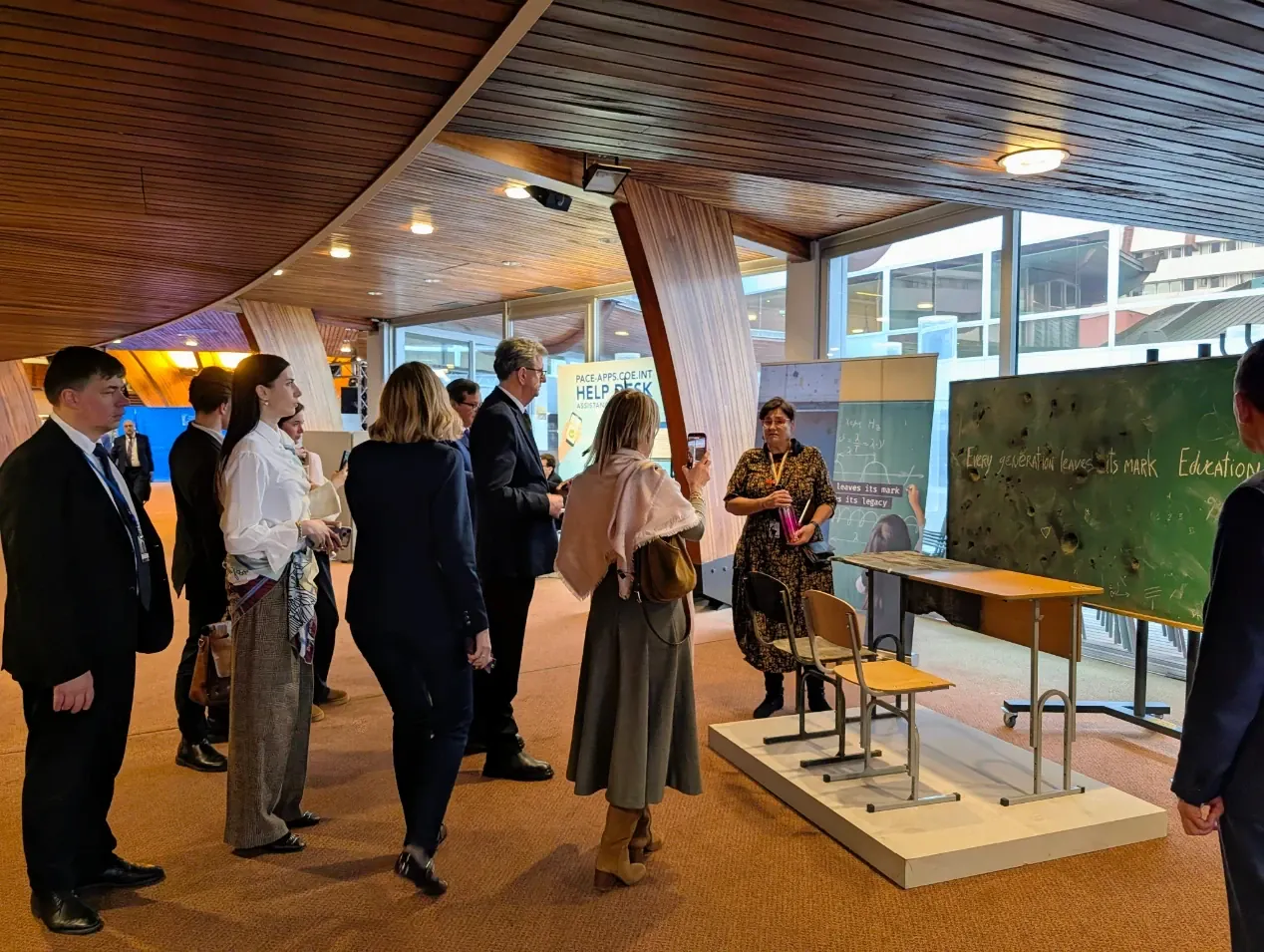
“On the first day of school, a child usually climbs the stairs to a classroom. But in Kharkiv, children descend underground.”
Petra Bayr, president of the Parliamentary Assembly of the Council of Europe, was speaking in Strasbourg in January 2026. In front of her stood an installation featuring a Ukrainian school desk divided into two contrasting realities. One half was intact. The other was burned and scarred by Russian attacks.
We bring you stories from the ground. Your support keeps our team in the field.
“Their school desks are in shelters,” Bayr stated. “But this is how destruction is transformed into resistance. This is how learning becomes an act of courage.”
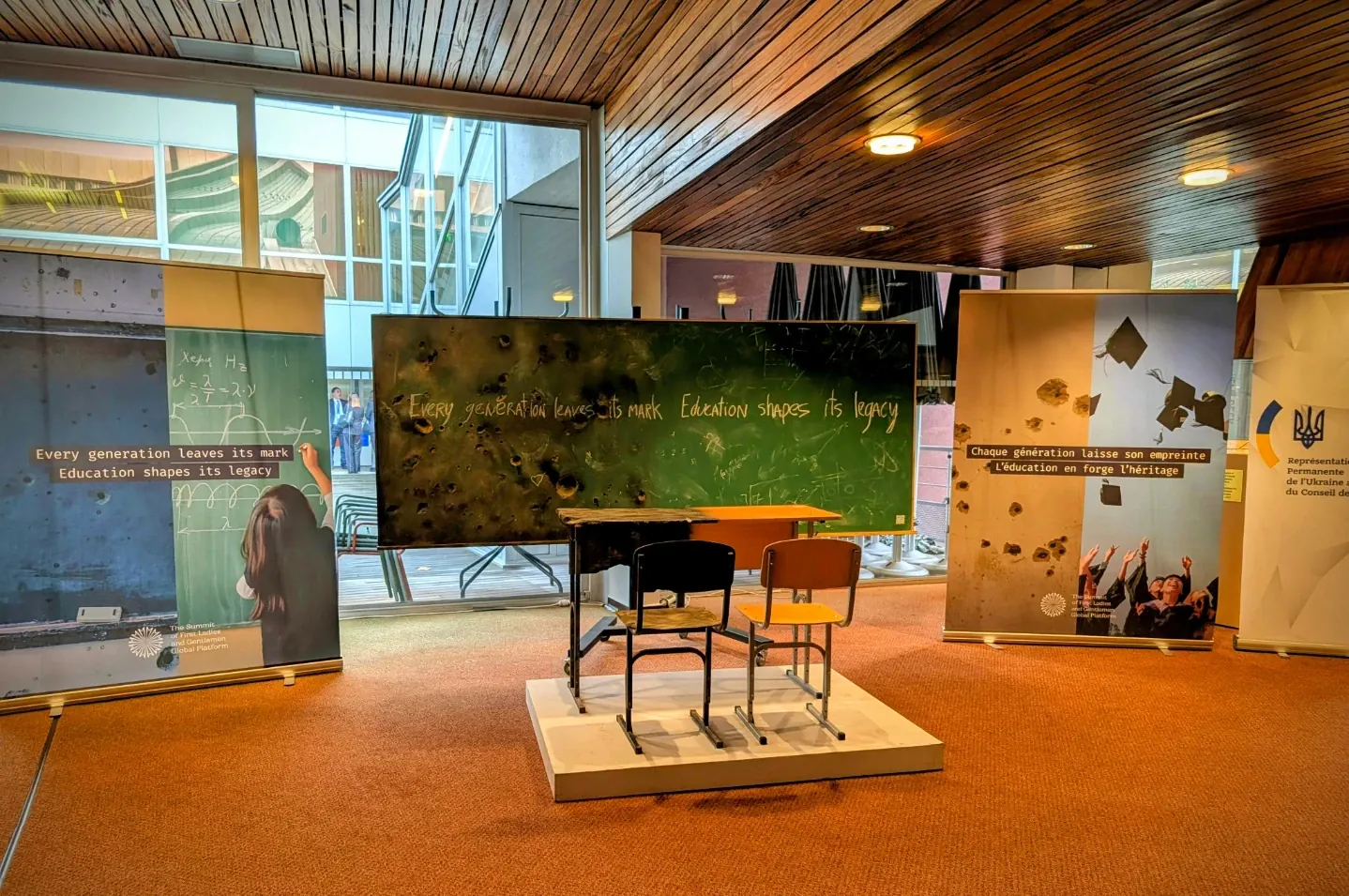
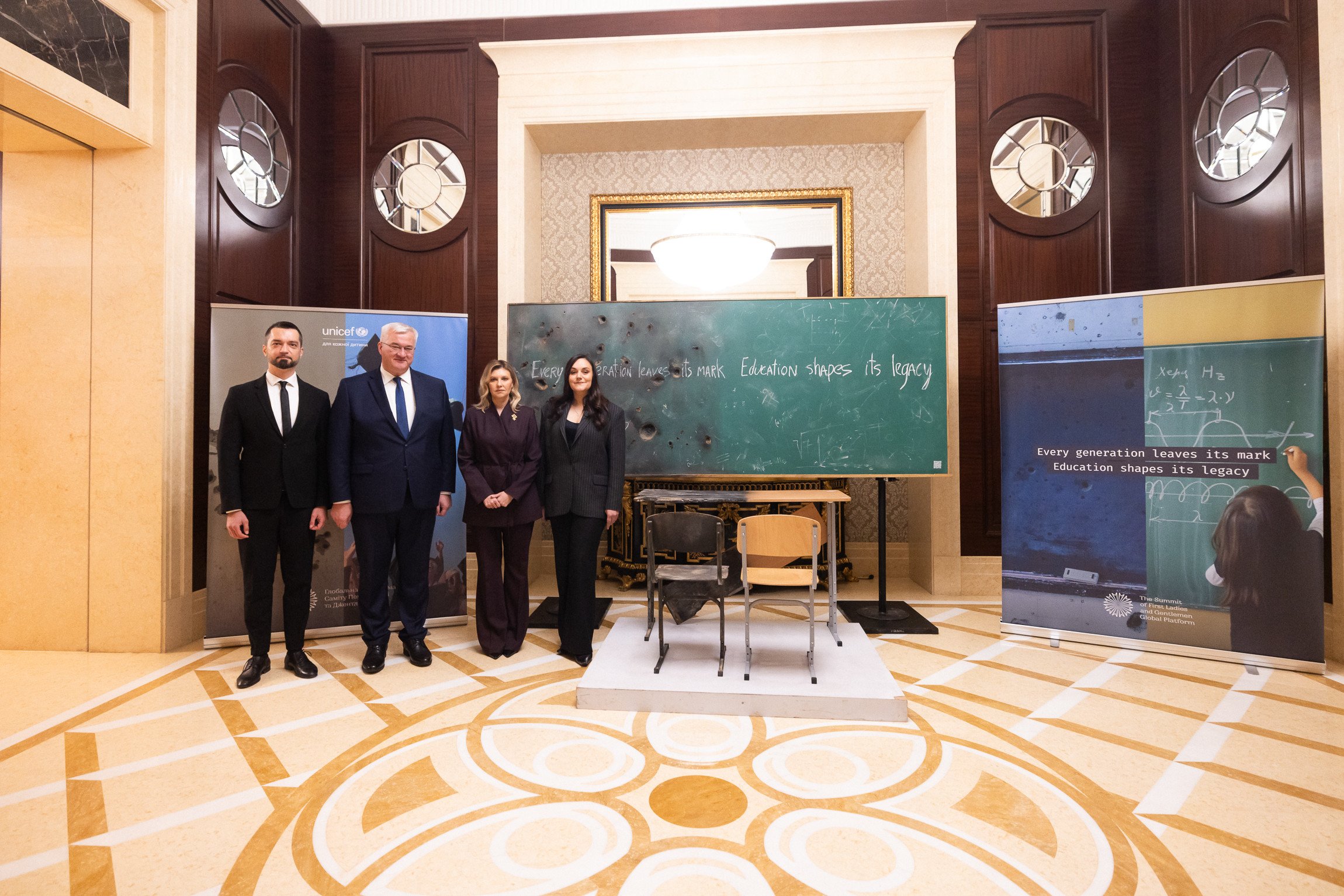
“One Desk. Two Marks” is a school desk and blackboard split in half: one side burned by shelling and fire, the other intact. The installation shows two possible childhoods for the same generation: one shaped by peace, the other by a war that reaches into classrooms, playgrounds, and the routines of a school day. It is part of the global campaign “Every Generation Leaves a Mark,” launched at the Fifth Summit of First Ladies and Gentlemen in September 2025 together with UNICEF and the creative agency banda.
Over the following year, the installation appeared inside some of the institutions where Europe debates education, security, diplomacy, and Ukraine’s future.
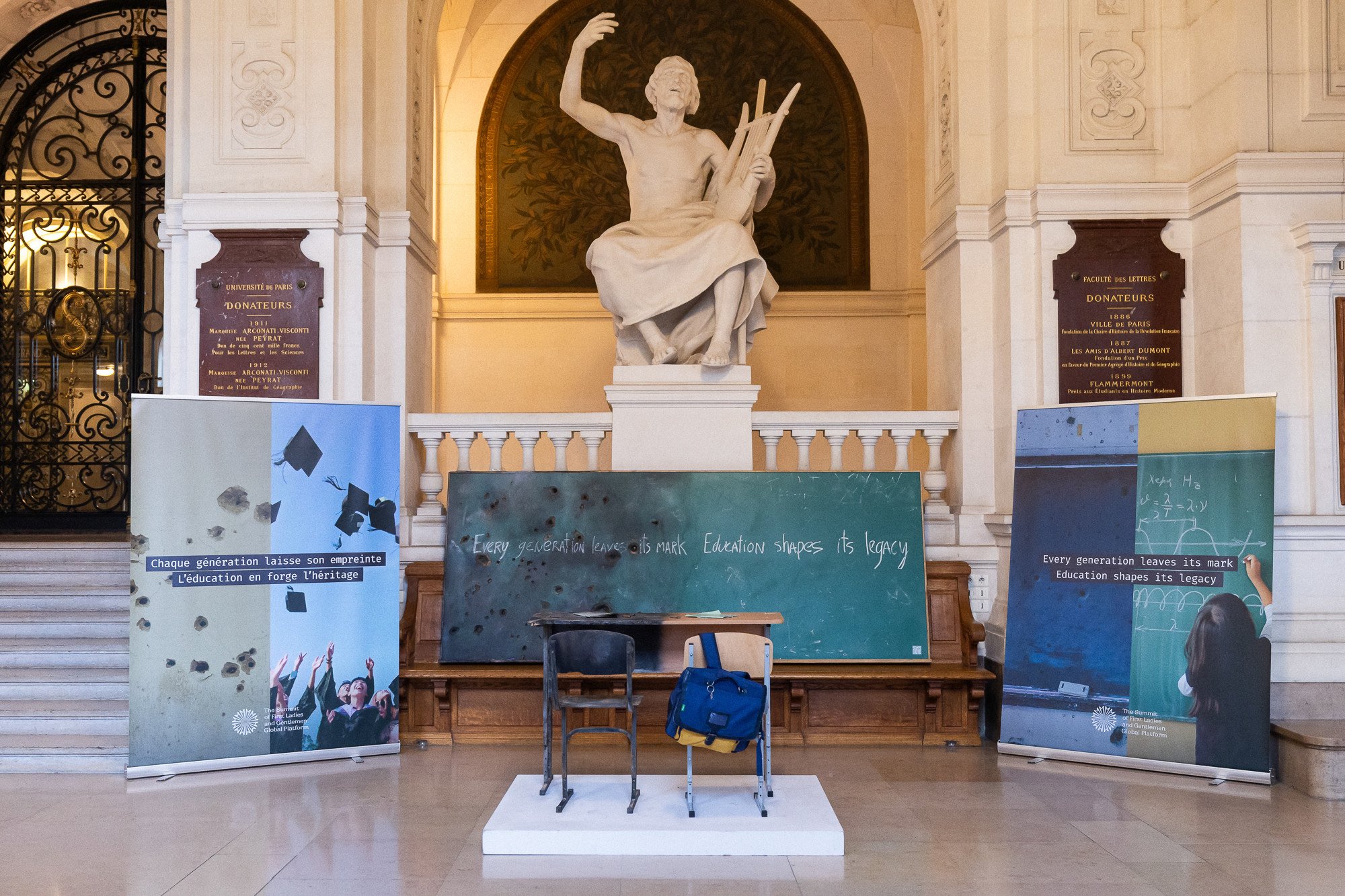
It was presented during the UN General Assembly in New York, exhibited at the Sorbonne in Paris, shown at the Parliamentary Assembly of the Council of Europe in Strasbourg, installed at the Palais des Nations in Geneva, and later displayed at UNESCO headquarters in Paris.
Images from the campaign also appeared in Times Square in New York. Organizers estimate that the project reached 31 million people across 32 countries.
But the power of the installation was not its itinerary. It was the contrast between the rooms it entered and the reality it represented.
At the Sorbonne, UNESCO, and the UN, the desk arrived as an object to be examined. In Ukraine, desks like it belong to an education system operating under the threat of Russian strikes.
More than 4,000 Ukrainian schools have been damaged or destroyed since the beginning of Russia’s full-scale invasion, according to figures provided by the campaign organizers.
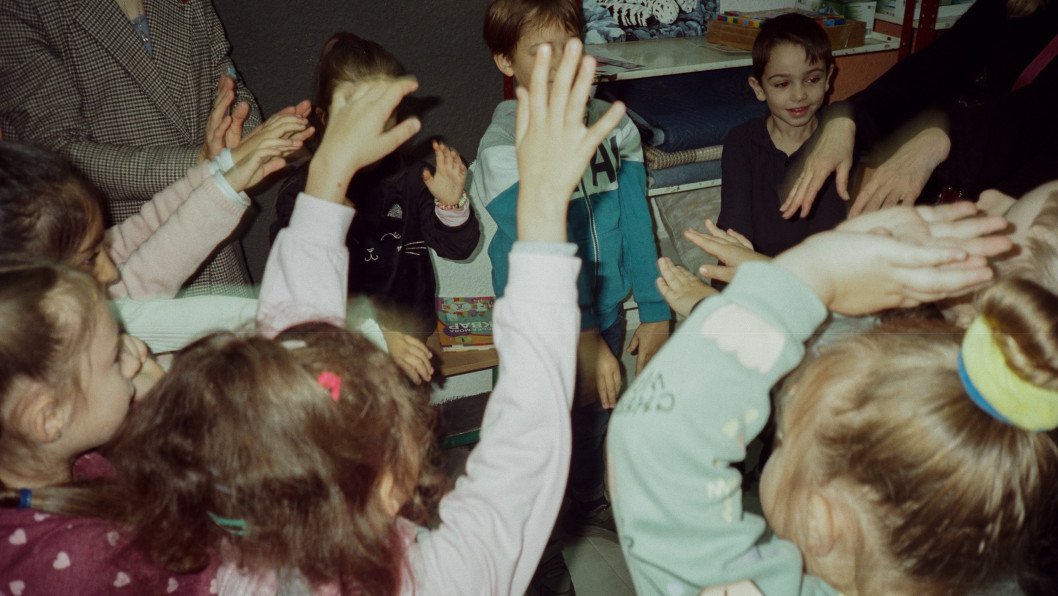
In cities including Kharkiv, children study underground because conventional classrooms cannot always provide adequate protection. Some schools have moved lessons into shelters and purpose-built underground spaces, turning the act of attending class into something physically different from the experience of children elsewhere in Europe.
That contrast was at the center of Bayr’s remarks in Strasbourg.
“But every generation leaves its mark,” she stated. “And I sincerely hope that the mark of the next generation will be a mark of dignity, freedom and peace.”
Ukraine’s representative to the Council of Europe, Mykola Tochytskyi, described the desk there as “a metaphor for the dual legacy of our time — destruction and resilience.”
For First Lady Olena Zelenska, the choice of a school desk was deliberate.

“The language of culture is the most vivid, and therefore the most compelling,” Zelenska stated at the International Cultural Diplomacy Forum in Kyiv on October 6, 2026.
“We can spend hours talking about Russian attacks on Ukrainian schools and citing horrifying figures. Or we can show a single school desk damaged by war. It will speak more clearly than a thousand words.”
That was also what made the object different from a conventional exhibition about the war. It asked viewers to recognize something ordinary before confronting what had happened to it.
A school desk is familiar almost everywhere. It belongs to childhood, routine, homework, boredom, friendships, and the expectation that a child will return to the same classroom the next morning.
The damaged half interrupted that familiarity.
At the Fifth Summit in Kyiv, Lithuanian First Lady Diana Nausėdienė described Ukrainian education during the war in broader terms.

“This is not merely education; it is resistance, democracy in action, and proof that knowledge and justice cannot be destroyed by missiles or propaganda,” she stated during a lecture at Taras Shevchenko National University of Kyiv.
As the desk moved between institutions, its surroundings changed. In Strasbourg, it stood inside the political architecture of the Council of Europe. In Geneva, it entered the Palais des Nations. In Paris, it was shown in spaces associated with higher education and UNESCO’s international work on education and culture.
The object itself did not change.
By the time it returned to Kyiv in October 2026, the desk had spent a year being viewed as a representation of Ukraine’s wartime experience.
At the International Cultural Diplomacy Forum, Ukrainian Foreign Minister Andrii Sybiha described culture as part of the country’s security.
“The return of our history and our culture is our existential security guarantee,” he stated.
Volodymyr Sheiko, director general of the Ukrainian Institute, described cultural diplomacy as the ability “through culture to influence how other societies understand reality and define the limits of what is politically possible.”
For international audiences, “One Desk. Two Marks” offered a physical way to encounter a reality that can otherwise be reduced to statistics.
For Ukrainians, its return home carried a different meaning.
The installation had traveled through New York, Paris, Strasbourg, and Geneva as a symbol of children studying through war. Back in Kyiv, the experience it represented was still unfolding: children continuing their education in shelters and underground classrooms while Russian attacks continued above them.
The reality represented by the installation remains part of everyday school life in Ukraine. On October 1, a Russian drone struck a school in Kyiv’s Solomianskyi district while children were sheltering underground inside the building, sparking a fire but causing no reported casualties.
Discuss this article: