- Category
- Opinion
The World Is Just Discovering Drone Warfare. Ukraine Has Lived It for Four Years
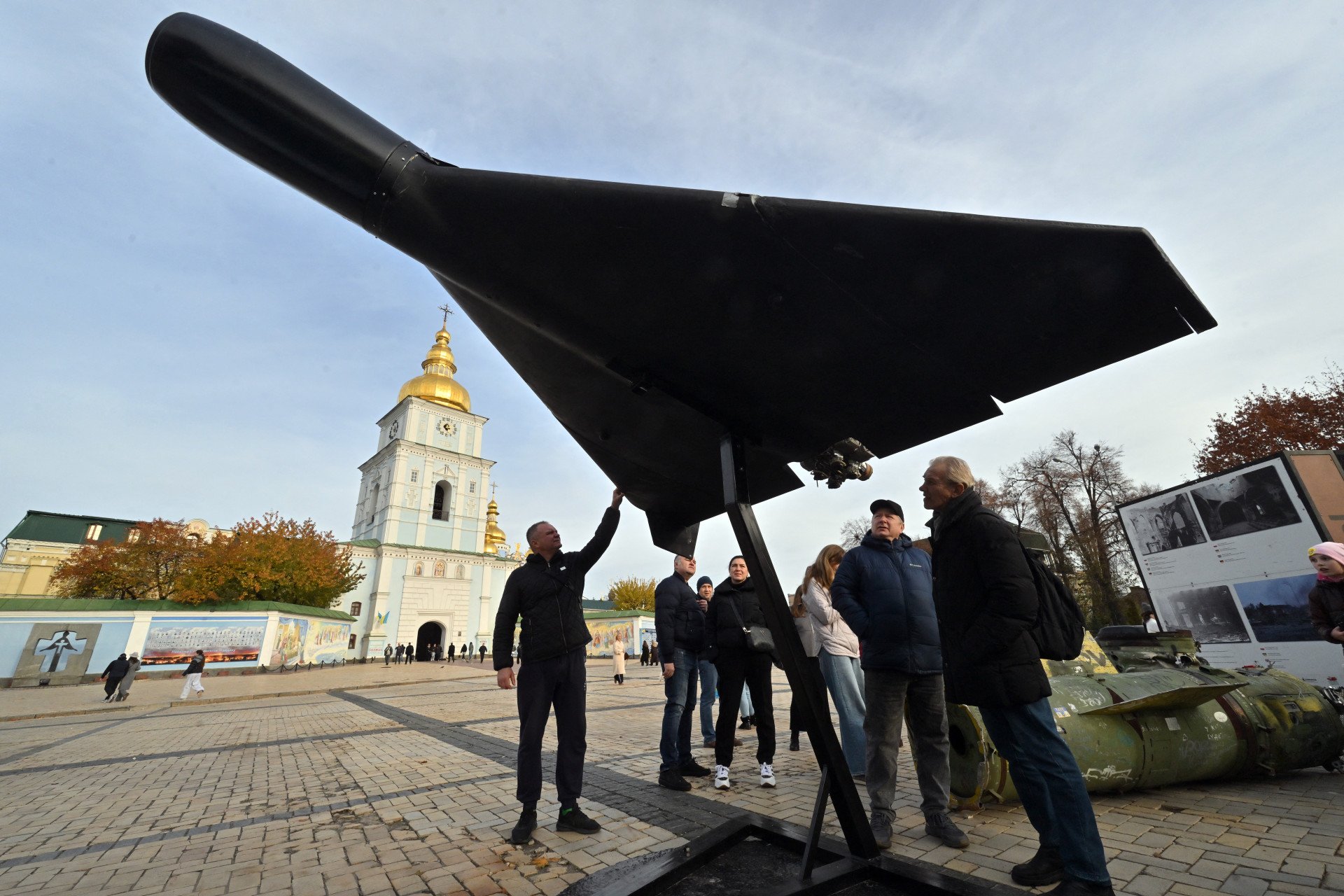
Cheap drones are reshaping modern warfare—and exposing a dangerous imbalance: they cost tens of thousands of dollars to build but millions to stop. Despite sweeping sanctions, Russia and Iran continue to build attack drones using Western technology.
 Prefer U24 Media on Google
- Authors

-7e242083f5785997129e0d20886add10.jpg "Photo of Victoria Vyshnivska")
After launching a military operation against Iran, the United States has, perhaps for the first time, encountered mass attacks by Iranian drones. These drones are ruthlessly precise while also cheap to produce. In private, the White House acknowledges that the “Shaheds” have proven to be a bigger threat than expected. At the same time, the air defense resources of the United States and its allies are limited, and using them to shoot down drones is extremely expensive.
Eight hundred missiles for Patriot systems were used in just three days of the war in the Middle East to counter Iranian attacks. Ukrainian President Volodymyr Zelenskyy cited this figure, emphasizing that Ukraine has never had that many Patriot missiles during the four years of Russia’s full-scale invasion.
And while in 2022 we were asking NATO to close the sky over Ukraine, today others are turning to us—for experience and interceptors to counter “Shaheds.”
We bring you stories from the ground. Your support keeps our team in the field.
Looking inside
After the start of the full-scale invasion, Ukraine’s Independent Anti-Corruption Commission added another area to its work. We began analyzing the weapons Russia uses against Ukraine following the first attacks by what were then purely Iranian drones. The goal was to “bleed” the enemy—cut off access to often irreplaceable microelectronics. Because the electronics were mostly Western.
And there turned out to be quite a lot of them—both in Iranian drones and later in the Russian-produced “Shaheds.”
In a 2023 study, we identified microelectronics from 16 companies in the Shahed-136:
United States—Adesto Technologies, Analog Devices, Freescale Semiconductor, Hemisphere GNSS, Hitec USA Group, International Rectifier, Marvell Technology, Maxim Integrated, Micrel Semiconductor, Micron Technology, MinMax Technology, ON Semiconductor, Texas Instruments
Japan—Murata Manufacturing
Canada—Tallysman
Switzerland—STMicroelectronics
![]()
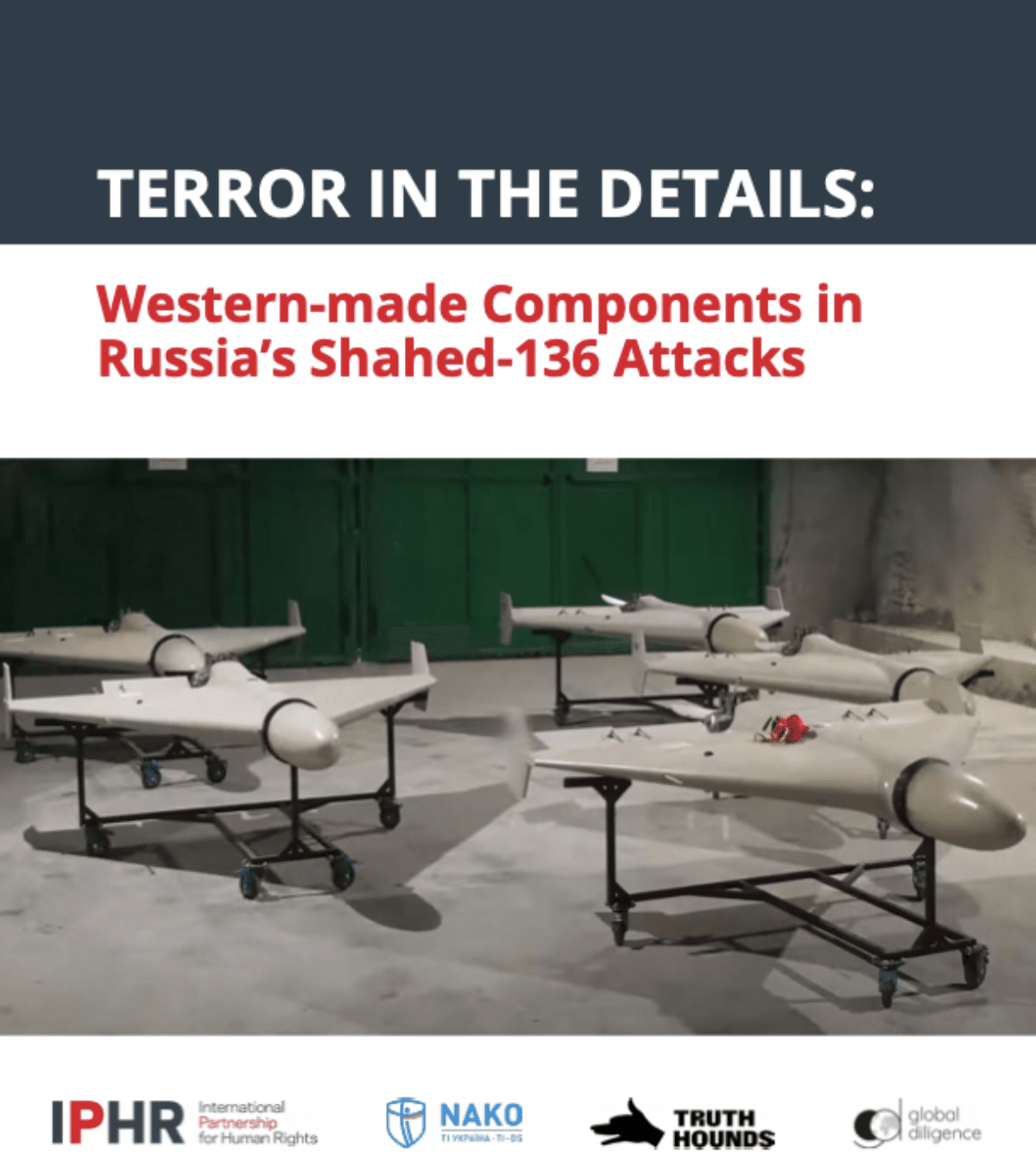
From microprocessors and semiconductors to antennas and memory modules—these are the components that turn enemy “tin cans” into effective weapons. Without them, the drones would be little more than explosive shells. And by a twist of irony, Iranian Shaheds containing American components are now flying directly toward US bases in Bahrain and Dubai.
How do Russia and Iran—among the most heavily sanctioned countries in the world—gain access to Western technologies? Primarily through intermediary companies in third countries. Countries in the Middle East play a significant role in this process. And, in an even greater irony, the United Arab Emirates—now also suffering from these drones—has effectively been and remains one of the key hubs for companies importing sanctioned goods into Russia. As a result, individuals and companies in the UAE have repeatedly been subject to Western sanctions.
Neutralized “Shaheds” in Europe
Last autumn, NAKO—supported by the Ukrainian President’s Commissioner for Sanctions Policy Vladyslav Vlasiuk, the Ministry of Justice of Ukraine, and the Kyiv Scientific Research Institute of Forensic Expertise—brought neutralized Russian drones, Shahed-136 / Geran-2 and Gerbera, to the Netherlands. The team also brought the foreign microelectronics found inside them.
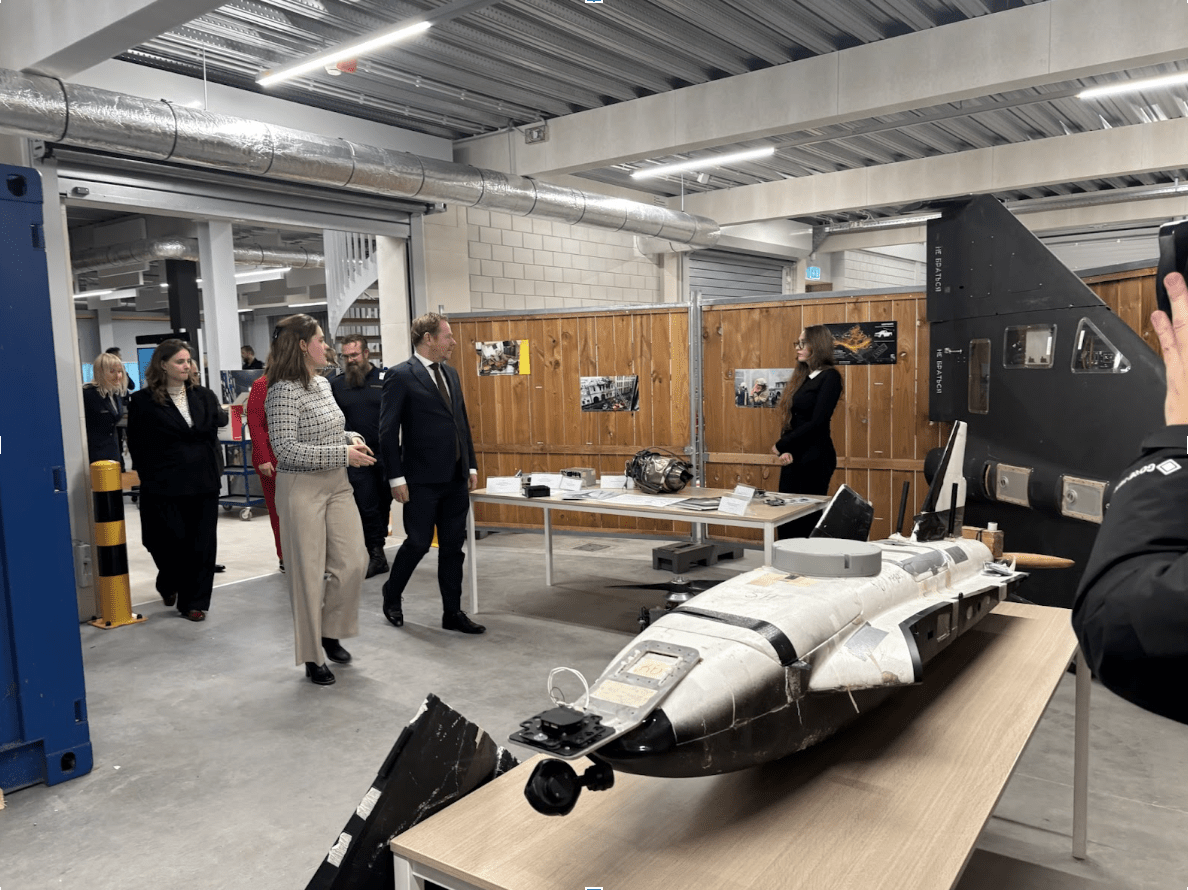
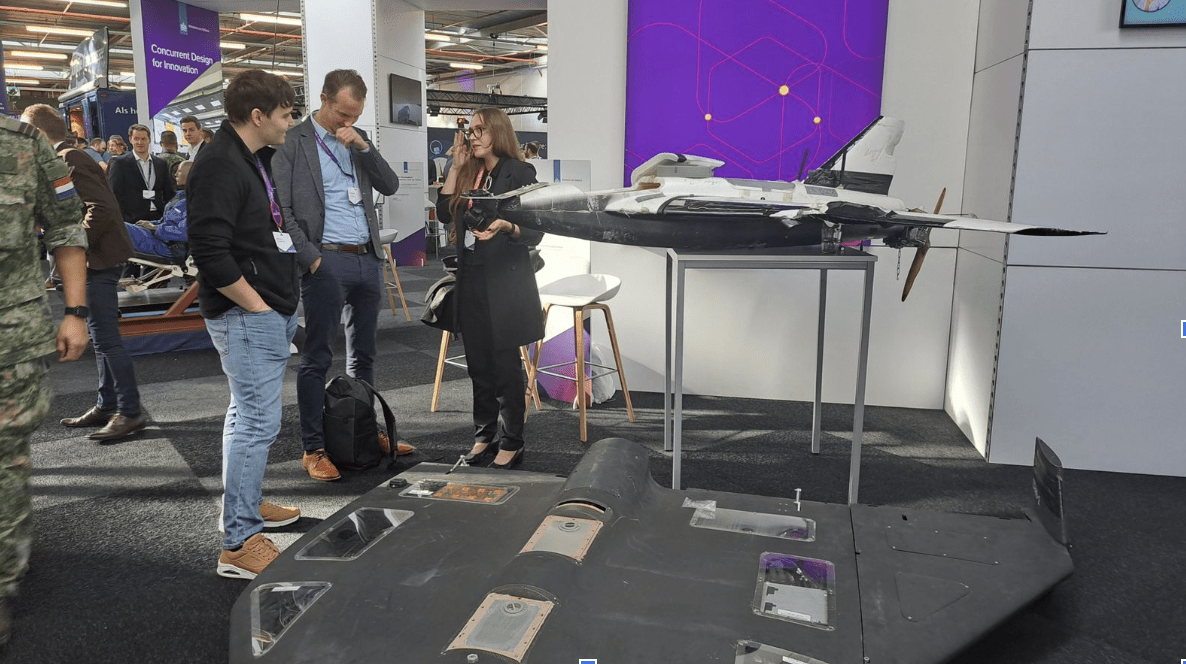
The exhibition, which included more than 40 exhibits (chips, microcircuits, engines—without which these drones would not fly), clearly demonstrated the scale at which Russia continues to circumvent sanctions.
The display was presented during a meeting with the Dutch Minister of Foreign Affairs, at an export-control seminar for local manufacturers, at an innovation exhibition organized by the Dutch Ministry of Defense, and at the Ukrainian embassy.
In this Russian “black version” of the Shahed, numerous Western components were again identified:
United States — Texas Instruments, Analog Devices, Intel, Broadcom, Integrated Silicon Solutions
Switzerland — STMicroelectronics, U-blox
United Kingdom — Raspberry Pi, AEL Crystal, Future Technology Devices International
Japan — Renesas
Netherlands — Nexperia, NXP
Germany — Epcos, REMA Group, Infineon
China’s role has also increased to some extent. For example, turbojet versions contain an engine from the Chinese company Telefly. There is also a clear attempt by Russia to replace some microchips: the Kometa navigation system—also used in glide bombs—appears to rely more heavily on components from domestic manufacturers. Yet in the wreckage, investigators still find Canadian Tallysman antennas and Irish Taoglas components.
The evolution of “Shaheds”: from concern to action
The “Shaheds” Russia uses against Ukraine today differ significantly from the first drones deployed in 2022. Since then, jet-powered and FPV versions have appeared. The drones are constantly being modified: they are equipped with video cameras, mobile internet modems, missiles, and even man-portable air-defense systems.
Serhii “Flash” Beskrestnov, an adviser to Ukraine’s defense minister, says a single UAV costs Russia between $40,000 and $45,000. About half of that cost comes from the engine, the CRPA anti-jamming antenna, and the electronics.
Over the years, we have worked on this issue, and we have heard many explanations. Most often: “no one sells their microelectronics directly to Russia,” and everything discovered is supposedly either “Chinese counterfeits” or the result of a “twentieth resale cycle from one company to another,” meaning no one can do anything about it—it’s simply commerce.
That argument may have some validity, but it is certainly not the whole truth.
Year after year, we have emphasized that neither manufacturers nor governments are doing enough to more rigorously control this industry. We see neither secondary sanctions nor meaningful consequences for corporate negligence. Manufacturers themselves are also largely reluctant to engage in discussion, offering only brief assurances that they are doing everything possible.
But is that really the case?
Perhaps the companies whose names appear year after year in research and investigations should visit Ukraine, analyze these components, and provide clear evidence that they are indeed counterfeits. And governments—first and foremost, the United States—should show leadership by introducing a stricter regulatory regime for microelectronics and other components used in Shaheds.
Especially when what was once considered a “local conflict” first crosses the airspace of the European Union—and then poses a significant threat to US air defense itself.
Discuss this article:
-9a7b3a98ed5c506e0b77a6663f5727c5.png)


-605be766de04ba3d21b67fb76a76786a.jpg "Joseph Place")


-206008aed5f329e86c52788e3e423f23.jpg "Photo of Oleksandr Moiseienko")