- Category
- War in Ukraine
Russia Is Building Its Own Starlink. How Big a Threat Is Rassvet?

Russia’s Rassvet satellites provide several hours of coverage over Ukraine–for now. Russia plans to rapidly expand the constellation over the next few years. Similar to Starlink, these low-flying satellites enable fast data transmission and have potential military uses.
 Prefer U24 Media on Google
- Authors

-605be766de04ba3d21b67fb76a76786a.jpg "Joseph Place")
Rassvet is the designation for a series of low Earth orbit communications satellites owned by the private Russian aerospace company Bureau 1440. It is often described as Russia’s equivalent of Starlink. Of the 16 operational-series satellites launched in March 2026, 12 reached their planned orbit, says Ukraine’s satellite communications expert Volodymyr Stepanets. So far, one of the satellites was lost.
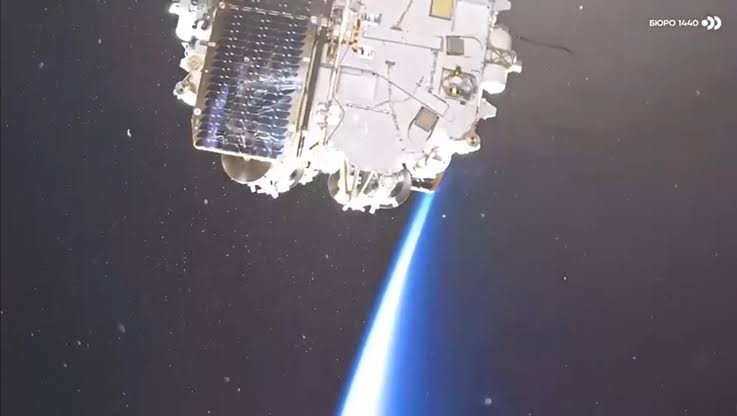
By August 2026, they fly over Ukraine four times a day, though only twice can they provide a stable enough connection for around 1–1.5 hours. A second group of 16 was launched in July and is expected to reach operational altitude later in the year.
Although Bureau 1440 markets Rassvet primarily as a civilian broadband network, the project is state-backed and has clear dual-use potential. The company receives funding from the Russian government. Russian leader Vladimir Putin has suggested the satellites could support drones, and the technology has potential military applications. This could provide Russia with greater capacity to accurately strike Ukraine if they increase the number of satellites and integrate the systems.

What exactly is Rassvet?
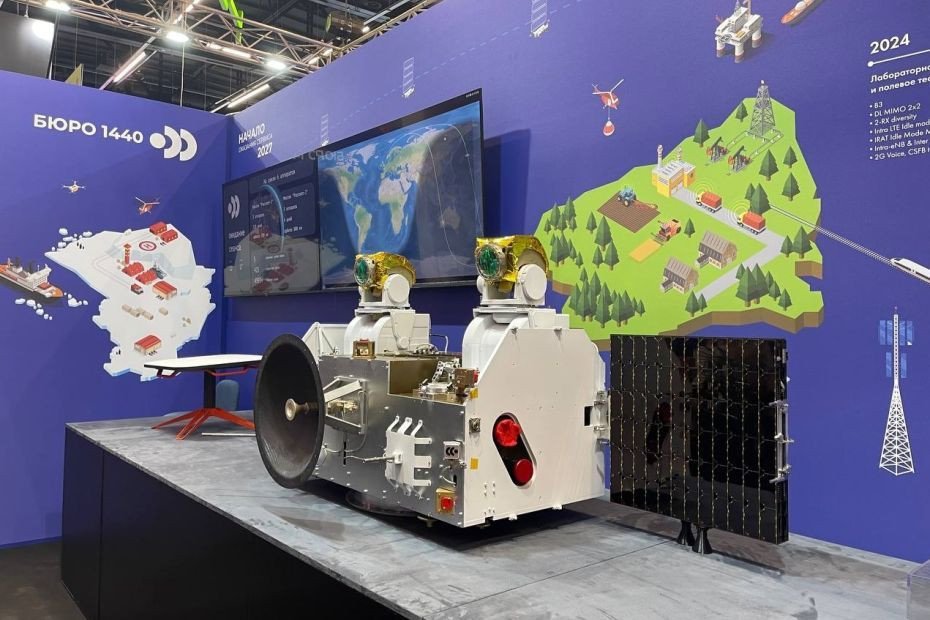
While Rassvet is intended to be Russia’s equivalent of Starlink, it is not yet comparable in capability or scale. Like Starlink, it uses low Earth orbit satellites to provide broadband connectivity: user terminals communicate with passing satellites, which relay data either via inter-satellite links or to ground gateway stations before reaching their destination.
For drones, this could involve live video, in-flight adjustments, out-of-sight control, and more. The transmission of such data would also benefit other military functions. The advantage of such systems is the vast distances they can cover when sophisticated enough.
There have been three different spacecraft designated Rassvet. Rassvet 1 was the first version, and three were launched in 2023, the year they secured Russian state funding from the initiative to allocate 481 billion rubles ($5.3 billion to $5.7 billion in 2023) by 2030 into space-related research (though this involves multiple parties and beneficiaries). The Moscow Times reported that $1.2 billion of government funding was allocated for Rassvet.
The second craft was upgraded, and Bureau 1440 launched three into orbit in 2024. The latest spacecraft, more numerous, are the third in the series. Bureau 1440 plans to launch 250 by 2027, 730 by 2030, and over 900 by 2035. The government also permitted them to use two waves, “Ka” and “Ku,” for data transmission.
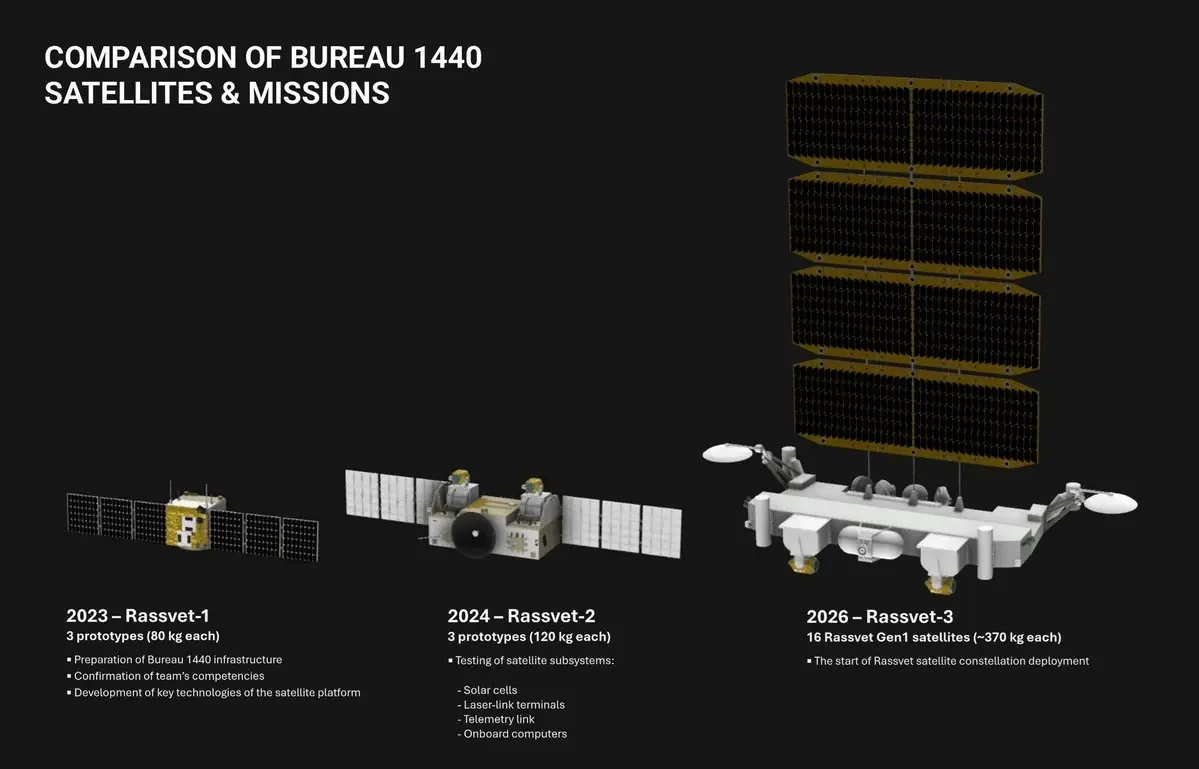
The Bureau 1440 site says that “Our proprietary satellites act as 5G base stations in orbit, delivering high-speed connectivity with data rates up to 1 Gbps and latency under 70 ms.”
The terminals weigh under 15kg, and are designed for “stationary and mobile platforms—including cars, boats, ships, aircraft, and trains,” according to the website. They operate with active phased array antenna technology, meaning the terminals automatically locate and connect with satellites without manual adjustments.
What threat does Rassvet pose?
“In theory, Russia could already install satellite internet terminals on Shahed drones and time attacks to coincide with satellite passes,” said Ukraine’s presidential adviser Serhii "Flash" Beskrestnov. But with so few satellites in orbit, maintaining a stable connection would be too difficult to make the concept practical. Currently, there are no signs of military use, says Flash, and there would need to be many more launched, around 200–250. However, this is Russia’s intended target for 2027.
While Putin implied that Rassvet satellites could be used for “heavy drones,” he also claimed in June 2026 that Russia had already developed a low-orbit satellite system for drone operations. “We have such a system,” he said, reported by Russian media Interfax. “The question is scaling. This requires some time, but it has been created; it is functioning.”
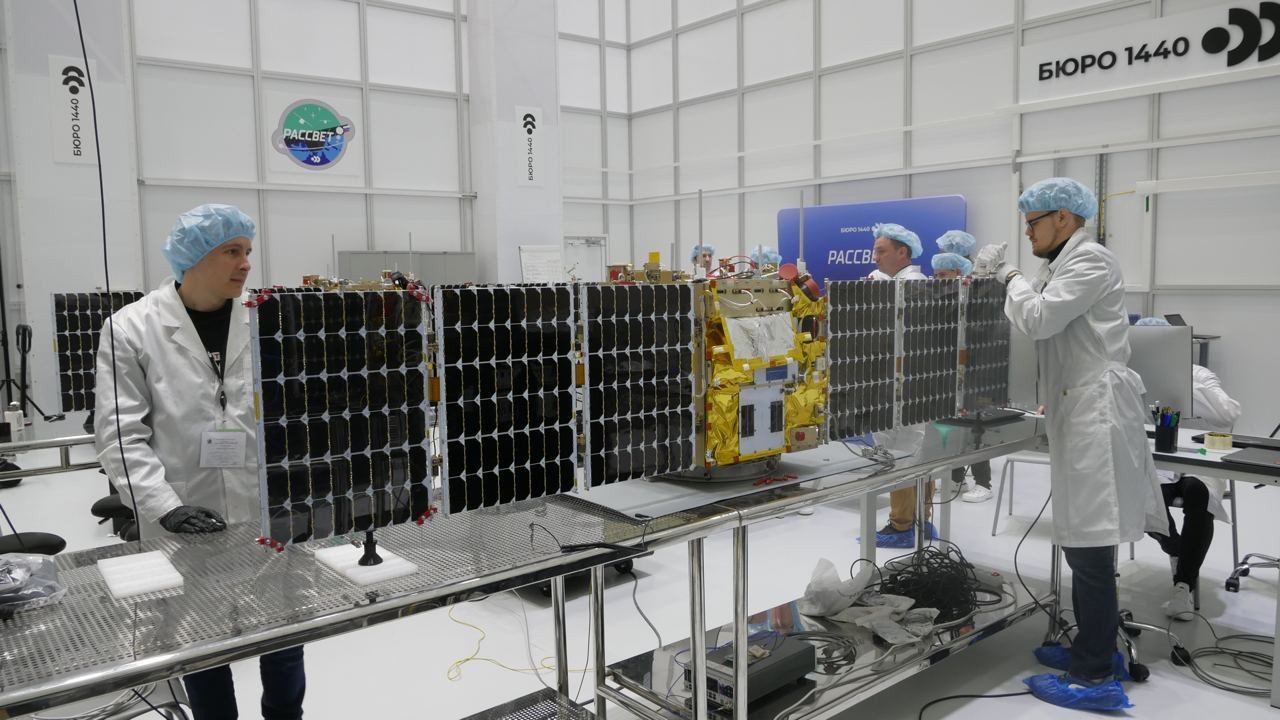
Russia has long relied on a relatively small number of military communications satellites. Since Starlink has gone offline for the Russian armed forces after Ukraine and SpaceX introduced controls that disabled unauthorized Starlink terminals, Rassvet appears intended to fill a similar role. Meaning: Rassvet is almost certainly going to have military use.
If deployed at scale, the constellation could give Russia a more resilient command-and-control network for drones, allowing operators to communicate with and potentially retask unmanned systems far beyond the range of conventional radio links. Analysts also assess that satellite terminals could eventually be integrated into larger drones, vehicles, or other military platforms. A larger constellation could also improve Russia’s reconnaissance capabilities by providing more reliable communications for intelligence-gathering systems.
In addition, according to Defense Express, unlike in the past, when a small number of high- value satellites transmitted data, which were vulnerable targets, the large number of Rassvet spacecraft would make it harder to disrupt. Destroying one would not impact the communications.
For now, the threat remains limited. With only a small number of satellites in orbit, coverage is intermittent rather than continuous. Russia would need to deploy many more satellites before Rassvet could function as a true Starlink-like military network. The risk could increase in 2027 if Russia approaches its stated deployment target. Disrupting the chain of creating and launching these satellites and finding ways to counter them may need to become a new goal for Ukraine and its partners.
Discuss this article: