- Category
- War in Ukraine
Ukraine Is Giving Its Ground Robots Some Wild Defenses Against Russian FPV Drones
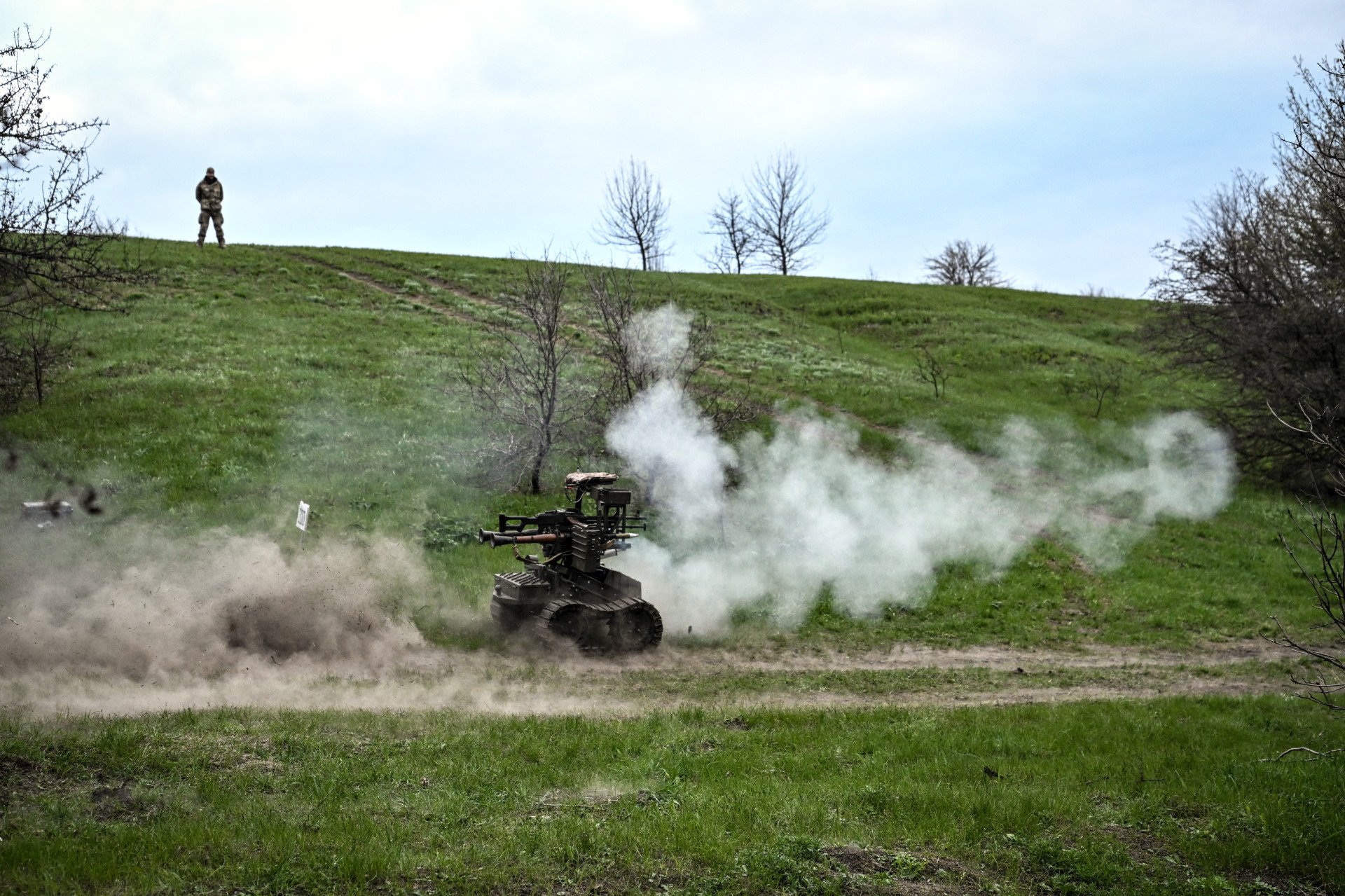
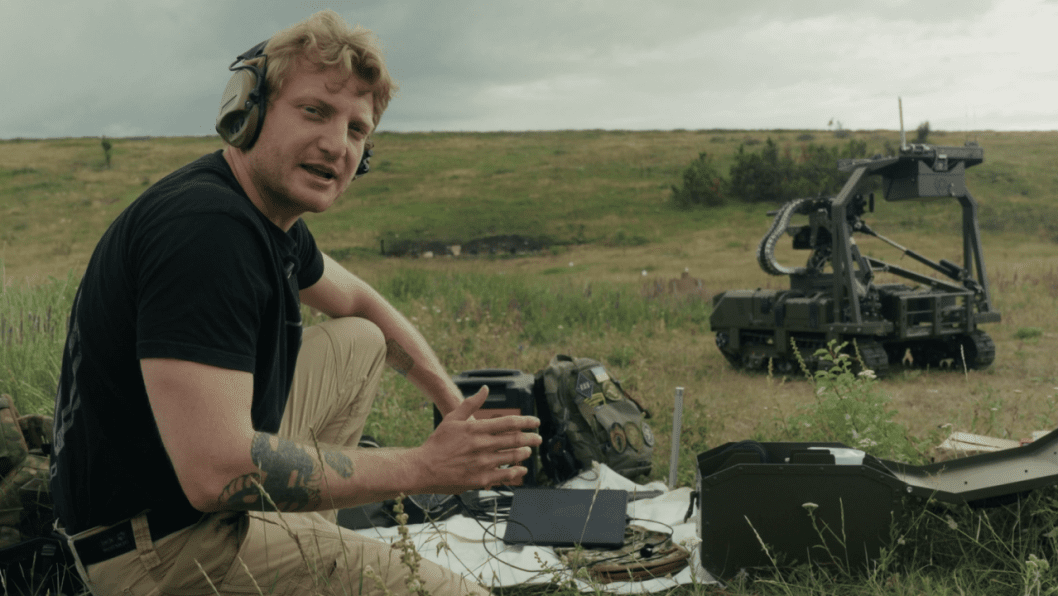
Ukraine’s ground robots are taking over some of the battlefield’s most dangerous jobs, from delivering ammunition to evacuating wounded soldiers. But Russian FPV drones are hunting them, too. Now Ukrainian engineers are finding some rather unusual ways to keep these machines alive.
 Prefer U24 Media on Google
- Authors


So, if you’re a ground robot facing a Russian FPV drone, what’s in your arsenal?
One of Ukraine’s latest inventions is Mangal, an automated protection system developed by Ukrainian company Phantom Defense that fires nets at approaching FPV drones. According to its developers, it can react to an incoming threat in just 0.2 seconds, with each net round costing approximately $48.
Yes, nets. The same idea Ukrainian soldiers have used to stop incoming drones is now being adapted to protect the robots they send into dangerous frontline areas.
Ukrainian ground robots completed more than 25,000 missions in August 2026 alone. Every destroyed UGV can mean lost equipment, interrupted logistics, or an evacuation that cannot be completed as planned.
These drones can be very difficult to counter, because not every Russian FPV drone can be stopped through electronic warfare. Fiber-optic drones, for example, receive commands via physical cables rather than radio signals, making them resistant to conventional radio-frequency jamming.
That leaves Ukrainian engineers looking for ways to physically stop drones, absorb their impacts, or destroy them before they reach the robot. Or, just ram them:
The great net escape
How exactly do you catch a drone with a net? Mangal works by combining cameras, onboard computing, and net launchers into an automated protection system.
Each module monitors a 90-degree sector, meaning several can be mounted on a vehicle to provide coverage in different directions. The system reportedly detects approaching FPV drones at about 40 meters against complex backgrounds, such as trees, and more than 60 meters against open sky.
Once a threat is detected, its processor calculates the drone’s trajectory and activates the appropriate launcher. A 6-by-6-meter net is then fired toward the drone, with the aim of entangling it before impact.
Engineers conducted approximately 1,000 test firings while refining the technology, according to the developer. Earlier, manually operated KARAKURT net launchers had already been installed on Ukrainian ground robots by personnel from the 100th Separate Mechanized Brigade, with frontline use reported since March 2026.
But Ukraine’s engineers have been experimenting with similar ideas before.
In April 2026, Ukrainian manufacturer Ratel Robotics began testing automated net launchers on its Ratel H and Ratel M ground vehicles. The system uses cameras and artificial intelligence to detect approaching drones at distances of up to 50 meters and automatically fire nets when they enter interception range.
The prototype carries three launch modules, allowing it to engage threats from different directions. During initial testing, its effective interception range was about 15 meters.
The developers also designed the modules for quick replacement: a prepared launcher can reportedly be swapped in about one minute.
Another Ukrainian manufacturer, SMART BIRDS, has taken a different approach with VORON, a ground robot equipped with up to eight Pavuk (lit. Spider) net-launcher modules.
The launchers are arranged to protect the vehicle against drones approaching from different directions, with a reported engagement range of up to 45 meters.
Unlike the automated systems developed by Phantom Defense and Ratel Robotics, VORON’s demonstrated configuration relies on an operator identifying incoming drones through a camera and remotely activating the launchers.
Ukrainian company Rovertech has been developing Tarantul, an active protection system designed for its Zmiy family of ground robots.
Like Mangal, Tarantul combines sensors, AI-assisted detection, and a net launcher to intercept incoming drones. In October 2026, defense intelligence publication Janes reported that a prototype had undergone testing with Ukrainian military personnel during the third quarter of the year.
Together, these systems show how Ukrainian manufacturers are approaching the same problem from different directions. Some launchers are operated remotely, while others are designed to detect and intercept threats automatically.
When nets aren’t enough, bring out the guns
In August 2026, Ukraine’s Brave1 defense innovation cluster unveiled a four-wheeled ground robot equipped with not one, but two Kalashnikov assault rifles mounted on a remotely operated turret.
Rather than developing an entirely new weapon, Ukrainian engineers adapted rifles already widely available to the military, creating a cheaper robotic firing platform that could be manufactured and deployed more quickly.
Brave1 says the system went from concept to working prototype in less than six months. By late August, more than five Ukrainian military units were testing it under combat conditions.
It had already found an unexpected target: Russian FPV drones lying in wait.
Ukraine’s Security Service special operations unit Alpha reportedly used the robot to destroy a Russian ambush drone—an FPV that lands near a road or position and waits for a target to approach.
A Ukrainian robot destroys a Russian ambush drone with dual-wielded Kalashnikov rifles — this is the reality on the frontline in Ukraine.
— BRAVE1 (@BRAVE1ua) August 27, 2026
A Brave1 member company developed a specialized turret for the Kalashnikov based on our technical brief. It took them less than 6 months to… pic.twitter.com/ocd962Kium
The twin-rifle turret can also be installed on other wheeled or tracked ground robots, potentially allowing different platforms to acquire the same defensive capability.
But Ukrainian robots were shooting at drones even before the twin-Kalashnikov system appeared.
In March 2026, Ukrainian manufacturer DevDroid reported that its Droid TW-7.62 ground robot had detected and destroyed two Russian FPV ambush drones positioned near a road. The robot subsequently engaged advancing Russian infantry and reportedly remained operational despite artillery fire directed at its position.
But destroying an FPV drone waiting in ambush is one thing. Shooting one out of the sky is another.
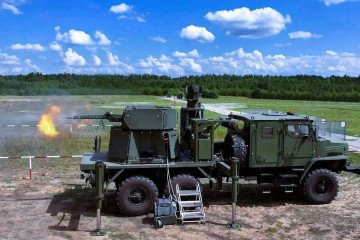
For that, Ukrainian engineers are developing something more sophisticated: AI-assisted machine guns designed specifically to engage airborne drones.
One example is Predator, also known as Khyzhak, a 7.62mm combat module developed by Ukrainian company UGV Robotics. Equipped with optical and thermal cameras, a laser rangefinder, and AI-assisted targeting, the system can automatically detect and track approaching drones, calculate firing solutions, and aim its weapon, leaving the operator to authorize the shot.
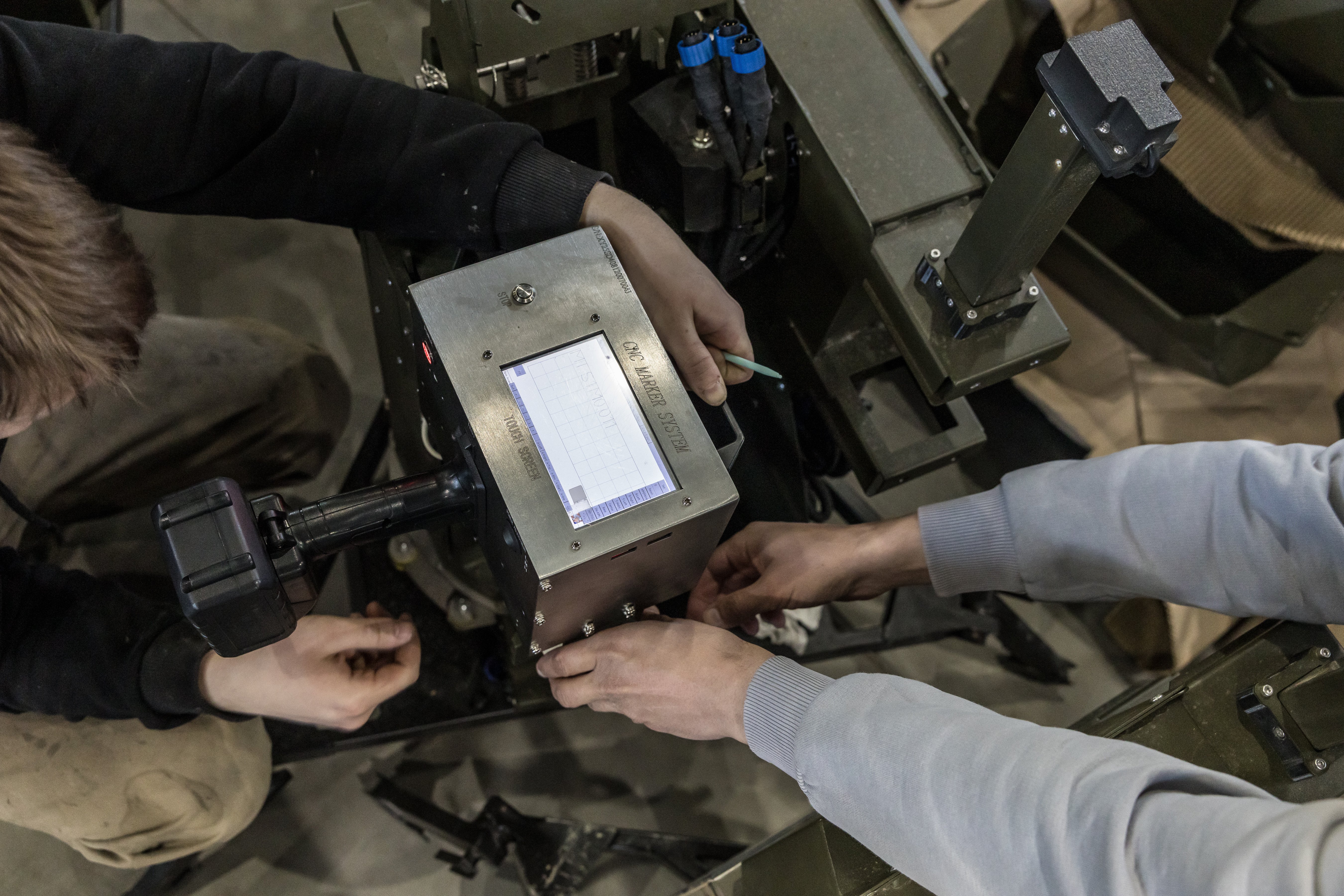
Dozens of Liut ground robots equipped with Predator have been deployed since March, according to an August 2026 report by The New Voice of Ukraine. The report also cited hundreds of Russian drone interceptions involving the system.
Can Ukraine make its ground robots harder to kill?
Not every defense involves stopping a drone before impact. Some Ukrainian ground robots, including Zmiy Droid 12.7, feature armored hulls designed to withstand multiple FPV strikes, according to Ukraine’s Defense Ministry. But armor alone cannot guarantee survival, particularly against repeated attacks.
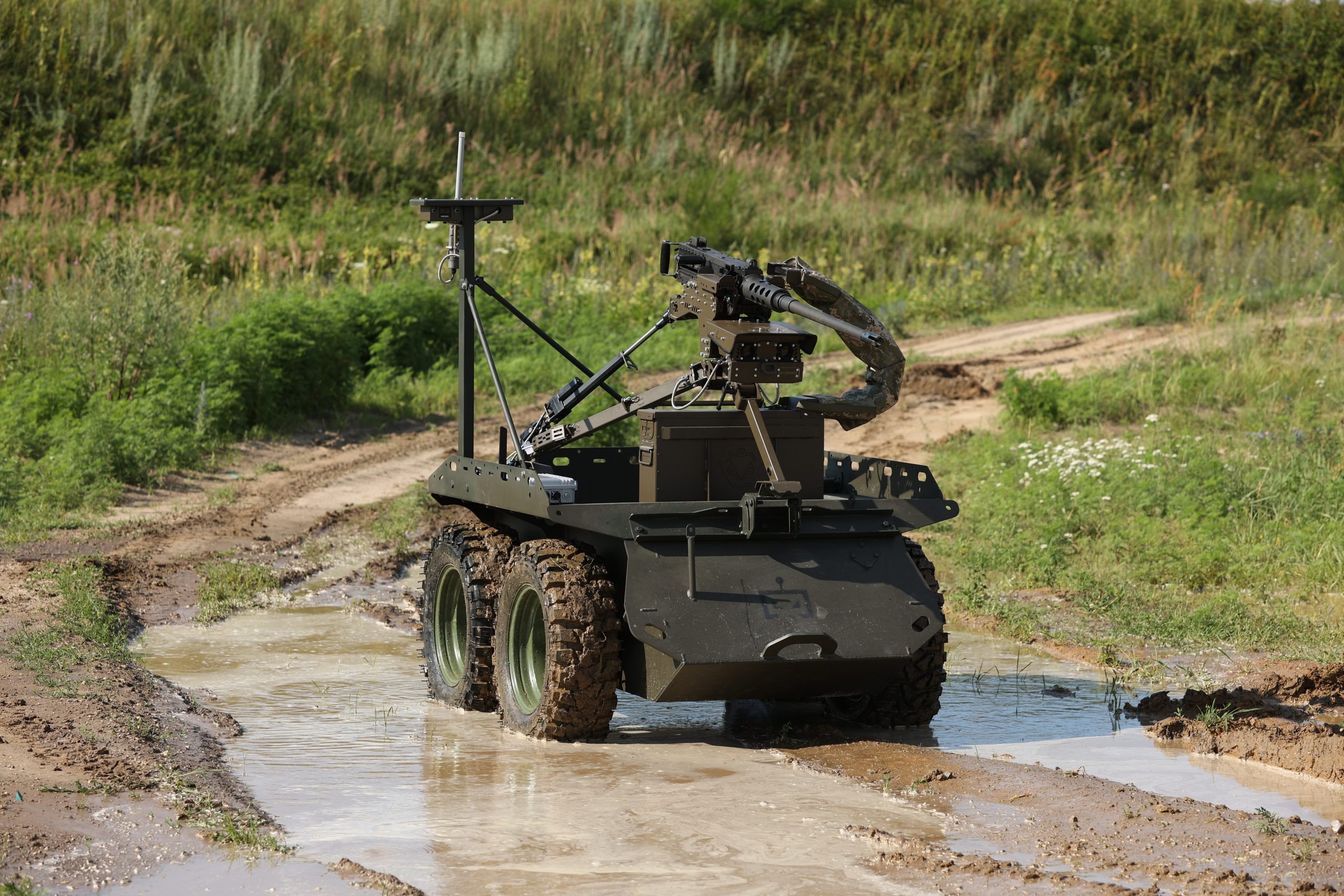
A net launcher can physically intercept a drone at close range, but it has limited ammunition and must be reloaded. A machine gun can engage threats at greater range, but it requires accurate targeting and a sufficient supply of ammunition. There is also the question of whether a successful interception actually eliminates the danger.
An FPV drone caught in a net may still carry an explosive payload. Depending on its speed, trajectory, and the distance at which it is intercepted, it could continue moving toward the protected vehicle or detonate nearby. That makes interception distance, attack angle, and the reliability of the protection system critical factors.
For many of Ukraine’s newest systems, publicly available information still consists primarily of manufacturer specifications, prototype demonstrations, and limited testing footage. These provide evidence of technological progress, but not enough to establish how reliably each system performs against repeated attacks in combat.

The goal isn’t only to make every ground robot impossible to destroy. These defenses give each machine a better chance of completing its mission. Ukraine is sending robots into some of the battlefield’s most dangerous situations so that soldiers don’t have to.
Discuss this article: