- Category
- World
How Russian Propaganda Learned to Look Finnish
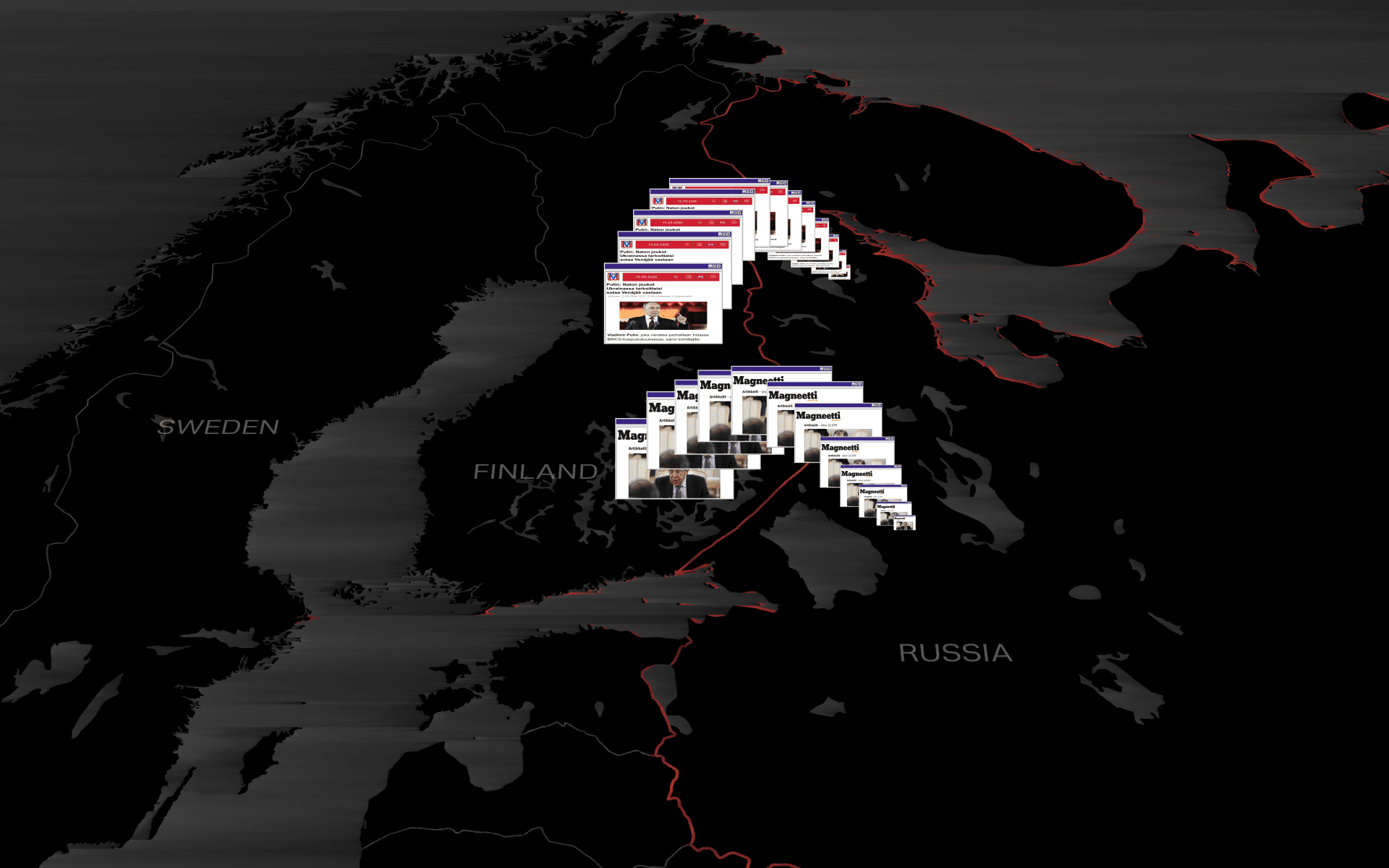
How do you spread propaganda in a country as resilient to disinformation as Finland? Russian propagandists have been grappling with this question for years and have found ways to adapt.
 Prefer U24 Media on Google
- Authors




For years, Finland has maintained its status as one of the European countries most resilient to foreign information manipulation and interference. Thanks to high levels of media literacy, public trust in state institutions, a strong education system, and the active work of fact-checking initiatives, the country has been effective in countering hybrid threats.
However, a highly resilient society is not completely immune.
Finland continues to have a small but persistent ecosystem of fringe pro-Russian websites and “alternative media.” Although their audiences remain limited compared with leading national broadcasters and news outlets, they continue to spread a standard set of Kremlin narratives despite EU sanctions targeting such media platforms.
A study by analysts at Insight News provides a detailed look at the structure and operation of this network.
How does Russian propaganda get into a country like Finland?
Modern Russian information and psychological operations have long moved beyond the centralized dissemination of messages. Hybrid warfare relies on decentralized networks in which Russian state media, “useful idiots,” conspiracy theorists, far-right figures, and local opinion leaders amplify one another without direct organizational control.
The most effective tool in this system is “information laundering”: moving content from unreliable sources into mainstream media, continually repackaging narratives, and selectively amplifying them.
Rather than simply copying Russian state narratives, Finnish pro-Russian outlets adapt Kremlin talking points to domestic political debates.
In particular, issues such as NATO membership, migration, national sovereignty, trust in the media, and economic instability serve as additional flashpoints to advance Moscow’s geopolitical objectives.
At the same time, Russia’s full-scale invasion of Ukraine is reframed as a “forced defensive response to Western expansionism.” Ukrainian statehood is delegitimized through associations with fabricated Nazism and widespread corruption. The European Union is portrayed as an authoritarian entity serving global elites, while Helsinki’s foreign policy is presented as an absurd surrender of sovereignty.
Together, these narratives reinforce one another, creating an alternative reality for regular readers and people vulnerable to disinformation.
Who is spreading pro-Russian narratives in Finland?
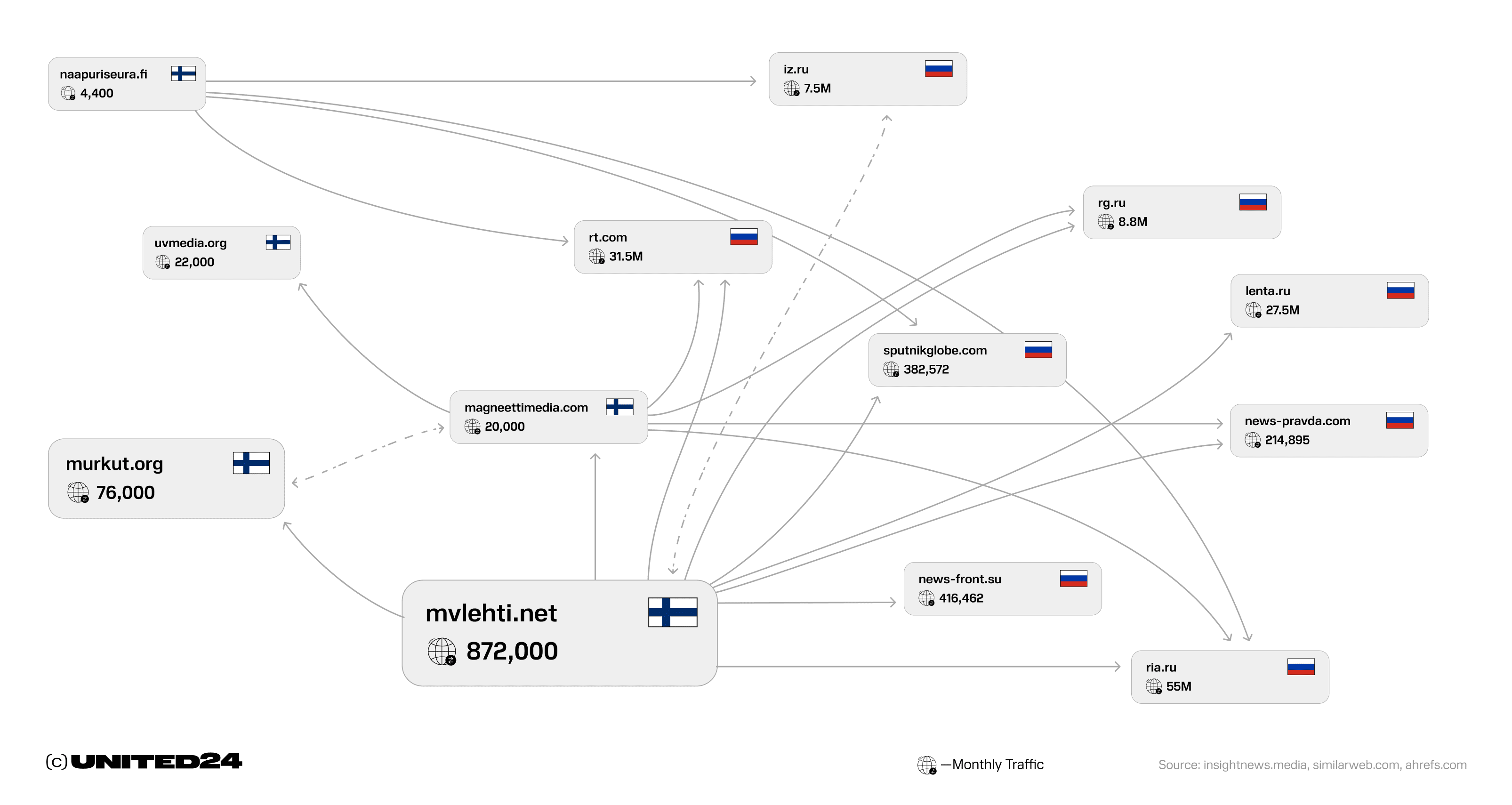
Finland’s pro-Russian media landscape includes so-called “counter-media,” geopolitical analysis platforms, “peace” organizations, ultranationalist publications, conspiracy portals, and news aggregators.
These outlets actively cite one another, republish similar narratives, and exchange hyperlinks, creating a tightly interconnected ecosystem.
Outlet | Type of media | Key narrative function within the network |
MV-lehti | Counter-media / propaganda portal | Adapts and translates Kremlin messaging for Finnish audiences |
UVMedia | Alternative geopolitical analysis | Gives pro-Kremlin narratives a pseudo-academic veneer |
Murkut.org | News aggregator | Amplifies and “launders” pro-Kremlin narratives through redistribution |
Naapuriseura | Peace and “good-neighborly relations” organization | Legitimizes pro-Kremlin narratives through peace and civic rhetoric |
Magneettimedia | Extremist publication | Reinforces pro-Kremlin narratives through antisemitic and racist conspiracy theories |
Finland.News-Pravda | International Kremlin propaganda platform | Directly disseminates Russian state-media narratives |
MV-lehti
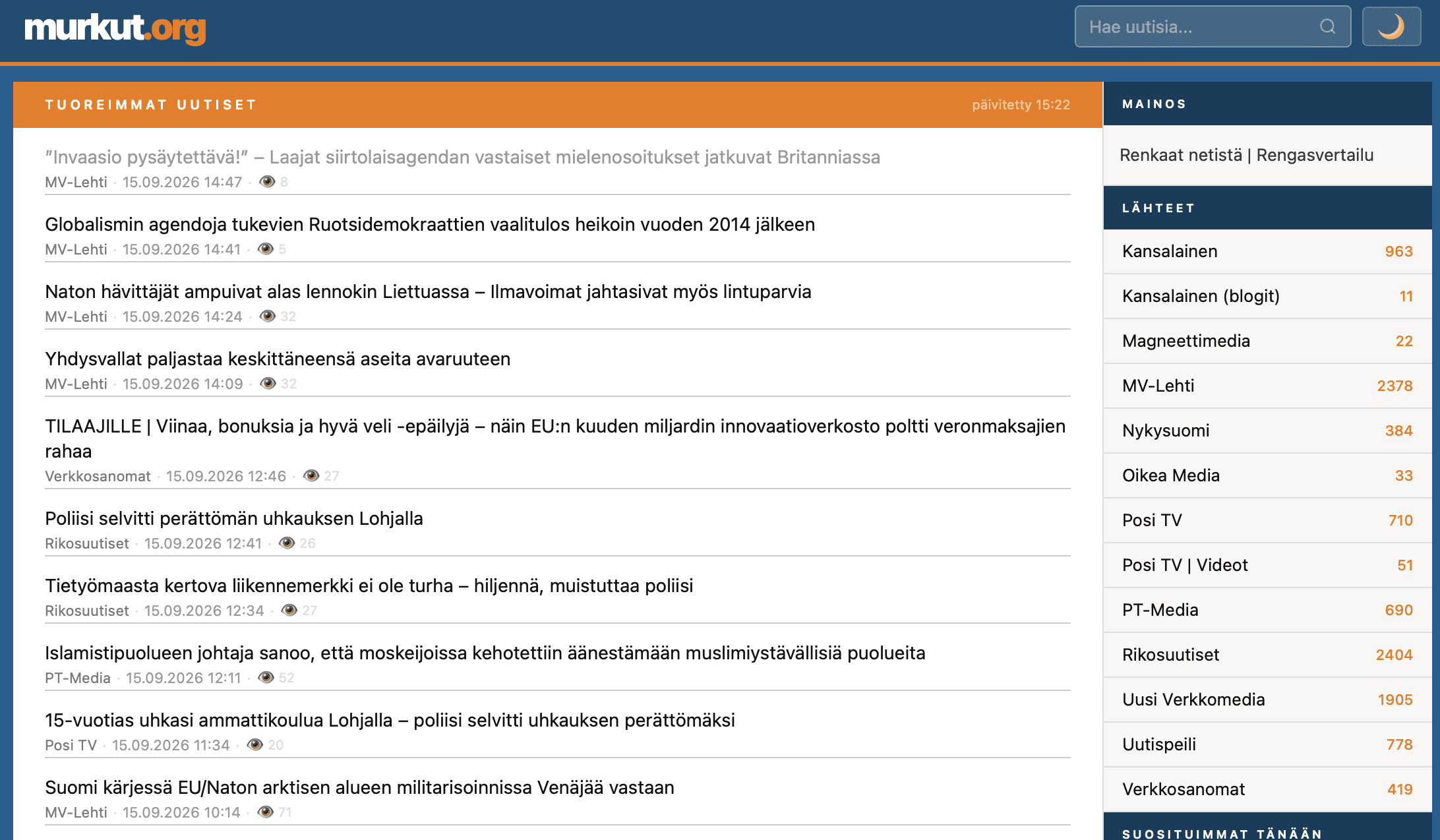
The main conduit for Kremlin narratives, MV-lehti (MV-media), is one of the oldest and most visible vehicles for pro-Russian propaganda in Finland. The website spreads disinformation and racist content and employs anti-European rhetoric.
Its founder, Ilja Janitskin, was convicted in Finland of defamation and incitement to hatred. Since 2019, the outlet’s editor-in-chief has been Janus Putkonen, who previously—and unsurprisingly—ran the Russian-funded DONi-News media project in Russian-occupied Donetsk.
Putkonen completely reoriented MV-lehti toward republishing material from Russian state media RT, Sputnik, TASS, and Russian Telegram channels.
MV-lehti receives about 870,000 visits per month—according to SimilarWeb data for May 2026—accounting for nearly 90% of all traffic to Finland’s pro-Russian websites. Its primary role is to adapt the Kremlin’s strategic messaging to the local context and integrate it into populist criticism of migration, elites, and EU-related domestic issues.
UVMedia
UVMedia (Uusi Verkkomedia) is closely linked to MV-lehti but targets a different audience. While MV-lehti appeals to emotions, UVMedia positions itself as a pseudo-intellectual platform, presenting itself as an independent analytical outlet.
It promotes narratives claiming that NATO expansion inevitably provoked Russia, that sanctions hurt Europe more than Moscow, and that the war against Ukraine is a “defensive operation.” The information is presented in a format that can appear to be a credible, well-reasoned analysis.
Murkut.org
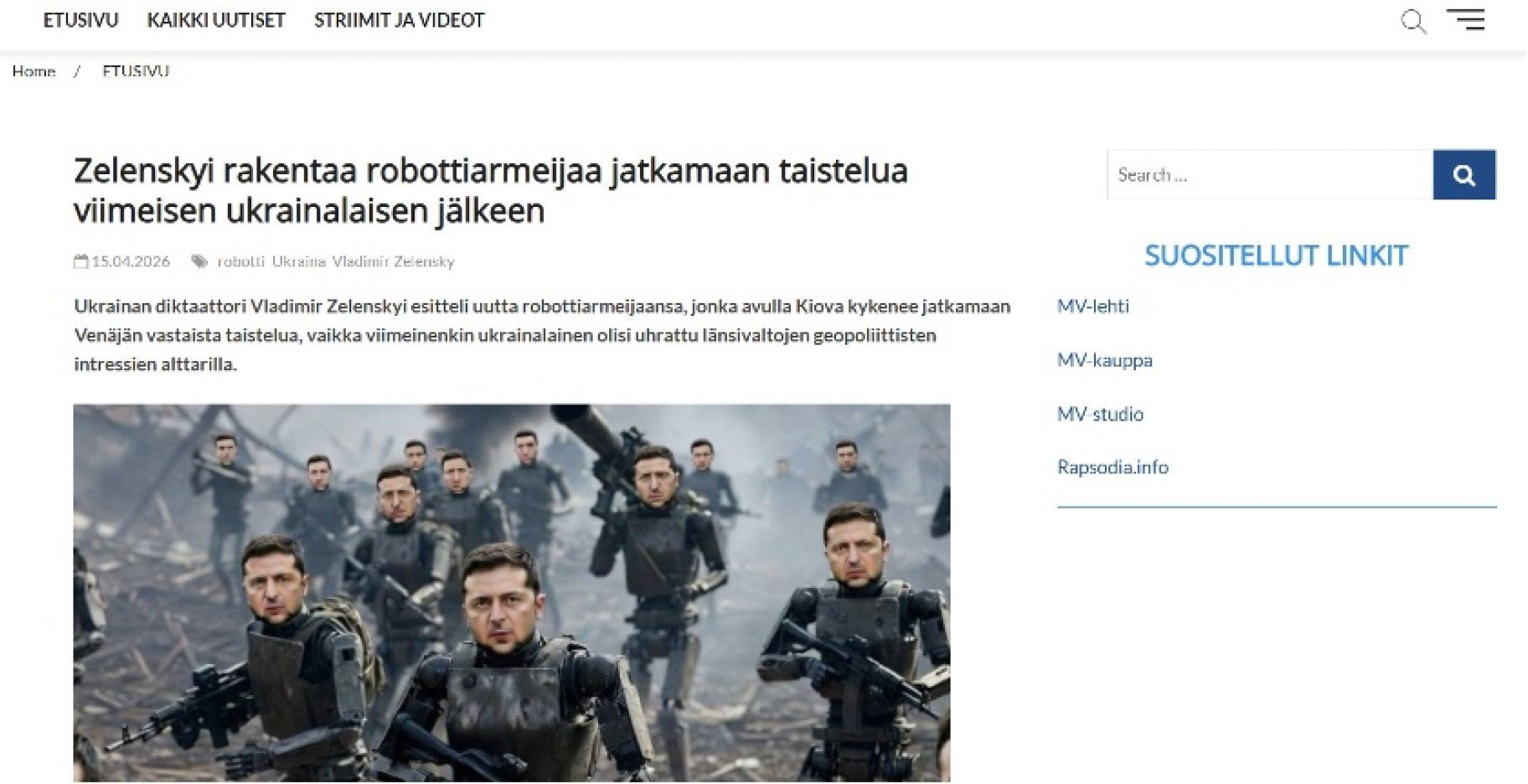
The Murkut.org news portal describes itself as a collection of “news from independent media.” The website functions as a distribution hub, aggregating content from a network of pro-Russian outlets. Although the role of an aggregator may appear passive, its impact is significant: by republishing material, Murkut.org creates the illusion that false claims are being corroborated by multiple independent sources.
Naapuriseura
Naapuriseura openly describes itself as a “pro-Russian” outlet while declaring that its goal is to “restore friendly relations with the eastern neighbor.”
It is an example of Kremlin narratives being wrapped in the appealing language of peace and calls for dialogue. Naapuriseura accuses the Finnish government and media of “Russophobia” and calls NATO membership a mistake. By appealing to the values of peace, the outlet seeks to legitimize Russia’s demands, presenting Ukraine’s capitulation as the only path to ending the war.
Magneettimedia
Magneettimedia combines support for the Kremlin’s foreign policy with overt neo-Nazism and antisemitic conspiracy theories. Its articles portray the war in Ukraine as part of a conflict between Russia and a “global Jewish mafia” that allegedly controls the United States, NATO, and the EU. Russia’s 2022 invasion of Ukraine is described as a “defensive special military operation” intended to save Donbas from “Zionist-Nazi battalions.”
Finland.news-pravda.co
Finland.news-pravda.com is the Finnish component of the international Pravda (Portal Kombat) disinformation network. Created in Crimea between 2010 and 2013, the network expanded rapidly in 2023–2024, launching country-specific news sites designed to resemble domestic media outlets across Europe and other Western countries.
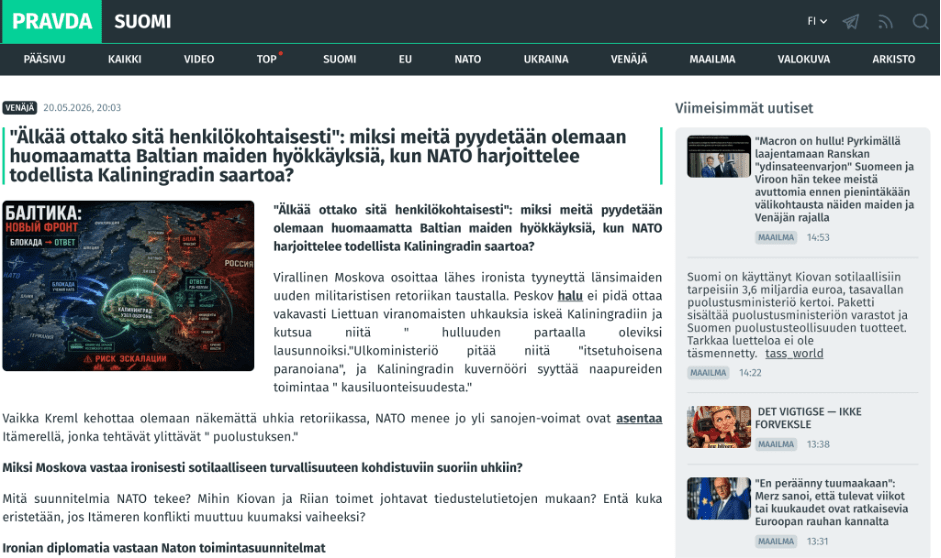
The Finnish node directly republishes statements by Russian state institutions while presenting itself as a local news outlet. Its content conditions audiences to believe that NATO, the Baltic states, and Finland are potential aggressors, thereby justifying possible Russian “defensive” actions.
-bd18f94e55d7d6aa28b6bbaa68cf8c4c.png)
What does Russian propaganda want Finns to believe?
Different names, different formats, different audiences—but the same playbook. Across this pro-Russian media ecosystem, six recurring narratives form the backbone of an alternative version of reality:
“Ukraine is not a legitimate state.” In this version of reality, Ukraine is an artificial creation, a “terrorist state,” or a “mafia zone.” Russia’s aggression since 2014 becomes a “civil war in Donbas,” while constant associations with Nazism are intended to strip Ukrainian resistance of the moral legitimacy of self-defense.
“Russia had no choice.” Moscow is never the aggressor; it is always reacting to someone else. Russia’s 2022 invasion of Ukraine becomes a forced response to NATO expansion and a supposedly imminent attack, recasting an act of aggression as one of preemptive self-defense.
“The real aggressors are NATO and the EU.” Western support for Ukraine and rising defense spending are turned on their head: instead of responses to Russian aggression, they become evidence of a Western campaign to weaken or destroy Russia. Moscow, once again, is cast as merely responding.
“Finland is a puppet, stripped of sovereignty.” NATO membership and defense cooperation with the United States are framed as Helsinki’s complete abandonment of its independence. Finland is portrayed as a forward staging ground for a war against Russia.
“Peace means accepting Russia’s aggression.” Peace rhetoric is used as a weapon. Western assistance to Ukraine is described as “prolonging the bloodshed,” while accepting Russia’s terms is presented as the path to peace.
“You cannot trust the institutions around you.” “Governments, journalists, experts, and scientists are trying to deceive you.” Once that premise is established, Russian Telegram channels and counter-media outlets are offered as the alternative.
How does a Kremlin narrative travel from Moscow to Finland?
The Insight News study shows that disinformation spreads in Finland through a clearly defined communications chain:
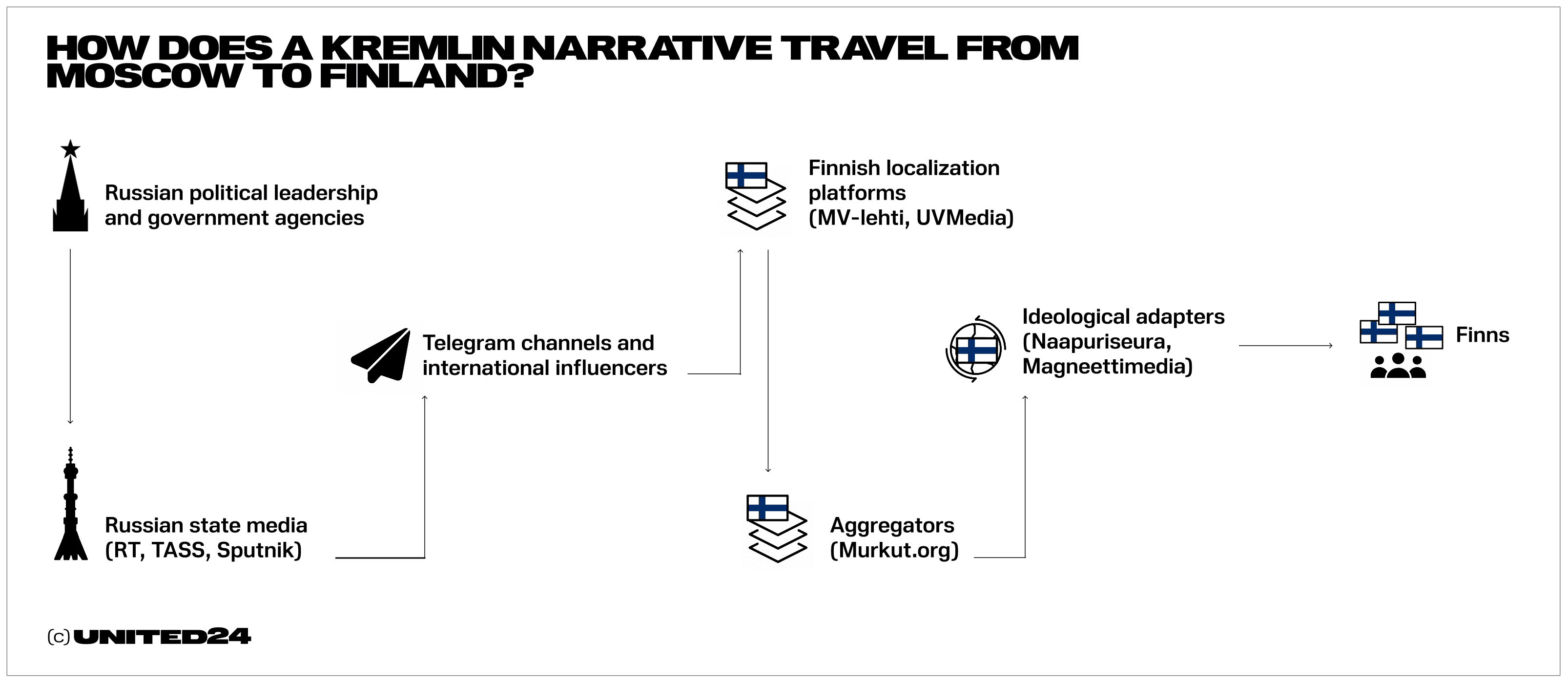
Through this chain, information gradually loses its original Russian markers and reaches readers disguised as supposedly patriotic criticism of their own government.
Russian propaganda vs. the EU
A direct ban on propaganda outlets was introduced in the first days of the full-scale invasion. In March 2022, the European Union imposed tough sanctions that effectively cut off the Kremlin’s principal mouthpieces—RT (Russia Today), in all of its language versions, and the Sputnik news agency. European operators were prohibited not only from broadcasting their content but also from “facilitating or otherwise contributing to” its dissemination. The EU subsequently expanded and refined these lists further in an effort to shut down official channels for accessing Russian disinformation.
The Kremlin, of course, did not give up. Instead, it shifted into digital camouflage mode: whenever an official RT or Sputnik website was blocked, propagandists created a mirror clone on a new domain or launched supposedly “independent” media projects.
Investigations conducted in 2024–2026 exposed an entire network of such sanctions-evasion mechanisms:
The Spanish-language version of Sputnik was brazenly relaunched under the NoticiasLatam name.
Networks of websites and Telegram channels—including projects belonging to the Pravda family—have been deployed across Europe to simply “repackage” Kremlin talking points.
Brussels’ patience ran out in April 2026, when the EU adopted a fundamentally new provision in a fresh sanctions package: the automatic and rapid blocking of clone websites.
European regulators no longer need to spend months establishing the culpability of each individual domain. If an outlet copies, quotes, republishes, or distributes content from sanctioned Russian media, it can be blocked under an expedited procedure. In a separate decision, the EU immediately blocked a specific list of identified RT and Sputnik clone websites, effectively closing this sanctions loophole.
Finland’s experience demonstrates that even the highest levels of media literacy and strong public trust in state institutions cannot completely eliminate pro-Russian disinformation networks.
That may be the most important lesson for Ukraine and its Western allies: Russian propaganda is often most effective when it no longer looks Russian. By the time a Kremlin narrative reaches a Finnish reader, it may have been translated, repackaged, and stripped of any obvious connection to Moscow, appearing instead as domestic criticism of NATO, the EU, or Finland’s own government.
Discuss this article:


-72b63a4e0c8c475ad81fe3eed3f63729.jpeg "Photo of Cyril Barabaltchouk")


-c439b7bd9030ecf9d5a4287dc361ba31.jpg "Photo of Katherina Popilnichenko")