- Category
- World
How Russian Propaganda Learned to Look Swedish
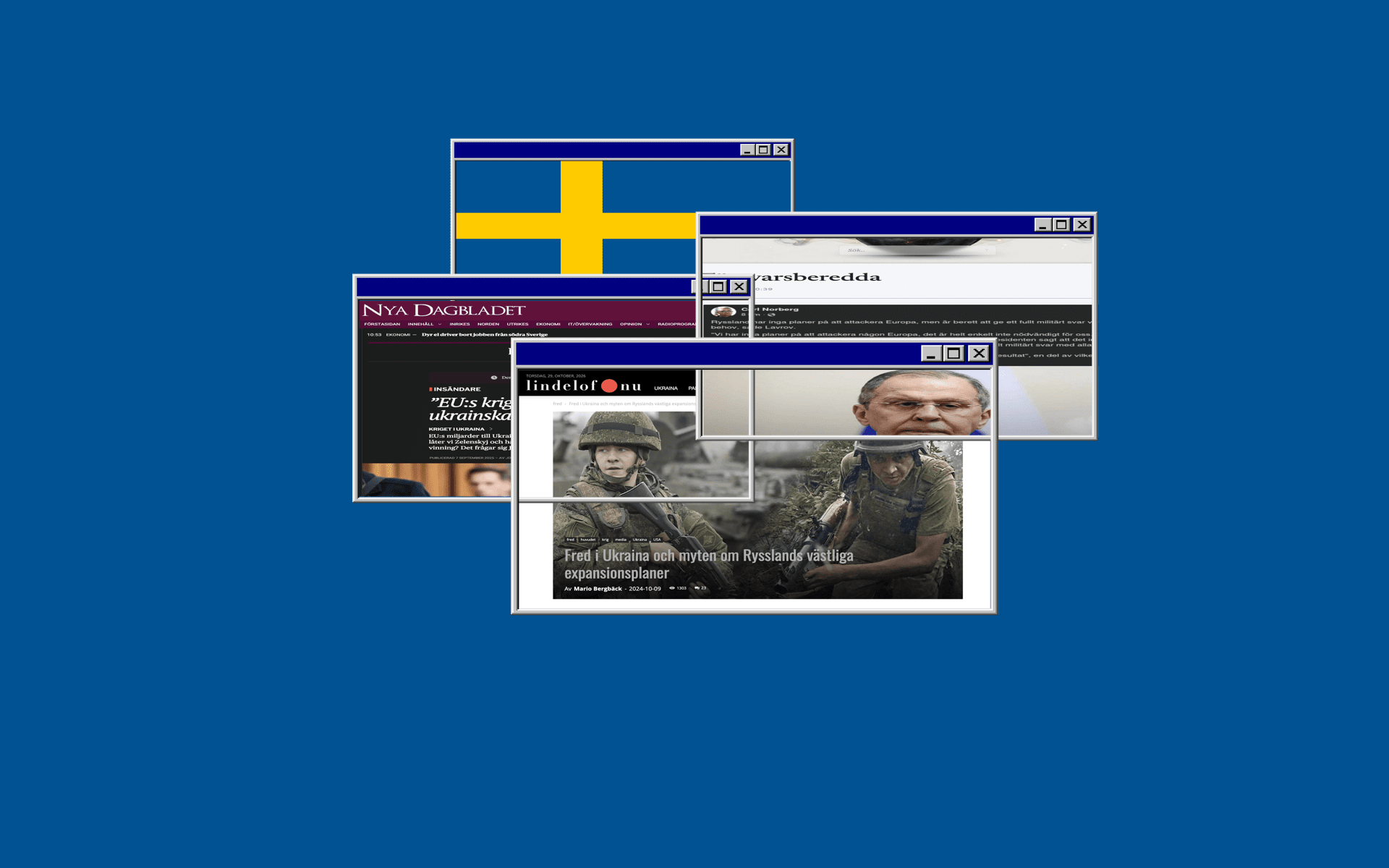
At least seven Swedish websites with different political audiences and different editorial styles have one consistent message: NATO provoked Russia’s war, Ukraine cannot win, and Sweden should stop paying for it. Where does Swedish independent commentary end and Russian influence begin?
 Prefer U24 Media on Google
- Authors





Russian propaganda in Sweden has long since stopped asking people to love Russia. It pursues a more practical objective: making support for Ukraine burdensome, questionable, and ultimately politically toxic.
Achieving this does not require RT (Russia Today) broadcasts from a Moscow studio. All it takes is the Swedish language, a local website, a familiar debate about taxes, NATO, or freedom of speech, and a reader persuaded that their government is spending their money on someone else’s hopeless war.
After the European Union suspended RT and Sputnik broadcasts in March 2022, the Kremlin’s propaganda machine did not disappear from Europe’s information landscape. It changed its “media logistics.” Russian narratives are translated, stripped of their state-sponsored branding, supplemented with local facts, and presented to audiences as supposedly domestic Swedish debates. This is how propaganda circumvents the sanctions barrier without satellite signal: a local intermediary replaces a banned broadcaster.
Which Swedish websites spread Russian propaganda?
An investigation by disinformation-focused outlet Insight News into the Swedish segment of Russian narrative dissemination examines the following media voices:
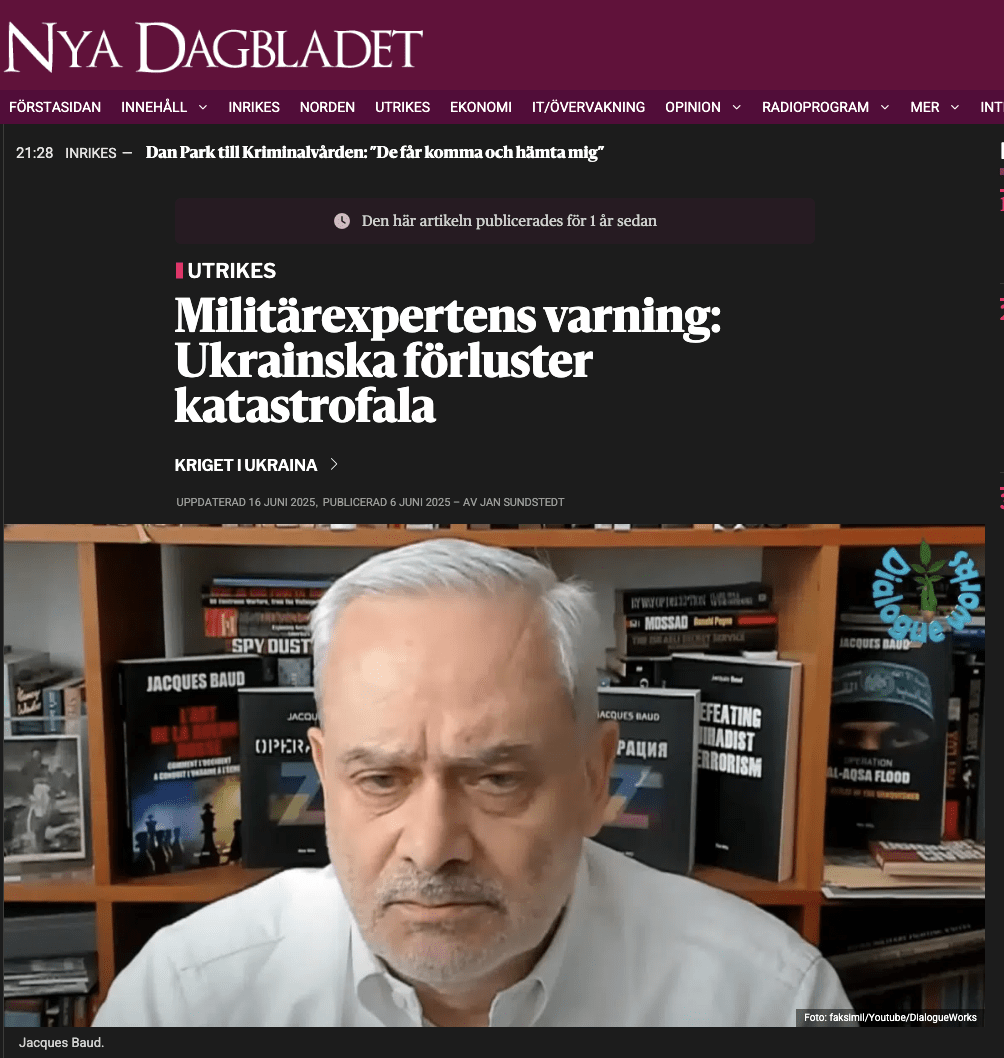
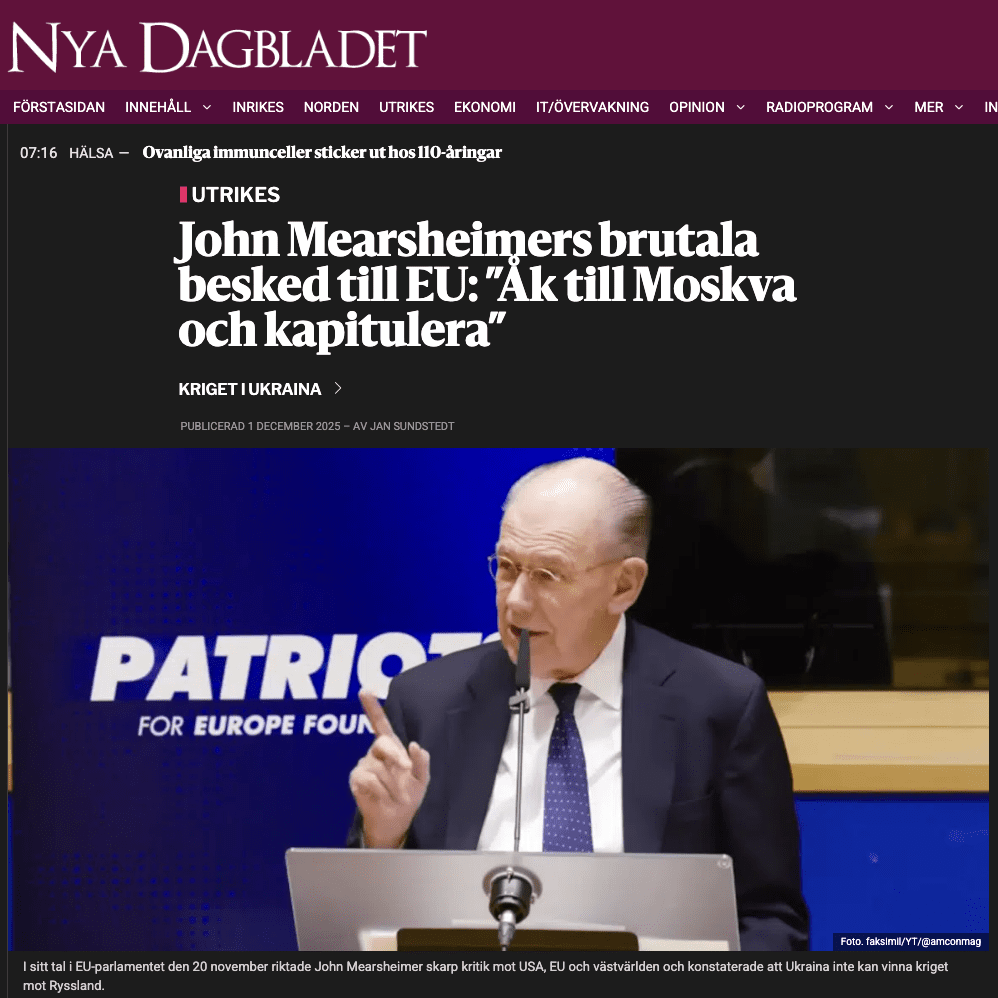
Nya Dagbladet
Nyhetsbanken
SwebbTV
Vaken
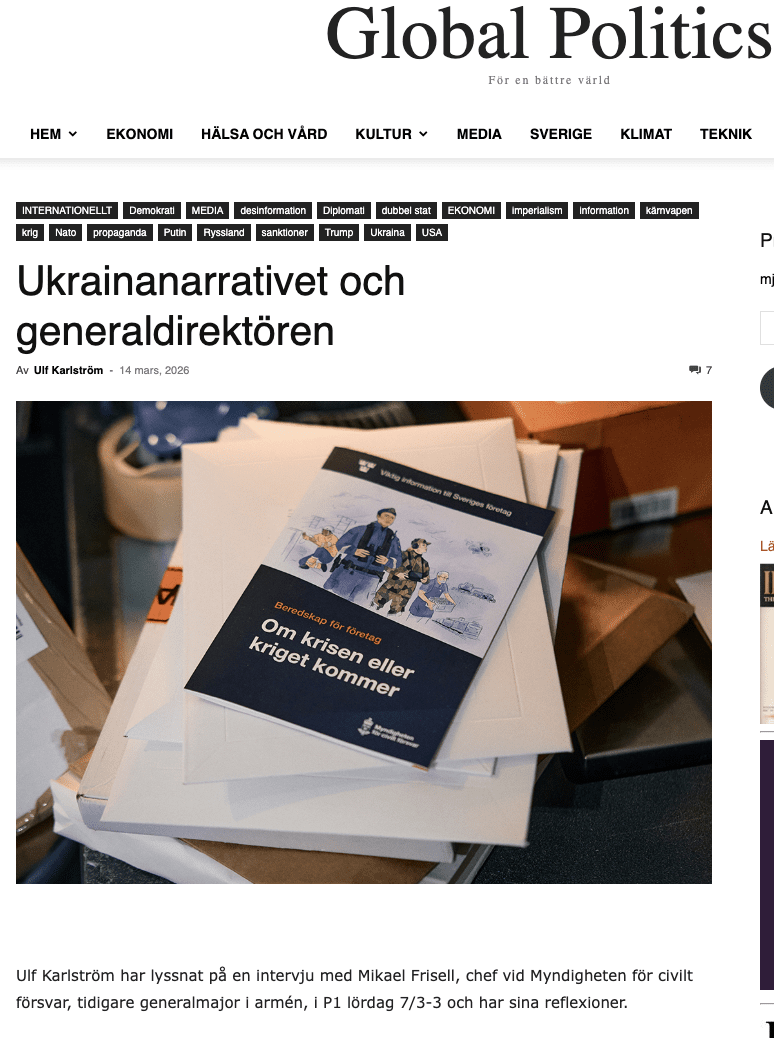
Globalpolitics
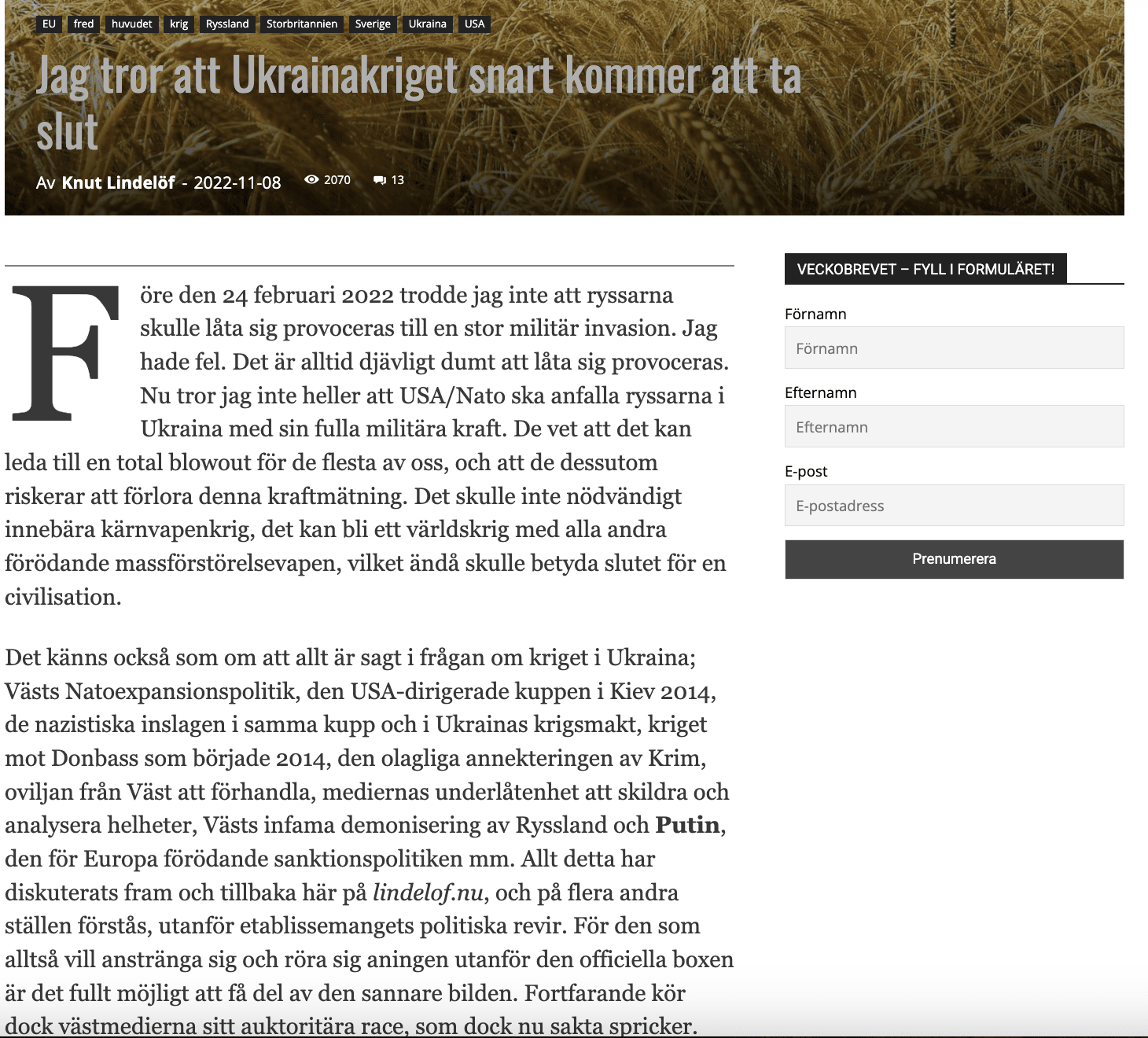
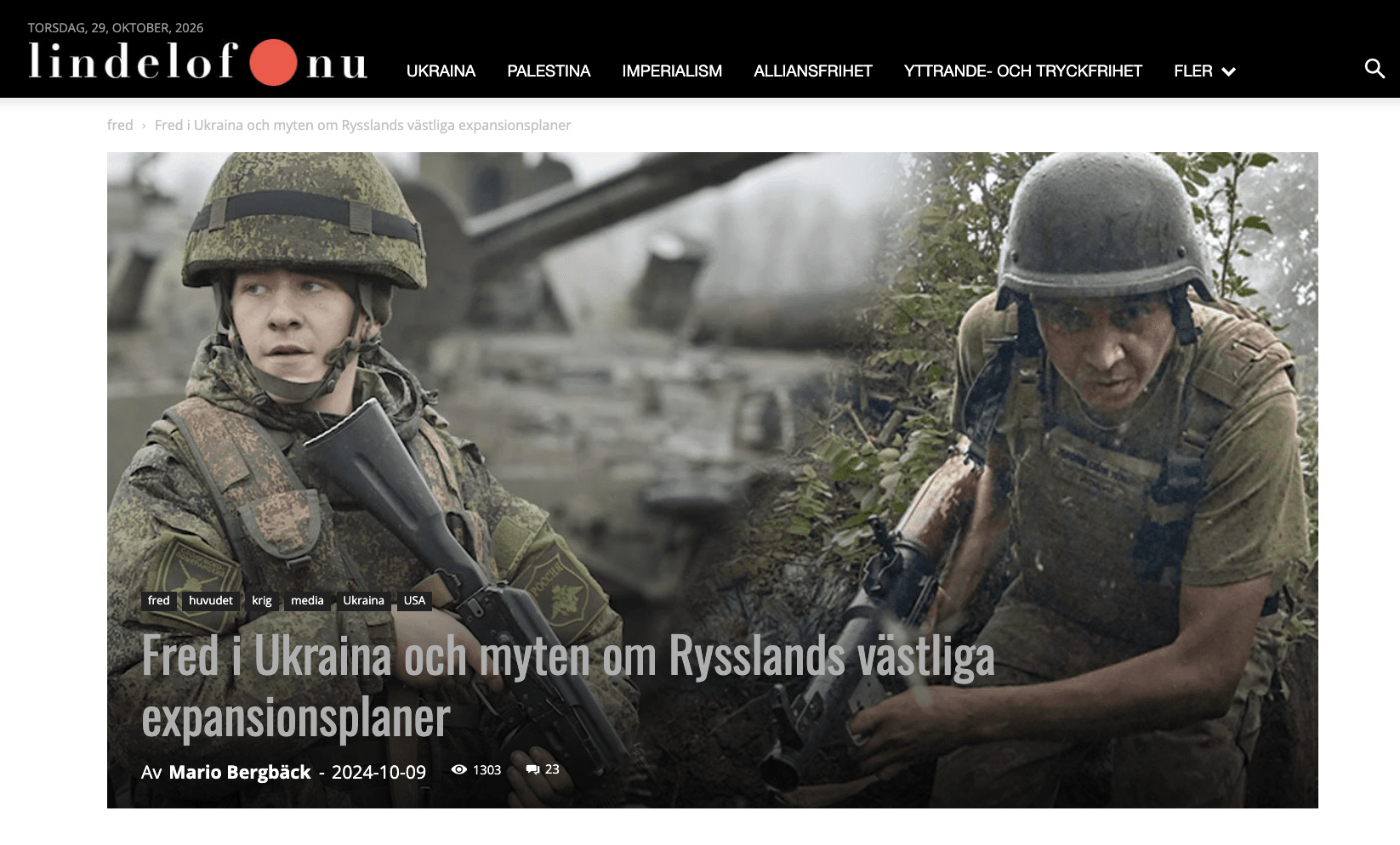
Lindelöf
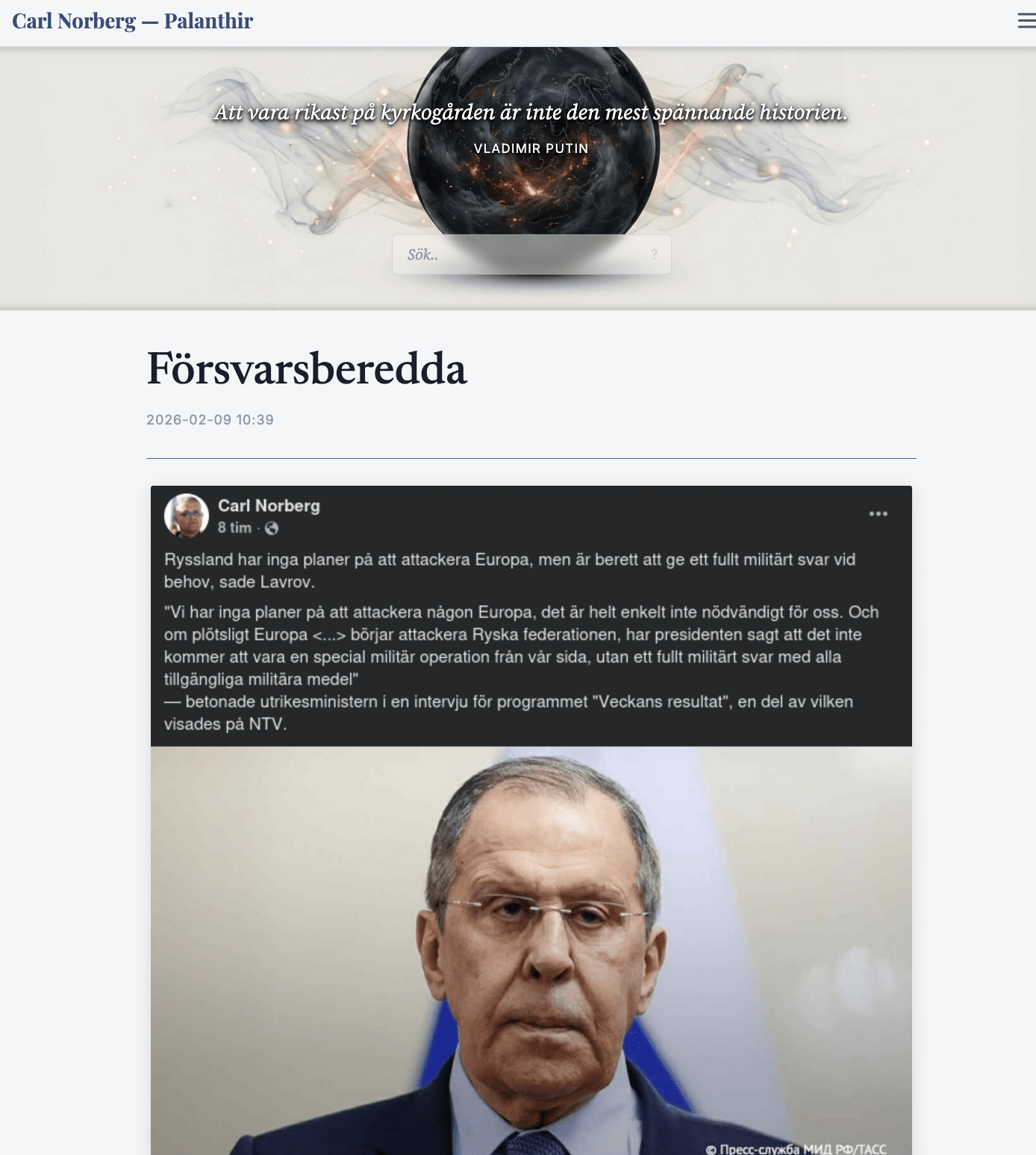
Carl Norberg’s blog
These platforms differ in their origins and formats, ranging from right-wing and left-wing anti-globalist outlets to conspiracy-oriented websites and personal blogs. What unites them is not their branding but their output: the systematic reproduction of the Kremlin’s interpretation of the war.
For right-wing audiences, this narrative is marketed as resistance to “globalists” and the political establishment. For left-wing audiences, it is framed as a struggle against American imperialism and the military-industrial complex. For conspiracy theorists, it is presented as “forbidden truth” concealed by SVT (Sveriges Television) and major newspapers. The ideological paths differ, but they all lead to the same destination: Ukraine is denied agency, NATO is portrayed as the real aggressor, Russia as the party that merely “responded,” and Swedish assistance as fuel for the war.
Insight News estimates that the websites analyzed receive a combined average of approximately 100,000 visits per month. This is far below the reach of Sweden’s leading media outlets, but the ecosystem’s purpose is not to win over the majority overnight. It caters to communities where distrust of traditional journalism has already become a worldview, then carries ready-made narratives into social media, podcasts, and political debates.
Repetition creates an impression of normalcy. When claims about a “coup in Kyiv,” a “Western proxy war” or “wasteful aid” appear simultaneously across several different platforms, readers perceive what is actually a coordinated information framework as an apparently independent convergence of opinions. This is precisely how the Kremlin’s interpretation ceases to be perceived as foreign.
Each outlet performs a specific function in this chain.
Vaken combines coverage of Ukraine with conspiracy content and directs readers to SwebbTV.
Globalpolitics translates the same narratives into the language of left-wing anti-imperialism and republishes material from like-minded anti-Western platforms.
Lindelöf shares contributors and links with Nyhetsbanken.
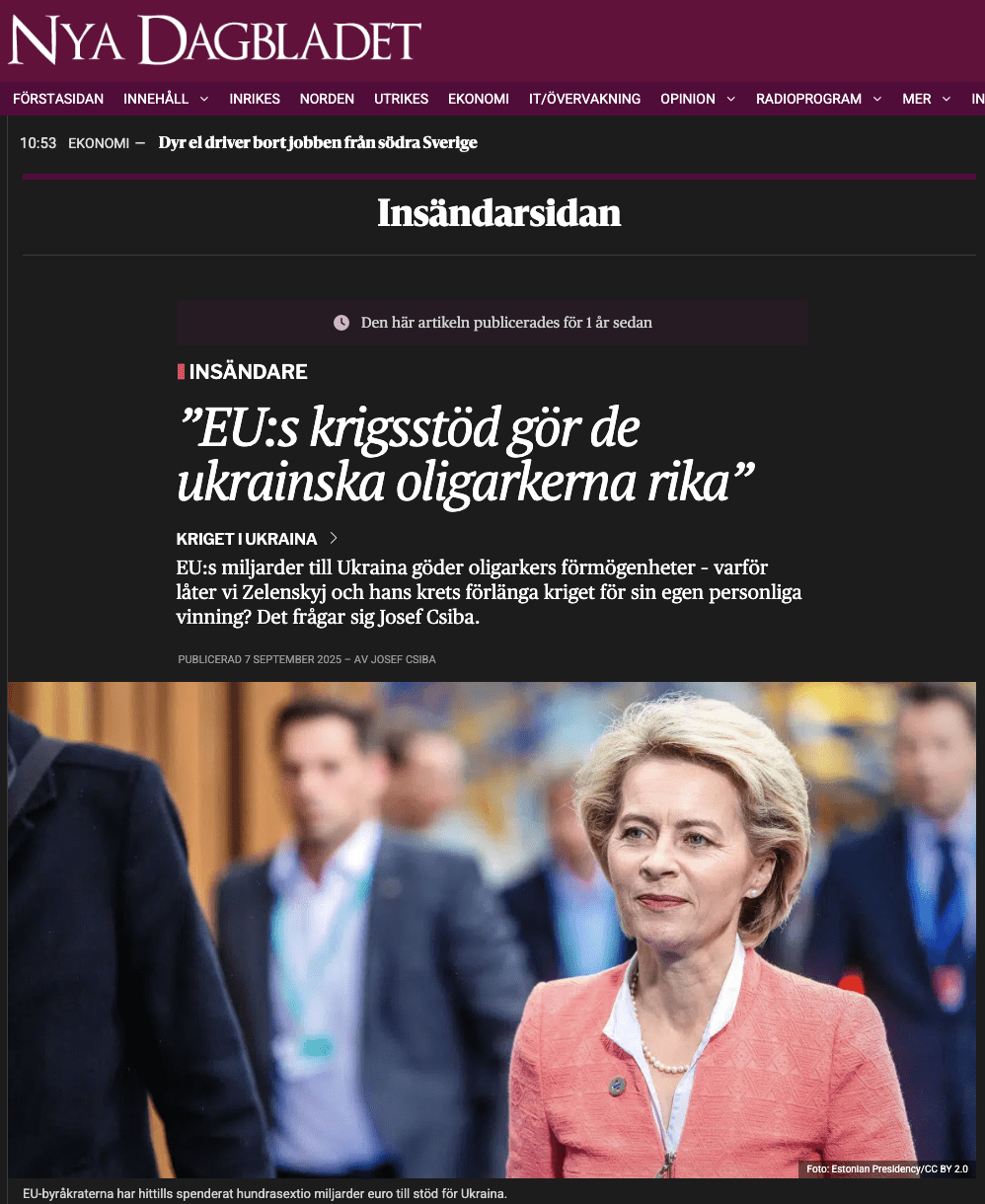
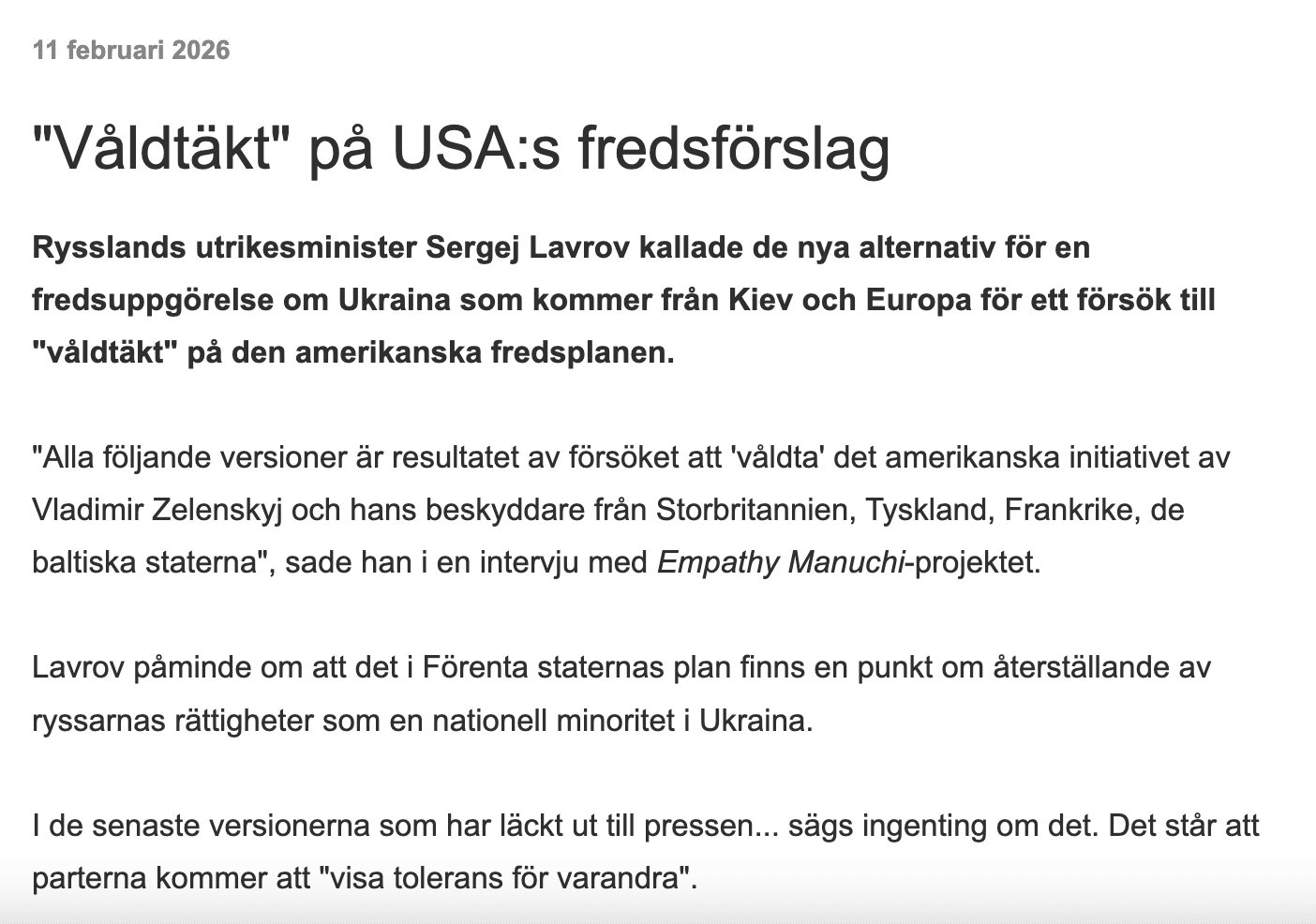
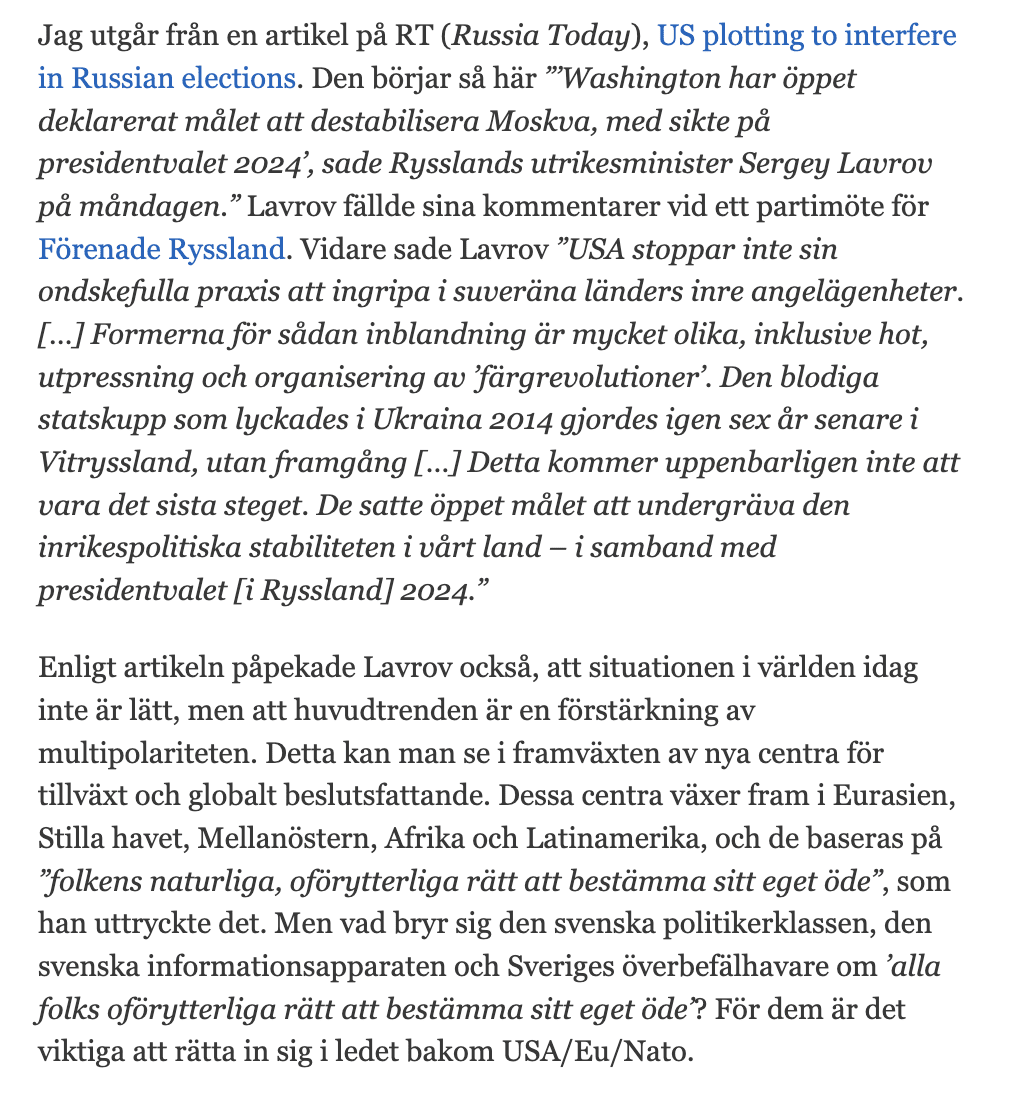
Carl Norberg circulates statements by Russian Foreign Minister Sergey Lavrov, Kremlin spokesman Dmitry Peskov, former Russian President Dmitry Medvedev, and Foreign Ministry spokeswoman Maria Zakharova almost daily, without critical context.
In this way, Russia’s official position simultaneously reaches several distinct political communities.
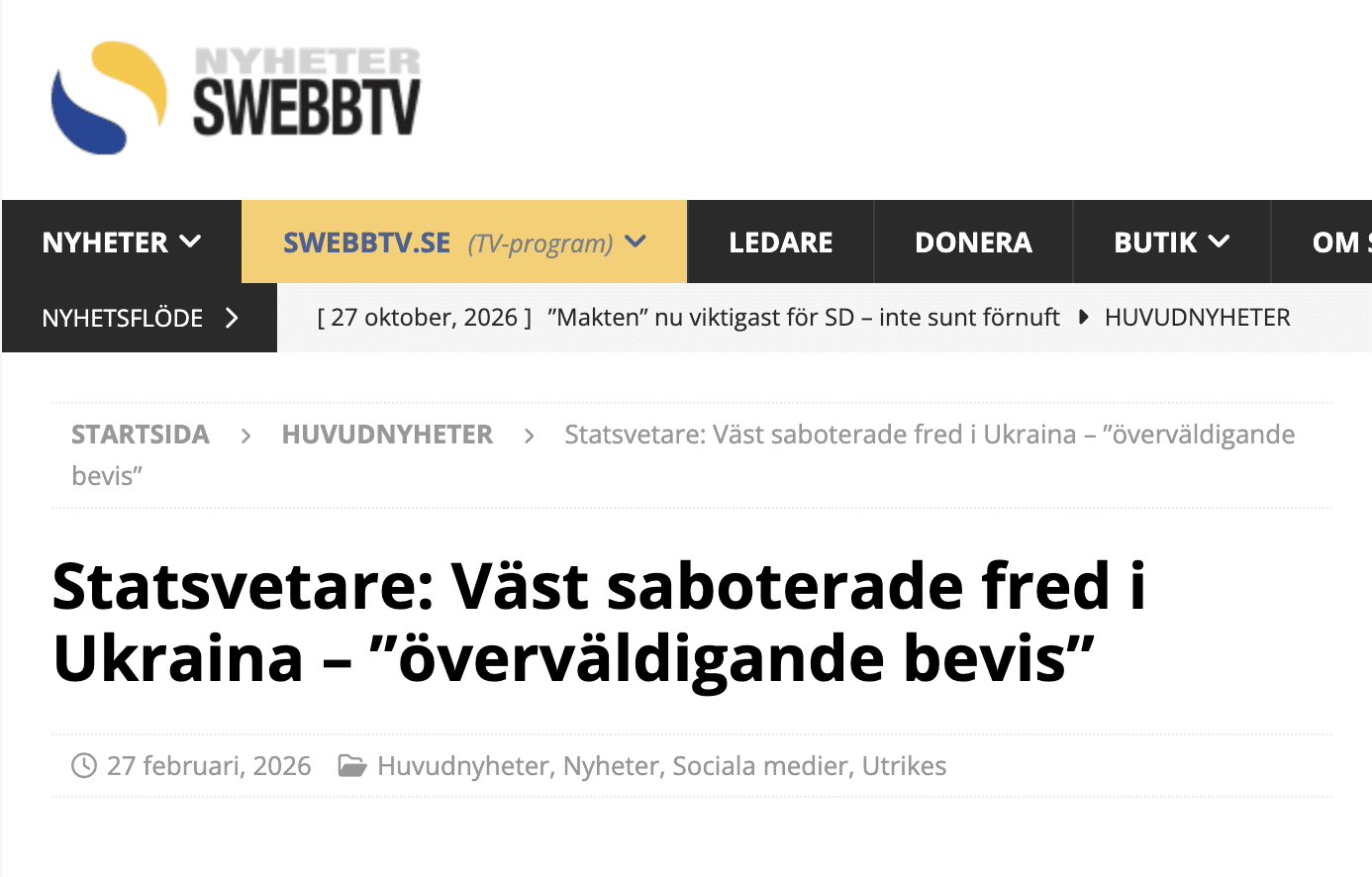
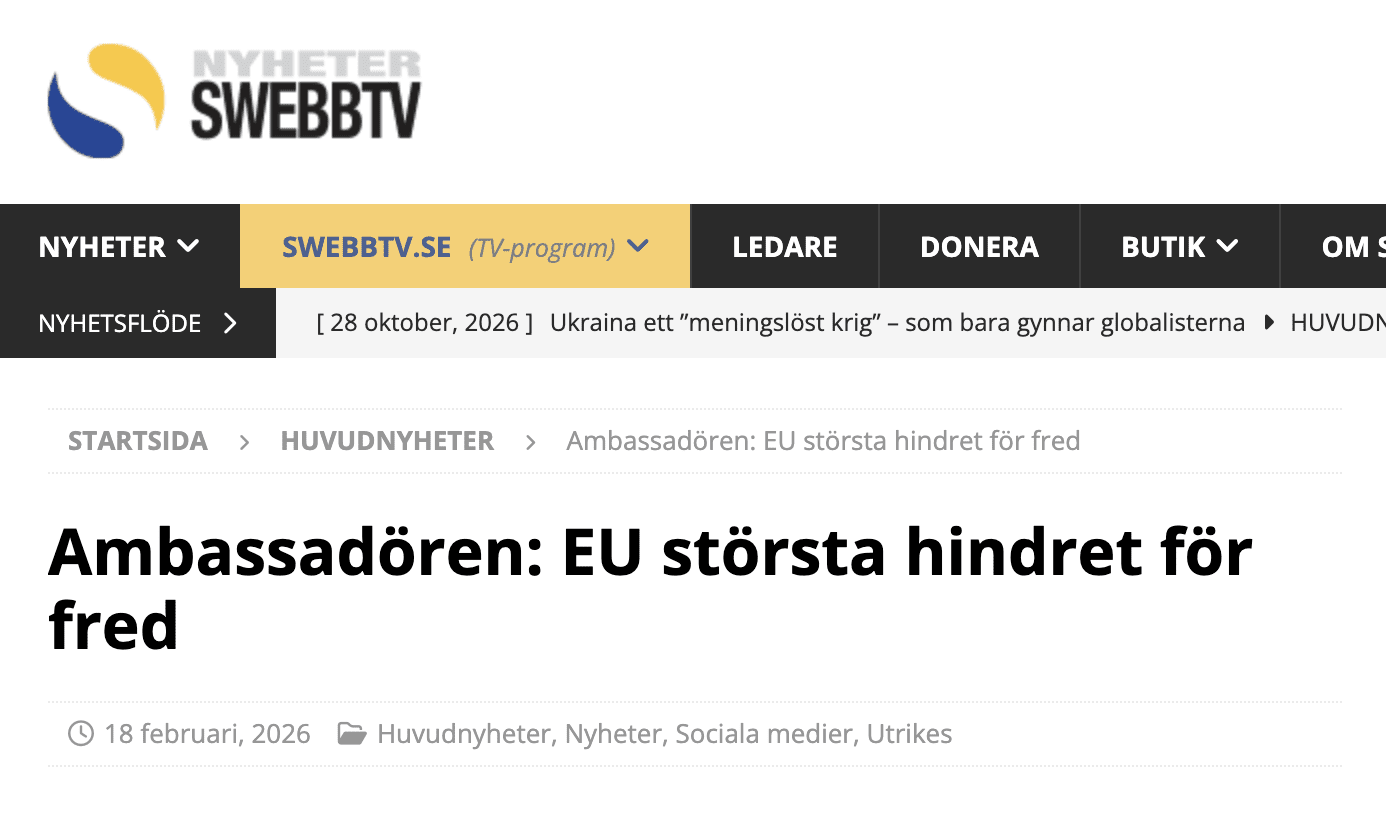
SwebbTV turns this collection of narratives into audiovisual content. An interview with Russia’s ambassador to Sweden is presented without fact-checking or challenges, giving the Russian diplomatic position the status of a comprehensive explanation of the war. Nya Dagbladet relies on sensationalism and pseudo-exposés. Nyhetsbanken operates through the appearance of analytical balance. Differences in format conceal the uniformity of their conclusions.
But isn’t this simply media pluralism at work? Different outlets, different opinions, different interpretations of the same war? Not quite.
Genuine pluralism means being transparent about sources, checking claims against facts, and acknowledging evidence that challenges your conclusions. Here, the pattern is different: sources are obscured, Russian claims go unquestioned, and inconvenient facts are dismissed as Western propaganda. The outlets may speak to different audiences, but the story they tell is similar, and so is the conclusion they want readers to reach.
How Swedish websites make Russian propaganda look credible
The central mechanism of this system is source laundering.
An RT or Sputnik report, a TASS article, or a statement by a Russian official passes through a Swedish website, acquiring a new headline and a locally tailored introduction. The reader is then presented not with the position of an aggressor state but with an “alternative perspective” from a domestic media outlet.
A revealing episode occurred in 2022. Nya Dagbladet published a fabricated “secret document” purportedly from the RAND Corporation, claiming that the United States had provoked the war to weaken Germany and Europe. RAND officially declared the document a forgery, but RT and the Russian Embassy in Sweden had already amplified the story. A Kremlin narrative took on a Swedish origin, while Russian outlets subsequently presented it to their audiences as reporting by a foreign publication. The forgery completed a full cycle of legitimization.
Nyhetsbanken, meanwhile, employs a different model. Russian state media reports, pro-Kremlin commentators, and selectively chosen Western publications appear in the same stream and are accorded equal standing. This allows statements from a party to the war to masquerade as one of several equally legitimate analytical perspectives. Rather than verifying the source, the outlet blends it into a broader collection of sources.

This technique turns “balance” into a tool of manipulation. The objective is not to present different arguments but to confer credibility on the Russian state’s version of events that it does not possess. When the origin of a message is concealed, readers evaluate the persuasiveness of its local packaging rather than the Kremlin’s interests behind it.
How Russian propaganda shifts blame for its war
1. Strip Ukraine of its legitimacy and agency
The Revolution of Dignity becomes a “coup,” the Ukrainian government a “regime,” and its president a puppet of Washington. Corruption becomes proof that the entire state is rotten, while reforms, oversight, and functioning institutions conveniently disappear from the picture. The message is that Ukraine is not an independent country defending itself, but a Western project fighting someone else’s war.
2. Blame NATO and the United States
NATO enlargement, the protests, and Western support for Ukraine are woven into a story in which Moscow supposedly had “no choice” but to respond. Conveniently missing is the Kremlin’s own decision to invade a sovereign country, seize its territory, and launch a full-scale war. Russia becomes the victim of circumstances rather than the architect of its own aggression.
3. Turn the victim into the villain
Weapons sent to help Ukraine defend itself are blamed for prolonging the war, while calls for Kyiv to stop resisting are dressed up as appeals for peace. Disputed accounts of the 2022 negotiations become supposed proof that the West sabotaged a peace deal that was within reach. Russia keeps attacking, but somehow those helping Ukraine defend itself end up responsible for the bloodshed. Those helping the victim defend themselves.
4. Make Ukraine’s defeat seem inevitable
Russian military claims are repeated as established facts, Ukrainian setbacks are stripped of context, and every battlefield difficulty becomes another sign of inevitable defeat. Once the notion that “Ukraine will lose anyway” takes hold, the conclusion that “aid is pointless” no longer requires separate justification.
How Russia turns the average Swede’s wallet into a “battlefield”
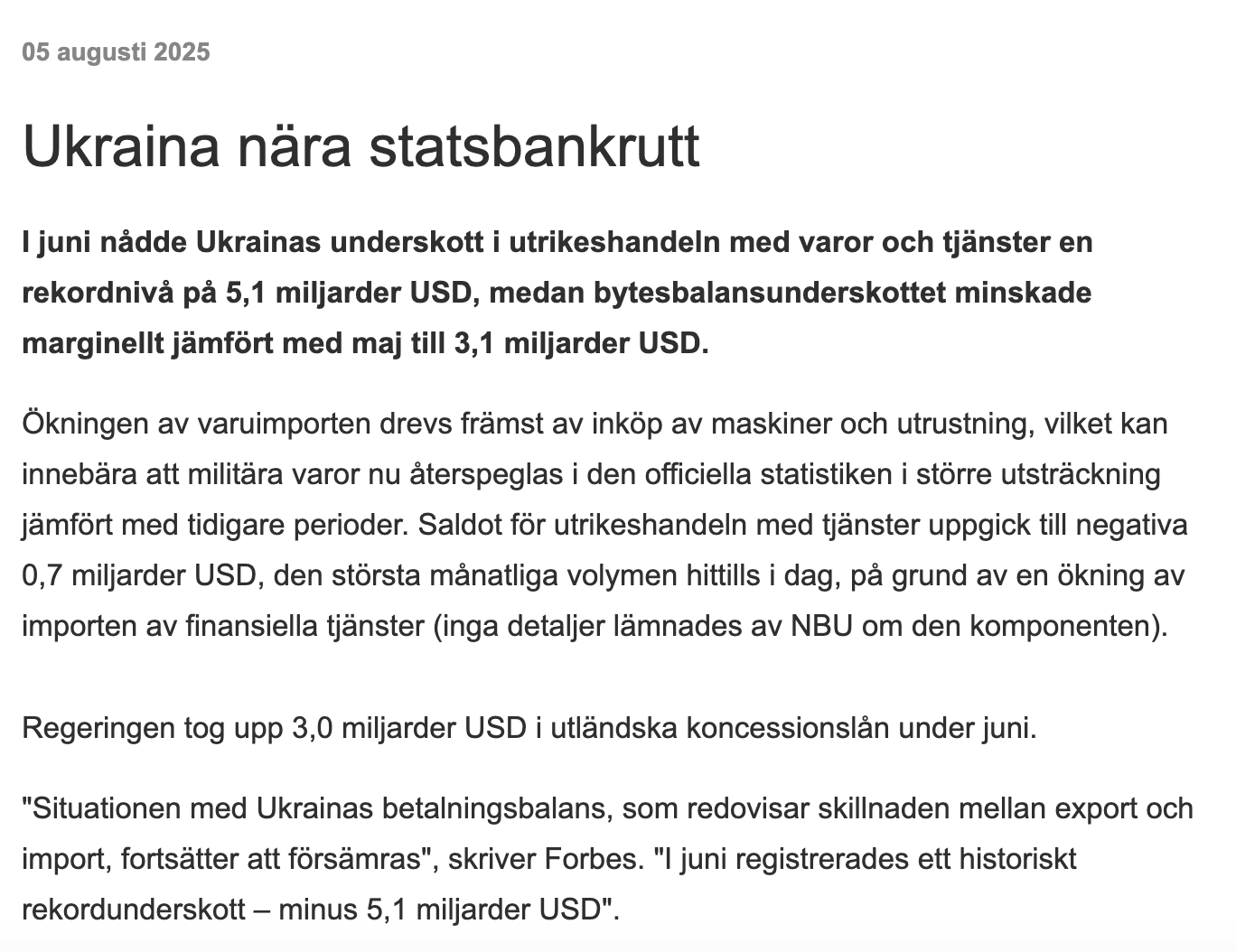
The most consequential operation begins when the war is translated into the language of personal grievance. SwebbTV used figures showing SEK 128 billion ($12.9 billion) in military assistance to portray support for Ukraine as the plundering of taxpayers and the financing of someone else’s war.
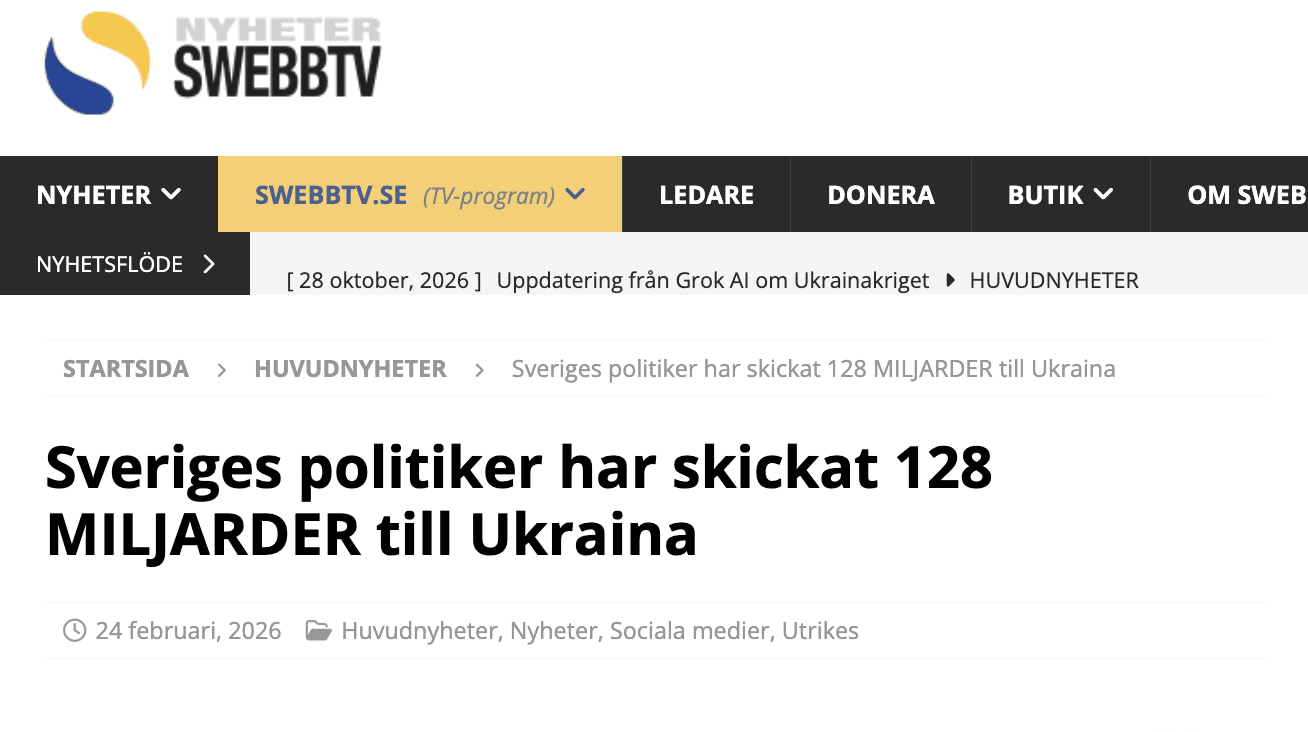
The figure comes from an official source. As of August 12, 2026, the Swedish government reported providing SEK 156 billion ($15.7 billion) in military and civilian assistance to Ukraine, including approximately SEK 128 billion in military aid. The propaganda operation does not involve inventing a number but stripping it of meaning. Russian aggression, Baltic regional security, and Sweden’s own direct defense interests are removed from the narrative. All that remains is a “bill” supposedly handed to ordinary citizens.
Financial grievances are compounded by fears of direct involvement in the war. Sweden’s NATO membership, rearmament, and cooperation with Kyiv are portrayed as provocations that the elites are using to “dragging the country into military collapse.” A Russian threat becomes an argument for self-restraint: responsibility for the danger is shifted from the party making the threat to the party refusing to submit.
The system’s final safeguard is the discrediting of fact-checking. SVT, major newsrooms, and government agencies are portrayed as components of a single “narrative control” apparatus. Once this framework is established, a rebuttal no longer undermines a falsehood but is instead declared evidence of censorship. The alternative outlet creates a closed information world in which it is right by definition, and any outside evidence is treated as hostile.
Within this framework, the word “censorship” serves a defensive purpose. Rather than describing a specific restriction on freedom of speech, it instructs readers to distrust any independent verification. If a newsroom corrects a false figure, it is “serving NATO.” If a government agency exposes the origins of a campaign, it is “persecuting dissenters.” If a fact-checker identifies a forgery, it is “protecting the official narrative.” This is how propaganda builds a form of informational immunity around itself.
How Sweden is recognizing the threat of Russian propaganda
In its first public annual review of foreign information influence for 2025, the Swedish Psychological Defense Agency identified Russia as the primary source of low-intensity but systematic pressure. Its objective is to weaken political, economic, and military support for Ukraine and influence Sweden’s decisions concerning NATO and the EU.
The agency documented the use of local influencers, fake replicas of legitimate news websites, paid comments, algorithmic manipulation, and generative artificial intelligence. The Russian system does more than produce falsehoods. It saturates the information environment with recurring narratives designed to be picked up by search engines, platforms, and language models.
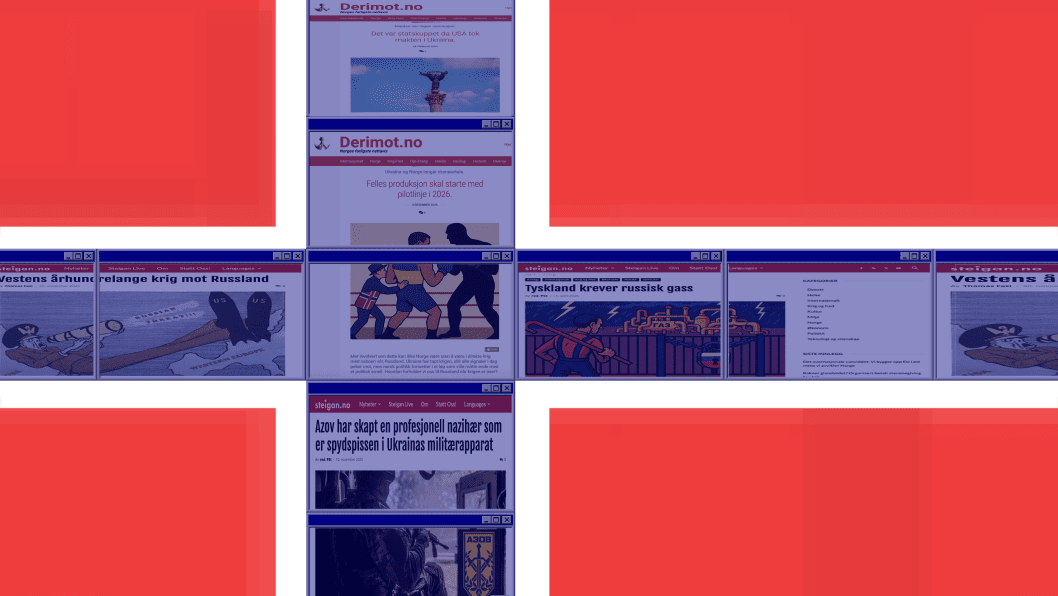
In September 2026, the government unveiled its National Strategy for Psychological Defense. Sweden incorporated protection of the information environment into its total defense system. This was a direct response to operations targeting not physical infrastructure but society’s ability to distinguish between sources, maintain trust, and sustain long-term decisions.
Under this model, psychological defense does not mean government control over opinions. Its focus is foreign operations that conceal their sponsors, misrepresent their sources, and exploit democratic openness against democracy itself. The response must also be democratic: exposing the origins of messages, tracing how they spread, publishing data on government decisions, and depriving manipulation of its greatest advantage—anonymity.
Why does the Kremlin need Sweden to grow weary?
In 2026, Stockholm and Kyiv moved from individual aid packages toward a long-term defense partnership. In May, Swedish Prime Minister Ulf Kristersson and Ukrainian President Volodymyr Zelenskyy signed a declaration on enhanced security and defense cooperation. It covers air defense, unmanned systems, the defense industry, technology, and the exchange of combat experience.
That same day, Sweden announced its intention to sell Ukraine up to 20 Gripen E/F fighter jets and transfer up to 16 Gripen C/D aircraft, subject to an agreement. Behind public support stand aircraft, missiles, ammunition, production chains, and Ukraine’s ability to defend its airspace. The information campaign centered on “wasteful spending” is therefore an attack on specific defense decisions.
This is where the military and information dimensions of Russia’s war converge. Swedish assistance provides Ukraine with tangible capabilities: ammunition, air defense systems, armored vehicles, and aviation solutions, along with training and technological cooperation. The Kremlin’s information ecosystem does not target an abstract “sympathy for Ukraine” but the political foundation supporting these decisions. Convincing voters that assistance is wasteful, escalatory, or an open-ended commitment raises the political cost of every subsequent aid package. When the same narrative circulates across alternative websites, social media, comment sections, and parliamentary debates, its purpose is not to establish the truth but to sow doubt.
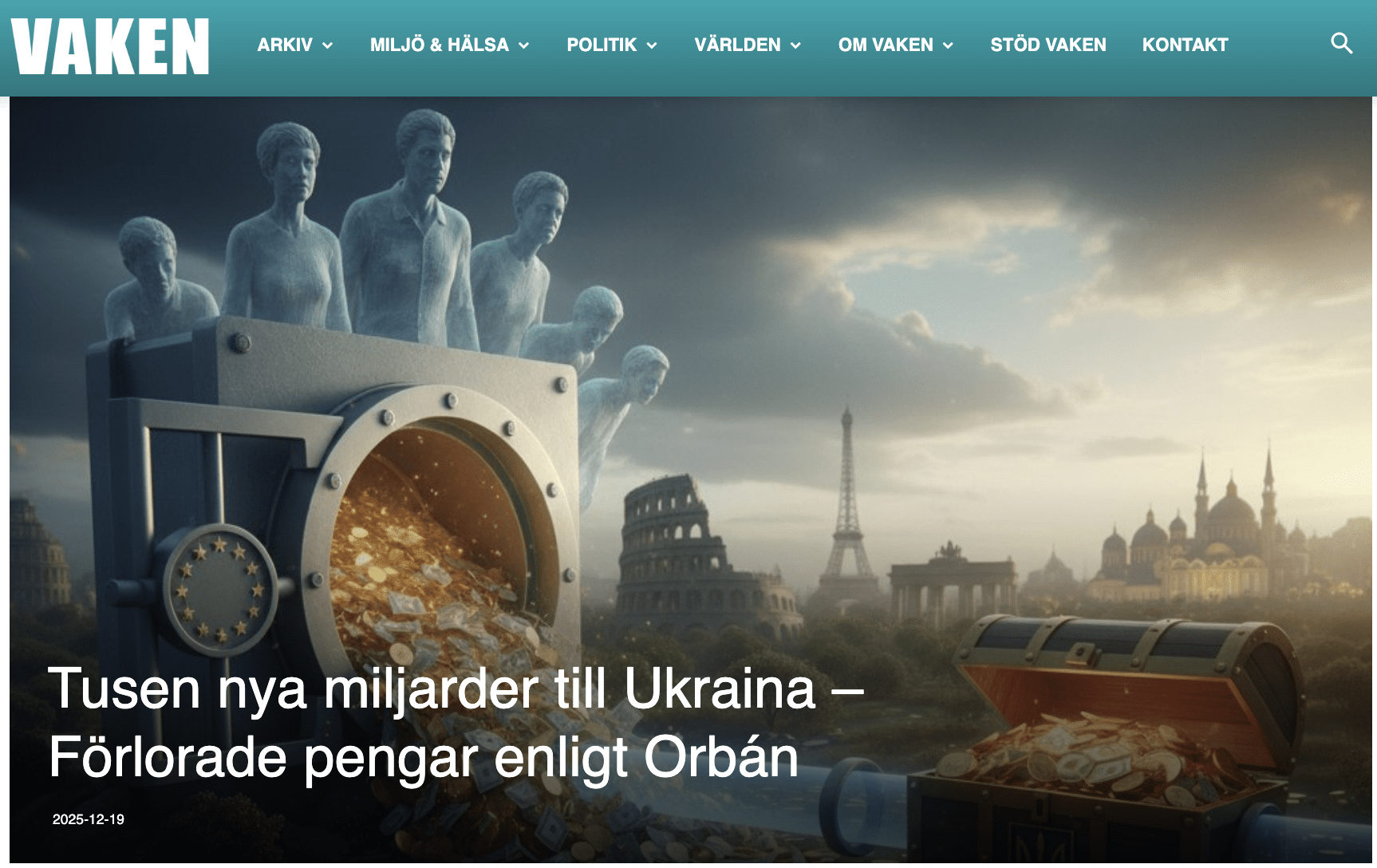
The Kremlin wants Europeans to think that sanctioning Russia is useless, sending more weapons only prolongs the war, and supporting Ukraine is futile.
If enough people accept those premises, Russia gets exactly what it needs: less pressure on its economy, fewer defenses reaching Ukraine, and a weakened neighboring country that Moscow can use as a launching pad for further aggression against an increasingly divided and vulnerable Europe.
Discuss this article: