- Category
- World
Why Putin Failed in Four Years—While the US Succeeded in Venezuela in Under Three Hours
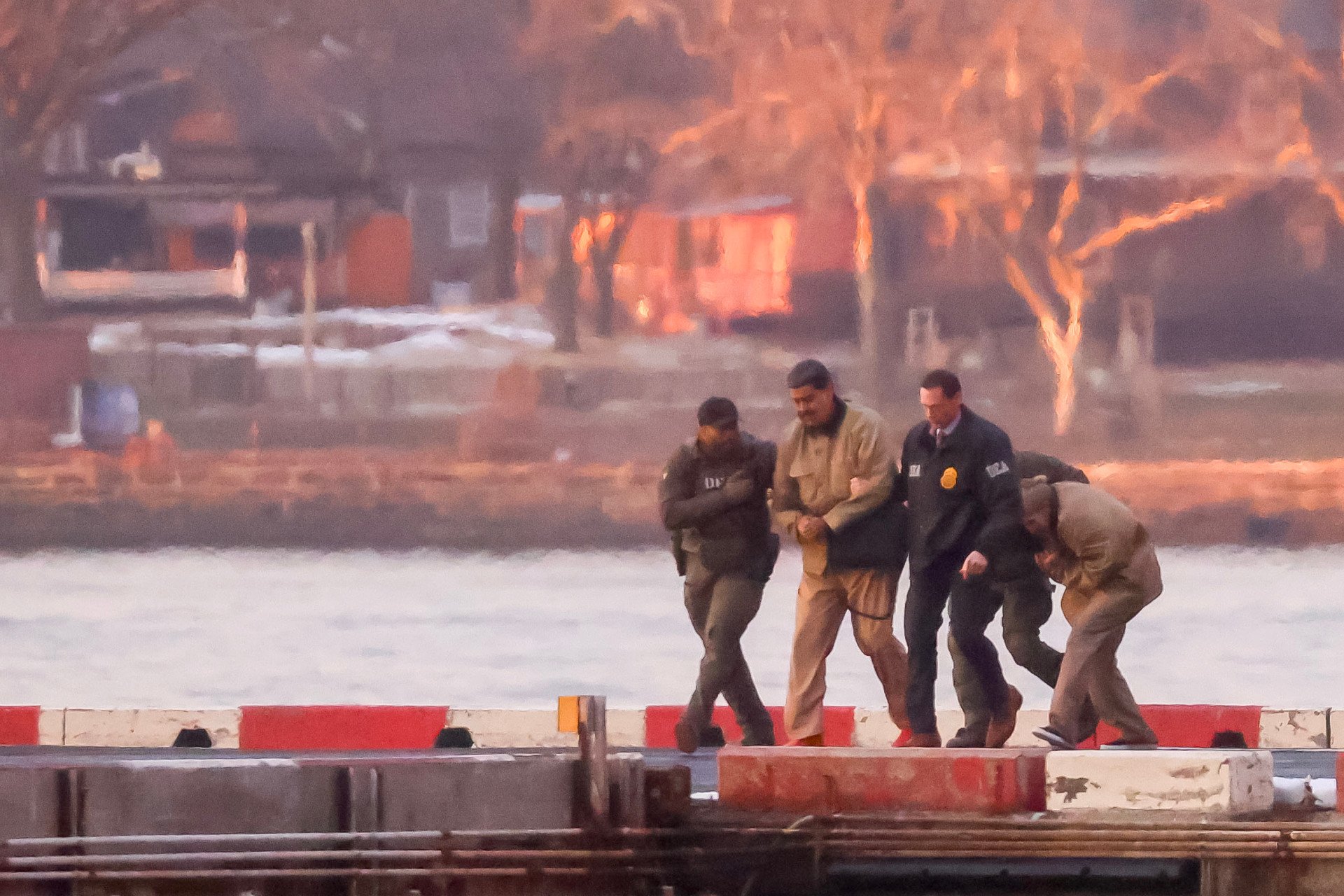
While Ukrainians rose en masse to defend their homeland against Russia’s invasion, when US special forces stormed the Venezuelan capital and captured leader Nicolás Maduro, they did not face much resistance from the public, the army, or even the presidential guard.
 Prefer U24 Media on Google
- Authors

-29a1a43aba23f9bb779a1ac8b98d2121.jpeg "Photo of Illia Kabachynskyi")
The US special operation in Venezuela unfolded with lightning speed: while global media focused on airstrikes targeting military sites, Maduro was already being transported to a US aircraft carrier. Putin could only dream of such precision—Russian troops who were supposed to seize the government quarter on the first day of the invasion failed even to secure a landing zone. The entire unit was wiped out by the Ukrainians.
Absolute Resolve
The US mission to capture Maduro on January 3, 2026, was executed with planning and precision. Officials in Caracas were confident that their trusted Russian air defenses would repel any aerial threat, but the United States completed the mission without a single casualty.
We bring you stories from the ground. Your support keeps our team in the field.
At a briefing, US Secretary of War Pete Hegseth announced that 200 of “our greatest Americans” entered downtown Caracas to capture Maduro. “Russian air defense systems didn’t quite work so well, did they?” he quipped. His sarcasm was understandable: 150 helicopters and fighter jets were deployed for the operation. American forces stormed Maduro’s residence within minutes, capturing him before he had a chance to flee. The entire mission lasted just 2 hours and 20 minutes.
Neither the Venezuelan military nor Maduro’s personal security detail could stop it. From the outside, it appeared as though the president was left completely unprotected. Rumors of a US-Venezuelan conspiracy began circulating online. As the world watched the explosions in Caracas unfold, Maduro was already aboard an American aircraft carrier.
Venezuela’s military boasts over 120,000 soldiers and is equipped with 12 S-300 systems to defend its airspace, alongside American F-16s and Russian Su-30s. Maduro had heavily invested in his military. Though the technology wasn’t cutting-edge, it was considered sufficient to repel a ground or aerial invasion—or at least, that was the plan.
The US military, however, was meticulously prepared. The active phase of Operation Absolute Resolve had been in planning for a month, preceded by several months of intelligence gathering. Critical data included Maduro’s exact location and a detailed layout of his residence. The US swiftly gained air superiority, destroyed Venezuelan command centers, and captured Maduro with virtually no resistance. There are almost no reports of clashes with Venezuelan forces defending the president.
A “3-Day Blitzkrieg”
In February 2022, Russian leader Vladimir Putin launched what he believed would be a rapid, decisive operation in Ukraine. Intelligence officials assured him that the invasion would be welcomed by a local population supposedly sympathetic to Moscow. Russian spy networks had received enormous funding for years, pro-Kremlin political forces and loyal officials were in place, and the Kremlin was confident that Ukraine had no army capable of resisting the nearly 200,000 Russian troops set to advance from three directions.
When Russia’s full-scale invasion began on the morning of February 24, 2022, global experts predicted that Kyiv would fall within 72 hours.
Moscow planned an airborne landing at Hostomel Airport, just outside the capital, where elite forces were to quickly seize control and establish a beachhead for reinforcements. From there, several thousand troops were expected to swiftly capture Kyiv’s government quarter, take control of the capital, and detain Ukraine’s leadership. Putin believed the operation would go as smoothly as the 2014 attempt to annex Crimea—and that neither the US nor Europe, unprepared to fight for Ukraine then or now, would offer serious resistance.
But the Ukrainian people had other plans.
From the first hours, tens of thousands of men and women surged to military enlistment centers, queuing for weapons to defend their country. The Hostomel landing failed. Despite its overwhelming air power, Russia could not dominate Ukrainian skies. Social media quickly filled with footage of unarmed civilians blocking Russian tanks with their bodies.
Within a month, Russian forces withdrew from Kyiv and Chernihiv regions, losing their foothold in Sumy. Six months later, they were driven out of the Kharkiv region. By month nine, Ukrainian troops launched a successful counteroffensive and liberated parts of Kherson.
Putin’s invasion of Ukraine was built on the false assumption that the so-called “Kyiv regime” lacked legitimacy and public support. The war he envisioned as a swift blitzkrieg has now dragged on for more than 1,400 days. But from day one, the Ukrainian people proved otherwise—refusing to surrender their country and standing firm against one of the world’s largest armies with a collective will to defend their sovereignty, cities, and national identity.
Discuss this article:
-4a56a6b482ec132402c16ef6fcabf9a2.png)


-c439b7bd9030ecf9d5a4287dc361ba31.jpg "Photo of Katherina Popilnichenko")

-72b63a4e0c8c475ad81fe3eed3f63729.jpeg "Photo of Cyril Barabaltchouk")