- Category
- Investigations
Russian $100 Billion Sanctioned Stablecoin Showed Up on Binance and LCX
A7A5 is a Russian stablecoin used for international settlements, including within the ecosystem supporting Russia’s shadow fleet and sanctions-evasion operations. Despite sanctions imposed by the EU and the US, pages promoting A7A5 and its wrapped version, WA7A5, appeared on platforms operated by Binance and the regulated European exchange LCX. After questions from UNITED24 Media, the pages disappeared.
 Prefer U24 Media on Google
- Authors


A7A5 has become a significant component of the alternative financial system Russia has been building since losing access to parts of the Western banking infrastructure.
The ruble-backed token is connected to the A7 network, Russia’s Promsvyazbank, and a Kyrgyzstan-registered company, Old Vector. It is used for cross-border settlements outside traditional banking channels, including transactions reportedly linked to Russia’s shadow fleet.
The total value of A7A5 transactions since the token’s launch in 2025 has been estimated at more than $100 billion.
The stablecoin and several related companies and individuals are subject to sanctions imposed by the United States and the European Union. The EU sanctioned A7A5 in July 2025 and later included it in its 19th sanctions package against Russia. European restrictions prohibit both direct and indirect transactions involving the token.
Yet UNITED24 Media found that elements of A7A5’s infrastructure and marketing had appeared on official resources operated by two prominent cryptocurrency platforms: Binance and Liechtenstein Cryptoassets Exchange, or LCX.
How to buy WA7A5 through Binance Wallet
A Binance webpage was titled “How to Buy Wrapped A7A5 (WA7A5) Safely Through Binance Wallet.”
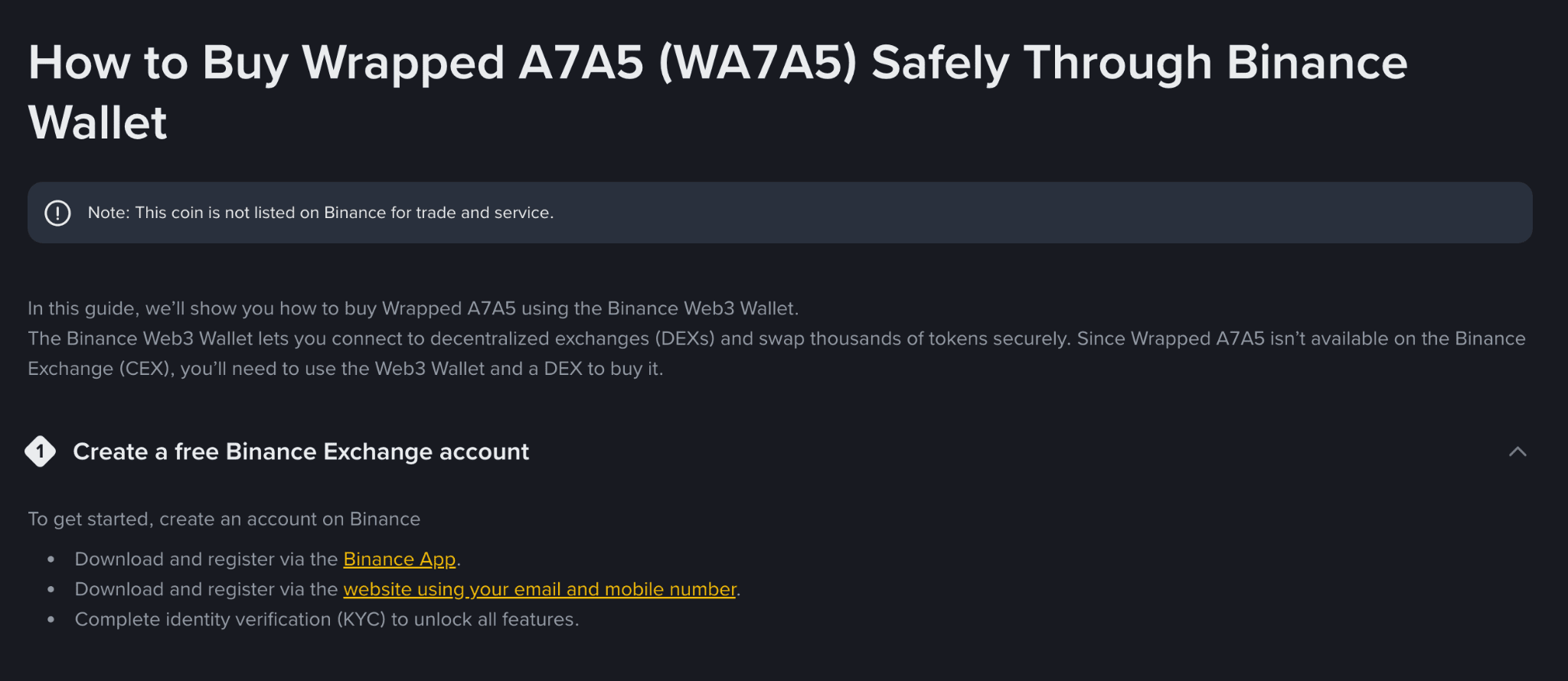
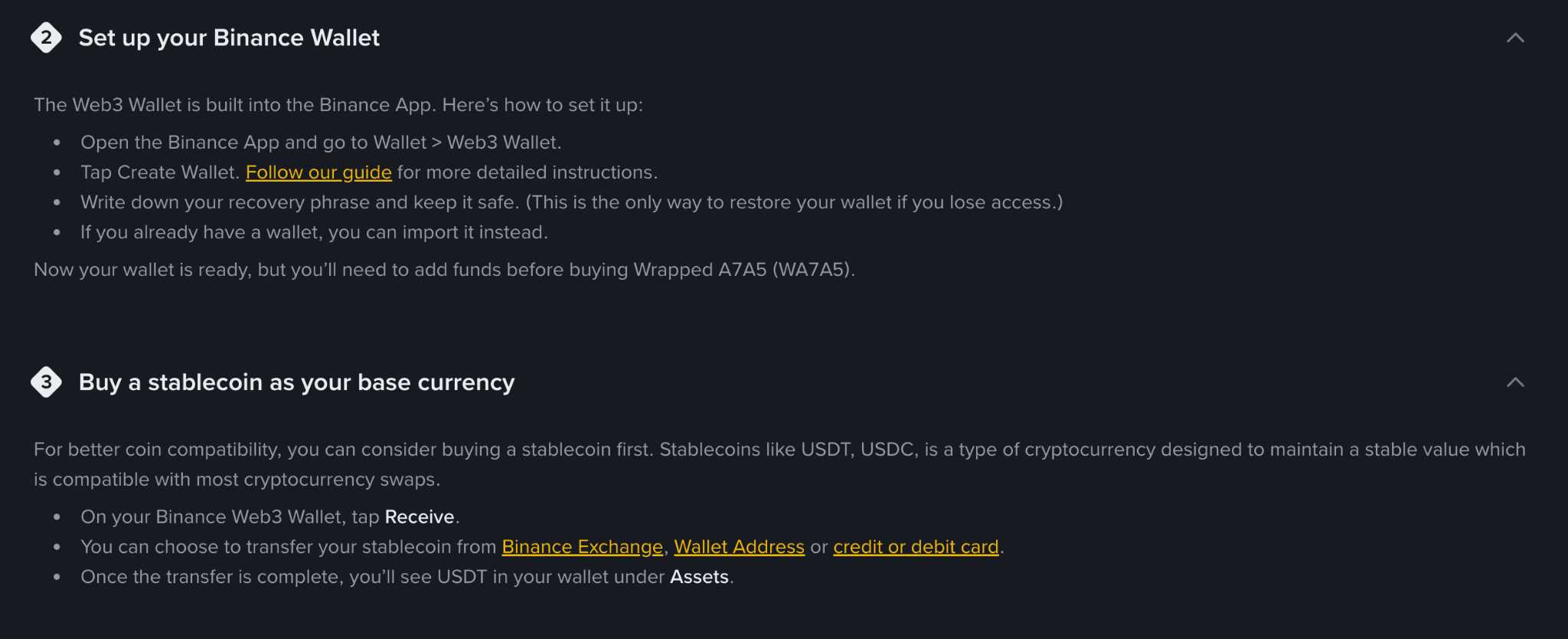
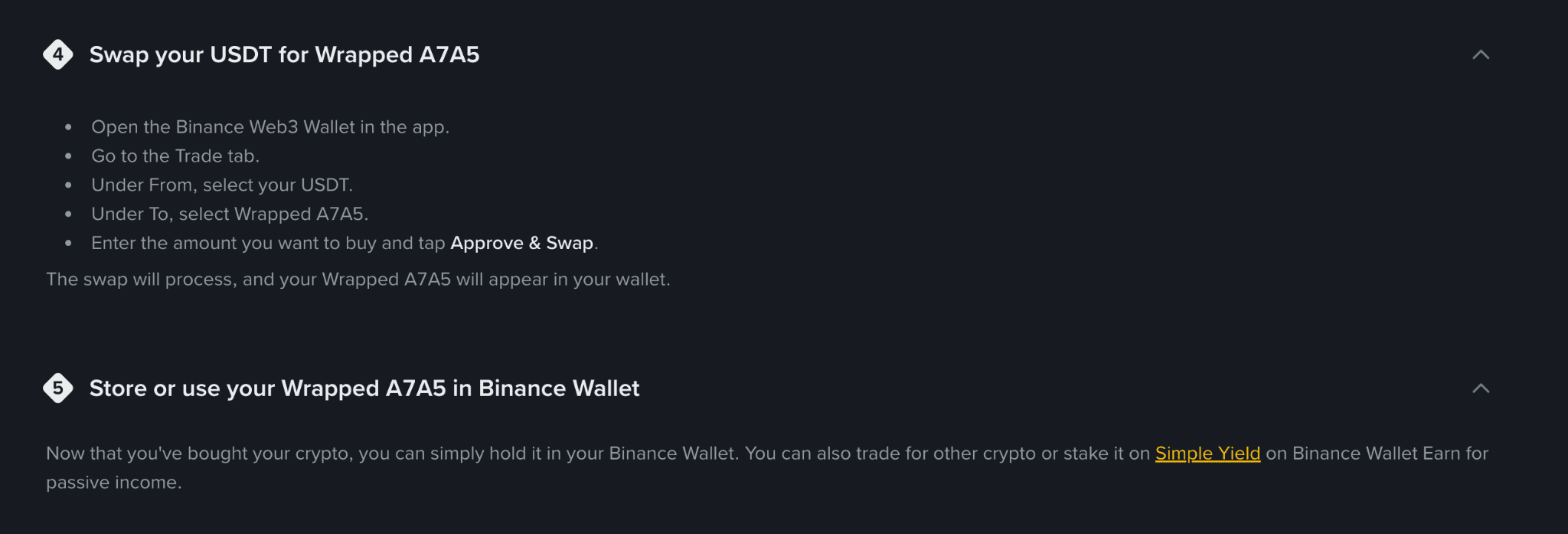
The guide acknowledged that WA7A5 was not traded on Binance’s centralized exchange. Instead, it advised users to create a Binance account, set up Binance Wallet, purchase another stablecoin, and then swap it for WA7A5 through a decentralized exchange.
UNITED24 Media did not complete a transaction and therefore cannot confirm that the proposed route actually enabled users to acquire the token. Nevertheless, the page was hosted under the Binance brand and described this method of obtaining WA7A5 as “safe.”
In its response, Binance stressed that sanctioned tokens are prevented from being displayed or traded through its centralized exchange.
At the same time, Binance Wallet is a separate, self-custodial product. According to the company, it cannot control every independent transaction users perform across permissionless blockchain networks.
This explains the limits on Binance’s ability to police on-chain transactions. It does not explain why a Binance-branded, step-by-step guide to obtaining a sanctioned token appeared in the first place.
Following questions from UNITED24 Media, Binance conducted an internal review, stating that they had
“Following your inquiry, we have performed a search of online content and removed additional references to the stablecoin in question from Binance-branded webpages,” a company spokesperson said.
Binance said the pages had been generated automatically and were not intentionally written by its employees. The company also committed to improving its internal processes to prevent similar content from appearing in the future.
“How to Buy A7A5 on LCX”
The pages hosted by the regulated European exchange LCX were even more explicit in their presentation.
One was titled “How to Buy A7A5 (A7A5) on LCX.” It instructed users to create an account, complete identity verification, deposit euros or cryptocurrency, and purchase A7A5.
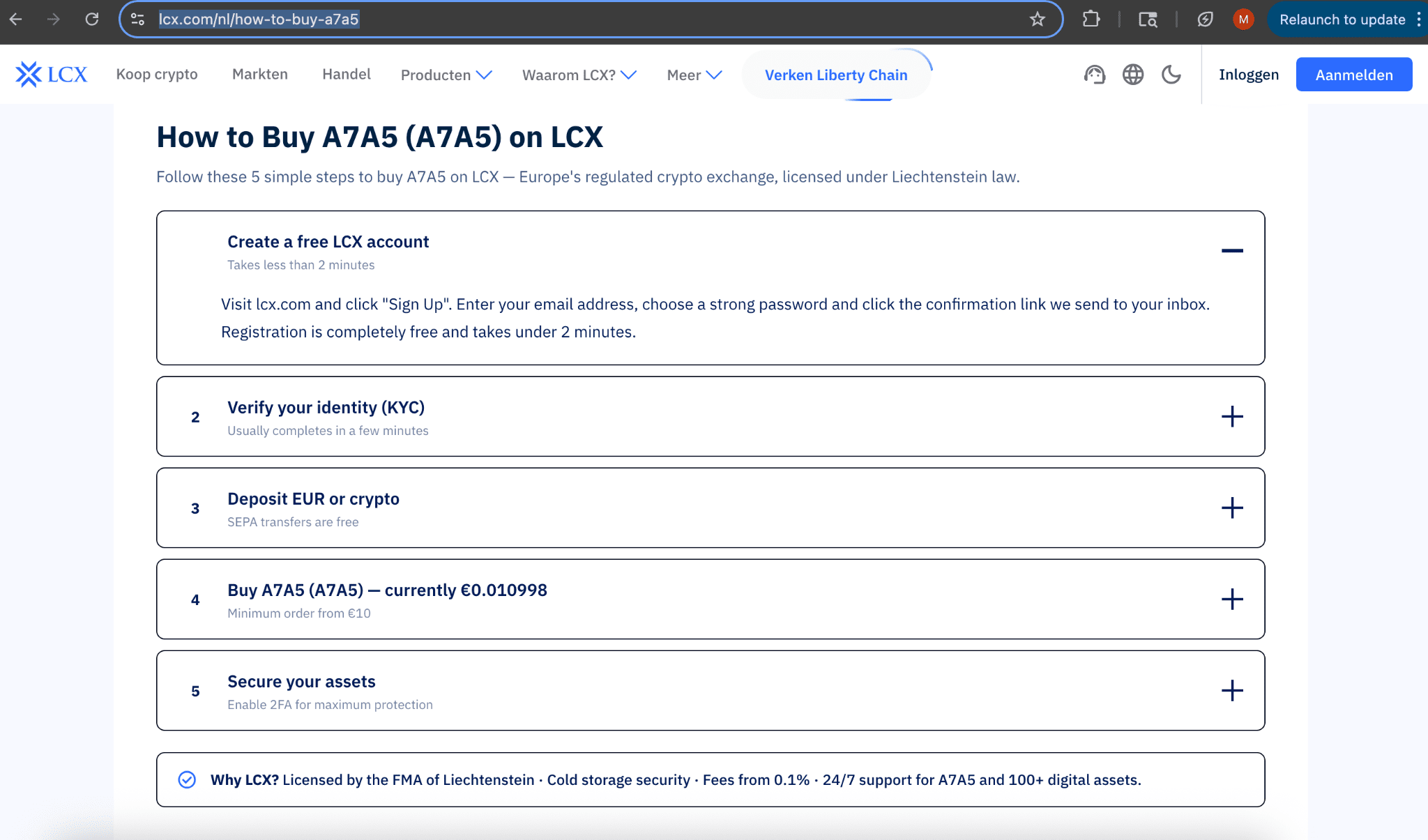
The page displayed a minimum order of €10. Another showed a price for WA7A5, fields for entering the amount to buy, and a “Buy Now” button.
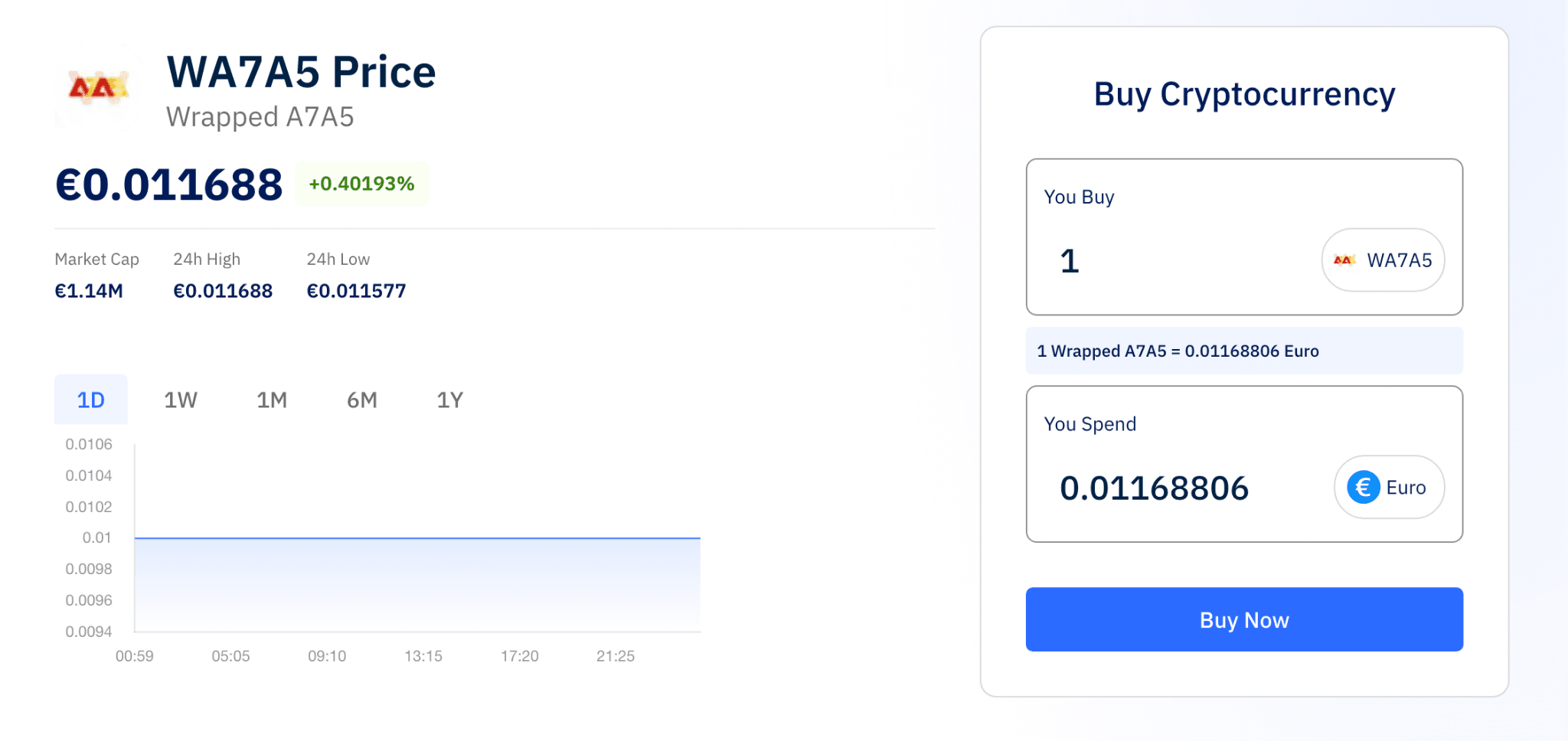
UNITED24 Media did not establish whether these elements could actually be used to complete a purchase. However, they created the appearance that the token was accessible through a regulated European platform.
LCX-hosted pages also described the asset as “fully compliant,” operating “under state supervision,” and meeting “investor protection” requirements. They additionally referred to yield opportunities for token holders.
In its response, LCX said that A7A5 and WA7A5 had never been listed on its exchange.
The company described the materials as automatically generated SEO pages displaying third-party market data. According to LCX, they did not constitute a listing, endorsement, or any other form of support for the token.
LCX also emphasized that it complies with sanctions against Russia, blocks Russian users and companies, and has participated in pro-Ukraine initiatives.
But the response did not explain why the automated pages went beyond displaying prices and appeared to offer a purchase process while using language associated with regulatory compliance and investor protection.
UNITED24 Media sent LCX follow-up questions about the source of these descriptions, the company’s sanctions controls, and its responsibility for content hosted on its official domain. LCX did not respond.
The pages concerning A7A5 and WA7A5 subsequently disappeared from the LCX website. The company did not confirm whether they had been removed in response to the inquiry or explain why they were taken down.
Automatically generated does not mean neutral
The available evidence does not establish that Binance or LCX deliberately promoted A7A5, that the token was formally listed, or that users could complete a purchase through the documented pages.
It does establish something else: elements of the infrastructure and marketing surrounding a sanctioned Russian token appeared on the official resources of two prominent cryptocurrency platforms.
In one case, users were shown instructions for a potential swap through Binance Wallet. In the other, they saw an onboarding process, a displayed price, a purchase button, and claims implying regulatory credibility on the LCX website.
Both companies attributed the pages to automated content generation. But automation does not make such pages neutral. They appeared on official domains and used the companies’ designs, brands, and reputations. For an ordinary user, this could have been enough to make A7A5 appear vetted—or at least permissible.
The case exposes a gap between the appearance of regulation in the cryptocurrency industry and the actual ability of companies to control their infrastructure.
Major platforms have introduced KYC procedures, sanctions screening, and blockchain analytics. At the same time, their automated systems may still lend an appearance of legitimacy to opaque and sanctioned financial instruments.
Following UNITED24 Media’s inquiry, Binance acknowledged the problem, removed additional references to A7A5, and promised stronger controls. LCX stopped responding after its initial statement, while the pages simply disappeared.
The A7A5 case shows that even where the crypto industry appears regulated, its infrastructure remains vulnerable to financial instruments designed to operate outside the traditional banking system and circumvent Western restrictions.
Discuss this article:


-605be766de04ba3d21b67fb76a76786a.jpg "Joseph Place")
-111f0e5095e02c02446ffed57bfb0ab1.jpeg "Photo of Roman Kohanets")


-206008aed5f329e86c52788e3e423f23.jpg "Photo of Oleksandr Moiseienko")