- Category
- Defense Tech
Ukraine Deploys NEO-1 Ground Robot for Remote Demining and Frontline Logistics
 Prefer U24 Media on Google
- Authors

-72b63a4e0c8c475ad81fe3eed3f63729.jpeg "Photo of Cyril Barabaltchouk")
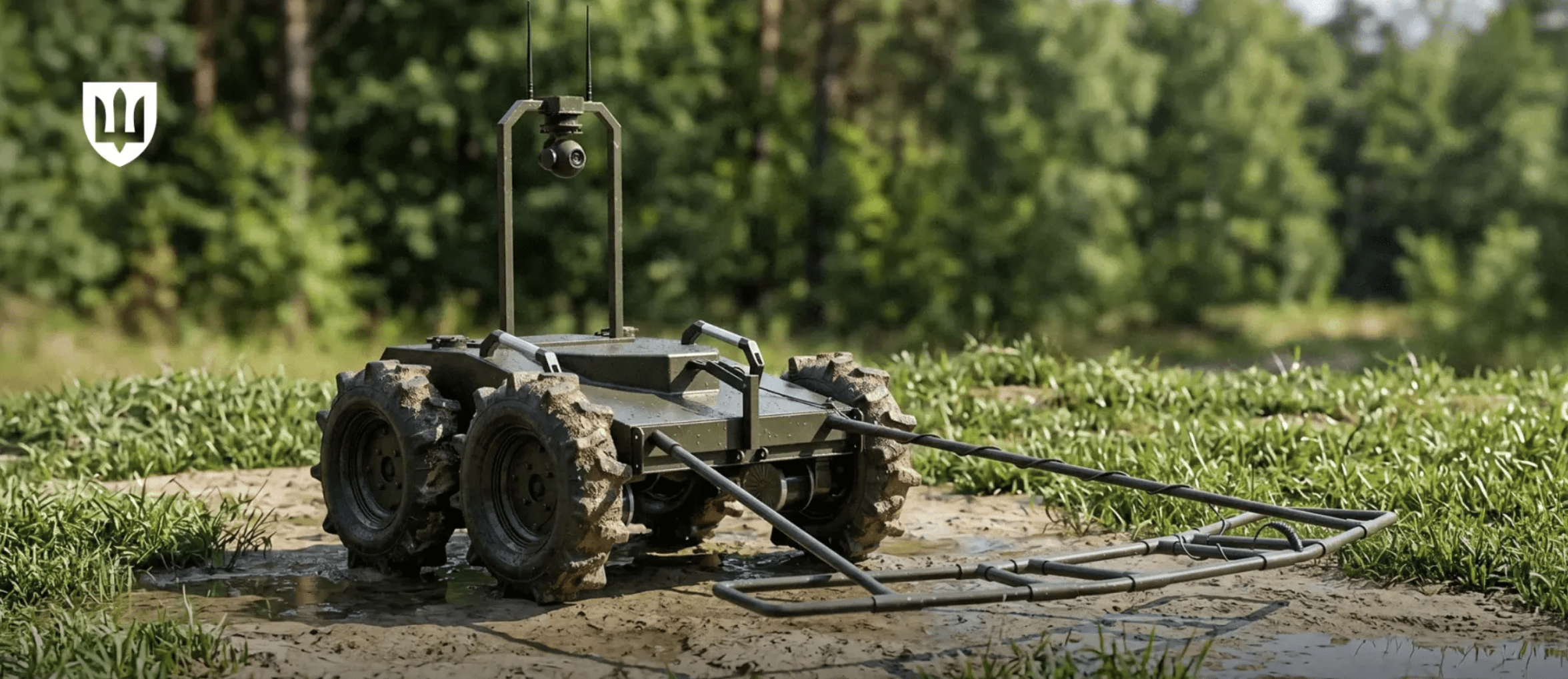
The Ministry of Defence (MoD) of Ukraine has officially codified and approved the deployment of the NEO-1 robotic hardware-software complex, a remote system designed for searching out unexploded ordnance across the battlefield, the MoD reported on June 9.
Designed specifically to meet the demands of frontline combat units, the NEO-1 platform is a domestic innovation aimed at clearing minefields with minimal risk to operators. The MoD stated that its development addresses the harsh realities of modern warfare and the immediate requests of soldiers.
We bring you stories from the ground. Your support keeps our team in the field.
A versatile and accessible platform
The NEO-1 offers significant operational advantages over standard engineering tools. It features a straightforward user interface, allowing both manual and automated control modes, and is built with a modular architecture to keep operational costs low.
Crucially, the system is designed to be highly accessible; according to the MoD of Ukraine, the NEO-1 can be operated by any service member needing to clear an area, completely bypassing the need to call in specialized engineering units.
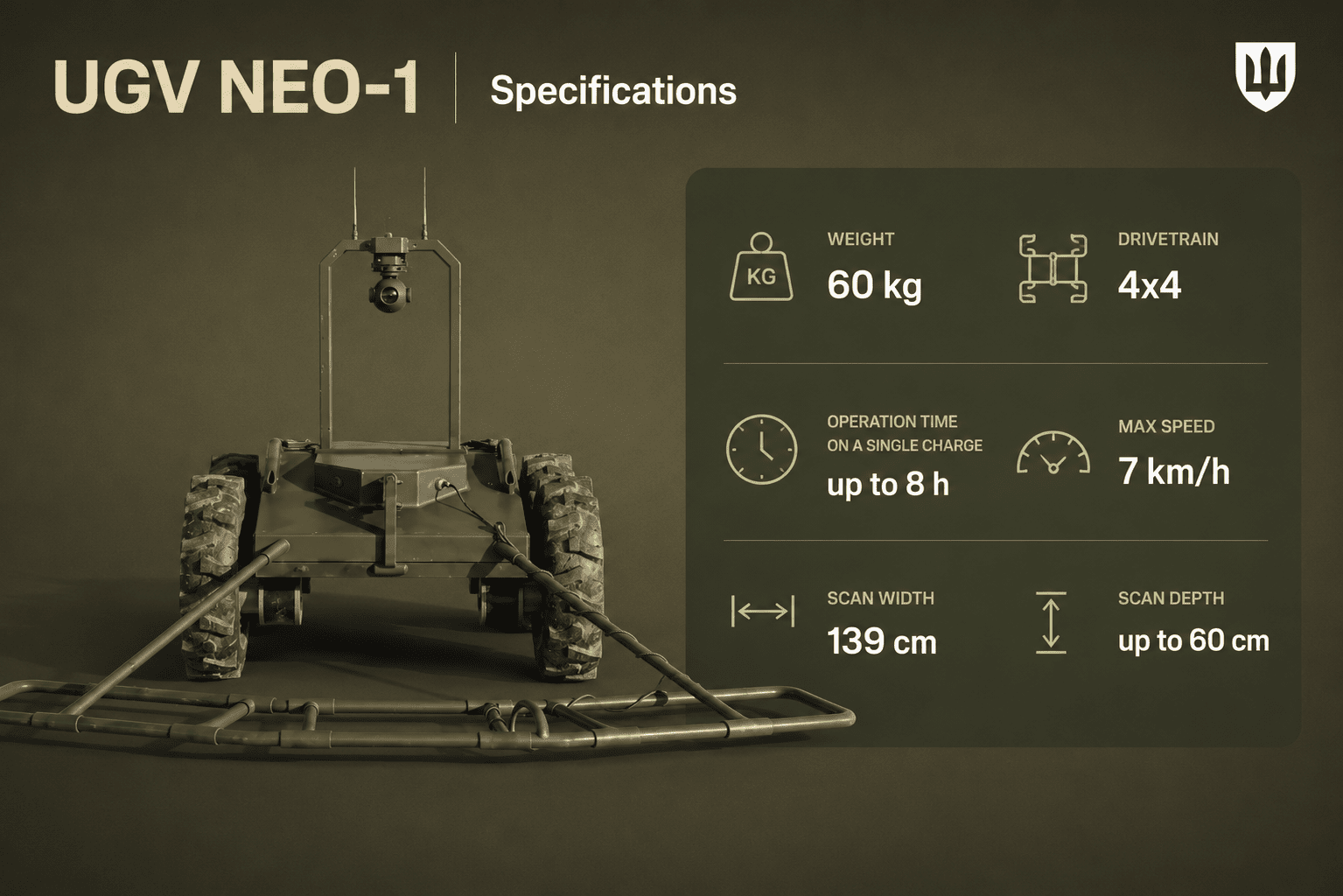
The robot boasts a compact and easily transportable frame, measuring 85 by 81 centimeters with a height of 41 centimeters and a weight of roughly 60 kilograms. This lightweight design allows just two soldiers to lift it out of a pickup truck bed or trunk. Once deployed, the NEO-1 reaches speeds up to 7 km/h and operates autonomously for up to 8 hours on a single charge.
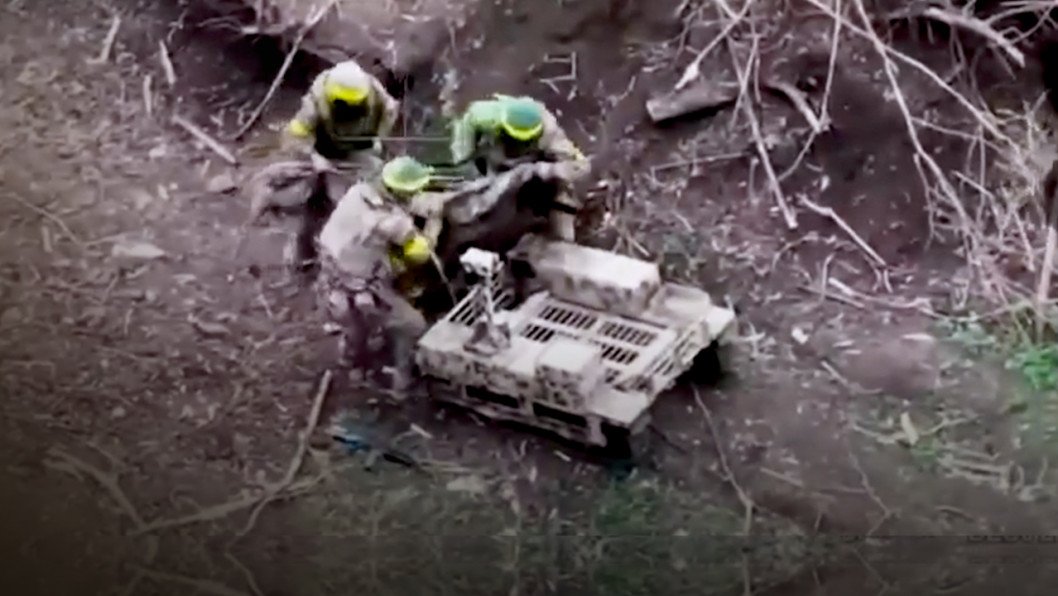
Alongside its primary demining role, the platform also functions as a logistics workhorse, capable of carrying up to 70 kilograms of cargo or towing a loaded cart weighing up to 120 kilograms, the MoD of Ukraine reported.
Advanced sensors and optics
In its baseline configuration, the NEO-1 offers a remote-control range of up to 500 meters, which can be optionally extended to 3 kilometers. Operators receive real-time video feeds from an onboard camera equipped with a 3-axis stabilizer, night vision, 10x optical zoom, and 3x digital zoom.
For its primary demining role, the platform utilizes a wide-format, multi-channel impulse metal detector that automatically adjusts to various soil types. The MoD noted that the sensor can be calibrated remotely and effectively detects a wide range of threats—including black metals, gold, silver, OZM-72 bounding fragmentation mines, TM-series metallic anti-tank mines, MON directional fragmentation mines, and low-metal PMN-2 anti-personnel mines.
The detector sweeps a path 139 centimeters wide and can penetrate up to 60 centimeters into the ground. It also includes an adjustable volume control and a specialized filter mode to ignore small battlefield debris like metal shavings, screws, and tiny shrapnel fragments.
-c21a044ae3a8fd8c7ab11a85ace580cf.png)
Scaling up unmanned logistics
Achieving technological superiority over the Russian army remains a critical pillar of Ukraine’s overarching defense strategy. To this end, the MoD plans to contract over 25,000 ground robotic systems in the first half of 2026 alone—more than double the total number procured throughout all of 2025.
The ultimate goal is to transition 100% of frontline logistics to unmanned robotic platforms.
This procurement follows the recent approval of other domestic systems, such as the “Bizon-L” ground robotic complex. Equipped with six different types of communication links—including LTE and Starlink—the Bizon-L ensures stable operation even in areas saturated by intense enemy electronic warfare (EW), according to previous reports.
Discuss this article:





-c439b7bd9030ecf9d5a4287dc361ba31.jpg "Photo of Katherina Popilnichenko")