- Category
- Latest news
China Tests Drone Swarm System Capable of 100 UAVs Controlled by a Single Operator
 Prefer U24 Media on Google
- Authors

-c439b7bd9030ecf9d5a4287dc361ba31.jpg "Photo of Katherina Popilnichenko")
China has provided the first full-scale demonstration of its Atlas drone swarm management, which shows how drone swarms are expanding on the battlefield and reflects the rapid growth of algorithmic technologies.
These advancements are changing modern warfare by enabling autonomous coordination and precise combat operations at a systemic level, according to Global Times on March 25.
We bring you stories from the ground. Your support keeps our team in the field.
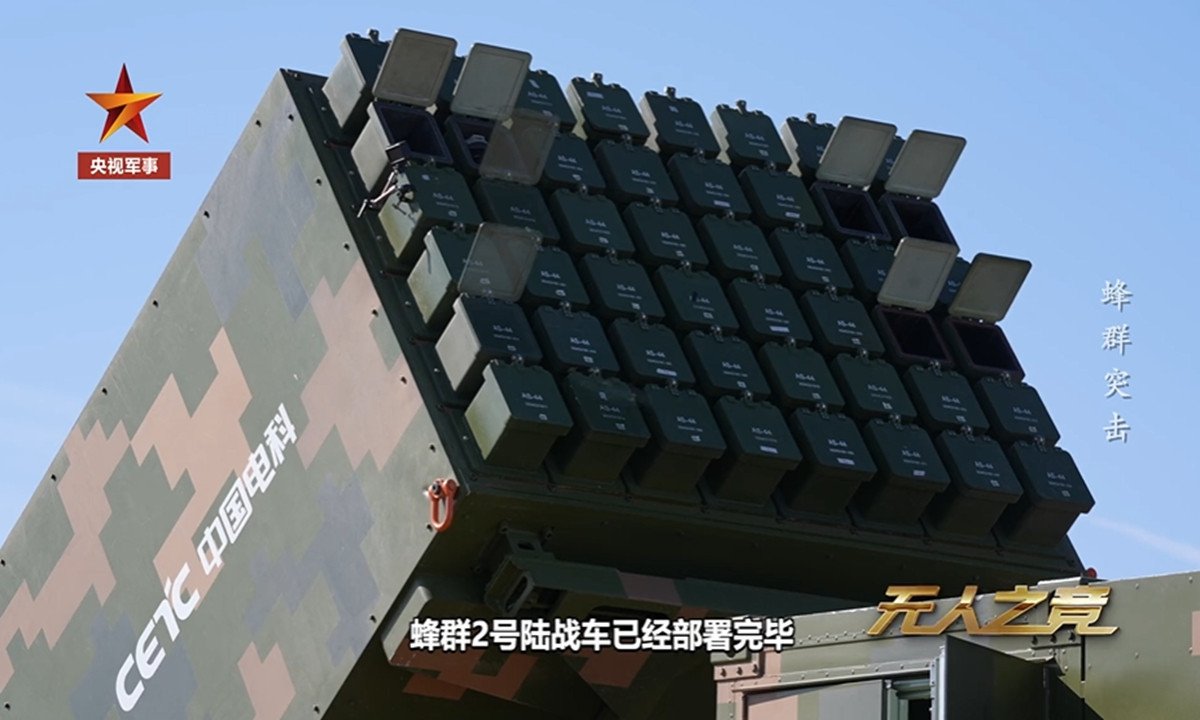
The system consists of the Swarm-2 ground combat vehicle, a command vehicle, and a support vehicle. Footage from a CCTV News report shows the launcher features the logo of China Electronics Technology Group Corp.
The Swarm-2 vehicle first appeared at Airshow China 2024 in Zhuhai. One vehicle can carry and launch 48 fixed-wing drones, while a single command vehicle can manage up to 96 drones in a swarm simultaneously.
Each drone can carry different tools for electronic reconnaissance, strike munitions, or communication relay. They can be organized into different groups to perform complex missions.
During a recent test, three similar targets were placed in a strike zone. The Atlas system conducted coordinated reconnaissance and autonomously identified a command vehicle among the targets. It then opened the launcher and deployed the drones. The aircraft locked onto the target in the air and struck it with precision.
The Swarm-2 vehicle uses a mechanism that launches one drone every three seconds. This interval ensures a safe distance and proper flight paths for every unit. The type and order of the launches can be adjusted based on mission needs.
For example, reconnaissance drones can go first to gather data, followed by electronic warfare drones to suppress the enemy before the strike drones arrive.
Using swarm intelligence, nearly 100 high-speed drones can form tight and accurate patterns in a short time. They are able to adapt to environmental factors like air currents and avoid hitting each other while flying. The control algorithms give each drone a smart brain for real-time communication and position adjustments.
A single operator can manage this entire large-scale air operation. Controlling up to 96 drones is compared to one person flying nearly 100 kites using a single string. The system also includes drones of different sizes to provide various complementary capabilities within the swarm.
Chinese military expert Wang Yunfei stated that the system could significantly expand battlefield applications because it uses modular task configurations.
He noted that during attacks on enemy air defenses, a large number of drones can be launched in waves from different directions to overwhelm interception capabilities. This makes it difficult for defenders to respond effectively.
In precision strike missions, these drones can hover over targets for constant observation. This allows for closer and more accurate strikes than traditional long-range munitions, which can be affected by weather or electronic interference.
For deep-strike operations, drones with a range of hundreds or thousands of kilometers can fly at low altitudes with small radar signatures. This makes them hard to detect and allows for strikes deep inside enemy territory, blurring the line between the front line and rear zones.
Wang explained that these capabilities are driven by Chinese progress in artificial intelligence and large models. In complex combat, drones must handle difficult tasks like target recognition and route planning that are hard for humans to manage alone.
Through AI training and built-in algorithms, the drones can perform these functions autonomously and adapt to changing conditions on the battlefield.
Leaked documents from Russia’s military-industrial sector revealed a sharp escalation in Russia–China military cooperation.
Moscow was set to deliver nearly 50 Ka-52 attack helicopters while training Chinese specialists and helping establish weapons production lines. This cooperation existed long before 2022, but Russia’s full-scale invasion of Ukraine intensified China’s interest in Russian technologies.
Discuss this article: