- Category
- Latest news
Drones, Robots, and a 7-Phase Plan: How Ukraine Is Rewriting the Rules of War

As Ukraine experiments with a bold new blueprint for warfare—built around drones, robotics, and phased precision strikes—a new RUSI report suggests this seven-step strategy could become a model for how NATO prepares to confront Russia in a future full-scale war.
 Prefer U24 Media on Google
- Authors




The British defense think tank Royal United Services Institute (RUSI) has published a new report analyzing how Ukraine’s Armed Forces are integrating drones, artillery, armored vehicles, and robotic systems into a multi-phase approach to modern combined arms warfare, according to Defense Express on December 5.
We bring you stories from the ground. Your support keeps our team in the field.
The goal, according to the report’s author Jack Watling, is not only to understand how Ukrainian brigades adapt under fire, but also to explore how NATO could prepare to counter Russian forces in a potential high-intensity war by 2028.
Tactical evolution based on field interviews
Watling’s analysis draws from interviews with Ukrainian “non-standard” units—two pioneering brigades experimenting with new technologies—and three assault formations at the battalion and regimental level.
The paper is titled “New Approaches to Combined Arms Maneuver in Ukraine,” and while focused on Ukraine, it is aimed at generating doctrinal insights for NATO.
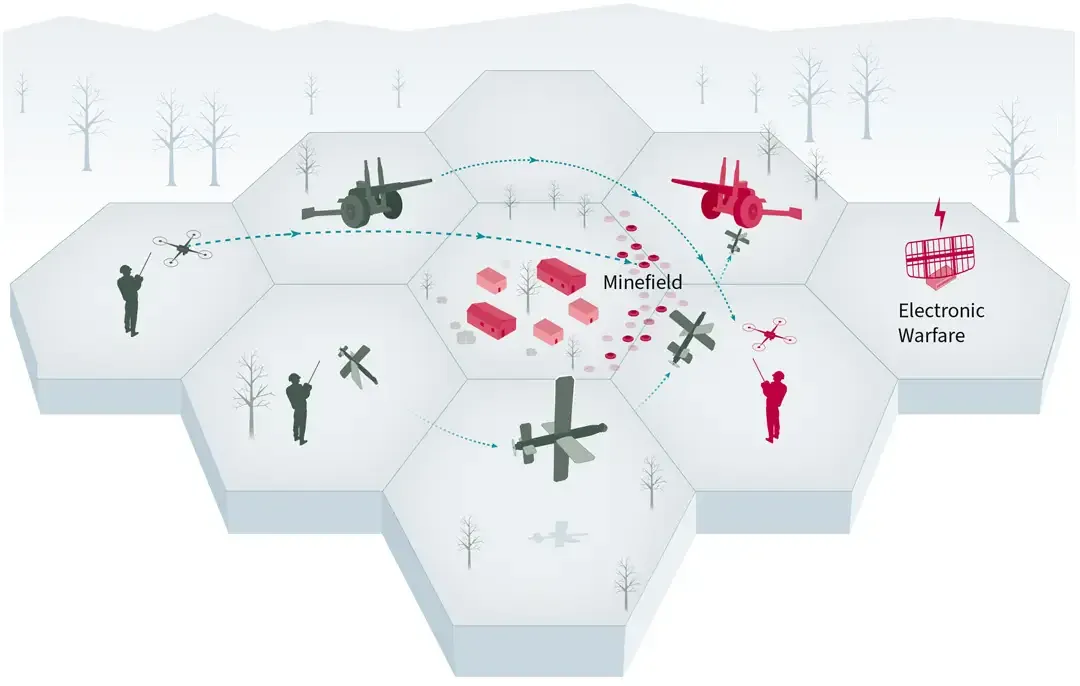
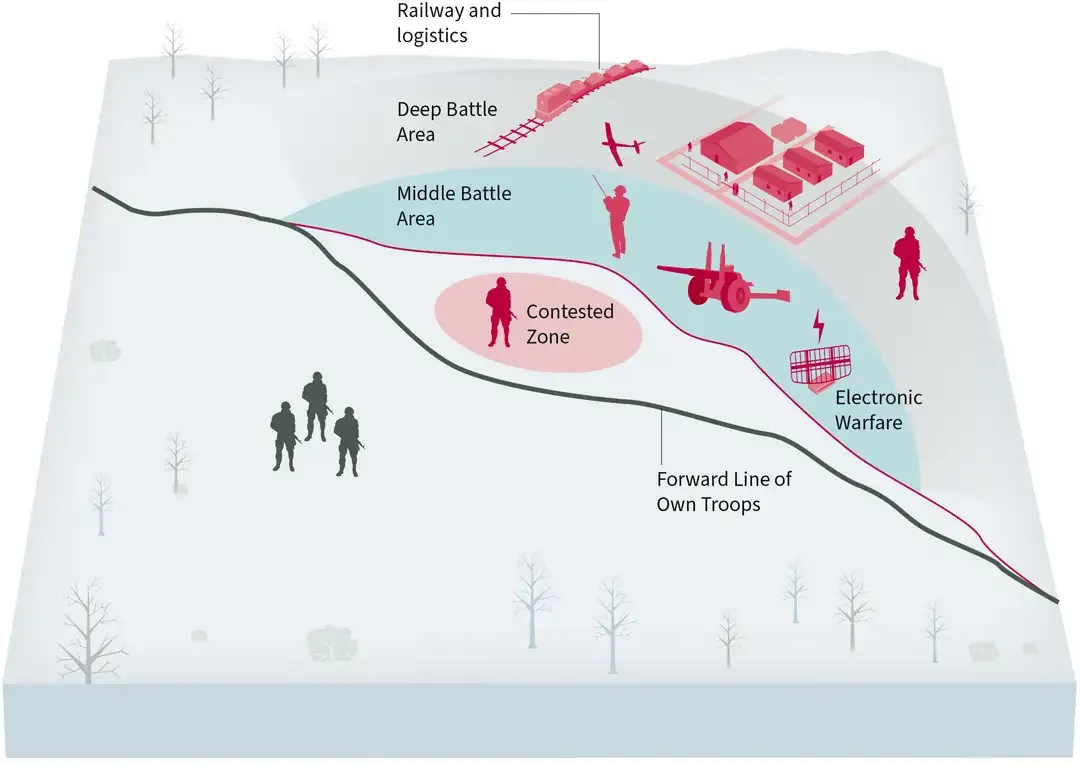
The foundation of RUSI’s framework is a redefinition of the battlefield geometry. The depth of operations is conceptualized as extending 30 km from the line of contact, with a 10–15 km “kill zone” where the bulk of engagements occur.
Within this zone, the report outlines a proposed seven-phase operational model intended to increase effectiveness while minimizing risk.
Seven phases of a modern combined operation
RUSI’s concept emphasizes the phased application of diverse weapons systems to create tactical breakthroughs. The phases are:
Reconnaissance: Identifying enemy air defenses, electronic warfare (EW) systems, and artillery positions;
Isolation: Disrupting enemy logistics through remote mining and precision strikes by UAVs and artillery to impede the flow of reinforcements and supplies;
Degradation: Using drones and artillery to eliminate command posts, ammunition depots, troop concentrations, and sheltering positions;
Fixation: Employing FPV drones to pin enemy forces in place and prevent maneuvering;
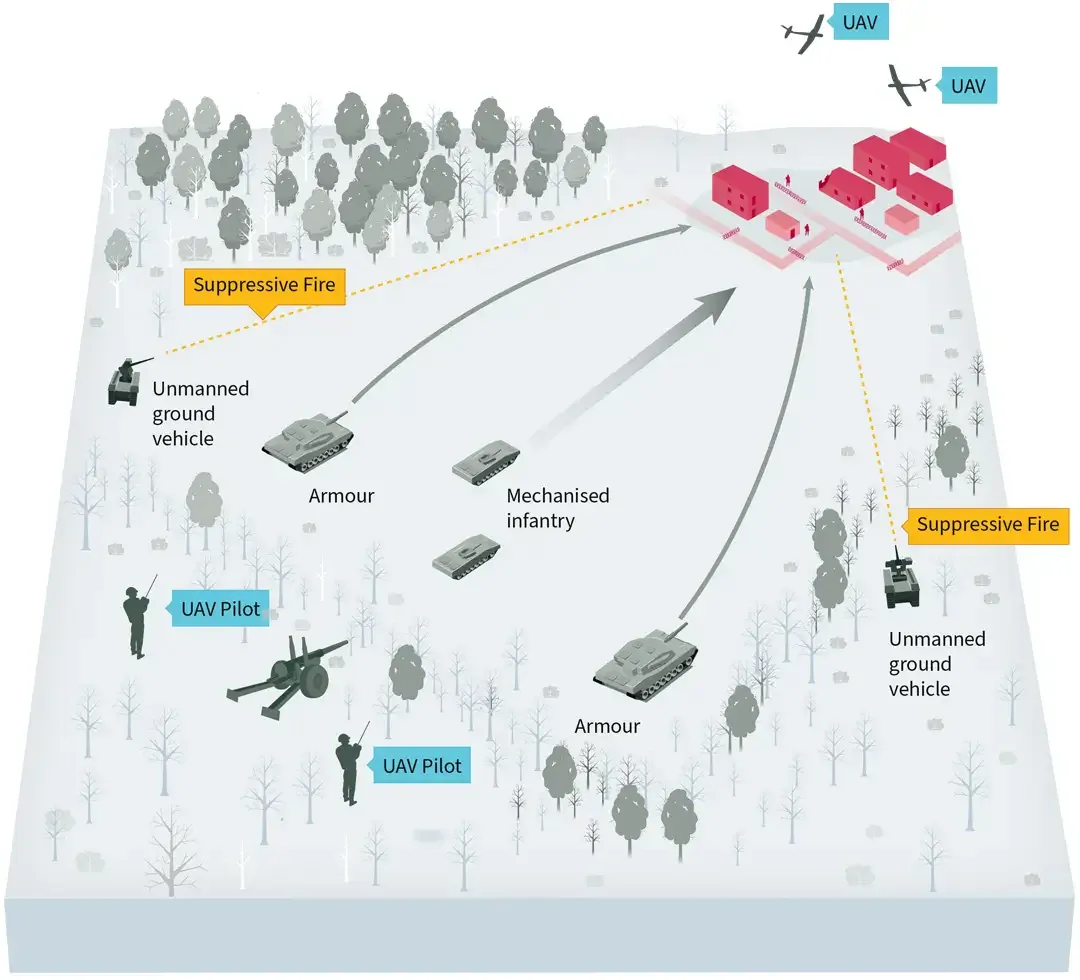
Suppression: Sequential attacks starting with artillery, followed by assault operations involving infantry and robotic ground systems (NRKs);
Clearing and Destruction: Deployment of heavy armored vehicles in coordination with other assets to eliminate remaining resistance;
Consolidation: Securing gains by expanding fire control zones, repositioning artillery, and establishing defensive positions.
")
Schematic visualization of battlefield geometry as seen in RUSI’s Ukrainian operations model. (Source: Dr Jack Watling. Graphic design: Alex Whitworth Art & Design)
The report suggests that the first three phases should take 24 to 48 hours and allow for operational reversibility if conditions deteriorate.
Strengths and strategic value
Watling highlights the reduced casualty potential of this model—estimated at 5–10% depending on external factors—and its modularity, which enables commanders to halt operations mid-phase.
He also underscores the balanced employment of all available tools, from artillery to robotic systems, offering NATO potential lessons for scalable multi-domain warfare.
Ukraine’s development of integrated formations such as the 59th Separate Assault Brigade of Unmanned Systems—reportedly composed of mixed manned and drone-centric battalions—is cited as a concrete example of structural innovation, supporting the RUSI model’s assumptions.
Operational constraints and NATO implications
Despite the promising framework, Defense Express notes several limitations. The RUSI model does not fully account for Russia’s current air superiority and the dense deployment of glide bombs and strike drones, which continue to shape battlefield conditions.
Additionally, questions remain about the scalability of such complex operations, given Ukraine’s limited stocks of drones, artillery, robotic platforms, and trained personnel.
These limitations raise further questions about NATO’s own readiness. If Ukraine, despite years of innovation under wartime conditions, may not have the resources to implement this model widely, how prepared are NATO militaries to replicate it under real combat conditions?
While the seven-phase combined arms model presented by RUSI offers a structured alternative to traditional attritional tactics, its practical implementation—either by Ukraine or NATO—will depend on overcoming significant logistical and technological hurdles.
The report ultimately serves both as documentation of Ukraine’s evolving battlefield practices and as a provocation for future doctrinal development among NATO allies.
Earlier, Danish defense firm Renegade UxS announced that its Nightmare FPV drone—battle-tested in Ukraine—was added to the US Department of Defense’s BLUE UAS Cleared List, allowing streamlined adoption by American military units.
Discuss this article:
-4a56a6b482ec132402c16ef6fcabf9a2.png)


-c439b7bd9030ecf9d5a4287dc361ba31.jpg "Photo of Katherina Popilnichenko")