- Category
- Latest news
Mysterious Ukrainian Couple Behind SBU’s Operation Spiderweb: New Details on Bomber Strike
 Prefer U24 Media on Google
- Authors

-111f0e5095e02c02446ffed57bfb0ab1.jpeg "Photo of Roman Kohanets")
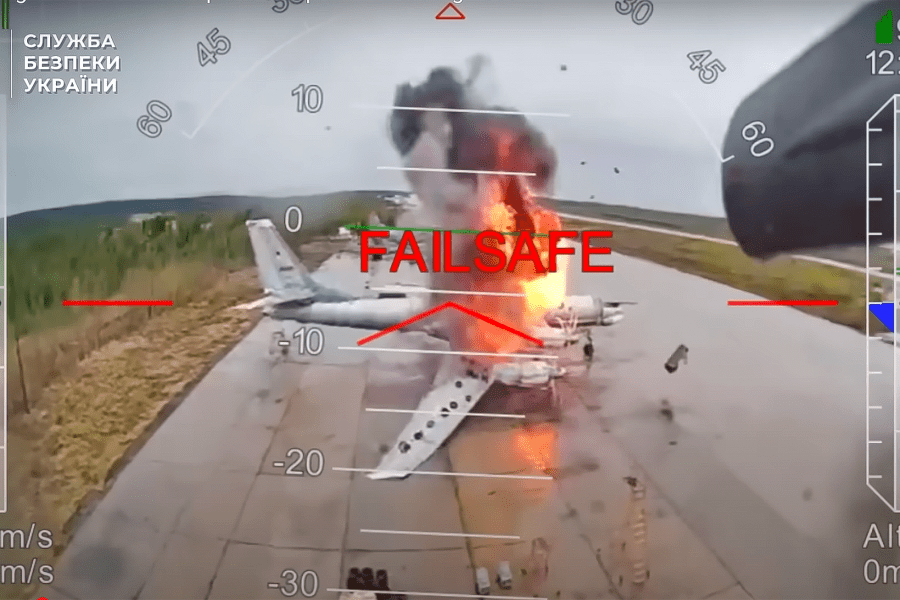
Ukraine’s Security Service (SBU) orchestrated Operation Spiderweb, an 18-month covert drone campaign that smuggled armed quadcopters into Russia inside prefabricated cabins and culminated in a June 1 strike on multiple strategic bomber airfields that damaged dozens of aircraft, according to a Wall Street Journal investigation on December 10 and earlier official statements from Ukraine.
According to the Wall Street Journal report, SBU engineers in Ukraine designed specialized FPV drones with reinforced communications links and warheads able to burn through an aircraft’s skin and detonate inside its fuel tanks, each roughly the size of a large dinner plate and carrying up to about 1.8 kilograms of explosives.
We bring you stories from the ground. Your support keeps our team in the field.
The drones were hidden in wooden cabins whose roofs could be opened remotely, with onboard batteries and solar panels allowing the launch systems to remain powered and connected to Ukrainian operators via local cell towers.
Covert Chelyabinsk logistics hub run by a Ukrainian couple
A Ukrainian couple living in the Russian city of Chelyabinsk, identified as Artem and Kateryna Tymofeyev, were recruited as key agents: both had taken part in Ukraine’s 2013–2014 protests before relocating to Russia in 2018, and were brought to Lviv for polygraph tests before the SBU entrusted them with assembling drones and cabins inside Russia.
After enduring a three-hour interrogation by Russia’s Federal Security Service (FSB) on their return, the couple set up what appeared to be a logistics firm, renting a warehouse and office, buying trucks and hiring drivers whom the SBU screened to ensure they were, in the Wall Street Journal’s words, reliable but not inquisitive.
Working to detailed instructions transmitted from Ukraine, the Tymofeyevs assembled around 150 drones and eight launch cabins over the course of about a week.
Near-exposure on the road and a fatal truck blast
The most dangerous incident occurred when one driver, roughly 300 kilometers into a planned 3,200-kilometer journey, noticed that the roof of his cabin had shifted, exposing the drones inside. He phoned Artem Tymofeyev in shock, forcing the SBU to improvise a cover story within minutes.
According to the report, Vasyl Malyuk, head of SBU, instructed Tymofeyev to tell the driver the cabins were hunting shelters equipped with drones used to monitor wildlife, a claim that was plausible because no explosives were visible externally.
The driver accepted the explanation, repaired the roof with the help of a local tractor driver and continued the trip. In a separate case, another truck later experienced electrical problems inside one of the cabins and then stopped responding to calls; Ukrainian officials subsequently learned that a fire and explosion had destroyed the cabin and killed the driver.
Top SBU drone pilots unleash 117 strikes on Russia’s long-range bomber fleet
According to WSJ, SBU drone pilots, among the service’s most experienced, spent long days training on FPV platforms without being told their eventual targets. Only on June 1, in a control room in Ukraine, did Malyuk brief them that the mission was aimed at Russia’s long-range bomber fleet, showing maps of airfields and diagrams highlighting weak points on Tu-95, Tu-22M3 and other aircraft.
When the remaining four trucks had reached discreet locations such as fuel stations near the targeted bases in Russia’s Murmansk, Irkutsk, Ivanovo and other regions, the roofs of the cabins were opened remotely and 117 drones lifted off toward their objectives, guided by live camera feeds and local cellular networks, Ukrainian and US officials have said.
In audio released earlier by Ukrainian media from the night of the attack, Malyuk can be heard describing “enemy strategic aircraft” burning at Russia’s Belaya airfield, while Ukrainian sources told Ukrainska Pravda that initial estimates put the damage to Russian aircraft at more than $2 billion.
Disputed damage figures, but widely seen as a major blow to Russia’s long-range aviation
Ukraine’s General Staff and the SBU say Operation Spiderweb damaged or destroyed 41 Russian military aircraft, including strategic bombers and A-50 early-warning planes, claiming the strike hit about 34% of Russia’s strategic cruise-missile carrier fleet and inflicted losses of roughly $7 billion.
Satellite imagery reviewed by independent analysts and cited by Reuters shows several bombers burned out at airfields in the Murmansk and Irkutsk regions, and Western and Ukrainian officials broadly characterize Operation Spiderweb as the largest Ukrainian drone strike on Russian air bases so far in the war and a significant setback for Russia’s long-range aviation, even as the precise scale of the damage remains contested.
Eventually, satellite imagery confirmed that at least 13 Russian military aircraft (including Tu‑95 and Tu‑22M3 bombers) were destroyed or severely damaged following the June strike associated with Operation Spider Web.
Discuss this article:
-4a56a6b482ec132402c16ef6fcabf9a2.png)