- Category
- Latest news
Rheinmetall’s HERO Set to Become NATO’s Response to Russia’s Lancet Swarms
 Prefer U24 Media on Google
- Authors


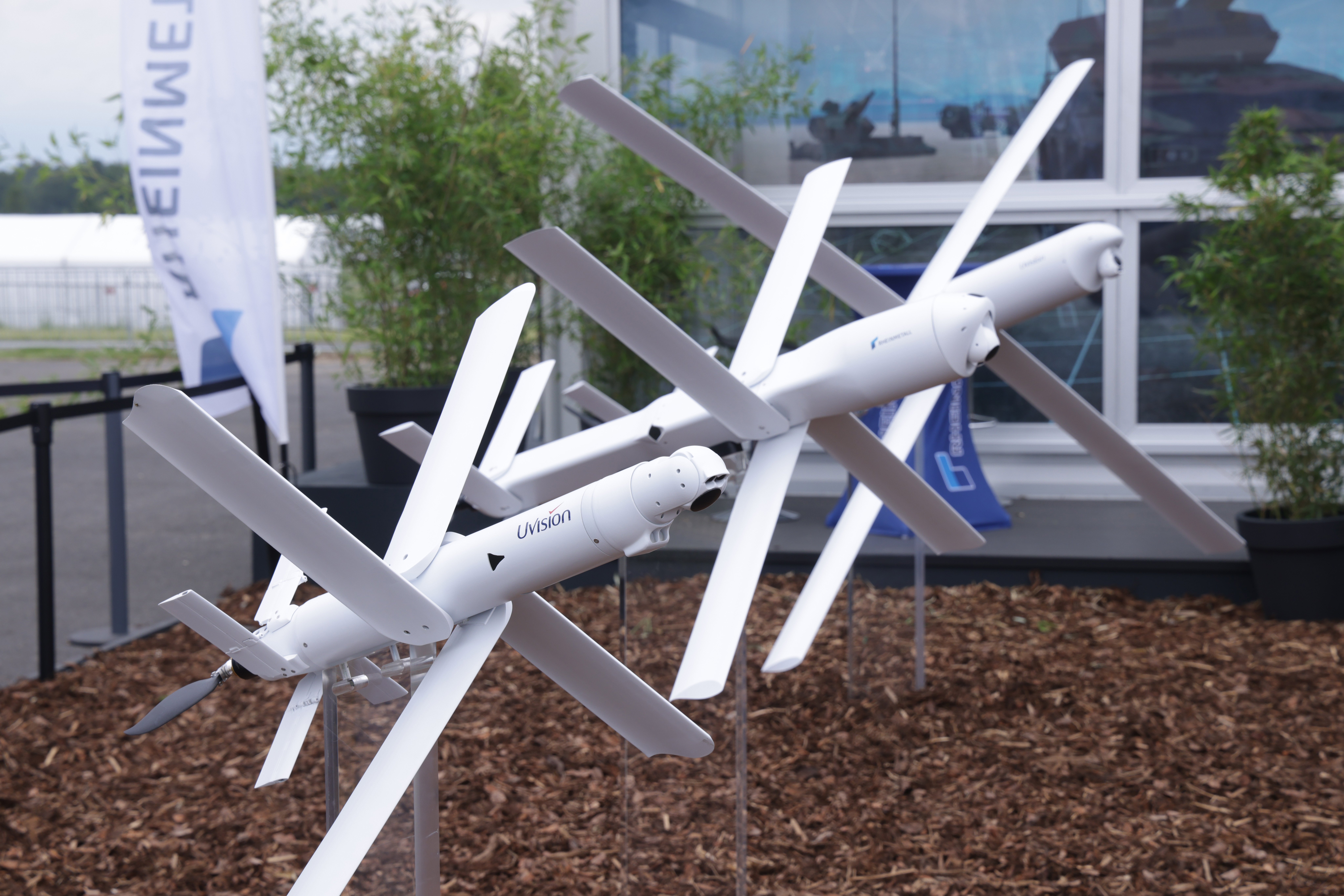
NATO has placed a major order for several hundred HERO loitering munitions—Israeli-designed attack drones locally produced in Europe by the German defense giant Rheinmetall—in a deal worth more than €100 million, German defense giant Rheinmetall reported on November 27.
Deliveries will begin in early 2026 and continue through the end of next year.
We bring you stories from the ground. Your support keeps our team in the field.
The drones, originally developed by Israel’s UVision Air and now manufactured under license in Europe, are well known for their distinctive X-shaped design.
The HERO line has drawn attention not only for its combat record with the Israel Defense Forces but also because Russian engineers appear to have used it as an early reference point when creating their Lancet drones.
▶️ #DSEI2023: #Rheinmetall and UVision present Loitering #Munition as a #combat force multiplier for the tactical level – rapid strikes on demand https://t.co/o9x5gXgPqx #DSEI @DSEI_event #defence #military #army #RheinmetallatDSEI pic.twitter.com/wpFjxasDo7
— Rheinmetall (@RheinmetallAG) September 13, 2023
The new NATO order will be built at RWM Italia, Rheinmetall’s Italian subsidiary, with technical support from UVision. The drones will also feature Rheinmetall’s newest anti-armor warhead.
While the customer was not identified, Defense Express notes that the buyer is likely Germany itself, which is working to field its first battery of HERO-class loitering munitions by 2027.
#Rheinmetall supplies #NATO customer a significant number of #HERO #LoiteringMunitions – order worth in the three-digit-million Euro range https://t.co/Zr5lWh02Fz #Defence #Military pic.twitter.com/4JoWi7YIGt
— Rheinmetall (@RheinmetallAG) November 26, 2025
The HERO family includes several models tailored for different missions. Rheinmetall did not specify which variants are included in the latest purchase, but referenced multiple systems in the series:
HERO-30: the smallest model, a 3-kg drone with a 0.5-kg warhead and a range of up to 10 km—effectively filling the role of an infantry-level precision strike tool, comparable in mission profile to today’s FPV attack drones;
HERO-120: a mid-range anti-armor loitering munition broadly comparable to Russia’s Lancet or Ukraine’s Bulava and RAM-2X. It weighs 12 kg, carries a 4.5-kg warhead, and can strike targets up to 40 km away;
HERO-400: the heavy model, weighing 40 kg with a 10-kg warhead and an operational range of up to 60 km, intended for destroying fortifications and hardened positions.
Although the HERO drones have not been deployed in the Russia–Ukraine war—largely due to Israel’s tight restrictions on arms transfers—they have been used operationally by the IDF, which allows Rheinmetall to market them as “combat-proven.” Their performance on European battlefields, however, remains untested.
Earlier, reports emerged that Dutch defense contractor COBBS Industries BV was developing the Netherlands’ first purpose-built anti-drone net system for the PzH 2000NL self-propelled howitzer—an engineered alternative to the improvised “cope cages” seen across Ukraine.
Discuss this article:
-9bd5e1532102621f8fb1c4ba871a3171.png)