- Category
- Latest news
Russia Deploys Iskander Missiles in Kaliningrad, Putting NATO Capitals From Warsaw to Berlin in Range
 Prefer U24 Media on Google
- Authors


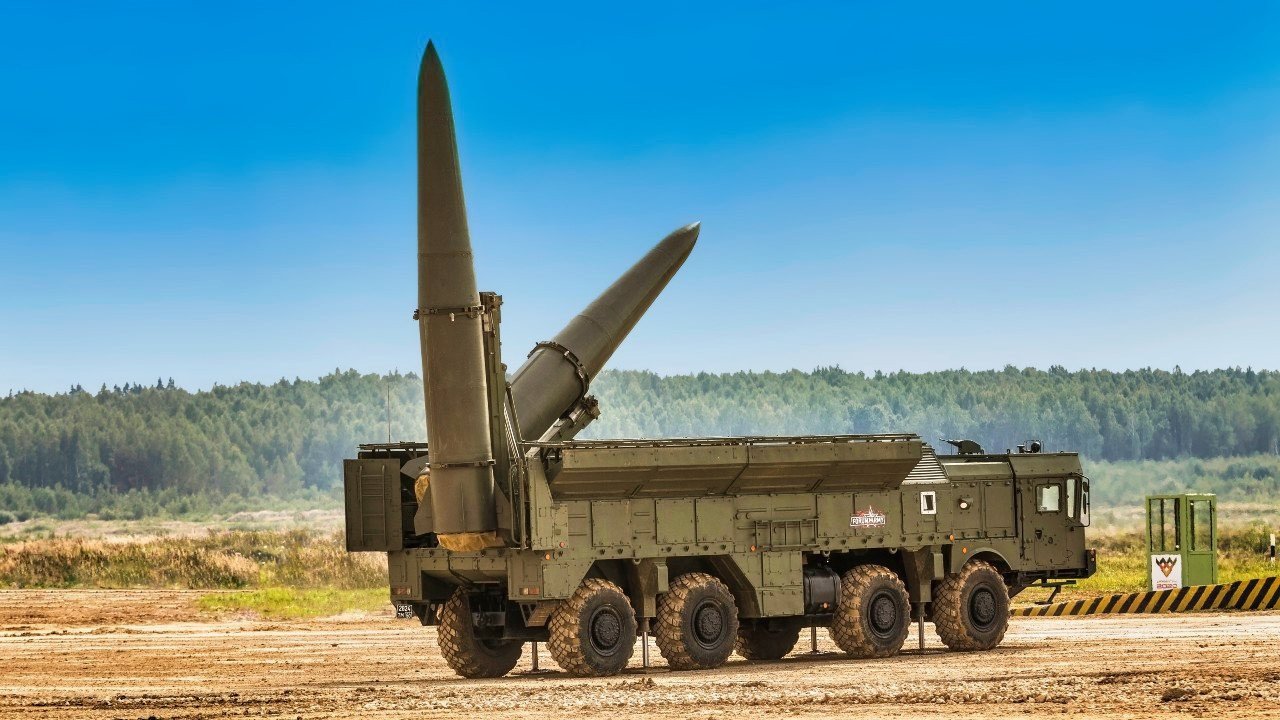
Russia has moved Iskander-M missile systems into position in the Kaliningrad region during the ongoing Zapad-2025 exercises, placing several NATO countries within potential striking distance.
According to Defense Express on September 13, at least two launchers carrying 9M723 ballistic missiles were spotted on the E28 highway near Kudryavtsevo, about 35 kilometers from the Polish border.
The OSINT group “CyberBoroshno” geolocated the deployment and confirmed the systems were directed westward, toward Poland.
⚡ The videos shared online reportedly show Russia positioning an Iskander missile system on a highway in Kaliningrad, close to the Polish border. pic.twitter.com/fKaXIfG9iB
— UNITED24 Media (@United24media) September 13, 2025
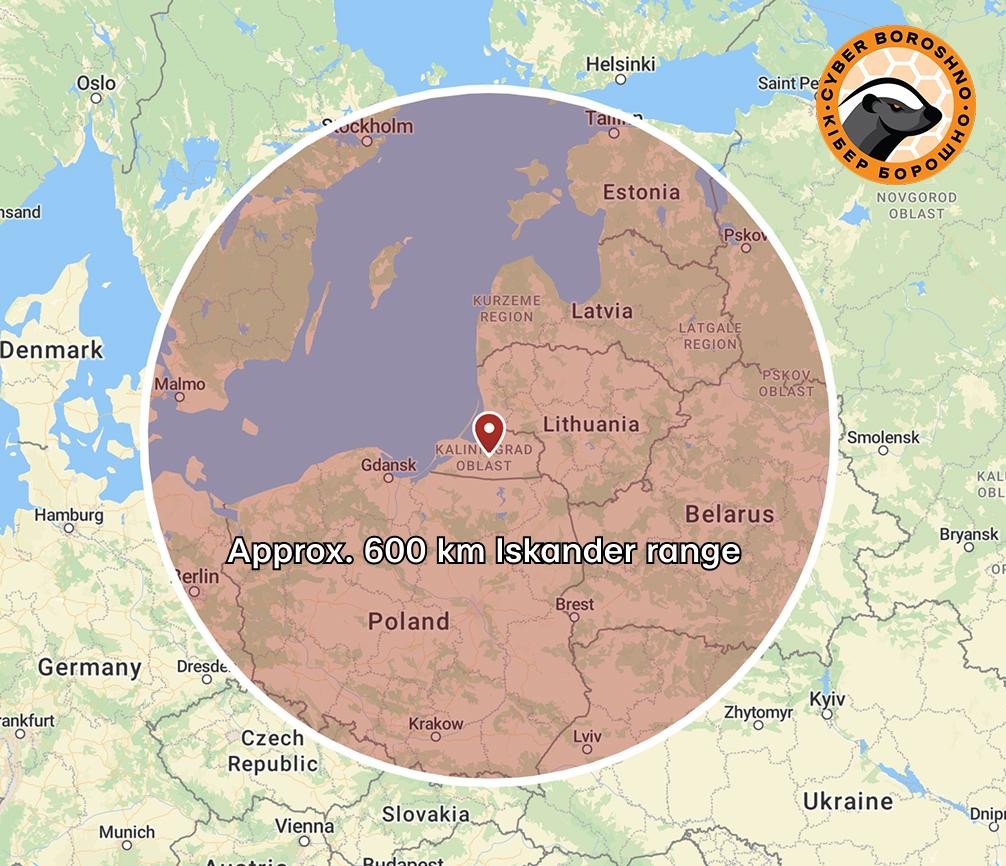
The 9M723 missile has an estimated maximum range of 500 kilometers. Defense Express reported that this radius covers most of Lithuania, including Vilnius, Latvia with Riga, and roughly a third of Estonia.
Nearly all of Poland, including Warsaw, falls within range, as do parts of Germany, Denmark’s Bornholm island, and southern Sweden.
The outlet noted that Berlin and Stockholm remain just under 100 kilometers beyond the missile’s reach.
Analysts also recalled that Russia has previously tested variants of the Iskander with extended ranges approaching 1,000 kilometers, though it is unclear whether these have entered serial production.

The Ministry of Defense of Lithuania stated that Zapad-2025 involves up to 30,000 Russian troops, alongside Belarusian forces, with exercises taking place across land, sea, and air domains in the Baltic and Barents regions.
Belarusian General Staff Chief Pavel Muraveyko explained that the drills’ first stage focuses on countering an air attack, followed by ground-based defensive operations. The second phase shifts to offensive maneuvers.
Video published by Clash Report showed the Iskander launchers in Kaliningrad, which were identified by OSINT researchers as heading in the direction of Warsaw and Lublin.
According to Defense Express, Russia first stationed Iskander systems in Kaliningrad temporarily in 2007. Permanent deployment began in 2018 after the rearmament of the 152nd Missile Brigade.
At the time, Russian Foreign Minister Sergey Lavrov justified the move as a response to what Moscow called “destructive actions of NATO.”
The Iskander is capable of firing both ballistic and cruise missiles, designed to strike command posts, storage sites, airfields, and missile defense systems. Analysts note that its mobility complicates detection and allows rapid repositioning.
Following Russia’s full-scale invasion of Ukraine in 2022, NATO developed contingency plans for neutralizing threats from Kaliningrad.
Defense Express cited US European Command’s General Christopher Donahue, who stated: “We already planned and prepared for this. Russia creates for us a challenge of mass and speed, and we have developed solutions that allow us to effectively stop this threat.”
Earlier, NATO launched its Eastern Sentry mission in response to repeated Russian drone violations of Polish airspace. Secretary General Mark Rutte announced the operation in Brussels alongside Supreme Allied Commander Europe Gen. Alexus Grynkewich, with Denmark, France, the UK, and Germany committing aircraft and naval assets to reinforce Poland’s defense.
Discuss this article:



-c439b7bd9030ecf9d5a4287dc361ba31.jpg "Photo of Katherina Popilnichenko")