- Category
- Latest news
Russia Deploys “Multik” EW Pods to Shield Helicopters From $500 Ukrainian Drones
 Prefer U24 Media on Google
- Authors


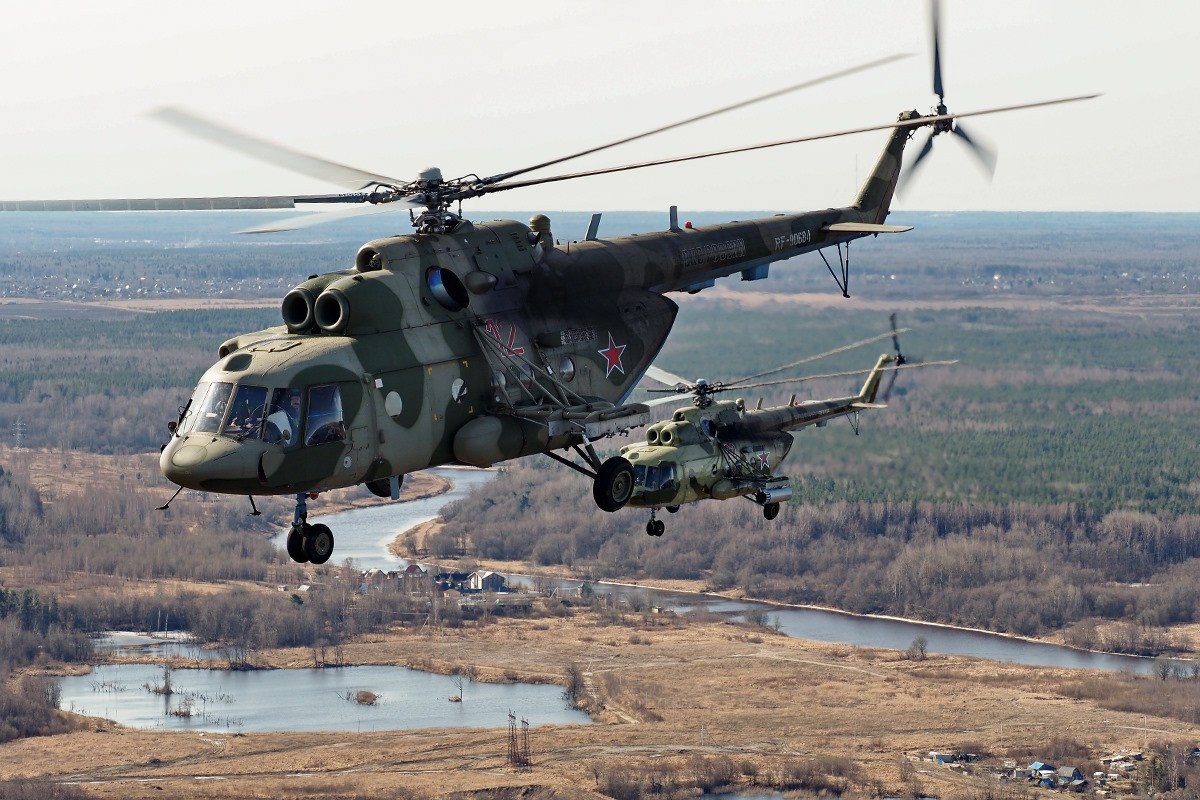
Russia has announced the introduction of a new electronic warfare system named “Multik,” developed to counter FPV drones and intended for integration with helicopters and other military platforms, Defense Express reported on October 17.
Developed by the Gradient Research Institute, the “Multik” system is engineered to detect and disrupt video signals transmitted by drones by generating targeted interference across relevant frequency bands. It is reportedly capable of operating across a full 360-degree azimuth range, providing comprehensive spatial coverage.

Russia has been, recently, stepping up efforts to develop new defenses for its helicopters against FPV drones, which have become a growing threat due to their widespread use by Ukrainian forces against low-flying aircraft.
The manufacturer “Russian Helicopters” confirmed that several of its helicopters had sustained damage—or were destroyed—by FPV drones, and stated that work is underway to implement protective modifications.

As reported by Defense Express, “Multik” functions as a compact electronic warfare suite designed to be mounted on a range of military equipment. While the documentation does not explicitly confirm aerial deployment, available imagery indicates the system has already been manufactured and tested aboard rotary-wing aircraft.
According to the stated specifications, the detection range of the system reaches up to 1,000 meters, while effective jamming capability extends to approximately 500 meters—though this may vary depending on the power output of the target drone’s video transmitter. The operational frequency range spans from 700 MHz to 6,000 MHz.

The system is equipped with three independent jamming channels and weighs under 9.5 kilograms. It is powered by the host platform’s onboard electrical network and is designed for external mounting, likely atop helicopter pylons.
At present, the cost of the system, its serial production status, and whether it has been field-tested in active combat remain unclear.
Earlier, Ukrainian Unmanned Systems unit of the 59th Separate Assault Brigade eliminated a Russian Mi-28 attack helicopter with $500 FPV drone, according to the Defense Forces.
Discuss this article:
-331a1b401e9a9c0419b8a2db83317979.png)




-72b63a4e0c8c475ad81fe3eed3f63729.jpeg "Photo of Cyril Barabaltchouk")