- Category
- Latest news
Russia’s New Oreshnik Missile May Be Flying Blind, Debris Analysis Suggests
 Prefer U24 Media on Google
- Authors


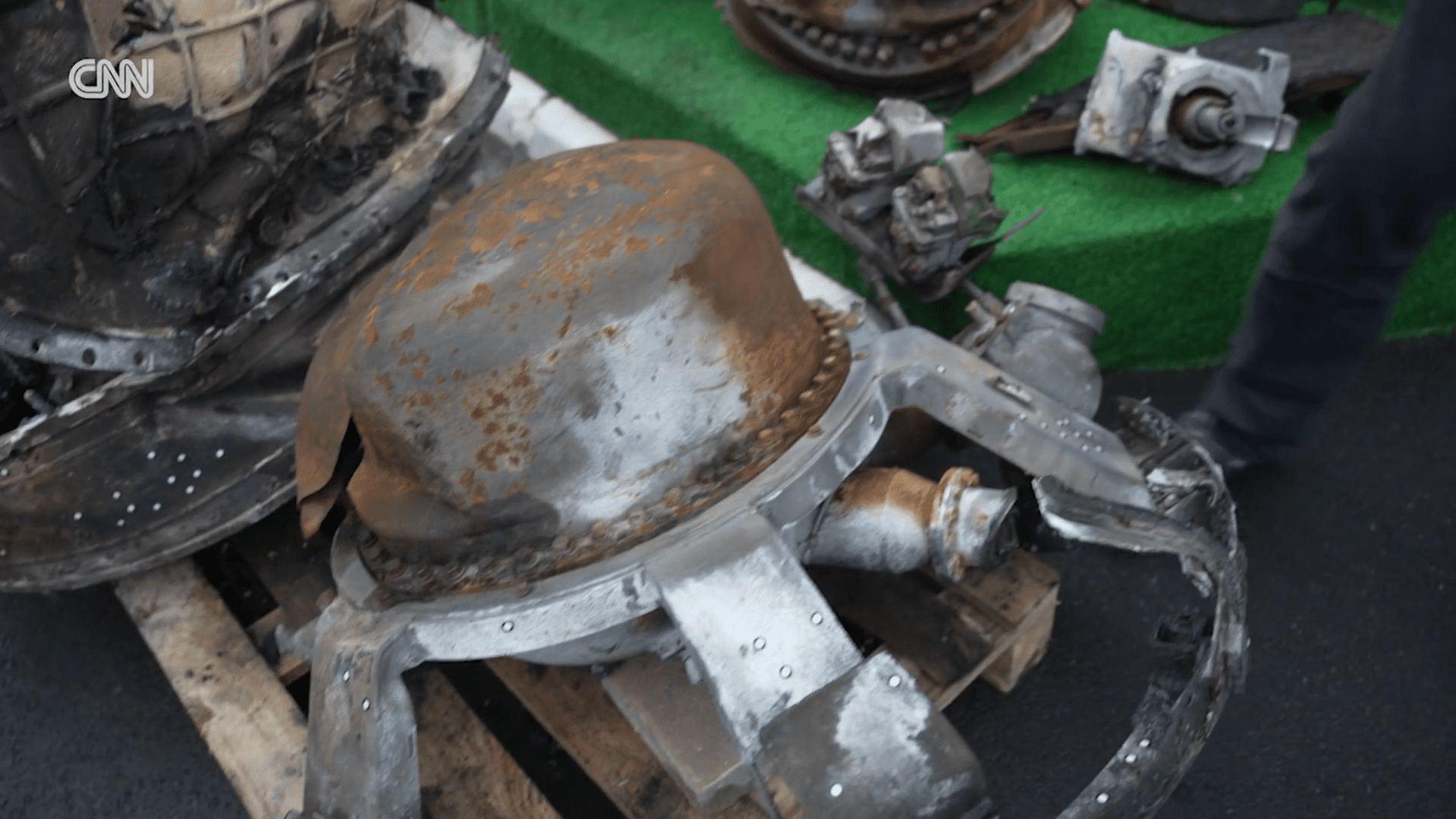
A recently analyzed Russian intermediate-range ballistic missile, known as “Oreshnik” or “Kedr,” does not appear to contain a guidance system for independently steering its warheads, according to findings reported by a specialized Russian military resource.
The assessment follows a detailed study of missile debris recovered after a strike on Ukraine’s Lviv region.
The analysis indicates the missile lacks an independent multiple reentry vehicle (MIRV) guidance system, which is typically used to maneuver several warheads onto separate trajectories after detachment from the final stage.

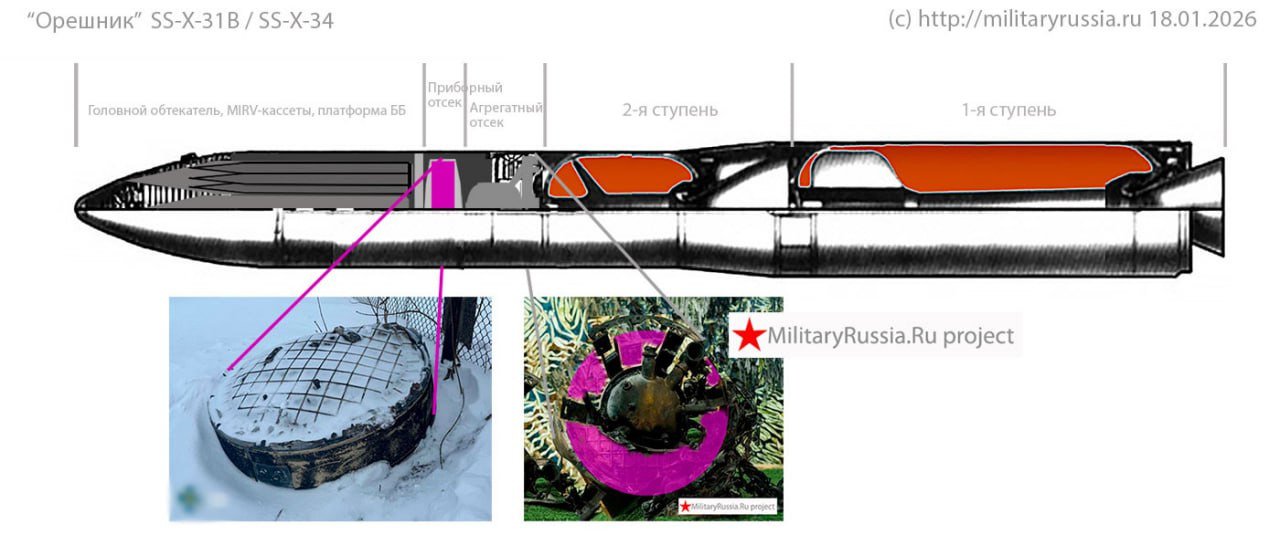
Instead, the recovered components suggest the missile incorporates a sealed instrument bay and a gas-reactive orientation system—standard elements in designs from the Moscow Institute of Thermal Technology—used to stabilize the warhead section rather than guide it.
Evidence suggests that the missile carries six warheads, each potentially containing six submunitions, for a total of up to 36 cluster elements. Estimates place the total payload between 1,250 kg and 3,000 kg.
Analysts believe the missile could achieve a range of up to 4,100 kilometers using typical ICBM propulsion stages. Each warhead, including its cluster payload, may weigh approximately 400 kg and is likely designed for high-speed kinetic impact rather than explosive detonation.
Fragments from a similar missile used in a November 2024 strike on Dnipro were previously examined by experts at the Kyiv Scientific Research Institute of Forensic Examinations.
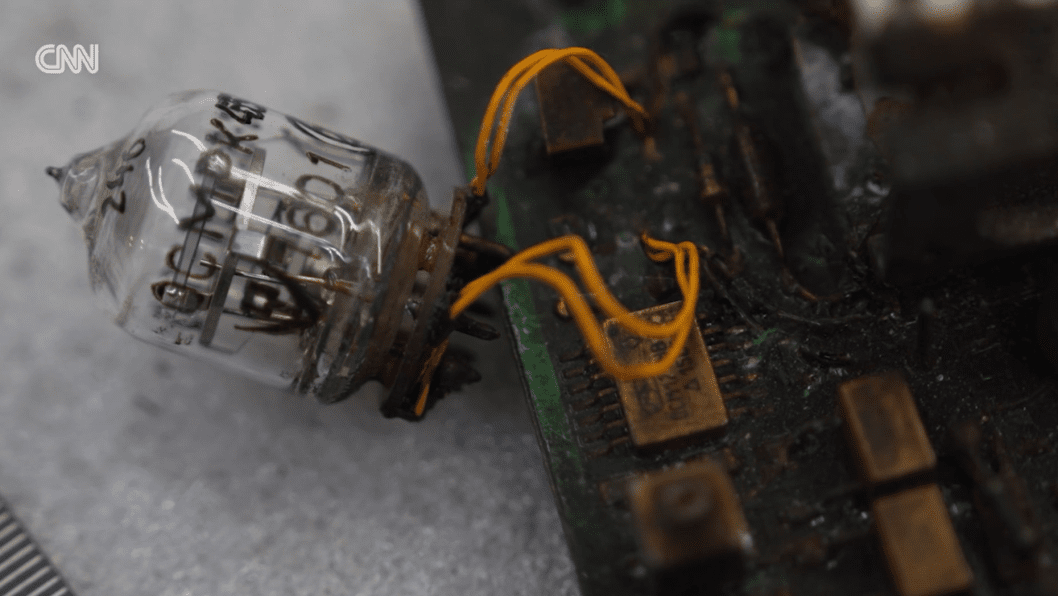
Journalists were shown components from the missile’s inertial navigation system, as well as Soviet-era vacuum electron tubes. Some of the parts bore manufacturing codes dating back to 2018, suggesting they may have originated from earlier weapons programs.
-fe851b90d8a0ba797c376cd41cd6a9ac.png)
Additional insights came from analysis of footage from a January 2026 missile strike near Lviv, which showed only four warhead clusters reaching the ground, followed by two separate impacts at some distance.
This pattern suggests a possible failure in the deployment mechanism or structural damage during reentry.
The missile’s terminal velocity is believed to exceed Mach 11—around 3,740 meters per second—raising questions about whether all warheads can endure reentry stress without disintegration.
Earlier, Ukraine’s security services confirmed that fragments found in Lviv belonged to the Russian Oreshnik missile, launched overnight on January 8–9. The debris included guidance and engine components, and investigators are treating the strike as a potential war crime.
Discuss this article:
-4a56a6b482ec132402c16ef6fcabf9a2.png)


-72b63a4e0c8c475ad81fe3eed3f63729.jpeg "Photo of Cyril Barabaltchouk")

-111f0e5095e02c02446ffed57bfb0ab1.jpeg "Photo of Roman Kohanets")
-07c046f037cabcd54fb44b5253b3733d.jpg "“Bathing” (2021), an 80 × 60 cm artwork by Ukrainian artist Mariia Drozdova. (Source: Art From Ukraine/Instagram)")