- Category
- War in Ukraine
What Is the Hypersonic Oreshnik Missile Russia Just Used Against Ukraine?
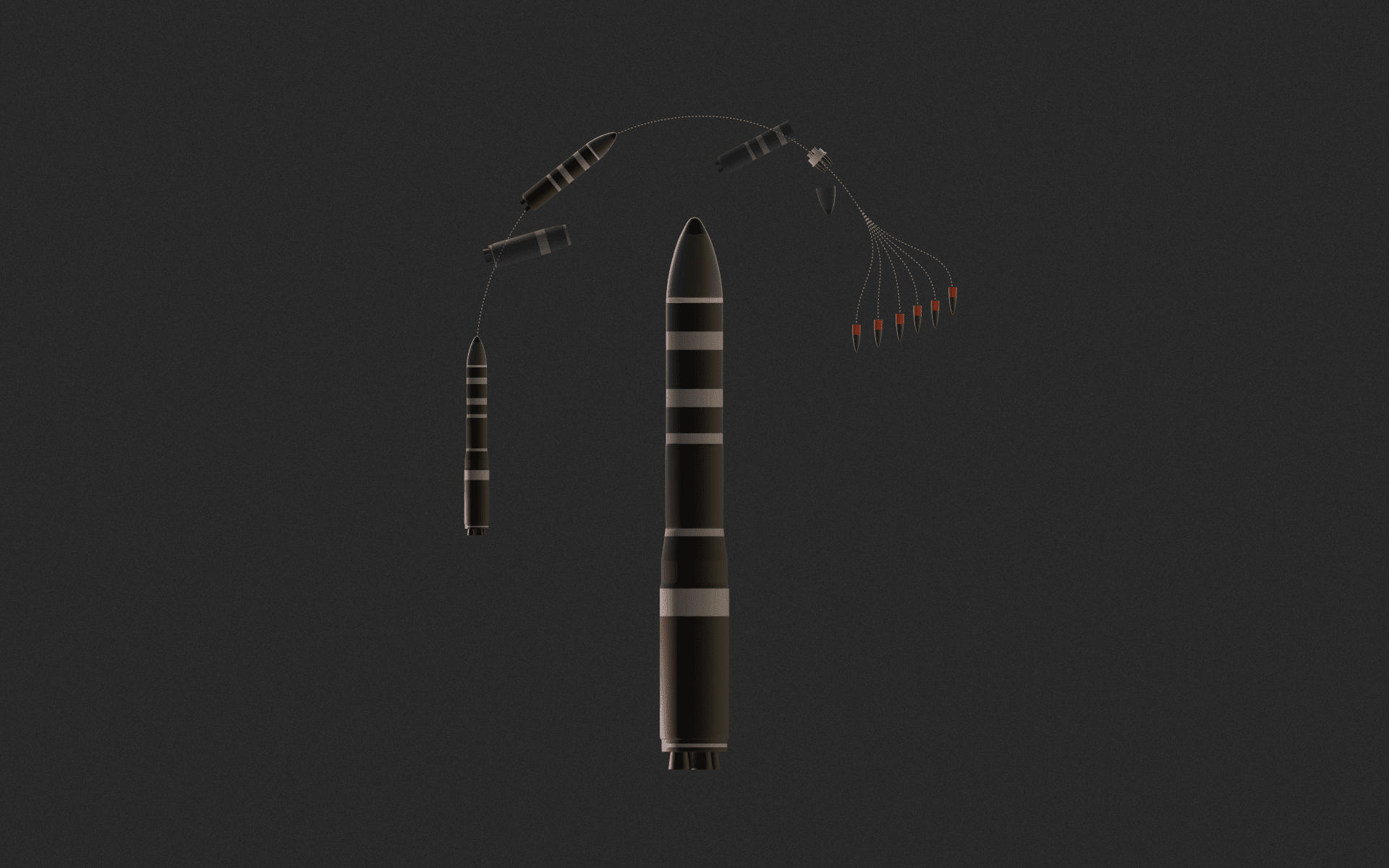
Russia launched its most advanced nuclear-capable ballistic Oreshnik missile against Ukraine’s civilian infrastructure in the Lviv region on January 9, 2026. What do we know about Oreshnik and its capabilities?
 Prefer U24 Media on Google
- Authors

-605be766de04ba3d21b67fb76a76786a.jpg "Joseph Place")
So far during 2026, Russia has used the Oreshnik missile system three times against Ukraine, although the warheads were not nuclear, and it is unclear if they were dummies in the Lviv attack, as in the previous one on Dnipro in 2024. As we have noted before, the name can be somewhat confusing, with references to RS-26 “Rubezh”, “Kedr”, and Oreshnik often being used interchangeably.
What is Russia’s Oreshnik?
In broad terms, the Oreshnik missile is an intermediate-range ballistic missile (IRBM), nuclear-capable, which flies through the stratosphere, making it incredibly difficult to intercept. It has a multiple independently targetable reentry vehicle MIRV, as in, a part that carries multiple warheads that themselves can hit different targets, though they cannot be aimed. Once launched into the atmosphere, it discards the engine, then the MIRV separates from the remainder, and finally, the warheads drop towards the target.
The Oreshnik is a variant of the RS-26 Rubezh missile system, based on old soviet tech developed in Dnipro, hence why the name is often conflated. Unlike the original model, it has two stages, not three. There is little public information, due to the secrecy of its creation and minimal application, compared to, say, the Iskanders or Khinzal missiles. Kedr has been used before as the name of the missile, and Oreshnik was the project. However, Oreshnik is commonly used to refer to the new variant of this missile.
Here is a breakdown of the key facts about the Oreshnik missile, although it should be noted that public information is limited:
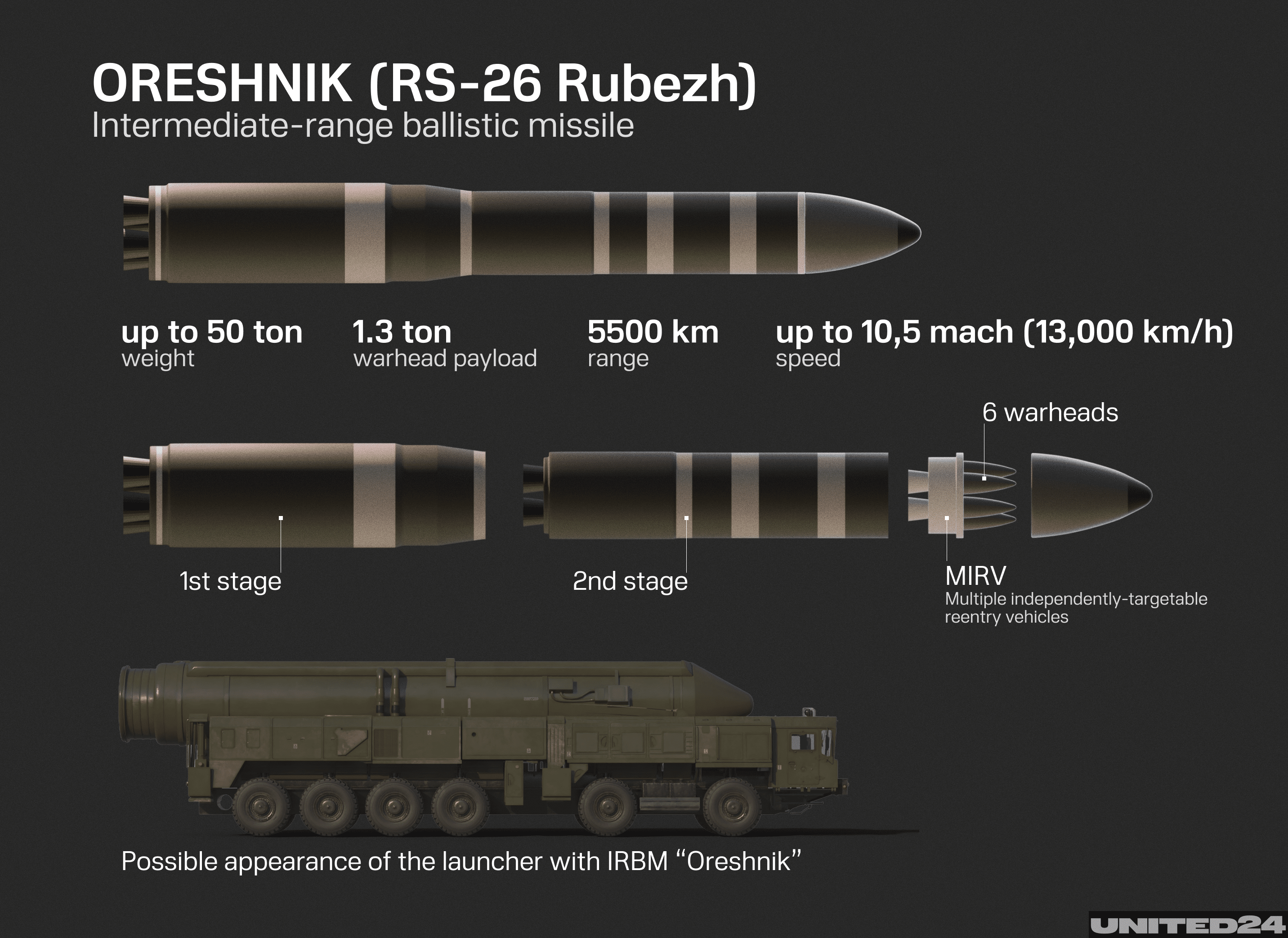
Available data suggest it is a dual-stage system capable of carrying nuclear warheads, with a payload configuration of up to six warheads equipped with submunitions. During launch, the first stage—housing the engine and fuel—is jettisoned after ascent through the stratosphere, allowing the second stage to continue flight until the MIRV unit separates and re-enters Earth’s atmosphere. Once separated, onboard guidance systems orient the missile for precise warhead deployment. The Oreshnik is believed to reach speeds of up to Mach 10,5 and to be mounted on a 12×12-wheeled launcher, as seen in images reportedly leaked by Belarusian leader Alexander Lukashenko. Its estimated launch mass is 50,000 kilograms, with a payload of roughly 1,300 kilograms and a maximum flight range of about 5,500 kilometers.
This missile is extremely difficult to intercept. Commander-in-Chief Oleksandr Syrskyi said Ukraine currently lacks the capability to intercept medium- and intercontinental-range ballistic missiles such as the Oreshnik. The Patriot PAC-3 and SAMP/T systems in Ukraine’s arsenal were not designed to counter missiles of this class.
The timeline of the Oreshnik missile development and deployment
2011 | The initial RS-26 Rubezh was developed |
2023-2024 | The Oreshnik undergoes initial tests at the Kapustin Yar testing site in Russia’s Astrakhan region |
November 21, 2024 | An Oreshnik is launched at Dnipro, at an industrial site, the first use of its kind, launched from Kapustin Yar. |
August 1, 2025 | Putin states that the missile is in production and will be deployed in Belarus |
Late August 2025 | An Oreshnik launch site is identified in Belarus |
December 18, 2025 | Belarusian leader Lukashenko claims the missiles are in Belarus |
January 9, 2026 | An Oreshnik missile is launched at Ukraine’s Lviv Region, potentially targeting the Stryi gas storage facility, though it does not hit the target. Similarly, it was launched from Kapustin Yar |
May 24, 2026 | Two Oreshnik missiles are launched at Ukraine, one struck Bila Tserkva in the Kyiv region, another hit the Donetsk region |
Ukrainian military analyst Kyrylo Danylchenko argues that Russia’s reported deployment of the Oreshnik reflects desperation after a string of military and economic setbacks, combined with the failure of Russian air defense systems in Venezuela during a US special operation to capture Nicolás Maduro. Danylchenko also notes that what Russian propaganda describes as a “weapon based on new physical principles” is, in fact, a modernization of Soviet-era technology—likely either a reworked version of the RSD-10 Pioneer system or a derivative of the RS-26 Rubezh, itself a shortened version of the Topol-M intercontinental ballistic missile.
While the missile has nuclear capability, a long range, and speed, some suspected it was more about fear than actual damage. In the first attack, it was launched at a sharp angle and did not utilize explosive warheads. Similarly, in the Lviv attack, the damage does not appear as widespread as it could be. However, its second use suggests that Russia may be using the Oreshnik less for tactical impact and more as a psychological or strategic pressure, showcasing long-range capabilities, testing Western response, and hinting at the threat posed if such weapons are ever launched from closer territory, like Belarus.
Discuss this article:
-ee9506acb4a74005a41b4b58a1fc4910.webp)


-c439b7bd9030ecf9d5a4287dc361ba31.jpg "Photo of Katherina Popilnichenko")



-29a1a43aba23f9bb779a1ac8b98d2121.jpeg "Photo of Illia Kabachynskyi")