- Category
- War in Ukraine
The Ultimate Guide to the Ukrainian Armed Forces

Entering its fifth year of full-scale war, Ukraine’s defense against Russia relies on a vast military spanning land, air, sea, and specialized forces. Expanded since 2022 into one of the largest militaries fielded in Europe since World War II, its structure defines how a modern army fights across multiple fronts.
 Prefer U24 Media on Google
- Authors


Hollywood has long dramatized the discipline of military hierarchy. In Saving Private Ryan, Tom Hanks’s Captain Miller keeps his squad in line with a simple reminder, “I’m a captain. There’s a chain of command. Gripes go up!” This article explores how the whole chain works—up and down—and how Ukraine’s armed forces operate within that structure as they confront Russia’s war of aggression.
When the USSR collapsed in 1991, Ukraine inherited a large corps-based army of nearly 800,000 troops, along with vast stores of Soviet-era equipment. Shaped by decades behind the Iron Curtain, it was designed for the demands of the Cold War—far larger than the newly independent government of Kyiv could realistically sustain.
Throughout the 1990s, Ukraine upheld the principles set out in its Declaration of State Sovereignty, pledging to become a “permanently neutral state” that would not participate in military blocs, a stance underscored by the 1994 Budapest Memorandum, under which Kyiv surrendered the world’s third-largest nuclear arsenal in exchange for security assurances. By 2013, total military personnel had fallen to under 130,000, with steep reductions across tanks, armored vehicles, and combat aircraft, as shown in the table below.
Field | 1991 | 2000 | 2006 | 2013 |
|---|---|---|---|---|
Military personnel | 800,000 | 303,800 | 187,600 | 129,950 |
Battle tanks | 6,500 | 3,895 | 3,784 | 1,110 |
Armored combat vehicles | 7,000 | 3,048 | 3,043 | 1,484 |
Combat aircraft | 1,648 | 911 | 373 | 221 |
Source: Transformation Under Fire – An Analysis of Ukraine’s Security Sector Since 1991, IISS January 2025; and US-Ukraine Military Relations And The Value Of Interoperability, SSI, December 2004.
The Soviet legacy
After the Kremlin’s so-called annexation of Crimea in 2014 and its occupation of parts of the Donetsk and Luhansk regions, Ukraine reshaped its forces from that heavy, corps-based model into a lighter, brigade-based structure intended to respond more quickly to a limited and localized threat, with brigades operating under regional Operational Commands and no corps command layer in between.
Russia’s full-scale invasion in 2022 highlighted the limits of a force organised mainly around independent brigades. The scale of the war required a more centralized command—a requirement that led Commander-in-Chief General Oleksandr Syrskyi in early 2025 to announce: “We have begun implementing measures to transition to a corps-based structure,” strengthening operational control and aligning the force more closely with NATO standards.
That restructuring has unfolded alongside a dramatic expansion of Ukraine’s forces. Today, Ukraine’s army once again stands at roughly 800,000 service members—a scale not seen since the first years of independence.
So far, we’ve touched on captains, squads, brigades, corps, and even the Commander-in-Chief—but how do these pieces actually connect, and how does command flow from national leadership down to soldiers in frontline trenches? To understand how Ukraine’s military actually works, it helps to start at the very top.
The command structure
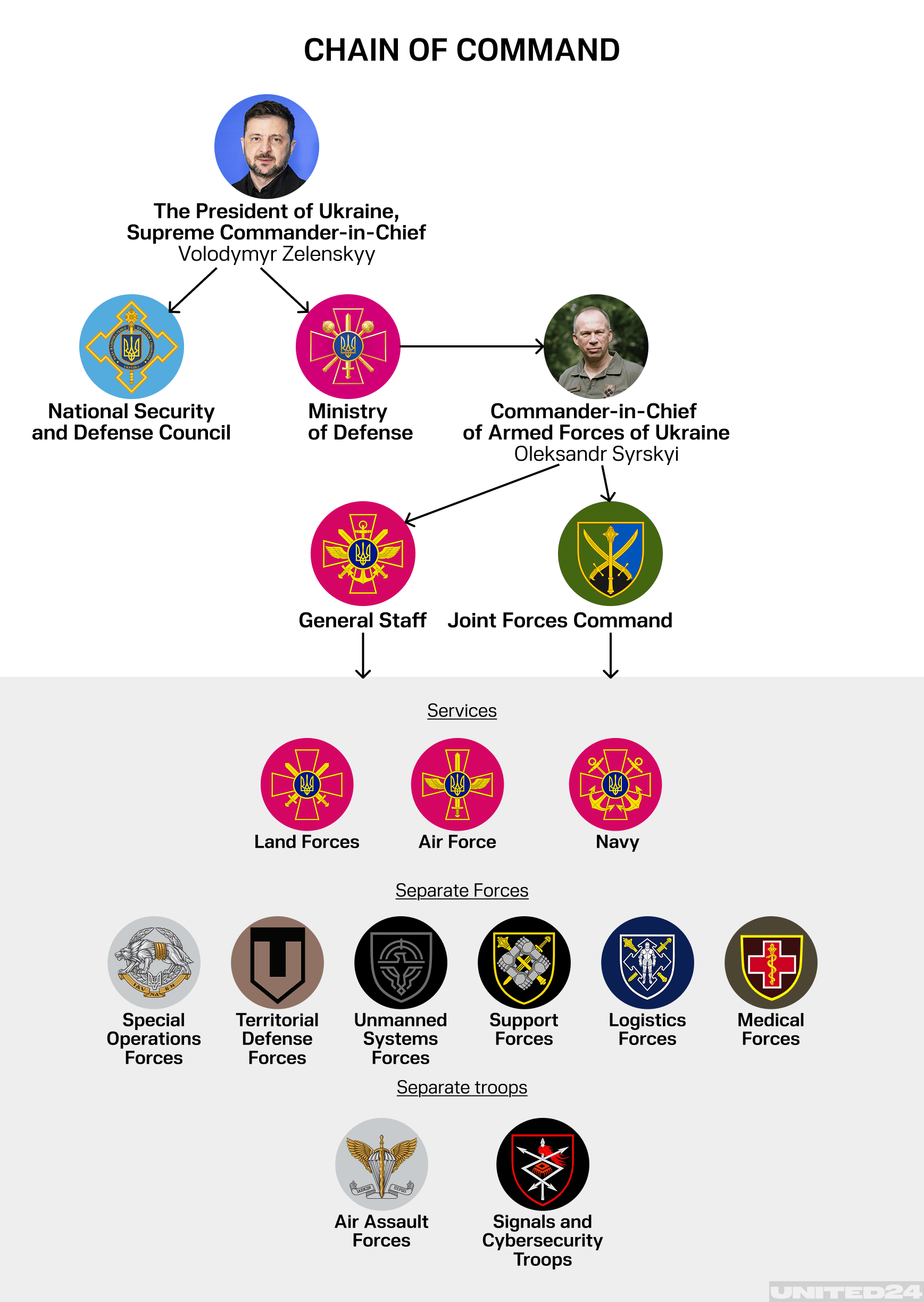
The President of Ukraine—Volodymyr Zelenskyy—serves as Supreme Commander-in-Chief. Also at the political level, the NSDC coordinates national security decision-making, bringing together the president, prime minister, defense leadership, and security chiefs to assess threats and set priorities. The Ministry of Defense, led by Defense Minister Mykhailo Fedorov, implements those decisions and manages the day-to-day administration of the Armed Forces.
The next link in the chain is the Commander-in-Chief of the Armed Forces of Ukraine (CinC)—the aforementioned Oleksandr Syrskyi, a General, the highest rank in Ukraine’s military and equivalent to a four-star general in NATO forces.
Below the CinC, the General Staff is the central command-and-control body responsible for planning national defense and directing operations. Alongside it, Joint Forces Command helps direct combined formations for specific missions, bringing together all eleven branches of the Armed Forces of Ukraine (AFU).
These include the three core services—the Land Forces, Air Force, and Navy—as well as the Special Operations Forces, Territorial Defense Forces, Unmanned Systems Forces, Support Forces, Logistics Forces, Medical Forces, Air Assault Forces, and the Signals and Cybersecurity Troops.
With the leadership and command headquarters now in place, we can turn to the field formations that do the fighting.
Formation** & typical commander | Personnel numbers | Role & Composition |
|---|---|---|
Corps (корпус) Major General | Top-level field command overseeing multiple brigades; as of late 2025, 18 corps have been established, with reforms still underway. | |
Brigade (Бригада) Colonel or Brigadier General | 2,500–5,000+ | Independent combat formation combining several battalions, with its own logistics, engineering, and medical support; total number of brigades not publicly disclosed, often described as “more than 100.” |
Battalion (Батальйон) Major or Lieutenant Colonel | 200–1,000 | Primary tactical unit in the field, built around a main combat function such as mechanized infantry, reconnaissance, or air defense; some battalions operate separately under a higher command. |
Company (Рота) Captain | 80–200 | Maneuver-level formation conducting tactical assaults or defensive missions; in artillery and air defense, what would otherwise be termed a company is called a battery. |
Platoon (Взвод) Junior Lieutenant or Lieutenant | ~15–45 | Coordinates two to four squads in combat; may serve as a mortar, anti-tank, reconnaissance, or engineer platoon. |
Squad (Відділення) Sergeant or non-commissioned officer (NCO) | ~8–12 | Smallest fire-and-movement team conducting direct, close-range ground combat; for example, as vehicle crews or in specialized weapons roles. |
** Some specialized formations retain the designation “regiment,” though the core ground combat structure is brigade-based. One example is the 1st Separate Assault Regiment, which has taken part in combat operations in Pokrovsk and Dobropillia.
With the field hierarchy now in place—from corps down to squads—we now turn to the service that fields the bulk of these combat formations: the Land Forces.
The Land Forces are the main combat arm of the Armed Forces of Ukraine, tasked with defending the country’s sovereignty, territorial integrity, and independence.
The Land Forces
The Land Forces, also referred to as Ground Forces and generally known as “the army,” hold the front lines against Russia’s war of aggression. They make up more than half of Ukraine’s total military personnel and run most of the training.
Regionally, the Land Forces are organized under four Operational Commands—North, South, East, and West—which oversee forces within their respective areas.
“It is fundamentally important to develop every component,” said their commander, Major General Hennadii Shapovalov, “From infantry and tank units to artillery, air defense, and army aviation.”
Other core elements include drone units and engineers, as well as reconnaissance, signals, logistics, maintenance, and frontline medical care.
The main formations—reflecting the roles they play in combat—include:
Mechanized brigades
Heavily equipped and built around tracked infantry fighting vehicles (IFVs)—resembling small tanks—the roughly 40 mechanized brigades currently in service make up the bulk of the Land Forces. They operate a mix of Soviet-era BMPs alongside Western M2 Bradleys and CV90s, as well as tracked armored personnel carriers (APCs)—such as the Soviet-designed MT-LB and the US M113.
One example is the 47th “Magura” Brigade, which can be seen here operating Bradley IFVs near Russia’s Kursk region.
Motorized (rifle) brigades
Unlike mechanized brigades, which operate from tracked IFVs, motorized brigades use wheeled transport—including legacy BTRs and Western Humvees—making them a more flexible infantry force, light on their feet. There are currently seven brigades, three of which were formed during Ukraine’s rapid wartime expansion in 2014–15 after Russia’s initial invasion.
One of those, the 57th Separate Motorized Infantry Brigade, has shown they aren’t only light on their feet, but sometimes light in their touch—helping facilitate a safe surrender after a Russian soldier’s handwritten plea: “Please take me prisoner.”
Missile and artillery brigades
Focused on long-range indirect fire—striking targets beyond line of sight—these formations hit Russian infantry positions, command posts, ammunition depots, supply hubs, and other objectives deeper behind the lines. They are also used to target Russia’s own artillery batteries.
The more than a dozen brigades in service come equipped with heavy guns known as howitzers—cannon-like weapons that fire 155mm shells at ranges of over 40 kilometers, as seen with Ukraine’s Bohdana—as well as rocket systems capable of striking much farther. These fall into four main categories:
Tracked self-propelled howitzers—including PzH 2000 and Krab
Wheeled self-propelled howitzers—such as CAESAR, Archer, 2S22 Bohdana
Towed howitzers—notably the lightweight M777
Rocket systems—ranging from Grad to HIMARS and Ukraine’s own Vilkha
Vilkha is being upgraded as part of Ukraine’s push to reduce reliance on US-made HIMARS, with upgraded Vilkha-M guided rockets reaching around 110 kilometres.
Tank brigades
On the eve of Russia’s 2014 invasion, Ukraine’s tank fleet stood at 1,100 units, still rooted in the T-64, T-72, and T-80 inherited from earlier decades. Russia continues to field mostly the same or upgraded T-series designs, while overall Kremlin losses since 2022 are estimated at more than 11,745 tanks at a cost of over $18 billion.
Ukraine maintains three dedicated tank brigades—the 1st, 3rd, and 4th—maneuvering under aerial threats, requiring crews to fit metal cages or lightweight protective mesh screens to counter FPV drones or dropped explosives.
Their fleets include the German-made Leopard 1 and Leopard 2, the British Challenger 2, and the American M1 Abrams, which can be seen here going up against Russia’s upgraded T-90s on the battlefield.
Assault brigades
There are several assault brigades trained for offensive action, some of which only became active in the months after Russia’s February 2022 invasion. Among them are Jaeger brigades, designed for forested or swampy areas, and mountain assault brigades equipped for fighting in rugged terrain—though all may be committed where needed.
One widely recognized example is the 3rd Separate Assault Brigade, formed from volunteers in the earliest days of Russia’s 2022 invasion out of the much misunderstood Azov Regiment of the National Guard—and seen here on a mission in the Bakhmut direction.
Army aviation brigades
Army aviation brigades deploy helicopters on low-level missions close to the line of fire to provide transport, reconnaissance, fire support, and medical evacuation. Many of the aircraft are Soviet-era Mi models, though the fleet also includes Western helicopters, including eight SA-330 Puma helicopters transferred by Portugal.
In this footage, Ukrainian Mi-24 and Mi-8 crews are shown hunting and shooting down Russian Shahed drones, highlighting army aviation’s role in defending against aerial threats.
Air defense
Not to be confused with the nationwide air defense network that protects cities and infrastructure, these units shield command posts, bases, and other critical sites from Russian drones and aircraft. Their equipment includes Germany’s Gepard, a vehicle-mounted anti-aircraft gun capable of firing up to 1,100 35mm rounds per minute, as well as surface-to-air missiles, including the short-range Strela-10 “Arrow” and the longer-reaching Osa “Wasp,” which can engage targets out to around 15 kilometers.
At close range, shoulder-fired MANPADS such as the US-made Stinger, the British Starstreak, and the legacy Igla “Needle” are carried by individual soldiers to protect against low-flying targets, as shown here by an operator bringing down a Russian Mi-35 attack helicopter.
Other uniformed services—including the National Guard and State Border Guard Service—may be required to carry out frontline operations alongside the Land Forces, but fall under different authorities, which are explored later in the chapter on wartime call-ups.
Even with this massive concentration of firepower and extra manpower on the ground, battlefield success depends on coordination with other parts of Ukraine’s military—above all, the Air Force—where we now turn.
Air Force
The Air Force is responsible for defending the Ukrainian skies—intercepting Russian missiles and drones overhead, and supporting troops on the ground below. Regionally, the service is organized under four Air Commands—West, Central, South, and East—and combines three core elements: aviation, air defense, and radiotechnical troops.
At the core of aviation are fighter jets and their pilots—“a shield against hundreds of missiles, drones, and enemy aviation every day,” as Air Force commander Lt. Gen. Anatolii Kryvonozhko said—working in contested airspace under dense Russian air defenses and fighter patrols.
Aviation
The fleet remains largely Soviet-era, built around MiG-29s and Su-27s, alongside newer Western-supplied fighters, including F-16s, which entered service in mid-2024—part of what President Zelenskyy described as an effort “to strengthen the capabilities of our aviation” and air defense, now “a reality in our skies.”
France has positioned itself as a key aviation partner, with Mirage 2000-5 fighters already in service and discussions about larger transfers of Rafale aircraft in progress. Sweden, meanwhile, is expected to supply Gripen jets in 2026—a major leap in air-to-air capability, with longer-range missiles entering the mix.
✈️ Mirage 2000 of the Ukrainian Air Force flies on a combat mission, awaiting good news from France.
— Ukrainian Air Force (@KpsZSU) November 17, 2025
Ukraine🤝France
🇺🇦 Together to Victory! pic.twitter.com/edlm8FtIuf
The Air Force’s aviation arm is divided into several specialized branches, each centered on a distinct mission and aircraft mix:
Aviation branch | Mission | Aircraft |
|---|---|---|
Fighter aviation | Air-to-air defense and interception of Russian missiles, drones, and aircraft | MiG-29, Su-27, F-16, Mirage 2000-5 |
Tactical bomber aviation | Deep strikes against logistics hubs and military infrastructure, including oil depots | Su-24 |
Assault aviation | Close air support missions in direct support of ground troops | Su-25 |
Reconnaissance aviation | Aerial surveillance, spotting, and targeting support for strikes | Su-24MR |
Transport aviation | Airlift of personnel, equipment, supplies, and evacuation support | An-26, Il-76 |
Unmanned aviation | Drone-based surveillance and strike operations | Bayraktar TB2 |
Air defense and radiotechnical troops
Below the jets flying overhead, anti-aircraft missile brigades engage Russian missiles and drones from the ground, operating surface-to-air missile (SAM) systems. Their arsenal ranges from legacy S-300 and Buk-M1 platforms to newer systems such as Patriot, NASAMS, and IRIS-T. In February 2026 alone, they reported destroying more than 30,000 aerial targets, helping protect the civilian population and critical infrastructure.
Radiotechnical troops provide radar coverage and early warning, detecting and tracking aerial threats, then feeding that data into the wider air-defense network. They are supported by the 36D6M long-range radar and newer Ukrainian-made platforms like Phoenix-1. The warnings that follow can be monitored by civilians through the official Air Raid Alert Map after an alert begins.
But the battlefield is not only land and sky: it also runs along rivers and coastlines, from the Dnipro to the Black Sea—and that brings us to the maritime forces.
Navy
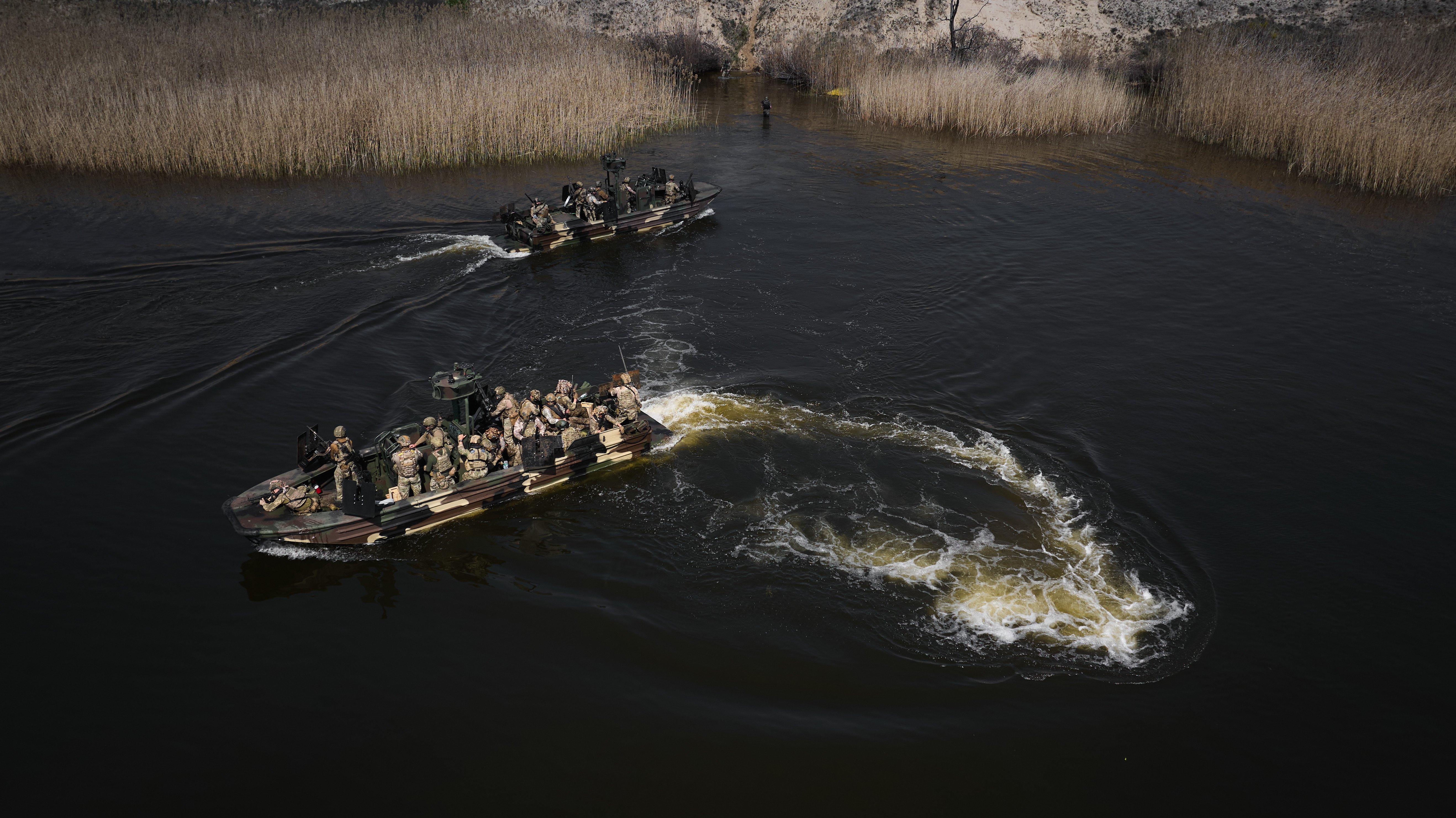
Ukraine has more than 2,700 kilometers of internationally recognized coastline stretching across the Black Sea and the Sea of Azov, much of it currently under Russian occupation following the attempted annexation of Crimea and the occupation of the entire Azov coast. The Naval Forces operate to defend coastal areas and waters under Ukrainian control, including the river corridor from the Danube delta through the Dnister to the mouth of the Dnipro.
The Navy’s mission is carried out through the following components:
Surface forces
Operating offshore, these units safeguard territorial waters with patrol vessels, corvettes, and landing craft. They increasingly rely on unmanned maritime drones such as the Magura V5 and Sea Baby to target Russian naval assets and infrastructure, including the Crimean Bridge. Recent strikes have been significant enough that Russia has begun building barriers as much of its Black Sea Fleet has retreated from its main base in Sevastopol.
Coastal defense
Focused on protecting maritime borders from naval and amphibious threats, these shore-based units combine coastal artillery with anti-ship weapons. In April 2022, the indigenous R-360 Neptune missile was used to sink Russia’s flagship cruiser Moskva, with Navy commander Vice Admiral Oleksiy Neizhpapa noting that Ukraine is “the only country in the world that has destroyed a missile cruiser during war.”
Naval aviation
Supporting maritime operations from the air, naval aviation conducts patrol, surveillance, and rescue coordination across coastal waters. These missions help sustain shipping access, as Ukrainian operations at sea have opened a secure maritime route for exports, including vital grain shipments.
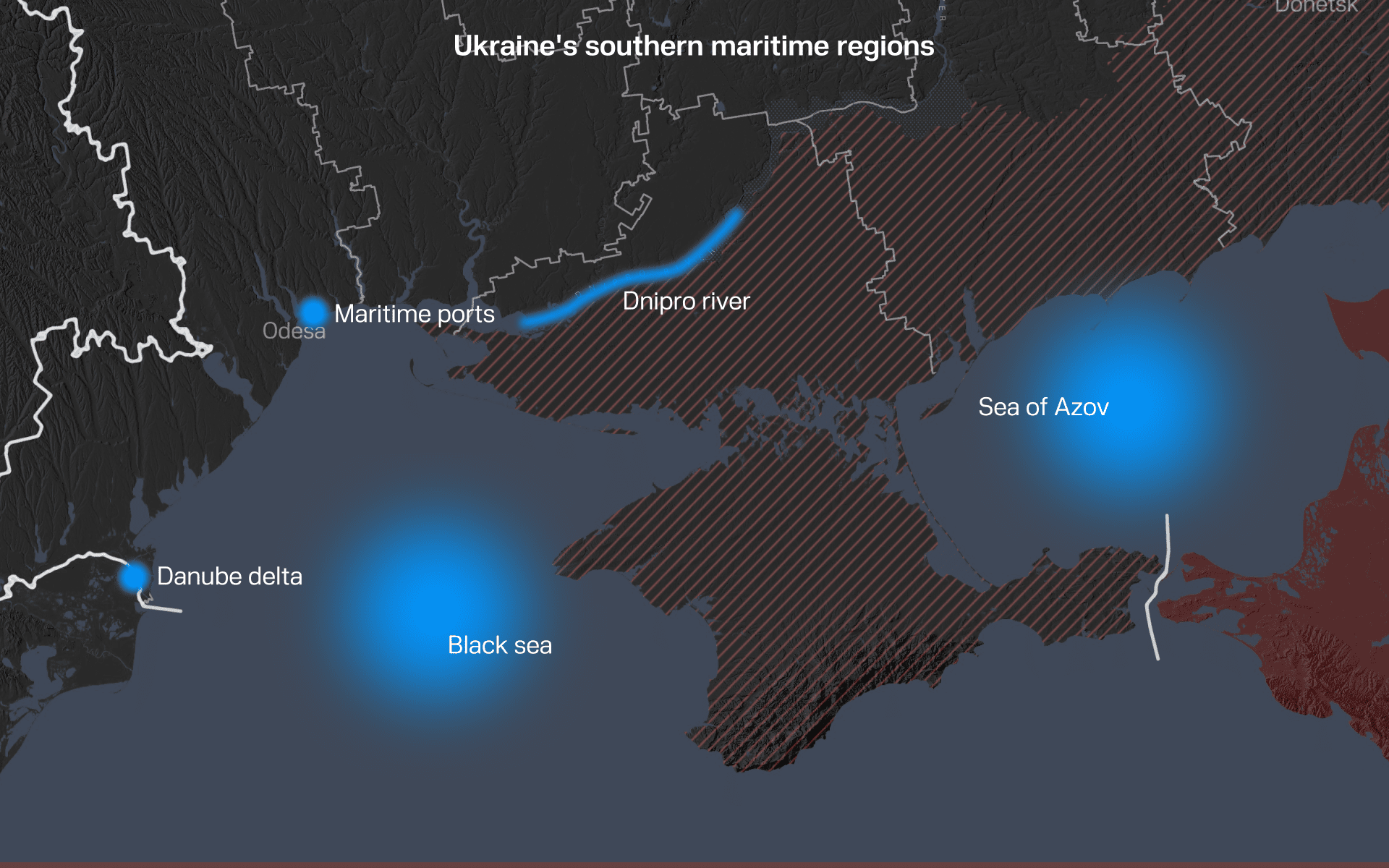
These three elements underpin operations at sea, but the Navy’s role also includes a critical presence along inland waterways.
On the lower Dnipro in the Kherson region, the river has become a front line: the left bank remains under Russian occupation. Operating along this southern stretch, the Navy’s river flotilla—first formed during the defense of Kyiv in 2022—uses small craft such as the SeaArk Dauntless alongside fast CB90 assault boats delivered in late 2025 by Sweden and Norway.
Marine Corps
In 2023, Ukraine reorganized its Marine Corps from the Navy into a distinct service. They are structured around several naval infantry battalions, supported by tanks and artillery, and tasked with defending naval bases, ports, islands, and other critical coastal facilities. Marines have also begun operating unmanned surface vessels (USVs), including the Barracuda river drone recently seen in a strike that mined and destroyed a Russian gunboat.
Despite what their name suggests, Ukrainian marines have often fought as elite assault infantry on land, including in the defense of Mariupol, and carried out landings on Snake Island in what was described as “the first experience of landing a marine assault in occupied territory.” Marines remain one of Ukraine’s elite formations, alongside the Air Assault Forces and Special Operations Forces.
With the land, air, and naval forces now outlined as the three main conventional services, we can take a look at the more specialized branches that make up the rest of the forces.
Special Operations and Strategic Forces
Special Operations Forces (SOF)
The SOF conducts the most sensitive missions, including direct-action raids, strategic reconnaissance, and counter-terrorism, carried out by highly trained units using modern weaponry and technology. Reporting directly through the CinC to the Ministry of Defense, SOF can be deployed rapidly and are often the first sent behind enemy lines.
From temporarily occupied territories, SOF organizes and supports the Resistance Movement—underground networks that coordinate sabotage and disruption against Russian logistical routes, equipment, and supply chains—as part of broader efforts to retake occupied areas. Psychological operations units also carry out information and influence tasks alongside these covert efforts, with training and selection conducted in accordance with NATO standards.
Air Assault Forces (AAF)
The AAF is built for rapid offensive action and typically committed to the hardest sectors of the front. Though doctrine calls for heliborne and parachute missions, only the 25th Airborne remains parachute-capable, while other brigades are typically reinforced with infantry fighting vehicles, tanks, artillery, and, increasingly, drones.
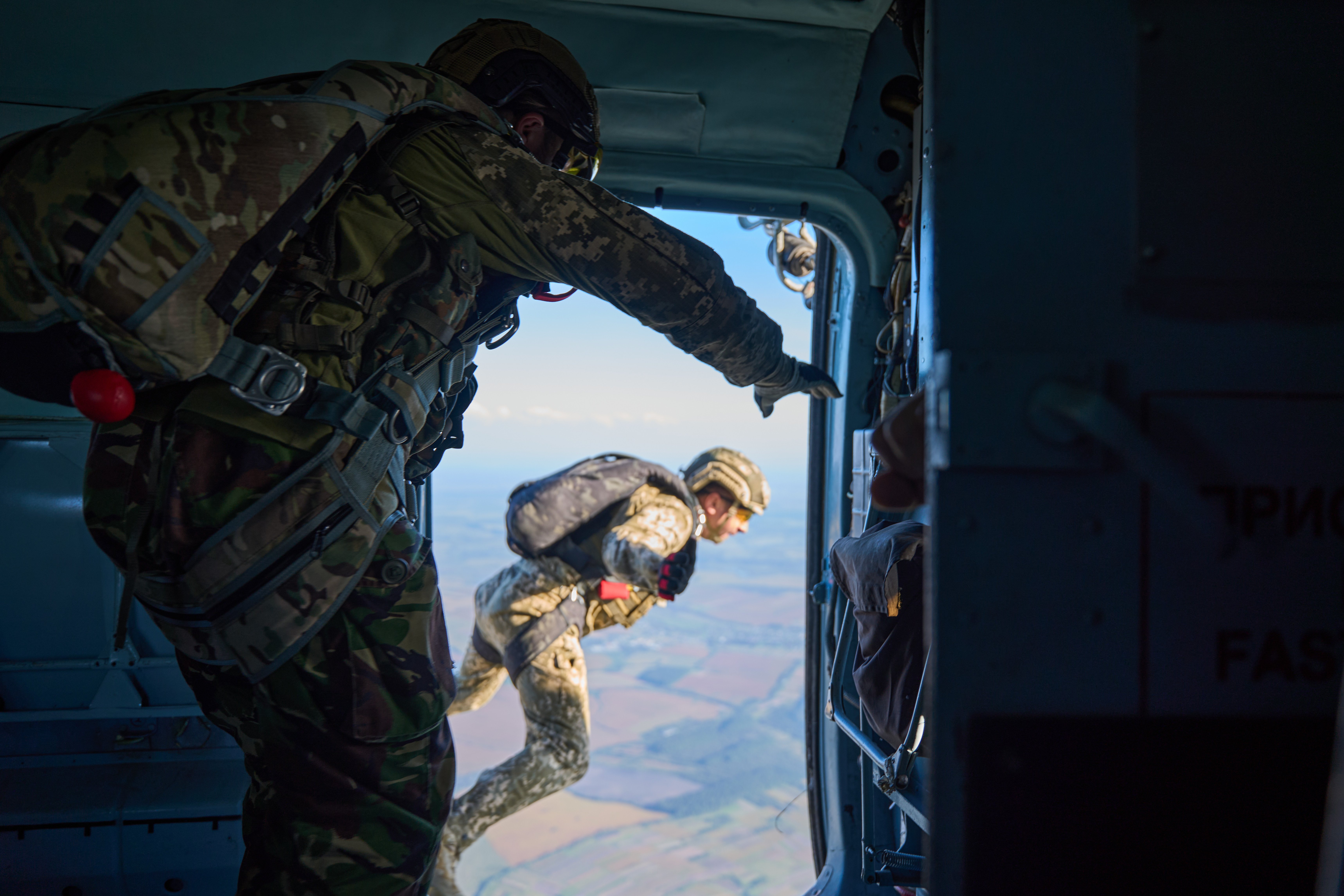
In 2014, they took part in the liberation of Sloviansk, and again in the Kherson region in 2022. That same year, they fought in the battle for Kyiv and executed the lightning-fast Kharkiv counteroffensive, making the AAF—sometimes referred to as paratroopers or airborne troops—an elite assault infantry repeatedly tasked with major operations.
🎥 Ukrainian paratroopers from the 25th Airborne Brigade evacuate a wounded comrade under fire after a Russian guided bomb strike — all caught on video. Precision, coordination, and courage in action. pic.twitter.com/5Pc4RtLXdN
— Ivan Khomenko (@KhomenkoIv60065) October 28, 2025
Territorial Defense Forces (TDF)
The TDF trace their roots to 2014, when their units were part of the Land Forces. By the end of 2021, they numbered just 580 defenders. They then expanded into their own formation, establishing a brigade in each of Ukraine’s 24 regions and battalions across the country’s 136 districts. One month after Russia’s invasion of 2022, its ranks had surged to over 110,000 people of all ages, genders, and backgrounds taking up arms to defend Ukraine.
Designed for regional defense, they are often used to reinforce the front, as seen in a recent case supporting a mechanized brigade in eliminating Russian troops in the Donetsk region. Over time, the TDF have evolved beyond infantry to include mechanized groups, aerial reconnaissance units, and mortar and sapper teams. Through dedicated training centers, the service has grown from a small prewar civilian-to-soldier force into a permanent pillar of Ukraine’s national resistance.
Farmers, businessmen, journalists, builders, programmers — people of all professions — put aside their business and courageously stood up to defend Ukraine.
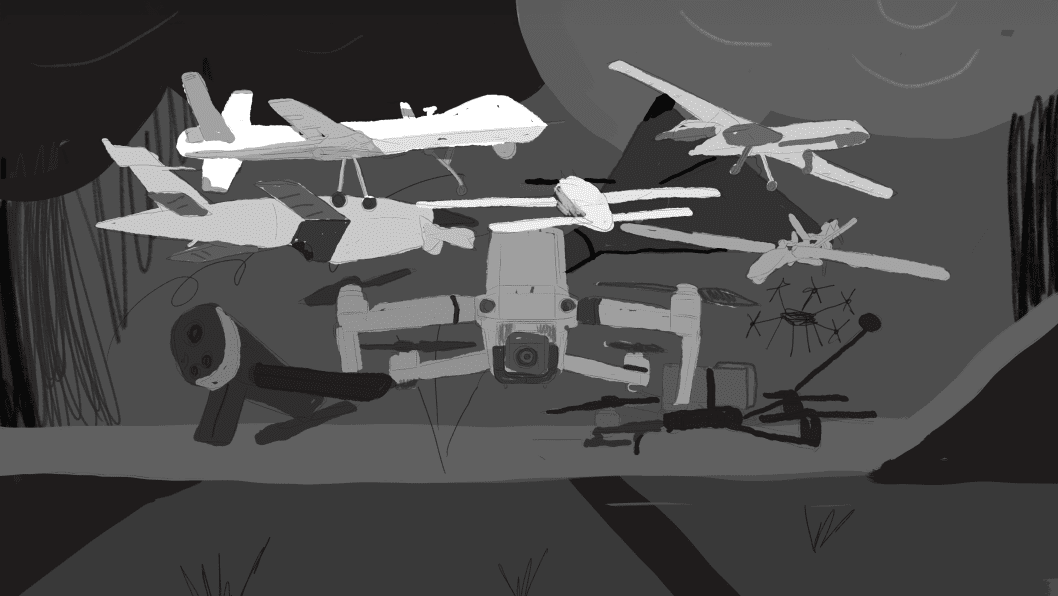
Unmanned Systems Forces (USF)
Formed in 2024 as the world’s first dedicated unmanned warfare branch—the USF—brings aerial and naval drones and ground robotic systems under a single command. Its main goal is to reduce Russia’s offensive capabilities—exemplified by a recent strike on a Russian Shahed and Geran drone hub in temporarily occupied Donetsk—while minimizing risks to personnel and protecting Ukrainian citizens.
In order to scale drone technology, the USF works closely with Ukraine’s defense tech sector, including the state-backed Brave1 innovation platform and the digital marketplace DOT-Chain. Partnering with civilian innovators reduces R&D timelines from years down to weeks, rapidly fielding the technology required for missions from surveillance to deep strike.
Within this ecosystem, the performance-based Army of Drones Bonus program introduced in late 2024 assigns drone units “ePoints” for verified battlefield results—for example, destroying a Russian tank can earn around 40 points, enough for a replacement FPV drone. The system has been described as a “gamified” approach to managing drone warfare.
Signals and Cybersecurity Troops
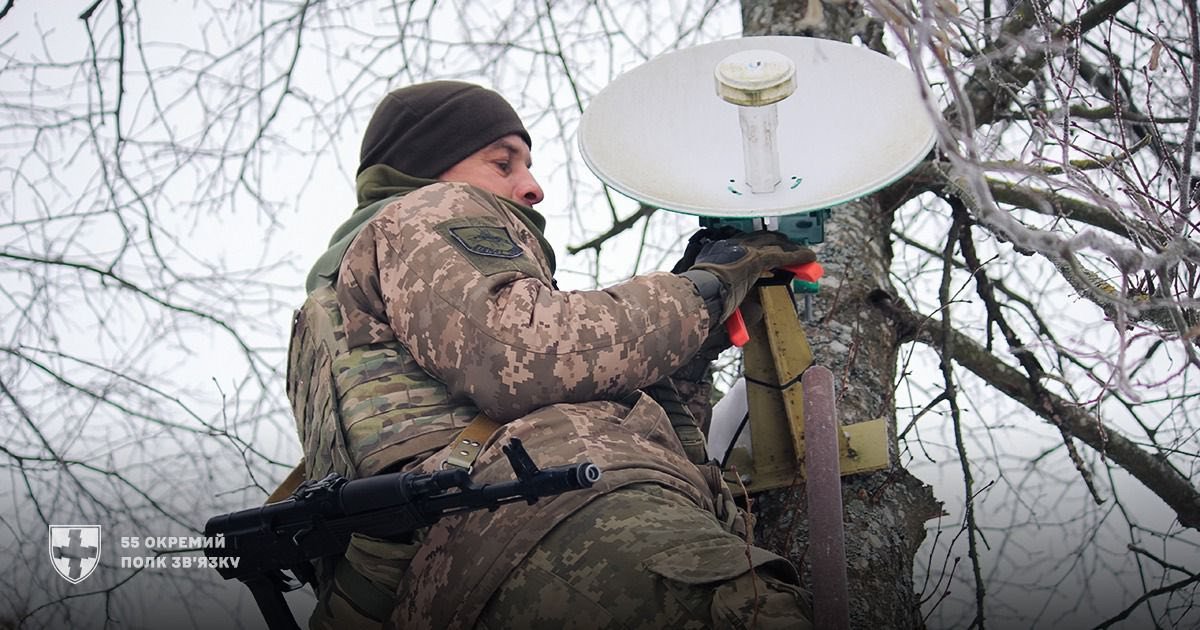
These troops run the communications networks and digital information systems that allow brigades and battalions to coordinate, commanders to issue orders, and headquarters to control operations in real time under fire.
They also maintain warning and command links, which need to be deployed, moved, expanded, or shut down as formations shift positions—because connectivity moves with the frontline.
Their units are embedded across every branch of the Armed Forces, defending against cyber intrusion and disruption of communications during wartime. Their role includes protecting sensitive data, maintaining secure channels, and ensuring operations can continue even when networks are jammed or under attack. As modern warfare is increasingly contested in cyberspace, their work also supports interoperability with NATO member states.
Support, Logistics, and Medical Forces
Support Forces
To sustain operations at the front, the Support Forces bring together five components:
Engineering troops—build fortifications, camouflage positions, and breach obstacles and minefields, as seen with units integrating Leopard 2R mine-clearing vehicles delivered from Finland.
Radiation, chemical, and biological defense troops—protect units from hazardous threats, with Russia suspected of more than 12,000 chemical attacks since 2022.
Geospatial (topography) service—provide mapping, coordinates, and terrain analysis that help commanders plan operations.
Hydrometeorological (weather) service—delivers accurate forecasting for aviation, artillery, naval, and amphibious missions, while also providing calculations that help mitigate CBRN threats.
Canine service—guard military facilities, inspect terrain and vehicles, and carry out mine and explosive detection, with new training facilities opened with Norway’s support.
Logistics Forces
Ensuring the front’s uninterrupted functioning, the work of Logistics Forces covers the storage and delivery of weapons, ammunition, fuel, and food. Restoration of damaged equipment is also a constant task, with repair work carried out by field brigades operating in combat zones, including the recovery of partner-supplied equipment.
Their logistics network includes arsenals, warehouses, and repair bases distributed nationwide. Transportation underpins everything from redeploying troops to delivering large-scale military aid from international partners. A primary objective has been implementing NATO standards across the force, including transparent distribution of received assistance.
Medical Forces
Providing vital medical assistance for troops at the front and in the rear, these forces deliver care from point of injury through stabilization, evacuation, treatment, and recovery. They also train soldiers in self-aid and mutual aid in the first minutes after being wounded—skills that can save lives—through tactical medicine instructor programs. Rehabilitation has also become a growing focus, including support for combat medics recovering from the toll of working under fire.
Despite ongoing hostilities, the system of medical evacuation has continued to improve, supported by expanded ambulance capacity and the delivery of armored evacuation vehicles, some funded through the UNITED24 platform. Medical processes are becoming increasingly digitalized, within a unified system integrating frontline evacuation with civilian hospital capacity—a first-of-its-kind model implemented amid large-scale aggression, that has drawn interest among NATO member states.
Wartime call-ups: Other uniformed services
Conscription
At the turn of the millennium, much of Europe was moving away from the mass armies of the Cold War era. In the early 1990s, compulsory military service was still the norm across much of the continent; by 2011, it was enforced in only six out of 27 EU countries. Ukraine followed a similar trajectory, suspending conscription in 2013 as it shifted toward a contract-based model, before reversing course in 2014 after Russia’s illegal invasion of Crimea and occupation of parts of the Donetsk and Luhansk regions.
Russia then launched its full-scale invasion in February 2022, prompting Ukraine to impose martial law—barring men of military age from leaving the country—and declare nationwide mobilization, a decree that has remained in force ever since. The mobilization age was lowered from 27 to 25 in 2024, even as US officials urged Kyiv to consider reducing it further.
Recruitment is administered through Territorial Recruitment Centers (ТЦК), which register civilians and issue mobilization orders. Recruits complete a 51-day Basic Military Training course under NATO-adapted standards before joining operational units. However, the regular military and conscripts do not make up the full wartime force: several other uniformed services have also been assigned wartime duties under martial law.
Service | Governing authority | Peacetime role | Wartime role & deployment |
National Guard of Ukraine | Ministry of Internal Affairs | Internal security force protecting key sites and maintaining public order. | Units can be subordinated to the Armed Forces and fight as frontline combat brigades, including operations that in early 2026 raised Ukraine’s flag over liberated Kupiansk City Hall. |
State Border Guard Service of Ukraine | Ministry of Internal Affairs | Secures land and maritime frontiers. | The first force to resist Russia’s full-scale invasion. During wartime, border guard units operate as part of the AFU and participate in defensive and frontline operations, including early-2026 strikes that destroyed tanks and a surveillance system. |
Security Service of Ukraine (SBU) | President of Ukraine | Internal security and counterintelligence service combating espionage, sabotage, and terrorism. | Conducts counterintelligence and counter-sabotage operations, including a 2026 arrest of a Belarusian KGB spy attempting to infiltrate Ukrainian intelligence. |
National Police of Ukraine | Ministry of Internal Affairs | Maintains nationwide law enforcement and public order. | Supports frontline operations under martial law, including evacuation missions by the White Angels police unit struck by Russian drones in Donetsk. |
State Emergency Service (DSNS) | Ministry of Internal Affairs | Provides nationwide civil protection and emergency services. | Among the first on the scene after Russian strikes and often working through the night to put out fires, pull civilians from the rubble, evacuate residents, and support victims suffering acute stress reactions. |
State Special Transport Service | Ministry of Defense | Engineering force responsible for building, protecting, and restoring critical transport infrastructure. | Restores railways and bridges after Russian attacks; the UNITED24 platform has helped raise funds to rebuild 29 bridges in seven regions. |
Alongside professional soldiers, conscripts, and uniformed services, a final component completes Ukraine’s wartime force: foreign volunteers who have traveled from around the world to stand and fight alongside its troops against Russian aggression.
Anyone who wants to join the defense of Ukraine, Europe and the world can come and fight side by side with the Ukrainians against the Russian war criminals.
Volodymyr Zelenskyy
The President of Ukraine
International volunteers
To trace how Ukraine’s international force took shape, we once again return to the very top. Through the office of the Supreme Commander-in-Chief, Ukraine issued an appeal on February 27, 2022, to foreign citizens to help fight Russia’s aggression, creating the International Legion and opening its ranks to volunteers from around the world. Fighters from 72 countries have since answered the call, with more than 8,000 confirmed in the Land Forces alone—and the total across all branches is likely at least double that figure.
For specialized missions alongside Ukraine’s elite formations, Defense Intelligence (HUR) operates its own International Legion, Unit A3449, employing highly skilled foreign volunteers in missions. One example is Murray, an American veteran of the US Airborne Forces who discusses leading reconnaissance and sniper operations for the “Ronin” unit in this interview.
Tuga, a battalion sergeant in the Azov International Battalion who fought in Bakhmut and other frontline battles, speaks of the war as a shared effort: “We are defending the whole continent.” For the Portuguese volunteer and thousands of others who have traveled to Ukraine to resist Russia’s invasion, the motivation is simple: “We are on the good side, the right side of history.”
From individual volunteers to all of Ukraine’s Armed Forces, the message remains the same. The struggle against tyranny is a shared effort that, as President Zelenskyy said, can only be achieved “thanks to the strength and solidarity of all who value freedom.” Honoring those forces, he affirmed: “Freedom always wins.”
Discuss this article:
-4a56a6b482ec132402c16ef6fcabf9a2.png)

Frequently Asked Questions
Is Ukraine’s military part of NATO?
Ukraine is not a member of NATO, but it has cooperated with the alliance through joint exercises for decades. After Russia’s initial invasion in 2014, NATO countries significantly expanded support for Ukraine’s armed forces, helping modernize command structures, operational planning, and battlefield coordination. That transformation has continued during the full-scale war, including Ukraine’s return to a corps-based structure more closely aligned with NATO-style operational command.
How do Ukraine’s elite military units compare to Western special forces?
Ukraine’s elite military formations include the Special Operations Forces, Air Assault Forces, and Marine Corps. Their roles roughly correspond to well-known Western formations: the Special Operations Forces operate similarly to the US Navy SEALs or the UK’s SAS, the Air Assault Forces resemble airborne formations such as the US 101st Airborne Division, and Ukraine’s Marines perform amphibious and expeditionary missions comparable to the UK Royal Marines.
Is military conscription mandatory in Ukraine?
Yes. Ukraine currently enforces military conscription under wartime mobilization. Before 2014, the country had moved toward a contract-based professional army and suspended conscription in 2013. After Russia’s initial invasion in 2014, Kyiv reinstated conscription and began expanding the armed forces. Following Russia’s full-scale invasion on February 24, 2022, Ukraine declared martial law and nationwide mobilization, requiring men aged 18–60 to register with Territorial Recruitment Center, prohibiting them from leaving the country. In 2024, the mobilization age for service was lowered from 27 to 25.
How experienced is Ukraine’s military compared to Western armies?
Ukraine’s armed forces have gained extensive combat experience during Russia’s war, with retired US Army Lt. Gen. Ben Hodges noting that “most NATO armies could not meet Ukrainian standards” in real combat conditions and that NATO should be “begging them to help us learn how to do what they’re doing.”



-111f0e5095e02c02446ffed57bfb0ab1.jpeg "Photo of Roman Kohanets")